Doom

You know, I think we may be experiencing a video game movie renaissance. I remember a long stretch of the 80s and 90s — okay, basically since there were movies based on games — when they were universally terrible, the low watermark by which modern movies were measured. Whereas, these days it seems like every video game movie I see can easily hold its head level with the mediocre genre fare being made that does not happen to be based on lines of code.

Case in point: Doom, loosely based in look on the third game of that series, in atmosphere on Alien, in plot on a freshman Ethics class, and in casting on Full Metal Jacket. You know how I mean. We’ve got the fear of God guy, the creepy coward guy, the strong silent black guy, the wisecracking black guy, the naively raw new guy, the, um, Asian guy (well, I never said it was a perfect mapping; or that I’ve seen Full Metal Jacket, for that matter). Plus our main characters: Hero-with-a-troubled-past guy, Scientist-who-shares-a-mysteriously-link-with-the-hero,-and-is-also-hot chick, and Sergeant The Rock.

So, you take all these guys, put them on Mars with some guns and some insufficiently hellspawned demons, and you’ve got the spam on a space station classic of 2005. Gallons more blood than I’ve seen in any new horror movie in several years, a massive body count, all kinds of scenery chewing courtesy of the gradually zombifying science board of Mars, a rolling head, a more gratuitous than usual breast, and enough vomit to recall the days when the audience would get sick in droves. You know, because of how shocking and violent the movie was. (This one isn’t, you understand; it just had a lot of vomit, is all. Space sickness. Spi- but I digress.)

Katamari Damacy

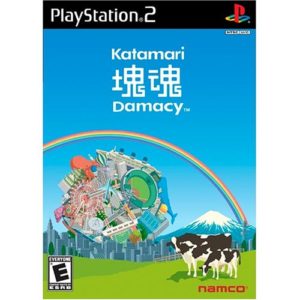
If I had to pick one game in all the world most likely to have universal appeal, Katamari Damacy would be it. There’s no part of it that has a downside. Well, okay, it’s perhaps too zany for some people. There is an undeniable zane element happening. And perhaps not everyone in the world likes Freddie Mercury. I’m willing to believe that’s true. But the King of All Cosmos is merely flamboyant, not actively gay. After all, he has a wife and a wee little son. So certainly the anti-gay lobby cannot complain here. Mothers Against Drunk Drivers might have a certain reasonable issue, what with all the stars in the sky having been destroyed. But nobody actually mentions alcohol so far as I can remember, and anyway, it’s not like anyone got hurt. Plus, the whole point of the game is to make it right again. So, basically, yeah. It’s the game for everyone!

Here’s what it has: a simple interface that anyone can pick up without ever having touched a video game in their lives, as long as they have working opposable thumbs; an engagingly quirky storyline following the crossing paths of a family of lego people and the family of the King of All Cosmos on a particularly fateful day; a brilliant Japanese pop soundtrack; and the ability to roll up things. This is both the simplest and the hardest to explain concept I’ve come across in quite some time. You take a roller ball, which we call a Katamari, and you roll it around the earth, where things that are sufficiently smaller than it will stick to it. Things sticking to it makes it grow, so that you can roll up larger things, which in turn make it grow faster, and so on. It may seem to you, the uninitiated, as though rolling up things is not a particularly interesting task. I am here to tell you that it is not merely interesting, but actively fulfilling in a way that allows for nearly infinite replayability.

That said, I have not made the North Star, and I find it unlikely that I ever will. But this is due to impatience rather than disinterest. Seriously, though: universal appeal. If you do not have it and either have or can afford a Playstation 2, get this game today, and then play it. A lot. (But then, having played it once, I feel confident that the ‘a lot’ is an inevitable outcome whether I specify it or not.)

Knife of Dreams

So, I’ve been kind of dreading this review, in the back of my head, ever since I got going with the whole ‘review things’ idea. (Which, clearly, was mine alone, never before conceived in the scope and breadth of human experience.) It’s like this. I’ve got these books that I started reading in 1993 (when there were just the four of them) (sidebar: I can still remember reading over my girlfriend’s shoulder about some guy named Mat whining about whether to go home with Perrin or what he should do if not that; funny how much better I like him now than I did in that moment of first exposure), and they’ve shaped my life, if only to a small extent. Sure, none of my big life decisions have been informed by them, but they account for about half of my friends and at least a quarter of my entertainment budget; and when you think about it, the stuff you do because you enjoy it really is the important part, so I guess it’s fair to say they’ve shaped my life to more than a small extent.

My point is, there are these influential books, only the quality has declined over the past, well, sadly, more than half the years since I first picked one up. And every time a new one comes out, there’s this balancing act between sufficient excitement to get and read the book and sufficiently lowered expectations to not loathe it afterwards. And now I have to review Knife of Dreams. So, yeah, that’s the source of the dread.

Only: it wasn’t that bad. I can do you one better. It was actually pretty good. Sure, there’s the overdescription gene he got from Tolkien. Sure, there’s a chapter that had me rolling my eyes at the pointlessness of dwelling on a single event for that many pages. (In fact, it involves Elayne being wet, just like in the last book.) But that stuff was the small part, not the large as it has been for so long. Plotlines advance in significant ways, and some of them resolve. Some of them even resolve satisfactorily. And if some others seemed like he was working on completing a checklist rather than presenting high drama, well, at least the little box did get checked.

And I can do better than that. There were multiple scenes that had me talking to the book, in anger, in disbelief, in excitement. None of them bad things about writing or lameness, though; all about plot elements that I was engaged by. Better still: there was a solid sense of wonder moment, and I thought those had been long gone, this far into the series (because of familiarity with the world as much as because of the author’s failures of late).

If the author wrote like this for a standalone book, I’d roll my eyes a few times, but I’d have enjoyed myself. It’s nice to be able to say that again, even if it’s not the ‘You have to read these books, now!’ diatribe I inflicted on people until about 1998 or so.

A few spoiler-like materials lay beyond. Before that, though, one thing. As much as I enjoyed myself, and as much as I was impressed by the way the plot appeared to have momentum: No, I don’t believe he can finish in one more book, unless he really does cram in 1000 pages of small font with as much plot density as the sixth book. Still, this one was a lot longer than they have been since, well, they were last good. So I suppose that’s a positive sign.
Continue reading

Flightplan

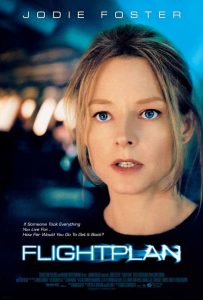
Some time ago, I mentioned one of the best previews I’d seen in a long time, for a movie where Jodie Foster gets on a plane with her daughter, goes to sleep, and awakens to discover that not only is the girl missing, but nobody remembers seeing her and there’s no proof she even had a ticket for the plane. In the months that passed between my first awareness of Flightplan and seeing it this weekend, I came to realize that it had a fatal flaw. The setup was all laid out in the preview, leaving only the central question of the movie unrevealed. Is the girl alive and kidnapped, or has she been dead all along, and Jodie Foster is just coping poorly?

So, here’s the good news. Despite the film proudly proclaiming to anyone who’ll listen, ‘hey, look over here, we’ve got some kind of twist ending that you’ll never see coming!’, there’s still enough meat to make a satisfying movie experience. Plus, it works on the visceral thriller level, with lots of people to suspect, tight camera angles (I mean, it is on a plane; see also Red Eye) and perfectly adequate music.

The bad news is minimal. There’s a plotline that gets completely dropped, and I can’t for the life of me figure why, or what I’m supposed to think there. On the bright side, you can’t tell it was dropped until the movie is basically over, so it won’t bug you while you’re waiting. That, and Jodie Foster is officially old now. Even as recently as Panic Room, there was something there. Oh, well.

Magnificent Desolation: Walking on the Moon 3D

Today was supposed to be disc golf day, but then Eric’s kid was sick and the weather was drizzly. Not to worry, we found a kid-watcher and the weather turned into a downright beautiful 60s extravaganza, so that part worked out okay, except for where I played really badly. But that’s not the point. The point is how, in the meantime, we headed off to the IMAX to see the Tom Hanks produced Magnificent Desolation, which is all about taking a bunch of astronaut quotes and voicing them with famous actors (including, obviously, Morgan Freeman) while Tom Hanks narrates and the astronauts keep kicking moon dust right in your face!!!

No, seriously, it’s pretty cool. Lots of magnificent, if desolate, scenery to gaze upon. Plenty of 3D, even if a lot of it was screen with data superimposed over the moonscape. A sidebar on how the landings themselves were faked. An examination of how they might have dealt with an emergency situation if they had one. (They did not; everything was pretty much blowjobs and funnel cakes.) Glimpses of the future. But mostly, people walking around on the moon in 3D. Let’s face it. If you go for that at all, the visuals with a completely silent soundtrack would have been sufficient to cover the price of admission.

Revenge of the Sith

I heard that the novelization of Revenge of the Sith fills in a lot of empty spaces left by the already high (if contrary to form) quality of the movie. There’s no question that Anakin seemed to fall easily, despite that I could get a handle on what wheels in his head were spinning. Plus, I could never quite get a handle on the very end, with Palpatine’s lie and Vader’s acquiescense, post- Force tantrum. And the part where I think Sidious was Plagueis’ apprentice who learned the secret of influencing midichlorians to maintain or create life, and how it indicated that he might have been the architect of Anakin’s conception in the first place. (Sadly, that last bit remains a mystery.)

So, the book. Found it on the cheap a few months ago, read it this week, somewhat faster than intended, but these things happen. At every point, Stover fills in crucial gaps in dialogue, stuff that I remember wishing the movie had been padded with in its original form, lines that would have made the movie maybe ten minutes longer all told while providing just the right depth to take away the choppiness that was the only real flaw. Even better, he has a gift for jumping into each character’s head and taking a mental snapshot for the reader. The best sections of the book begin and end with ‘This is how it feel to be Anakin Skywalker, right now.’

To sum up: as much as I was happy with Lucas for finally recapturing the spirit of Star Wars completely, it is my sad duty to report that the many people who have created bits and pieces of his universe since the 1990s are still, on the whole, more to be trusted with the creation than he is himself. But so be it. At least someone is doing this stuff.

Guilty Pleasures

My current book is kind of vampire porn. Less self-absorbed than an Anne Rice offering, less explicit than Vampire Vixens, the first Anita Blake novel is of the approximate quality of a decent Buffy novelization but rated PG-13 for adult themes. (So, a lot like Season 6, except for the part where Buffy novelizations are, as a rule, trashy.) The thing is, I heard that it turns into a real train wreck somewhere down the line, plus I have a soft spot for the undead as entertainment. So, here I am.

In an alternate 1990s where our hero raises zombies for a living, vampires are lobbying for the right to vote, and bachelorette parties can be held at the vampire strip club Guilty Pleasures, it’s easy to be jaded. But even an ex- vampire hunter can be caught by surprise when the police and the city’s master bloodsucker both want her to find a criminal who has been murdering very powerful vampires.

Will vampires be slain? Will there be existential angst? Will there be a variety of possible love interests? Will our heroine have skills that are incongruous with her appearance, thus causing people to constantly underestimate her? All this, and a promise of more zombies to come in future books. So that’s alright, then.

Cry_Wolf

As it happened, I managed to squeeze another movie in on Thursday after all. It probably would have been Flightplan, only the timing was off. So, I picked the horror movie I preferred of the two that are out right now, Cry_Wolf.

The title gives away almost everything, of course. You have a group of prep school seniors and the new guy who wants to fit in. They hatch a plan to follow up the murder of a local girl by creating an urban legend of a serial killer who has struck several campuses in the past killing various people from the school in the same way, but always starting with the dead townie. But then, the killer starts threatening the kids via IM and large stabby knife. OR DOES HE??? And in a completely shocking twist, none of the cops or school admninistrators believe them for some reason. For that matter, they can barely trust each other. It reminds me of a fairy tale or fable or something I read sometime, but frankly I can’t be bothered to investigate further.

We’re looking at three parts Wild Things[1] to one part April Fool’s Day[2], but with the ongoing PG-13 breastlessness that is either what has revitalized the genre via wider ticket sales or else strangling it via the removal of core values. I’m not sure which it is, but I suppose as long as the plot (not the dialogue, though, believe me) is mildly intelligent, I shouldn’t complain too much.

[1] Down to the same wet, chilled blue bikini top.
[2] It’d be cool if I could make a direct comparison here too, like if someone had the same noose-shaped braid. But that never actually happened in the movie, much to my disappointment.

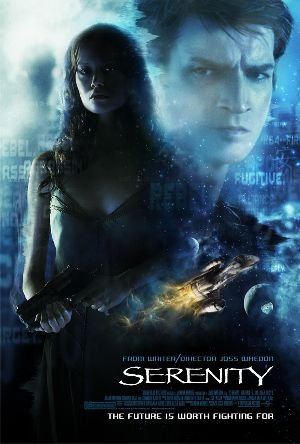
Serenity

mv5bmti0nty1mzy4nv5bml5banbnxkftztcwntczodazmq-_v1_sy317_cr0Some time ago, there was a new Star Wars movie coming out. I’d been burned by the series a bit, if not as badly as some, so I was looking forward to it still, but guardedly. Meanwhile, the Joss Whedon movie, Serenity, was pushed back from before Star Wars until months after it, here at the end of September. So I hatched a plan, made a promise with myself if you will. Star Wars was over, whereas Serenity might spawn new films or even a return to television for its show of origin, Firefly. So, however many times I felt compelled to see the Sith get their revenge, I would see Serenity twice as often. The problem is I no longer have a job with its pesky reliable income, and that the Star Wars movie was really quite good. Good enough that I kind of saw it four times, and only didn’t see it more because I was in the midst of moving, and ran out of time to see it before it vanished.

So, now I need to spend some reasonably large amount of money to see Serenity seven more times. (Or possibly eight; previews don’t make money and so don’t count toward totals, and emptying my pockets to them was kind of the point of this exercise.) So, that’s the bad news. The good news is this: except for having to sell my body on the cold, cold streets for ticket cash, I will not find this task in any way burdensome.

I had a couple of problems with the movie, although at this particular moment I’ll be damned if I can remember what they were. Instead, my head is flooded with individual scenes, some funny, some gripping, one that left my mouth open for at least a full minute, not a few technically amazing pieces of work that would have, well, if not left Lucas jealous of the skill, at least left him acknowledging that it’s not only him can make these things happen on a screen, these days. So, I’m a geek for Joss Whedon and especially for this show, and no denying it. Perhaps that makes me easier to please, perhaps it makes me harder to. I know this, though. I’m going to wander around in a happy daze for the next few weeks.

Will it work for new people? I think yes, if they can be talked through the door. The introduction scenes were rapid, because Joss doesn’t assume his viewers are stupid. I’m pretty sure the average Hollywood consumer is in fact not nearly as stupid as most movies take them to be, so having rapid-fire intros shouldn’t be a problem. A couple of the characters were introduced less well, but I think still well enough. He created the sense of history without deigning to explain it, but it was there solidly enough that you should be willing to allow it to be true and wait for the payoff. The plot should be plenty easy to follow, though, and the characters and dialogue should make up for any unfamiliarity by the end of the second sequence.

As far as the plot: River Tam, a government experiment in mind-reading and enhanced military capability, and her brother Simon are on the run from the government that created her. They have fallen in with the crew of Serenity, a group of people who don’t much cotton to the way the Alliance of Planets keeps its nose in the affairs of people who would just as soon be independent, and who make their living on whatever side of the law is most convenient. The problem is, River has a secret buried in her brain, and very important people want it back. At any cost.

Lastly, the part where I snagged it early. It was a bit of an event last night. I got to see it in an Old West ghost town (well, okay, a movie set, but done up well enough), at sunset, with a Chinese box lunch and a fortune cookie that included an actual fortune if you can believe it, not just a compliment. Also, Kaylee and River were there. I would have a hard time imagining a better way to get to take it all in. Here’s my point, though. Go see it. This weekend if possible. If I’m wrong, tell me about it and I’ll make amends. But I’m pretty sure that won’t happen. (Even if I did have a couple of complaints.)
Faery Lands Forlorn

Apparently, I waited a while to hit the second book in my current Duncan series. I’ll see about maybe reading the last two closer together. This will be tricky, as there are a couple of gotta read books coming out here soon, plus a couple of other books I want to read in between or whatnot.

Faery Lands Forlorn continues the adventures of Queen Inosolan and Rap the stableboy, now separated by half a continent from each other and from home. Things move fast despite the introduction of a few more races of people with which to fill in the map. In a way, they moved too fast almost. All the events of the first three quarters of the book felt like they should have taken up only a few dozen pages, not a few hundred. And yet there was no trace of things seeming dragged out or focussed on disinteresting side material. It’s a neat trick, and although I wouldn’t want to duplicate it, I wish I knew how he did it. Lots of enjoyable but ultimately empty calories, perhaps.

In the midst of the fast-forward buckle-swashing, sorceress-escaping, and romance-creating, Duncan still found time to flesh out the magic system quite nicely and introduce more powerful enemies while giving old enemies new powers of their own. I think my favorite thing so far is how the word enemy is a misnomer. There are people opposing our heroes’ goals and people assisting them, but there haven’t been any (well, more than one, and I haven’t made up my mind there) truly bad people in the world; it’s all about politics and unobjectionable people who have different goals from each other. The very opposite of run of the mill, and good enough on that merit alone even if it weren’t so rompful.