Derailed (2005)

Jennifer Aniston was always basically the hottest Friend, and now she has a psychological thriller movie. So, hey, that’s for me! Off went I to Derailed on Wednesday, and that was worth the effort of going to. This guy meets a hot chick on a train, they start down infidelity highway, and then things go suddenly awry; but not in the Glenn Close hide-your-bunnies manner.

As always, one moment of truth could have re-railed the whole situation, but the tragedy of psychological thriller lead actors is that they’re flawed with dishonesty. And so instead of admitting to his wife what happened the very first night, our hero is drawn ever further along the road to hell, with no offramp in sight. And that’s what the movie is really about: how you react to the gradual, inevitable dissolution of your life. Except, given the genre, you know someone is going to get shot by the end.

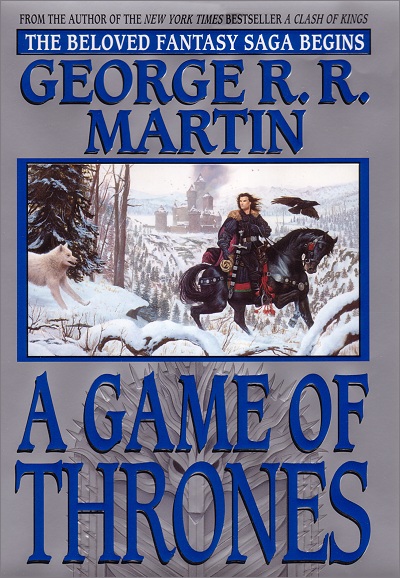
A Game of Thrones

thrones22To my very great surprise, my most recent book has been the opening entry in Martin’s A Song of Ice and Fire, A Game of Thrones. What with my dad so much out of it via his time in the hospital, we needed something to do while visiting. I eventually started reading the series to him, figuring that he’d like it and also that it would give me a chance to catch up in time (well, okay, not exactly, but sort of) for the most recent volume.

But, the unexpected part is where I finished it so quickly. In fact, it read fast, and the politicking is sufficiently pleasant that I didn’t very much mind the relative lack of frozen zombies. (They are, after all, both the point and the pay-off.) But I get ahead of myself. What we’ve got here is a story about the end of the world, not by fire but by ice. Specifically, the undead Others from the polar north are on the verge of emerging for the first time in 8000 years to destroy the world of men. Only, nobody in the world of men is particularly aware or concerned; after all, there is power to be won, and money, and most importantly, a crown.

Westeros is a brutal land, but also an honest one. All too rarely do people get what they deserve; instead, they get what they can grasp and hold onto with their own two hands, and the penalty for a reach which exceeds that grasp can be dire indeed. And so the question becomes, can the honorable old Stark family of the North, the gold- and power-hungry Lannisters, the last daughter of a usurped throne, and all the men of Westeros settle vast gulfs of difference before Winter has come?

Thematically, it shares a lot with Jordan’s series. The goal appears to be to demonstrate exactly how divided man can be from man, and still manage to pull together in time to save the world. He outpaces Jordan in that mistakes have real consequences to actual characters in the storyline, not merely to the faceless masses. Prosewise, his errors are less glaring but nearly as annoying as Jordan’s can be. Or maybe it’s my own peeve, but quite frequently I’ll see the same word twice in a sentence or consecutive ones. Repetitive word choice drives me crazy. On the whole, though, excellent start to a series that appears to be over halfway through right now, and that continues to show a great deal of promise.

Saw

Having seen Saw II, I decided that it was time to… watch… Saw. And I have to say I liked it. I claimed a few weeks ago that a scene in the sequel ruined the original. As it happens, that was not true. So, I still got even to enjoy the ongoing plot as it unfolded, although it turned out there was a whole different issue where the reveal of the bad guy was a major plot element, and I already knew that part. Still, not so bad on the whole.

Saw is the tale of two men chained on opposite sides of the room, how they got there, and what they have to do to get out. (If you think a saw will be involved, you just might be surprised! But probably not.) As good as it was (and I’m willing to proclaim any future sequels must-see for horror fans; finally, some good footage is getting put in film cans instead of direct-to videos), it could have been an order of magnitude better if they’d managed to tell the same basic story and keep all of the action in that room. Tension, cat-and-mouseness, substantial gore, it was all there. Luckily, the outside scenes mostly involved Danny Glover, who seemed to know even if he didn’t admit it that he is definitely getting too old for this shit, so the remainder of the movie was pretty well saved too.

Harry Potter and the Goblet of Fire

Big movie of the weekend, I hear, and yet mostly unpopular with the literary set of which I am aware. Yep, it’s November, which means it’s time for Harry Potter to go back to school. (Except for that time he went back to school in July. British people are weird; I think it’s because of all the fog.)

Note: Expect spoilers for the books below, as well as for previous movies. Well, and maybe for this movie, depending upon your perspective.

As the books get longer, the movies get longer; nevertheless, more and more of the books is disappearing. Harry faces the dangers of a magical tournament between Hogwarts and other wizarding schools around Europe while plagued by dreams of Voldemort’s return to power. Also: adolescence! Anyhow, it was pretty good for what it was. It kept the core plot elements, sacrificed a number of unnecessary elements (freedom for house elves, Percy is a prat, some guy is in hock to the goblins), and then sacrificed several wholly relevant plot elements (the second half of the Rita Skeeter plotline where the wizarding community loses its crush on the Boy Who Lived, Harry’s growing relationship with his uncle Sirius, a reasonable explanation of what happened in the climactic moment). But that’s okay in a way; as long as those elements are established solidly in the fifth movie when they would be coming to fruition, then it could still work out. Of course, that book is longer still than the current one, so it hardly seems fair to try to cram in info from an earlier book too. Luckily, this is not my problem.

In short? Decent movie, pretty to watch, and the edits are all the more painful for coming so near to being masterful and then falling short of it. I’m missing all the actual wizard-learning as well, but that is disappearing from the books too, so, y’know. Below the cut, my one big (and unmistakably spoilerish) complaint with the film adaptation.
Continue reading

Saw II

Having a father in the hospital makes for a dramatic slowdown in consumption. Only one movie in the past few weeks, and I do have at least a couple I wanna see right now. Only one book lately too, but part of that is my choice to read a doorstop novel so as not to have to do any other reviews for a little while. (Is it cheating to acknowledge stuff like that? Well, whatever.) But, lots of Harry Potter to while away my dad’s time, and let me tell you: that lady uses really a freaking lot of adverbs. Which is pleasant, as they’re very much like script directions, and I can be sure I’m getting the voices down solid. But still, I’d never noticed just how frequent it was, reading them quietly to myself. Just saying.

However, I was actually talking about movies, this time. I saw II…. um, no, that’s not right. Let’s try it again. Um. I went to see Saw II. But I didn’t see Saw, so how can you claim you did too? Look. Seriously. Shut up.

It makes me want to see Saw (I mean it. Shut up.) even more than I already wanted, even though through a probably inevitable turn of events, I know how Saw ends already from this current film. Leaving that aside… yeah, it’s pretty good. There are twists, as all good horror movies should have. Also, violence and brutality. The conceit (I think of both movies) is pretty simple. A homicidal sociopath (or possibly an ethically unfettered clinical psychologist) puts people in deadly situations but with all of the tools necessary to escape from them, and then watches to see what they’ll do. This one has two subplots, seven people (or eight? who can remember?) in a trapped house from the mold above, and meanwhile a cop whose son is in the first subplot has captured and is interrogating the maniac, in the hopes of rescuing everyone.

The main thing I took away from this is what a great RPG subplot #1 would be. You set the house, and the clues, and assign the characters to people, and then see if they’re able to save themselves before the deadly gas kills them all. Far better RPG than movie, and it was much better than the average slasher movie, which had very nearly fallen by the wayside anyhow. So, thanks for the cool idea which I may use someday, unnamed Hollywood scriptwriter(s), and also thanks for revitalizing stuff that was just lame direct-to-video anymore. I now have a new most anticipated movie to look forward to (well, not counting if Snakes on a Plane materializes), 2006’s Slither, starring Sheriff Mal Reynolds.

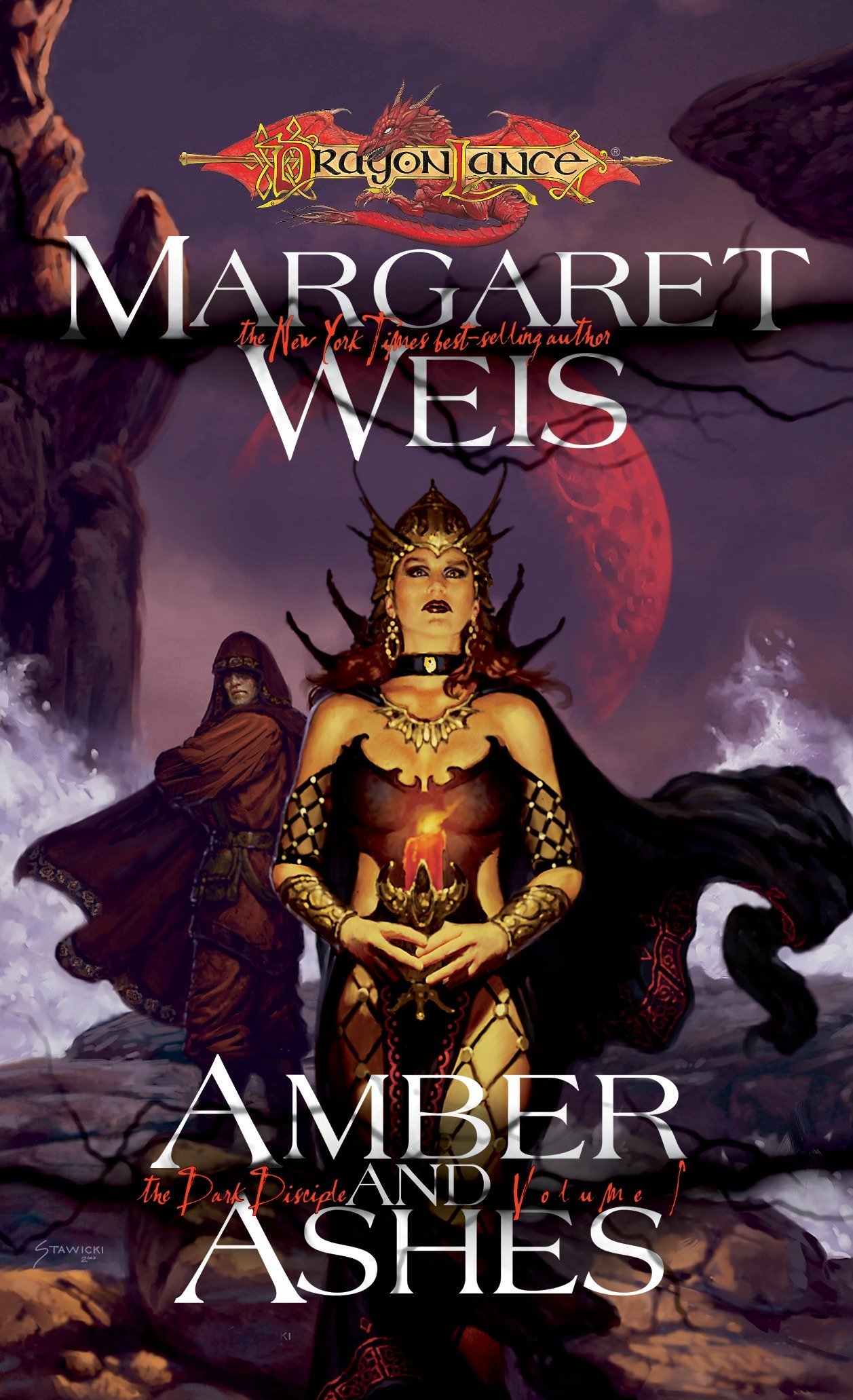
Amber and Ashes

For a lot of people, the DragonLance series has not been a high point in their reading careers, and for still more, it’s been relegated to the dustbin of history since the late ’80s. But me, I’ve always had a soft spot for those original authors, and the characters and world they created. So I know the more recent history, with a great huge novel devoted to killing lots of people and taking away the gods and the moons and whatnot, and then another trilogy revealing that the cause behind the preceeding events was not what it seemed. Now, there is a new trilogy in which nature abhors a power vacuum, and so Miss Weis is going to see to it that it has been filled.

Unfortunately #1, all the old characters are completely out of the picture these days, excepting the newly returned gods of course. But since they’ve never really appeared as characters before (well, okay, but these ones haven’t), it’s hard to have a stake of familiarity involved. Unfortunately #2, the land is so different as to be unrecognizable, littered with elven refugees and a Solace on the verge of becoming the southern Palanthas. Unfortunately #3, vampiric cult. Seriously.

But it’s not all that bad, it’s just that I have mildly higher expectations, and they have not been met. As generic fantasy, it’s perfectly inoffensive, and in fact still more reliably written than a portion of what I read these days. (Ask me three years ago, and it’d be better than two-thirds of what I read, so.) Amber and Ashes tells the tale of Mina (disciple of the One God in the years when Krynn had none) coming to terms with the lie that has dominated her entire life and choosing what to do next with the new life that has been left to her. It’s also the story of that vampiric cult I mentioned (which is not quite as bad as it sounds), the gods setting a new pecking order after recent changes, and the pawns they are using: in this case, a monk, a kender who sees dead people, and a death knight. (Yes, the kender can see him.)

The Weather Man

The Weather Man has been advertised mostly as a bunch of people throwing stuff at Nick Cage, not because of his naturally depressed expression or because his movies can be overbearing, even the actions ones, but because he sometimes predicts the weather wrong, and people apparently like to dress appropriately more than they like to hold onto their food. Although this has a bigger place in the theme than you might initially expect, it is nevertheless a very misleading portrait of what the movie is actually about.

It’s slice of life, just like Sideways that I saw early this year. Which means that I found the conclusion ultimately unsatisfying; as is nearly always the case with this kind of thing, the end result is an internal change in the character irrespective of the presence or (more likely) absence of a change in external circumstance. It’s not that I want the “good guy” to win or be happy or whatever; he could reach his lowest low instead, but the mind-numbing horror of the status quo terrifies me a lot more than Jason Voorhees ever could, whether he lived on to kill another teen or died to be resurrected later on (and, okay, still kill another teen).

However: the acting is pretty good all around, and my early without-seeing-the-nominations prediction is that Michael Caine can get Best Supporting out of it. The themes are not just adult, but uncomfortably adult, the kinds of things that could end up causing a divorce even in people who were compatible emotionally but not strong enough to get through bad times, never mind people like weatherman Cage and his ex-wife. It’s not exactly black comedy, and it’s not dark enough to be black drama, but it is certainly an oppressive piece of visual fiction. See it for the acting, but wait until you can afford to be introspective and quiet for a little while, to shake off the gloom; or, if you’re a death row inmate, or Saddam Hussein, or Scooter Libby or someone like that, see it to feel better about your circumstances. (Worst of all: I say all this fairly secure in the knowledge that what the weatherman got was a happy ending.)

Lord of the Flies

And now, a kind of new feature for Shards of Delirium, always assuming that the group lasts, which I do not. A batch of local friends have put together the idea of a reading discussion group. My personal estimations, for which I have absolutely no proof, are that about half the people are genuinely interested in the idea and about half want not to be left out of stuff. Also, we’re having a bit of a problem settling due dates and the like. I was thinking monthly or so, but it’s been at least a month since Lord of the Flies was suggested, and I only know of two people who have read it. (This includes me, and I only finished this weekend, after caving in and buying a new copy. So I’m not exactly shining, here.)

The last time I read this I was 14 or so. The movie came out right around then, too, and I wrote a perhaps overly glowing review of it in the school newspaper. (I suppose I could go in search of archives, but I don’t see that happening.) If I had a very clear idea of how I felt about it then, I could compare that with this time. But the stuff I can remember I still agree with now, so that would be useless. Also, it’s been out long enough and assigned to students long enough that I’m not going to worry about spoilers, so read further at your own peril.

A great lot of British schoolboys crash-land onto a small, deserted island in the Pacific, while rumbles of World War III inhabit the background. At first, they can all agree on the important things: what to do to get rescued, what to do about food, what child to label the outsider so that everyone else may safely belong. But the struggle for power between Jack (who in his former life had been the head of a boy’s choir, and was thus used to “command”) and Ralph (who was the original catalyst to bring all the lost boys together into one tribe) proves to be too much for one idyllic paradise to contain. A mounting death toll, at first the results of accidental fires and the hunting of the indigenous wildlife, grows quickly more horrific, as though they were following along with the district attorney’s criminal death checklist; by the end, every boy on the island is working toward the premeditated murder of Ralph, whose only crime is his struggle (as difficult to achieve in his own head as it is on the island) to maintain civilization.

So, yeah, we’ve got metaphor galore. Mankind’s impossible struggle against its animal past, for one thing. Coming from a Christian standpoint, the conclusion seems especially bleak, a declaration that God’s creation is essentially flawed, at its very pinnacle. And Golding had to have some amount of that idea in mind, considering the name of the book is a name for Satan, and was literally the voice of the theme, spoken through the mouth of the trophy pig’s head, left on a stake in the forest to sate (wait for it) the Beast, and turn aside his wrath. The fact that there is no beast (aside from themselves), well, there are ways and there are ways to plug that into Revelations. And coming from an evolutionary standpoint, the idea is initially untenable. After all, natural selection has brought us to civilization, so how could it so easily turn us aside from that path? Only, one of the children maintained his grasp on and desire for civilization at all times. The sad, nameless fat boy who was only provided with the foreshadowing thematic title Piggy, stayed the course right until the climactic moment of the story, when the hatred for everything he struggled to represent turned the lost boys from terrified killers to angry murderers. Looked at from that perspective, I feel like if the voice of civilization had been attached to a stronger personality, the boys would have been able to follow it. Which means, from the evolutionary perspective, that we must hold the people who brought us here in awe, and from both perspectives, we must always remember that we have to fight at some fundamental, internal (and sometimes external, unfortunately) level to keep what we have.

Anyway: pretty good book, yeah?
The Legend of Zorro

A random Friday movie occurred, and thusly, I update. The Legend of Zorro had, to the best of my recollection, everything I expected, and a few things I did not. In no particular order, then:

Swashbuckling swordplay. Defenestrations. Explosions. A casual at the best of times approach to historical accuracy. (An Alabama general in 1850 referring to himself as Confederate, not to mention Abe Lincoln signing CA into statehood in that same year. Also, he had a southern-accented gravelly voice. Oy.) All kinds of annoying child sidekick scenes. Elements of a cop/animal buddy movie, complete with animal vices. Multiple nods to The Miller’s Tale. Enough modern references to kill the suspension of disbelief still standing by now, but not nearly enough to convince me that they were doing it on purpose. A Christian bad guy so cartoonishly laid out that he has a never-explained scar on his face, in the shape of a cross. Shipments of evil soap. Translatable Latin and a secret society bent on world domination.

Worst of all: over two hours of film spool to leisurely tell the story that combines all of those elements. Best of all: Catherine Zeta-Jones has acceptable cleavage. Random: Although the music was composed by Howard Shore, I kept hearing phrases that sounded like Raiders of the Lost Ark, or occasionally Revenge of the Sith. Plus, it was Amblin Entertainment, so I was pretty well shocked to see it not be John Williams.

The Teeth of the Tiger

Then I read the latest Clancy book. Despite the agenda and the predictability, spy novels are pretty fun. I’ve got some Ludlum in the pipe too, and intend to snag a Cussler if I can ever remember which one to look for first while I’m in the store. But that’s neither here nor there. (Well, okay, it’s there. Sometimes, these idioms really don’t work in even the native language.)

In the case of The Teeth of the Tiger, the plan is to write an afternoon daydream in which we’re allowed to leverage all of that stock market know-how to fund an infrared ops organization who will analyze lots of data, pick out the exact right terrorist bad guys, and then go kill them without leaving a trace that murder occurred. Clancy pretty well succeeds at this fantasy; after all, it’s his novel. I can’t decide if this makes me a bad person since it’s fiction, nor if it was his intended outcome (probably not, since it’s happened in previous books too), but I find myself rooting for the bad guys. Maybe because the stakes aren’t high enough just preventing the bad thing, there has to be some fallout too. Or maybe I just groove on things going downhill. There’s plenty of evidence for that in my entertainment tastes, I suppose.

The problems are plentiful, though. First of all, you have the same Jack Ryan syndrome that has existed from day one, where this one guy is much better at analysis out of the gate than all the thousands of people with decades of experience. Which wasn’t so bad back in the day, but now it’s Jack Ryan Jr., and having a genetic lightning doublestrike seems unreasonable. (Oh, and to make matters better still, his twin cousins are the equally skillful assassins sent to do the jobs.) Based on multiple sets of dangling bad guys, expect CIA: The Next Generation sequels to be hitting shelves near you.

But the plot isn’t even my primary aggravation. It’s Clancy’s quirks. First, he makes sure that every noteworthy character has something like three names, minimum. And then he makes sure he never uses the same reference twice. I don’t want to have to work to figure out who is speaking or acting at any given moment, and I certainly don’t want to have to work at it when I’m reading an airplane book. Second, he takes exposition, a fine and necessary ingredient of anything containing a plot, and doubles it up. Constantly, you’ll get the same information presented in exactly the same way but a few pages later. Like he wanted to make sure you were really paying attention and didn’t just miss it the first time. It’s like he’s taking the necessary exposition, and then doubling it. (Annoying, huh?) All things considered, I’m pretty sure these novels were quite a bit smarter in the 80s. It could be that I was much less smart, though.

Oh, and although I’m pretty sure this is the kind of thing the terrorists have already figured out, I wouldn’t mind terribly if he’d stop writing up blueprints for the exact correct way to go about inflitrating our meagerly defended national borders. I’m just saying.