Superbad

I saw Superbad on Sunday, and have since been wholly unable to review it. A combination of too many thoughts swirling through my head and entirely too much work going on at work and errands-slash-tasks going on at home. Also, I’ve been tired, I guess? I could fall asleep in 120 seconds right now, at least. Be that as it may, there was the movie, right? Sure, it’s a little bit gross-out, and sure, it’s a lot high school coming-of-age thing, and sure, like pretty much all of those since the 80s ended, it’s the social misfits who are the stars of the show. In no generality should you assume this is something you haven’t seen before, because I promise, you have.

That’s okay, though. I mean, it’s still funny at levels appreciable by both the lowest common denominator and the high ones. Sure, probably not at the same time, but by turns isn’t nothing. And if the plot is far too simple to even bother describing, the characters are nearly all extremely likable; you’ll want to see them succeed at their everyman tasks. At heart, it’s a sweet teen comedy disguised as an over-graphic disgustorama. Or possibly vice versa, I’m not sure. But it’s definitely both, and it definitely worked.

Y: The Last Man – Safeword

I’ve been plowing through books lately. I can tell, because the last Y review was only about a month ago. So that’s pretty cool? I’m torn about the current one. Safeword was fun all the way through, and fast to read in the way that this series is far more than any of the others that I read. It had interesting plot developments, necessary and meaningful character growth, and the usual spotlight on how women run the world just as well or as badly as men do, once given the chance. But at the same time, it felt a lot more like a transition book than anything else. I know you have to do that sometimes, and it’s not like I enjoyed the momentary events any less than usual. But I’m always left feeling a little bit dissatisfied, if I can’t also find something obviously interesting to talk about after the fact. And other than a couple of cool spoilery plot turns, that is exactly what I have right now. Oh, well.

Point of interest, though. There was discussion among the characters about how much time has passed since the men all died and since Yorick, Agent 355, and Doctor Allison have been traveling toward Allison’s lab in San Francisco. And said timespan is completely unbelievable to me. On the road for over a year, and only into the Mountain timezone? I understand that society has broken down, such that gas is rare for cars and trains and so forth, and such that it’s dangerous for everyone, and extra care has to be taken to keep the last living male mammals safe from that danger. So if they told me they’d been on the road (counting train hitching sometimes, mind you!) for 4 months, I’d be fine with that. 6, and I’d shrug and let it roll off my back. 12 to 18 months, though? I can’t bring myself to believe it. If it took me more than 6 months to walk from Boston to Los Angeles, even having to beg and forage my own food, I would be amazed. (I mean, I might fail to forage and starve, I guess? But that’s outside the scope of my complaint.)

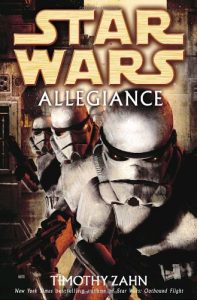
Allegiance

I guess there’s a new Star Wars series out, right? But for a really long time, I couldn’t find the first one used. (It’s in hardback, and I’m reasonably picky about paying $25+ for a book. Well, obviously I wouldn’t be spending full price, but I still think of it that way when making the financial decision.) I finally did find it, plus the subsequent ones, and now I’ve apparently got six books in said new series stretched out in front of me. Naturally, then, I opted to read the new Zahn book instead.

Allegiance is set in the Splinter of the Mind’s Eye era, when the Rebellion was only really starting to get its legs following the propaganda victory that comprised the destructions of Alderaan and the Death Star. A group of pirates apparently working with a regional governor to declare independence from Palpatine’s Empire sets Luke, Leia, and Han, Darth Vader, the Emperor’s newest apprentice, Mara Jade, and five recently deserting stormtroopers on a collision course, during which each of the characters must determine how their personal morality interacts with their sworn duty in an ever-darkening galaxy. (Well, okay, I’m thinking Vader was probably pretty secure in his actions and choices. And Leia. But the others!)

Decent book. Still pretty close to top-shelf for Star Wars, but the author has almost always done better. I can’t help but think it was a set-up novel to allow us to see more of the Hand of Justice in the future. Which is fine; those stormtrooper guys were pretty interesting, and definitely the best part of the story.

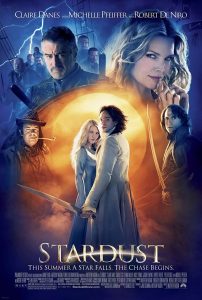
Stardust (2007)

Stardust, right? It’s been such a long time since there was a good fairy tale movie. (Well, let’s head off the Disney people and specify live action; but I’m pretty sure most or none of them compare anyway.) The downside to this is that the already viable comparisons to The Princess Bride become practically inevitable. The upside is that there’s finally something on film to mean to the kids what that movie meant to me. Oh, sure, they could just watch it instead, but since when do people go for their parents’ fogey old movies when there’s new hotness to deliver the same kind of impact?

Perfectly interwoven storylines follow a star that has fallen to ground beyond the Wall, a chest high stone wall that separates England from the magical kingdom of Stormhold. All she really wants to do is get back to the business of being in the sky, you know, hanging out at night, shining. Basically, the kinds of things a star would want to do. Meanwhile, people seek her on all sides. Heirs to the throne of Stormhold, looking to prove themselves according to long family tradition. A lad from England, looking to prove himself to a village girl by bringing her the star, which they watched fall to ground during a moonlit dinner. Three witches, trying to maintain their immortality. And that’s just the tip of the iceberg.

I loved it. I really can’t think of anything to add to that; the previous two paragraphs and the closing sentence of this one are, for the most part, fluff to fill out that central point.

Girls Volume 3: Survival

Still off the grid, and I have a solid concern that I’ll end up repeating myself. I suppose it’s always possible I’ll end up re-writing the whole thing, and nobody will ever know of these thoughts flitting through my head as I prepare my review of the penultimate graphic novel in the Girls series, Survival. As I type this, I’m sitting in a small town about 40 miles northwest of the point where I-35 crosses into Oklahoma, a town not much larger than Pennystown in our story. And it’s pretty easy to feel cut off from the rest of the world here, even though I’m clearly not. Far more easy to feel that way if I was trapped behind an impenetrable sphere with a disturbingly familiar death monster in the middle and dozens of naked girls running around trying to kill any women they see and reproduce with any men. Probably even the arrival of military forces wouldn’t ease my concern overmuch.

But if I have to be trapped like that, I think I’d rather face all that stuff alone. Because as bad as bizarre sci-fi monsters and as horrible as all that sex would be (and, okay, once they started being daughters and granddaughters, it would be kind of horrible), my trapped fellows would be far worse. Refusing to work together, insisting on assigning blame and punishment in the midst of the crisis, putting together dangerous half-baked schemes without any real discussion or foresight… by this point in the series, there are only a handful of people that I want to see walk away alive. That is, I care whether the rest of the people live or die, it’s just that I’d prefer them dead.

On the bright side, there’s still a pretty good chance of that outcome.

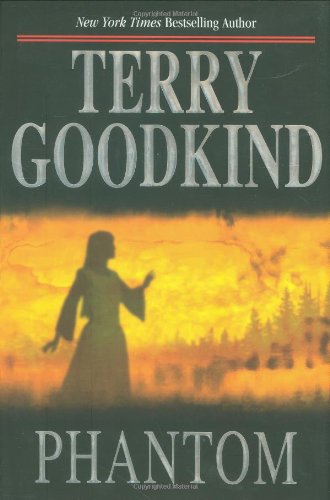
Phantom

41zwvtAmaMLNormally, this is the point in the review where I’d be digging up my previous reviews and getting an idea of what I thought of the last few books in the Sword of Truth series[1] and what the tone of the pieces were. However, as I’ve been telling anyone who will listen, I’m currently off the grid. And since I didn’t make the entire contents of delirium.org available to myself offline before I left, well, you can see that I have no choice but to wing it.

Okay, then. Plot summary first, I guess. Phantom continues Richard Rahl’s search for his wife Kahlan, erased from everyone’s memories and perception via the Chainfire spell. As if that weren’t enough to deal with, the seemingly infinite army of the Imperial Order is nearing Richard’s army, which has no realistic chance to do more than momentarily slow their inexorable advance on the last free capital on the continent. He’s already lost his sword, and now someone is in the shadows, poised to steal the last advantage he has left. And I maintain that all of this could be pretty cool, tension-driven fantasy drama, if only it weren’t interspersed with the repetitive objectivist lesson plans disguised as storyline.

The Phantom in question is still supposed to be Kahlan, as you’d expect, though Goodkind shoehorns in a few other phantom references in other parts of the plot. (A bit clumsily, to be honest; if he’d used synonyms every now and then, it would have felt a lot less hammery, at least.) But the real phantoms of the book are the various strawmen against whom he’s arguing. It’s all fine and good to think that religion dulls people, that a focus on an unproven next world beyond death can be actively harmful to providing the best possible life for oneself, one’s neighbors, and one’s progeny. There’s an interesting debate there, and it can work even if you’re an author providing both sides of that argument. But it can’t work if your authorial position is that the logical conclusion of a religious focus is a communistic dystopia in which all beauty and knowledge is despised for taking peoples’ attention away from the afterlife and in which people can be easily brainwashed into believing that the wanton rape and murder of friends and enemies alike can be an expression of solidarity in collectively marching toward that goal beyond the veil. It’s not just that painting the opposite side as ravening beasts incapable of all rationality is insulting and ultimately detrimental to any persuasion, although it is those things too. It’s that it renders the entire counter-argument suspect, if the opposition needs to be placed in such an unattractive box for the authorial mouthpieces to be able to effectively debate their cause.

[1] Yes. Still. There’s a bright side, though, in that the next book is the final one, and I will at last be free!

The Bourne Ultimatum

Popular wisdom states that the Bourne series has redefined the spy thriller genre. And when you consider that the latest James Bond movie turned away from the action-adventure tropes that have been the series’ bread and butter for decades (power-hungry megalomaniacs bent on world domination, big explosions, fancy gadgets, and so forth) to focus on gritty reality and mental chess games with equally skilled opponents, well, it’s hard to argue. After all, except for a digression to fall in love, get his girlfriend killed, and bring down bloody revenge upon the heads of those responsible, Jason Bourne has hardly done anything except make move after inexorable move toward the answers to his missing identity, countered by and countering the monolithic CIA that has yet unrevealed reasons to prevent him from reaching his goal. Gritty reality, mental chess? Check and check.

And now it’s time for the checkmate. The Bourne Ultimatum picks up our hero back on the trail of himself, that goal once more his sole reason for being. Non-stop action accompanies his quest to track down a CIA leaker who seems to know far more about him than he has known about himself in years. His few friends are no better than grudgingly helpful, while his numerous and almost limitlessly funded enemies want only to see him dead and his mess once and for all under rug swept. Luckily for him, he was created for these kinds of odds.

The camera work was all handheld, which at first seemed like an odd choice. I know people say it’s more intimate, but that was only rarely appropriate to the subject matter. My theory is that if you’re used to the slightly shaky camera, then by the time the frenetic action scenes start up, your eye will have a much easier time following what’s happening, from all the practice it’s gotten. On balance, the movie itself transcended the fairly redundant plot. Sure, questions that have never yet been answered reach resolution, but it feels like we’ve spent all three movies to reach this point. And the movies have previously felt too distinct to suddenly be shoehorned into a trilogy now. But, as I said, despite the sense of retread, the constant adrenaline and the understated passionate intensity of the acting make up for all that.

Discussion topic for after the movie: Why do we have a primarily patriarchal religion, when men are always portrayed as ultimately seeking their forgiveness and redemption from the hands of women?

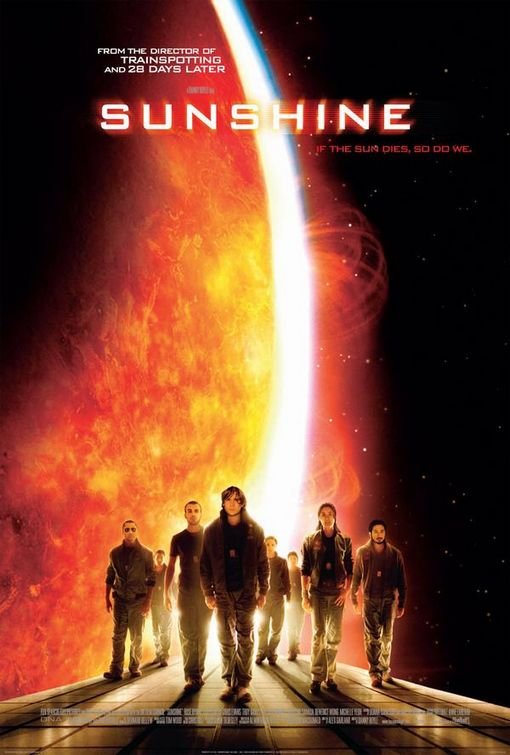
Sunshine (2007)

Sunshine is the kind of movie you see in Austin, or the San Francisco Bay Area, or maybe Vancouver. It’s got the art film look, but with the science fiction sensibilities to ground the plot from wandering as randomly as one expects from art films. Or, if you prefer, it’s a science fiction movie but without being constantly dank, dripping, and gloomy, nor impossibly pristine and modern, due to its latent art film sensibilities. In any case, it just feels more right to watch it in one of those places that is obsessed with both how movies look and whether they make a good story instead of just one (L.A.) or the other (Pittsburgh or New Jersey). Now that I’ve gotten my cinematic biases on the record, there’s also this movie to talk about.

In the future: the sun is getting dim, and humanity is unlikely to survive the worsening problem. Six years ago (let’s say), the Icarus was launched with a devastatingly vast nuclear payload and a mission to launch that payload into the sun in order to restart it. (This may or may not be based in science, and failures of adequate explanation may or may not be mine; but I don’t remember the movie going into details. They were not necessary to my enjoyment, in any case.) Except, the sun stayed relatively dark and nobody ever heard anything from them ever again. Now, it is the future-present, and the Icarus II is en route with a second vast nuclear payload that comprises the end of the earth’s capacity for creating sun-restarting bombs. Eight astronauts have the future of the species in their hands, and they are just entering the 16 months of interference-enforced radio silence as the tale opens.

I could ask you plot-leading questions that would reveal a little more of the story, but why bother? Either you’re into science-fictiony isolation stories or you’re not, and spoilers will not help to answer that question. The high points were how pretty it was and how tense it was. The low points were that the climactic scenes were just a touch clichéd (or possibly overdramatic instead; but not both) and also dove a little too far into metaphor for my personal taste. But nothing like how things went in Solaris. If anything, Sunshine redeemed the isolated spaceship drama for me, so don’t worry on that count. (And if you liked Solaris-the-film… really? Really?)

The Walking Dead: Safety Behind Bars

81oYvI9tEcLBack-to-back zombies! Pretty gross, right? Luckily, I mean books, not literal zombies. Although I suppose face-to-face or side-by-side would not be less icky, all things considered. Though probably less dangerous; who wants 360 degrees of brain-eating action coming at them? Since zombiism has not been romanticized the way that vampirism has: nobody, that’s who!

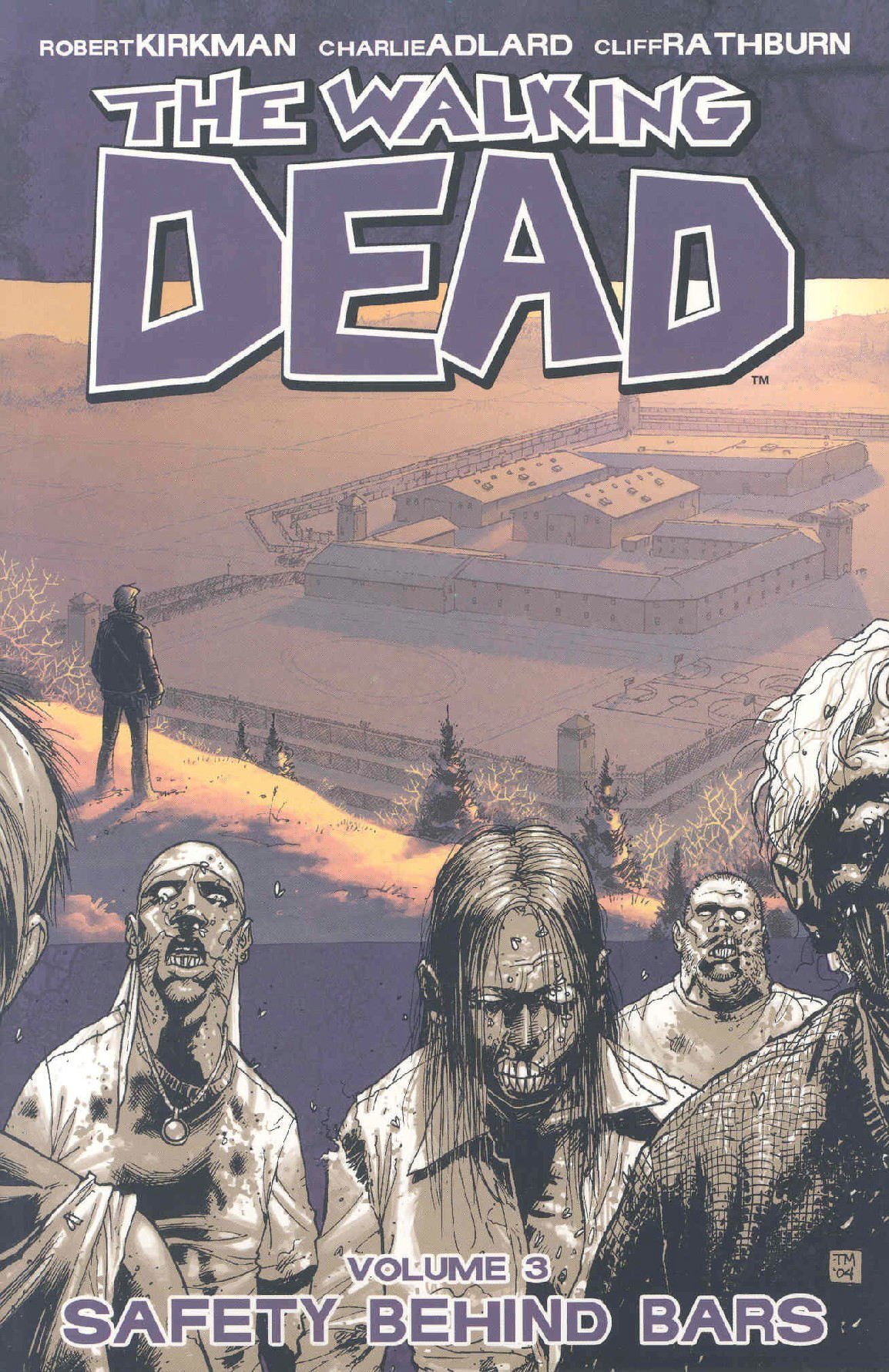
All of which is a roundabout way of mentioning I read another Walking Dead graphic novel. I’m seriously starting to appreciate the choice to present these in black and white. Images that would be over the top in color are appropriately horrible without; if pressed into guesswork, I’d say because the lack of red everywhere draws my attention back to the line-work. And there was a lot of horrible to behold. As the title indicates, Rick Grimes and company have finally found their shot at safety: a prison. Sure, it’s full of zombies now, but careful application of force can see it emptied out, leaving multiple security measures in place to prevent more of the undead from entering the grounds, ample space to spread out and form a community instead of a cluster of over-crowded and increasingly disaffected-with-each-other survivors, and more than enough open land to begin farming and herding while the weather holds. In short, it’s a latter-day paradise. Except… well, any details beyond that there’s a catch would be telling.

In short, I feel like it’s possible to view volume 2 as the transition novel I claimed it would be. Appropriate themes are back in full force in this story, and to shocking degree. (No lie: at one point, my jaw dropped open in surprise at a turn of events.) The tagline for the series claims, “in a world ruled by the dead, we are forced to finally begin living.” This is true, and it’s the one thing that I like the most in the entire disasturbation genre. But the additional theme that shows most strongly in zombie stories is that other people are far more dangerous those who survive the initial outbreak than zombies will ever be. I dig that one almost as much, which possibly is a reflection of my cynical nature. Be that as it may, my point here is that the author is not holding back anything in this particular regard.

Finally, a dislike. Rick’s pregnant wife is beginning to have real problems with both his assumption of the leadership position as well as with his choices as leader. It’s a little hard to watch, since I’m starting to actively like both characters. (Not Teckla hard, but hard.) But it’s really good character conflict, and I want to see where it leads, right? Except, they’ve spontaneously defused the tension via her admission that the pregnancy hormones are making her say things she really doesn’t mean, and she can see herself stepping over the line but is unable to prevent it. And I’m suddenly disappointed, both from the cessation of storyline possibilities and from the somewhat insulting explanation. I grant that hormones can run wild in fact, but having them do so in fiction with no consequences is both a cop-out and a little bit… well, not misogynistic per se, but at least anti-feminist, without even the excuse of it changing the plot in an important way. My only hope right now is that something will still come of these arguments, and she’s been exaggerating the hormonal excuse in a misguided attempt to be conciliatory and stop the hostilities instead of actually hashing things out.
The Simpsons Movie

The Simpsons Movie is proving pretty difficult to review without either running far too long or far too short. I could take forever talking about why the show is funny and why the movie is, or I could promise that if there was a time when you liked the show, you’ll like the movie, and only spend about a sentence. Neither of these is very palatable, and yet I’m mostly left without recourse. Because, even if I felt up to trying, who can explain humor? But to be clear, it was quite funny, and the humor was more apolitical than the show has been lately.

Plotwise, it was a little boilerplate. Homer makes a mistake with far-reaching consequences, and must make amends with his family. It worked well here, but I’m a little tired of it nonetheless, since it’s been happening more than once per season on the actual show. Lisa has her eye on a boy and the environment, Bart is reconsidering his paternal-figure options, and Springfield is trapped under a giant, impenetrable dome. So, except for the dome, yeah, we’ve been here. But it was funny enough that I’m revisiting events in my head now as I type these words and giggling all over again, days later.

Also: Spider-Pig! (The superhero, not a spider/pig hybrid. Good God!)