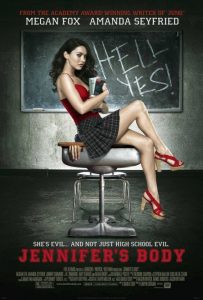
Jennifer’s Body

This was not the movie I expected. I saw previews in which the freakishly hot Popular Girl and the attractive but movie-mousy Best Friend have a power-based friendship that devolves when the hot chick is revealed to be a vampire, and I was pretty sure I’d be seeing a horror-slanted riff on the darkly comedic high school ground broken by Heathers. Coming out of the theater though, I can better relate it to the cinematic version of Buffy the Vampire Slayer that Joss Whedon disliked so much. There’s still a little black comedy, sure, but it’s pretty much an even split between an actual horror movie and an over-the-top zany comedy.

Jennifer’s Body follows the devolution of that primary relationship I mentioned after the aforementioned Jennifer turns out to be a demon who is gradually eating the boys in the senior class. Which is not really a good measure of… Well, words are kind of failing me here, which is unfortunate because it’s a surprisingly good flick. Mixed in with the hilarity and the occasional scares is a pretty decent metaphor for growing out of school relationships that are based more in history than reality and toward adulthood. Then again, the paired sex scene between the main characters in dueling scenes[1] made no sense to me at all, so I’m not trying to say it’s all oniony layers of impressive and thoughtful depth here.

But I can say that Megan Fox has the best set of dying words I have ever seen on screen.

[1] 2018 edit: I know what I mean here, but damned if I can figure out how to phrase it better. They each were having sex with other people, in different locations, in one intertwined scene in the movie, is what I mean to say.
Ultimate Spider-Man: Warriors

So, the most recent Ultimate Spider-Man, Warriors[1], has me thinking about Peter Parker’s foes. Most of the time, they’re dudes that were changed by science like he was, only with more sinister results. Most of them are bit characters, because there are always way more villains than heroes, and the heroes never permanently lose. (Mostly.) You’ve got the Green Goblin and Doctor Octopus, with whom he shares pretty much a familial bond.[2] But otherwise, most of what he faces is a generic stream of similar villains that he can quite easily quip to death, even without the spider powers. But then there’s the Kingpin.

Wilson Fisk is just a rich guy mob boss type. His henchmen are all just folk too; Elektra has no special mutant or science-run-amok powers that I can figure, and just about everyone else he works with isn’t big-time enough to have a recognizable name. He could be Spider-Man’s least interesting foe, and yet instead I think he may be the best of the bunch. He’s scary smart and he has the power that money brings, even though he’s been laying low due to legal difficulties for practically the entire run of the comic. I guess it’s a lot like Lex Luthor with Superman: the only person who can really compete with an unstoppable force is the one who can out-think it. And okay, Kingpin is a bald rich guy, so maybe there’s a little bit of larcened[3] idea in the character at that. But I don’t really care, because the more important of the two is original, and nowhere near an unstoppable force anyhow, which leaves Kingpin free to be even more of a puppet-master. Case in point: the book that I just finished reviewing, albeit in footnote one.

[1] The actual book? Of course it was fantastic. What do you expect me to say instead, at this point? In a way, there were way too many bit characters from previous continuity (and, okay, also from previous events in this series), but in another way, that managed to work and be really cool itself, even though that kind of thing usually pisses me off. Which is why I keep writing paeans to Brian Michael Bendis. Whatever he’s selling, I apparently keep buying it.
[2] I mean, Norman Osborn created him, and the paternal vibe has been there ever since. All too readily, Harry Osborn falls into the overlooked brother role, and Otto Octavius, self-created but still in Osborn’s employ when it all happens, kind of feels like part of the family to me too. The last part may be a stretch, I admit, but I’m impressed with how neatly Bendis shoehorned the other three characters into these roles, just as though they had always been written this way.
[3] Is that even a word? I bet not.

Ultimate X-Men: Phoenix?

Robert Kirkman, who you may recall me lauding from the Walking Dead series, begins his run as the writer for Ultimate X-Men with Phoenix?, in which the X-Men take some time off. No, seriously. The first half of the book is pretty much a date night. I mean, it’s literally named that. So, anyway, most of what happens is character development rather than plot advancement, but I’m okay with that. The central question of the book, as you may be able to guess by combining the title with some small amount of X-Men knowledge, is “Is Jean Grey the Phoenix?” And it’s a pretty interesting question even if you are familiar, because the Ultimate Phoenix has always been different from standard continuity, at least from what I know of the latter. Other questions for the book include: “Which character is homophobic?”, “What’s all the weirdness with Wolverine lately?”, “Who is this new Magician guy and did Kirkman create him out of whole cloth to seem awesome?”[1] and, if you are like me and reading these books in the wrong order, “Why are there Ultimate Spider-Man spoilers, dammit?”

An additional question, if you are familiar with Kirkman, would be “Why is the dialogue so stilted and basically terrible?” Thankfully, that question is obviated by reality as of his second issue, which means I don’t have to claim this book is terrible. Which is nice, since I had only recently started to really like the series.

[1] I hope the answer is “No”, because the character is kind of annoying, however intentionally.

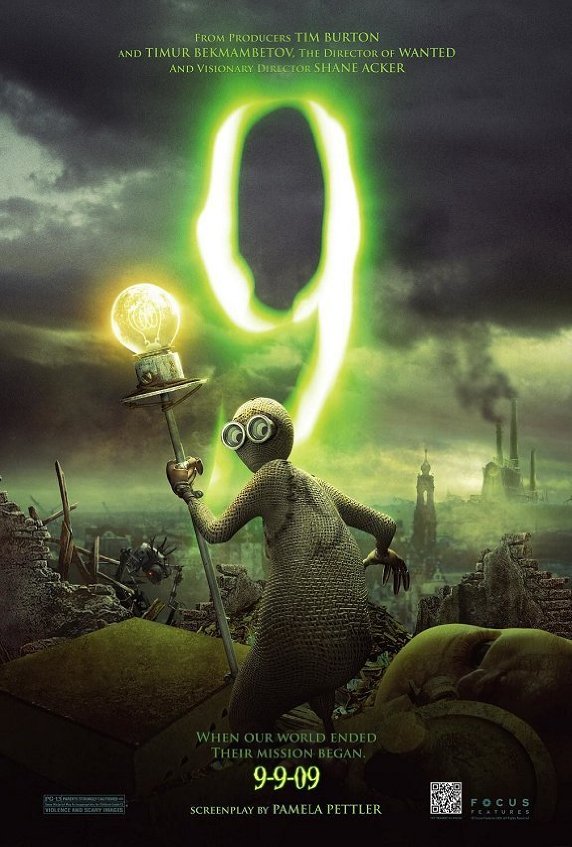
9

MV5BMTY2ODE1MTgxMV5BMl5BanBnXkFtZTcwNTM1NTM2Mg@@._V1__SX1859_SY847_I had my time-killing afternoon movie for yesterday narrowed down to three options, when suddenly someone at the end of the table said, “Hey, do you wanna go see 9?” And other than a slightly more expensive ticket price, I had no compelling reason why not; after all, it’s a flick I’ve wanted to see, even if Tim Burton is kind of getting played out by virtue of basically every single one of them being about loneliness. I can deal with that in my music, but it starts to get old on the screen, eventually.

In the dawning years of World War II, war-attuned scientists have created self-replicating machines “for the defense of the nation”. And then… well, you know what happens next, don’t you? As sure as zombies commute on trains[1], the machines rise up against their masters. And as humanity declines, one scientist, perhaps seeing the way the wind is blowing, engages in a knit-punk experiment to create nine tiny homunculi in the slim hopes of carrying on life on the planet. So, that’s where the movie begins; as for the actual plot, it can best be summed up as “adventure and interpersonal[2] conflict ensue”.

It was a decent albeit flawed movie. I look at it like this: if you want to see a movie with incredible animation, as good as any I’ve ever seen, you should check this out. If you want to see actiony dramatics, you’re good. If you want to see the best use of Over the Rainbow as score, this is the place to be. If you want to see a thoughtful movie that makes coherent sense as a whole, well, you might should ought to look somewhere else. Also, if you are at all allergic to the really crunchy granola[3], you’ll have some problems.

[1] Dude, it rhymes. You expect more depth from zombies?
[2] Grpuavpnyyl, vagencrefbany, but that would be a spoiler. P.S. http://rot13.com
[3] Hippies, yo. Hippies. You know what I’m saying.

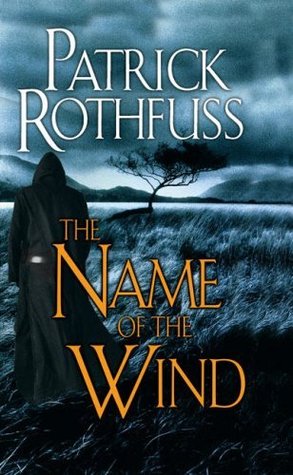
The Name of the Wind

186074Last year, I read an author’s first book about which I had only the best to say. I like this kind of thing, because I get to know about a good author early in the career, and I can keep up over the progression and have thoughtful, chin-stroking opinions and pass on the news to other people to repay all the times that people have done this for me. The thing is, though, it really doesn’t happen very often. So you can imagine my surprise when I’ve got another one, a mere year and a half later.

The Name of the Wind tells the first third of a story that borrows liberally from the tone of Scott Lynch’s books, the voice of Steven Brust’s Vlad Taltos, and the plot, among many others, of Harry Potter. How many of these are actual influences I cannot guess, of course, but there’s no question that whether influence or simple similarity, Patrick Rothfuss has created a character and a story that both are very much all his own. His world is a fairly standard fantasy landscape in trouble: the roads aren’t safe, war and the rumor of war are on everyone’s mind and tongue, and demons stalk the landscape. But stories and legends abound, very old and recent alike.

A chronicler of such stories is following rumors of one Kvothe[1] the Bloodless, Kvothe Kingkiller. He finds trouble on the road and yes, demons, but he also seems to have found what he is looking for in the guise of a small-town innkeeper. And to even his own surprise, Kvothe agrees to have his story told, if it be told exactly as he tells it, with neither embellishments nor redactions. Of course, who but Kvothe himself is to say how true the story really is, but as it involves magic, demons, dragons, and still more stories of the world underlying his own tale, it makes for a worthy read.

Well, okay, lots of terribly unworthy reads have those things too, but Rothfuss’ premiere work has, as I’ve already implied, an excellent voice telling it. This is the rare work in which the prose and plot are of equally high measure. It also has an entertaining mythology, an engagable and interesting take on magic, and, regardless of Kvothe’s veracity, a great deal of truth to it. The best of the book, though, is Kvothe himself. Unreliable narration has been a pretty sure guarantor of my enjoyment of a book for some time now, but The Name of the Wind is all the more interesting for alternating between Kvothe’s tale and the room in which he tells it, where we can see him through eyes other than his own. He contains in him the heroism he claims, the boundless sense of duty he may not even wholly be aware of, and unplumbed depths of bitter anger that appear whenever the world does not really conform to his liking. Despite how pleasantly entertaining he comes off in the story, an event during its telling that lasted for a mere page told me far more about him than anything he actually said. And this is exactly the kind of thing I love to read about. I suspect it may have to do with my hobbyist interest in psychology? In any event, my only warning and the only complaint I have about the book at all is my lack of clue about when the first sequel will be published.

[1] “Pronounced very nearly the same as Quothe”

Sorority Row

One of the things I like best about horror movies is how there are no surprises. I mean, there are, obviously, but they’re all of the shocking, jumpy, and/or dramatic reveal types. There are no archetypal surprises, though. The story goes exactly the way you expect it to, and the characters act exactly the way you expect them to. Take Sorority Row. If you know the title and that it’s a horror movie, there are immediate expectations set up in your mind. There will be a bevy of attractive, sexually permissive, emotionally distant sorority chicks, at least most of whom have distasteful personalities predicated upon their innate senses of superiority over the common throng of humanity. And through some slight, real or perceived, they (and their similarly described boyfriends) will “earn” a series of brutal murders. All that, just from title plus genre.

The reason I’m okay with this is that it leaves the slate clean for the important parts of the movie. Like, how will someone die next, and who will it be? Who is the killer? Is it a g-g-g-g-ghost? Or someone with more plausible motivation? Will the movie take itself seriously and therefore be bad? Will it take itself seriously and be so bad that it’s entertaining on those very grounds? Or will it not take itself seriously and instead be equal parts ridiculous and awesome within its self-awareness?[1] Most importantly, will Carrie Fisher kick some ass?

These questions, you can clearly see, are far more interesting than the ones raised by mainstream movies. Which of these characters should I care the most about? Where is this storyline going? Who has secret tragic cancer that will be revealed in the second act? That shit simply doesn’t rate, is all I’m saying.

[1] It’s this one.

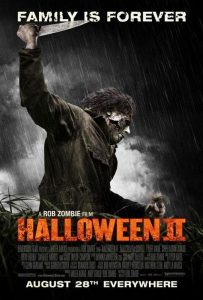
Halloween II (2009)

This right here is a difficult review. Because I’ve just reviewed a movie that, however barely serviceable its plot, understands the way horror sequels work. Because John Carpenter’s Halloween II is the best horror sequel ever made. Because I enjoyed both Rob Zombie’s remake of John Carpenter’s original Halloween and his other movies that I’ve seen. Because it will pretty much require a non-stop spoiler parade to really explain myself. But mostly because, despite a deep inner craving to love Rob Zombie’s Halloween II, I kind of hated it. So, that’s the short version review. The longer one[1] includes, as stated, dangerously high spoiler levels.
[1] Everything below this footnote, basically

Continue reading

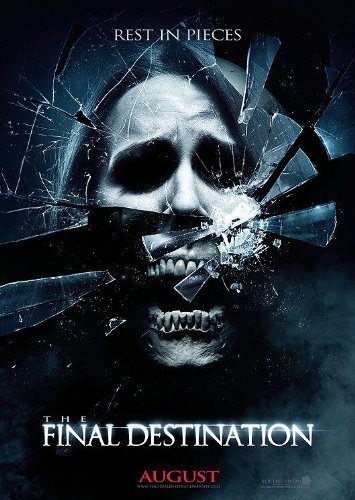
The Final Destination

MV5BOTMwMTMzNDM1N15BMl5BanBnXkFtZTcwMjMyNjk3Mg@@._V1__SX1859_SY847_I’ve said it many times before, but it has been true for as long as I’ve known about it. It appears to have been true since Joe Bob Briggs first said it in the early ’80s: if you want to make a good sequel to a horror movie, look at the movie you made in the first place and make your sequel identical to that. As such, I will not have very much to say about The Final Destination. Because it had a dude who has, for no apparent reason, visions of an upcoming tragedy and accidentally helps several people escape said tragedy.[1] After which, Death’s plan has been thwarted, and thusly these several “lucky” near-victims start to die in unlikely ways to bring things back on track, while vision-dude continues to have new visions and tries to prevent all their deaths and his own, despite the inevitability.[1]

I mean, let’s be clear. There is no point to this movie except to see people die in gruesomely inexplicable ways. But you have to give some credit to whoever came up with a concept that allowed them to film death after grisly death while avoiding all semblance of a plot, and then has gone on to do it three more times.

Also, it’s in 3D if you like that sort of thing.

[1] Matching the original film as well as both previous sequels? Check.[2]
[2] I believe that the vision-dude in Final Destination 2 may well have been a chick.

Lucifer: Mansions of Silence

With the conclusion of Mansions of the Silence, I have completed over half of Mike Carey’s Lucifer story. And from a structural perspective, it is pretty obvious that the story is about half over. Well, I can’t say that much, but it’s at least obvious that it has reached a dividing point. That’s it’s half instead of a third or whatever, that can only be seen in retrospect. My point, anyway, is that the loose ends are rapidly being tied off. In keeping with his character, Lucifer is repaying his debts regardless of the cost to those around him.

Half the story follows his crew on a journey he himself cannot take, to rescue the soul of Elaine Belloc and clear that debt to her. And it makes for a pretty good travel-adventure yarn, sailing through the planes of the heavens on a Norse boat of the dead, built by honest-to-God[1] giants out of the fingernails of dead Vikings. Good mythical stuff, is all I’m saying. Meanwhile, the angel himself and his brother Michael take advantage of a device Lucifer recently found that can see into the mind of God, the results of which have almost certainly set in motion the second half of the story in ways that are currently well beyond my perception.

Pausing to take stock and look at the series through the Sandman lens[2], the storyline is pretty much as complex still, but the literary weight is… I’m having a hard time with it. It’s either not so much there, which is kind of reasonable, Sandman being pretty much seminal in the field of literary graphic novels. Or else, it’s there, but much weightier and a lot of it is sliding by me. Which is certainly possible. But without being too full of myself, if I’m missing it, most of the other readers are too. Anyhow, I say again: not quite living up to Sandman means you have a damn fine story happening.

[1] Er. Yeah, sorry about that.
[2] Since this seems to be my day for comparisons.

Saints Row 2

Saints Row 2 is the rare sequel that follows the horror movie rule of good sequels: make exactly the same thing again, only adding an incremented number on the end of the title. Five years after the rise and sudden fall of your character from Saints Row, he (or, this time around, possibly she!) wakes up from a coma ready for revenge. Only, revenge will have to wait: the 3rd Street Saints are no more, crippled in power by the total loss of their leadership[1], crippled geographically by the corporate gentrification of their seat of power, and crippled statistically by the rise of three new gangs who have taken advantage of the power vacuum to once more carve up the sad and inexplicably water-bound city of Stilwater.

The game, being a carbon copy, has flaws in keeping with the original: the glorification of gang lifestyle and graphics that seem almost hokey when held up next to Grand Theft Auto IV are the most obvious. But the newly chatty main character[2] is so over-the-top in her villainy and love of chaos that it felt a little less scuzzy than the voiceless original protagonist upon whom one inevitably would imprint their own motivations. As with the first game, I completed something like 93% of the available game, leaving out only a few races and stunt jumps and such. The series has been very good to me, on a value basis.

There is a remaining inevitable question to be answered. Having played them in such proximity, how does Saints Row 2 compare with Grand Theft Auto IV? Well, the similarity of game is a bit of a plus here; I really appreciated that the map of the city was so familiar, as opposed to Liberty City being so vastly different in GTA. (Then again, the time between sequels was only a couple of years rather than a decade, so I understand Rockstar’s point of view on the Liberty City update.) Storywise, GTA is the clear victor, hands down. Niko Bellic is a meaningful, tragic character while the nameless leader of the Saints is a caricature. And the respective stories very much reflect that comparison. All the same, I think Saints Row is the more fun of the two games; mindless mayhem and frequently-thin story motivations did not leave me wallowing in misery, the way Niko’s life did. And Saints Row’s story does have a handful of dark and dramatic turns, don’t get me wrong. If it wasn’t for the graphical disparity, I think I’d have to say it’s down to a matter of taste. But no, less fun-filled or not, GTA is objectively the better game.

[1] Some to retirement, some to the corporate sector, some to (seriously) the police force, and of course there’s the one that’s been imprisoned and in a coma.
[2] To my surprise, there was no option to import the previous character design from the original game. In compensation, there’s an ongoing joke about the character having “new hair”. Since mine changed gender, yeah, I found the understatement pretty amusing.