Ultimate Spider-Man: Silver Sable

As promised, a long overdue return to my graphic novel sequence! I’m still gradually catching up with the Marvel Ultimate series; the book I’m reading right now… is not the book I should be reading right now, apparently[1]. Son of a bitch. On the bright side, none of that has any effect on this particular review. And it’s not like I’m ever caught without a backup book in this kind of situation, it’s just frustrating to break order yet again, when I’m only finally getting back into it! So, I guess I’ll start over? Right, then.

That guy Spider-Man, yeah? He has been having a rough couple of months. He lost two close friends right in a row and then had to[2] break up with his girlfriend, and all the while the villains are mostly getting cannier. Plus, enough people have seen his face that if they all got together they could work up a composite and start putting him on milk cartons. When you get right down to it, it’s really about time he caught a break. And, well, that actually sort of happens in Silver Sable. I mean, on the one hand, he is being stalked by one of the pre-eminent bounty hunter types in the world, and that’s not so great. But for once, the chaos surrounding Peter Parker is really not of his own making, not even indirectly. Plus, as the X-Men had previously spoiled for me (since I’m reading a little bit out of order and all), he has a new girlfriend who is far less likely to be killed as a result of Spider-Man’s interference in a normal life. All in all, the book is a humor-centric piece of breathing space amid the various tragedy and drama in Peter’s life. And I’m glad; as well as Bendis handles the drama, it was starting to get a little oppressive in here! …though I can’t help feeling bad for Mary Jane.

[1] It was supposed to be Ultimate Annuals. I instead have Ultimate Annuals 2. And I’m really not sure how my filing system allowed it to happen!
[2] Had to? Plausibly yes. He certainly did, regardless.
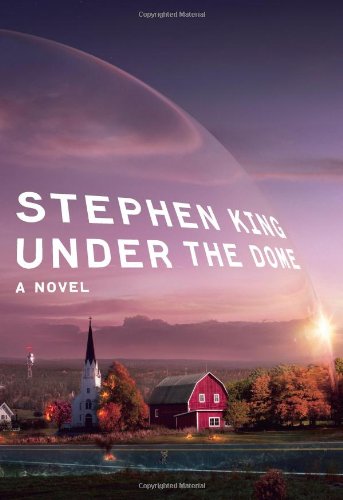
Under the Dome

41PZik3LNWLAs with the majority of Novembers in my adult memory, there’s a new Stephen King novel on shelves. Less usually, I got it for about 75% sale at Amazon, because apparently they and like Wal-Mart are in a weird book price war right now for best-sellers? At that price, I’d have bought it unemployed without blinking. (I guess technically I did, since the pre-order was placed just before my start date, last Monday.) In the subsequent week and change, I have read Under the Dome. Don’t worry, I’m finally reading graphic novels again, the schedule will resume normalcy at this time.

The premise is simple, and I think that simplicity is where the genius of the book lies. Imagine a small town, full of people who are good, bad, and indifferent, corrupt and pure, power-hungry and service-minded. Any small town will do. And then, cut that town off. Completely, and in some cases, literally. Under the Dome is about that: about the people on the outside who want to find a way to help; about the people on the inside who want nothing more than to get out and get on with their lives; about the not entirely stable people they could be trapped with; and about the people who only see an opportunity for greatness. Aside from King’s reliable eye for characters, what struck me most about the book was the breakneck pace. Not even halfway through the book, and it already felt like the inevitable decline and fall of Chester’s Mill, Maine was hurtling toward me faster than I could turn the pages. The last couple of days’ reading was actually stressful in some ways. (Not that I minded.)

In the end, the only complaint I have is about the Dome itself, and I don’t really know of a way around it. People will naturally want to know how the Dome got there and why, and I know the question had to be answered. But I submit that this misses the point of the book, and if there were a reasonable way to pretend that its origin could be ignored, it should have been. The book is about people who are trapped, people who are concealed from the eyes of the world and from its external consequences, and the way they behave in these extreme conditions. And that part was golden, and it filled up probably a thousand pages of excellent literature. So, there’s that going for it! (For the record, I am more or less satisfied with the origin story part; it’s just I know some people will not be. I may not have been, if I had actually cared at all? No way to be sure, I expect.)

2012

So, the Mayans, right? I’ve been keeping an eye on this calendar thing since way before it got trendy. That said, I’m glad it got trendy, because how else am I supposed to get a gem of a movie like 2012, in which the world is destroyed non-stop for two and a half hours? In case you have managed to miss the media blitz, it goes like this. The Mayans had this calendar that predicted star movements, eclipses, pretty much everything going on with the earth’s interactions with the rest of the solar system and possibly galaxy. And this calendar has been around for thousands of years, constantly being right. But, as of the winter solstice, 2012, the calendar just ends. I guess the present day Maya people, of whom there are not many, say it’s this thing like the end of an age, and a new age will start afterward? But it was quickly appropriated[1] as the predictive date of the end of the world. After all, if the world doesn’t end, where did all of our eclipses and tides go, Mayans? Either keep predicting, or give us our orgiastic apocalypse fantasies![2]

I should ought to point out that the world does not immediately begin ending once the credits have concluded; in fact, the film opens in 2009, because someone decided we needed a scientific reason for the inevitable carnage. Please note that we were not provided with a scientific reason, at all, but, you know how these things go. All the same, Roland Emmerich clearly understood that his audience would not be pleased by the lack of instant carnage, because the evidence montage was suffused with rapid tension music from the orchestra pit. Then, after a brief pause to introduce John Cusack, the rest of the film actually was the non-stop destructive roller coaster I had jokingly promised my double-dates for the evening. I’m not even kidding; if there was a scene after the 30 minute mark that did not include either an explosion, a tidal wave, an earthquake, flowing lava or (at the bare minimum) floating ash, I genuinely don’t remember it. And every time the film thought about being emotionally serious or speaking intelligently on the loss of worldwide culture or the death of an entire sentient species, Roland’s steady hand was there on the script to pull back from that brink and resume the carnival-of-the-ridiculous the film was clearly meant to be.

The only problem I had, the only problem, was with the audience. Because except for me and my dates, there was nobody laughing every two to five minutes at the newest bit of over-the-top parody of disaster film that I’m positive Emmerich intended to make. I’m pretty sure nobody else laughed the entire time! The director clearly got it. The sprawling cast of Hollywood notables appeared to get it. I certainly got it. Why didn’t they?

[1] Probably by The Man.
[2] Actual orgies, while likely, are not necessarily included. This was meant to be more in the metaphorical doomsday-excitement sense.

The Well of Ascension

I was already reading this book when the Robert Jordan book came out, which explains both why I have skipped my allotment of graphic novels and why I read two books in a row by the same author. At least it isn’t the same series? Anyhow, The Well of Ascension chronicles the continuing adventures of… well, I guess I never talked about the characters in the first Mistborn book, did I? So, anyway, there’s this skaa thieving crew and our heroine, Vin, and they achieved a pretty big victory at the end of book one. And now, as book two opens, they and their noble allies must face new dangers in the form of invading armies, untraceable spies in their inner circle, and a growing certainty that the world is still in the same grave danger that the Hero of Ages was supposed to have defeated a thousand years before.

Sanderson has done a pretty good job of maintaining sense of wonder, by delving more deeply both into mistborn abilities and into the history of the Hero of Ages and the Final Empire. As in the previous book, each chapter starts with an excerpt of writings from a thousand years prior when this chain of events first began. Unlike last time, however, the writings are more or less in order of the story they are telling; it was all I could do not to ignore the book and jump ahead to read the entire ancient record at once, and then come back. All of which to say: see? totally sense of wonder. The mood of the book is by turns ratcheting tension, romantic angst, a little bit of creeping dread, and occasional doses of intense action, all of which build toward a pretty explosive last hundred pages. I was out at dinner Tuesday night and just itched to read the last 20 pages instead of interacting with my companions. I didn’t, but probably only because Skwid was there to answer my minor spoiler and relieve the tension just enough to hold out until I got home.

The Stepfather (2009)

Except, I actually went to see two movies yesterday, not just one. Which sort of catches me up on current horror, except that I think I missed one on a spaceship. I guess I should investigate that? Anyway, said second movie was The Stepfather, a remake of a late ’80s franchise in which this one guy moves from single mother to single mother in search of the perfect family. Since people aren’t, as a rule, perfect[1], he trends toward disappointment. Which is fine as far as it goes, except for his habit of killing everyone in a fit of rage before he moves on to the next family.

The flick was by turns tense, suddenly violent, and occasionally quite funny, but it did raise a few question in my mind. How did I watch two horror movies in a row with no nudity in evidence? (Well, one of them was PG-13, but still: lame!) Is it really warm enough in a Portland summer to justify constant bikinis? (I am willing to suspend my disbelief in service of even mildly occluded plot points.) How come murderous psychopaths have a really easy time picking up women in supermarkets, while I… (Yeah, I got nothing on this one. Obviously.)

[1] This is especially true when gathered in groups of more than one.

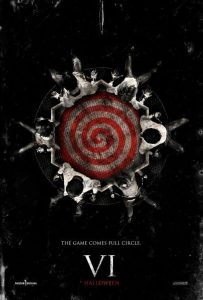
Saw VI

There are, aside from the first spare and intelligent entry in the series, only two reasons to watch a Saw movie. Either, you want to see what new Rube Goreberg[1] devices and tests that Jigsaw and his apprentices have devised for their latest victims, or you want to learn a little bit more about the story behind said murderous fiends. Because, the series is really excellent about doling out new information about an increasingly intricate backstory without retconning anything that has gone before, despite the overall tale spending far more time in the past than the future. And it’s really excellent at killing people in new and implausible ways.

So, pleasingly, Saw VI hit both of these marks, and to some extent, that’s all you need to know. But it also went zany. I don’t think I minded much, but it was really strange watching the franchise get all political. Because this time, the targets were not random people who needed to learn lessons about living, but health insurance executives (and associated hangers on) who needed to learn those lessons. The message was ham-fisted, albeit timely. But I think that was kind of the point, the ham-fistedness. To just really stick it to those jerks, if you will, in full-on audience service.[2] Plus, the ongoing plotline stuff was wrapped up a little bit more thoroughly than usual. So, strange movie all around. That said, I’m pretty sure there will be a Saw VII next October. ‘Cause, y’know.

[1] Yeah, still proud of that one.
[2] Not quite the same as fan service.

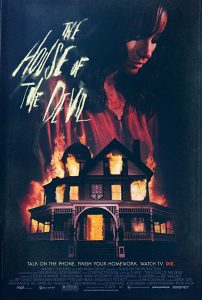
The House of the Devil

I would ask why all my favorite movie stories happen at the Alamo Drafthouse, but I know why: because it’s the kind of place that builds good industry relationships, and so it gets all the cool stuff that is mostly reserved for the red carpet premiere set. I am jealous of this lack in Dallas, but I do get to go to Austin now and again and relive the awesome all over again. In this particular case, I watched a movie called The House of the Devil, which is presently only in release in New York, Los Angeles, and one screen in Austin. Not that this was carpety or star-studded, or that it even particularly had stars[1], but I still appreciate on some level the exclusivity.
What we’ve got here is your basic 80s Satanic cult flick, in which a girl takes a babysitting job on the night of a lunar eclipse, only the situation keeps getting weirder and spookier and tenser. Generally good stuff, and it was definitely made as solid homage to the genre, with every detail spot on down to the film stock quality. And it was good. It just… I feel like I watched a movie someone made in the early 1980s. As that was the apparent goal, I must admit that they nailed it; they did[2]. But somehow, I feel like the 25 years that have elapsed since then requires some kind of advancement in the state of the art. Not the film, or the special effects (of which there were almost none beyond the ones based on violence), but the plot. Like, maybe a modern twist, some hint that this was not in fact an old reel someone dug up, but an actual new movie? I liked it, don’t get me wrong. The slavish devotion to nostalgia just made it feel empty.

[1] The biggest name was a pre-credits cameo by Dee Wallace.
[2] Seriously, the only detail that felt wrong during the opening credits was that the release date Roman numerals started with MM instead of MCM.

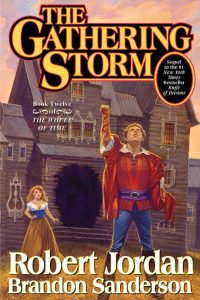
The Gathering Storm

This has been a strange experience, probably from start to finish. The last time I read a Wheel of Time book, I think Robert Jordan wasn’t sick yet. I had certainly never heard of Brandon Sanderson. And it’s probably been that long or longer since I last bought a new book in a bookstore, instead of used or (rarely) Amazon. But, it’s been four years since that last book, which I suppose leaves a lot of room available for changes of this type. It’s just weird, is all I’m saying. Anyhow, expect no particular spoilers, but also expect me to think you’re familiar with the series. If you aren’t, this wouldn’t really be the right place to start anyhow.

The Gathering Storm is an accurate title for a good book. The Last Battle is drawing closer day by day, and the Pattern is unraveling at the same rate as Rand al’Thor himself. ‘Cause, y’know, Fisher King metaphor. And nobody else’s life is much better, at least what we saw of them. All of the characters were visited, but Rand and Egwene were the mainstays; I think I can therefore expect a lot of Mat and Perrin in the next book, due out a mere year from now. Anyway, that’s plot if you know what’s been going on, and if you don’t, I still wonder why you’d bother to closely read a review of the twelfth book in a non-standalone series.

The thing is, we all know that plot review is boring and completely disregards the s’redit in the room. How did Brandon Sanderson do at (all too literally) ghostwriting from Jordan’s notes? And you know… it’s hard to compare. The plot was much tighter even than the previous book, much less than the several that preceded it. But then again, Jordan swore for the last years of his life that he’d be finishing the series in one book. So plot tightening was, one hopes, guaranteed. Plus, there’s no guide to who wrote which sections[1]. So all I have are sense impressions. Some of the language is different, but not in a way that was bothersome. I mean, I noticed it, and it took me out of the trance for a moment, but, what can you do? The characters were mostly the same, though there were outliers. Mat especially seemed a little off, but I think it was mostly because he didn’t have any plot moves to make, and that he will thusly seem far more familiar in the next book.

The biggest weirdness came in the Egwene scenes. Not that she seemed not herself, but the way she talked was… there was a lot of lecturing in there, and some pontificating as well. You know what it reminded me of? Take away the solid characterization and plot points, and just look at tone, and it kept reminding me uncomfortably of the polemics Terry Goodkind has been placing in his characters’ mouths for the past five years. She never sounded objectivist[2] or crazy, but the manner in which she spoke and all of the people around her took careful notice and nodded wisely while stroking their ageless faces? It hurt what was otherwise the best sequence in the book.

But, to break it down: this is really a minor complaint, and it did not hurt the book or even plot surrounding said complaint. And my other complaints, mentioned and un-, are far more minor still. Whether Sanderson or Jordan had more words typed, this was an excellent Wheel of Time novel that has me as excited for the next release as I last was over a decade ago in my college days. I think I may even reread the series, before the last book drops, to get it all in one gulp. But that’s a couple of years out, so, we’ll see.

[1] Jordan had been writing at the concluding volume[s] for months or years before he died.
[2] I toyed with saying “Randian”, but, you know.

A Night in the Lonesome October

I have been vaguely aware of A Night in the Lonesome October for ten years or better, but it’s really hard to find a copy, so I’ve never read it. However, I finally did find one earlier this year. Which I suppose is pretty obvious, as, review! I have always been told, during the span of said vague awareness, that the appropriate way to read the book is day by day throughout October, to coincide with the chapters which are each their own day. And so I was gonna do that this year, but then on top of it, some people I know decided to do a reading-club-style daily read at the same time, so I also got to discuss as I went. This does not, per se, take away from my review thoughts, because the talks were mostly about the plot revelations and not much at all about theme. Still, it will turn out to have an influence nevertheless.

Because mostly what I learned is that it’s the kind of book about which the less you know going in, the better. If I had my druthers[1], I would not even have read the jacket text explaining the setting and plot outline. Which, well, makes it tricky to give much of a proper review of what’s going on, is my point. In short, a group of animals (including the book’s narrator, a dog named Snuff) and the humans they are attached to have gathered in the English countryside in October in order to perform an apparently supernatural task. And they are not all on the same side. And so the book gradually unfolds the nature of the task while exploring the motives and, of course, actions of the participants. I know this sounds boring, but I can guarantee that the majority of characters are compelling, and the plot is old-fashioned October horror. And probably that you’ll be happy not knowing more.

[1] Real word? You decide!

Ex Machina: Ex Cathedra

The Ex Machina series has been, at every point, stingy with its distribution of information. Why did this one Mitchell Hundred guy (and his nemesis Pherson) get powers? Is someone pulling the strings? What is the end goal? But this stinginess has been basically okay, because the character and political interactions fill up a lot of time and entertainment. What is currently weirding me out, therefore, is how Ex Cathedra doesn’t really seem to fit any of the established patterns.

Honestly, it’s enough out of bounds that I wonder if I need to reread the book. It’s happened before with stuff this short, that if I’m just not all there on the day I read it, I have a bookfail. Anyhow, the majority of the book is taken up by Hundred’s acceptance of a requested audience with the pope, in Rome. So, there’s religious talk throughout, but less political than you’d expect. And the flashback scenes about Hundred’s career as the Great Machine, pre-politics, have no apparent tie-in with the rest of the story like I’m accustomed to seeing. On what I’m gonna call the bright side, it had the weirdest vision I think I’ve ever seen in a comic. The final one-shot storydid have nice character development, but the main plot has left me scratching my head.