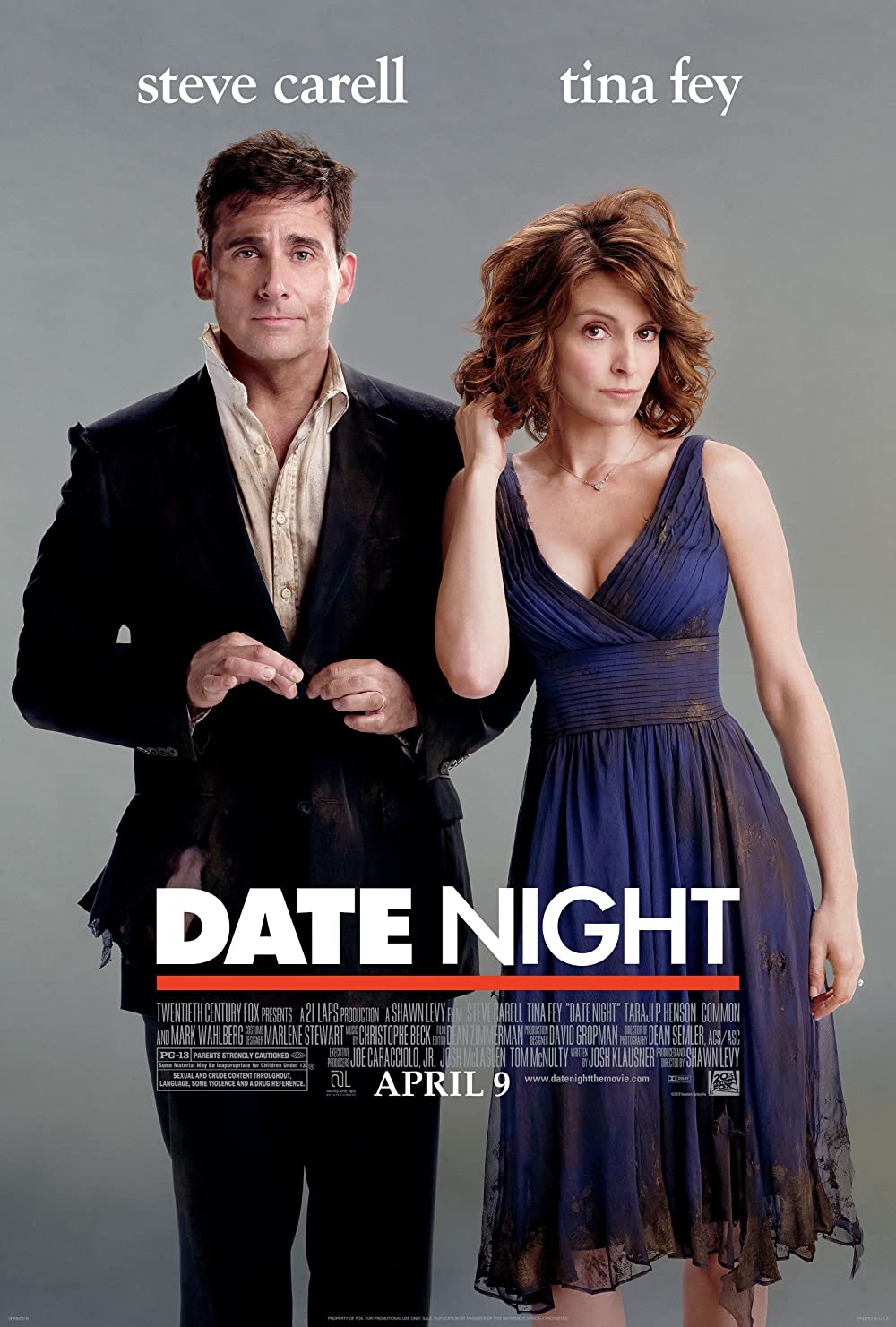
Date Night

Despite the near-universal panning of Date Night, I pretty much had to go see it, because of my very great love for Tina Fey. And the thing is, it’s honestly not all that bad. But it is barely north of mediocre, which fails in every way to match the talent involved. (I include Marky Mark in this assessment, as undoubtedly do you.) I expect its flaws were highlighted by the conditions in which I saw it, those being a completely empty theater yesterday afternoon. Inherent irony of that venue aside, I really think it needed the crutch of other people laughing aloud at things I only found amusing.

So, anyway, there’s this married couple, and they are in exactly the kind of couple-rut that has spawned so many movies in which the woman empowers herself by finding someone who is more attractive, more stylish, smarter and more funny but for whom she inexplicably didn’t look in the first place, in favor of screwing over a perfectly decent but not movie-quality husband-or-boyfriend that never did anything wrong except for failing to create the fairy tale she was expecting, and has now finally found.[1] Thankfully, this is the rarer movie that shows them trying to struggle past that and rediscover each other, actually admitting that there was a reason they were together in the first place. They break out of this rut by, you guessed it, taking over the reservation of a missing party at a swank Manhattan dinner spot, and thereby accidentally getting tangled up in a case of mistaken identity involving secret information on a flash drive, hired guns, a mafia boss, and Mark Wahlberg’s pecs. (Possibly his abs as well.) Which sounds like a perfectly serviceable zany action/comedy, except that for some reason it just wasn’t funny the way you’d expect that to be. Script problems are an inevitable aspect, and the credits make it clear that the funniest scenes were adlibbed multiple ways by Ms. Fey and Steve Carell anyhow. But I also kind of figure that they tried too hard to be both a good romantic comedy and a good action comedy, and neither element came out as well as they might have if it had been a single-genre flick.

Maybe next time! I’m pretty sure chemistry was not the issue, so letting them try again would be worthwhile.

[1] …what’s your point?

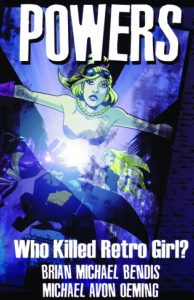
Powers: Who Killed Retro Girl?

Here’s the thing. Either I (via listening to my friends and Amazon recommendations, it’s true, but in this case also on my own merits, since I bought it used and un-recommended) am really good at picking graphic novel series that I will like, or else I am a sucker for the format and just like any of them that I read. I don’t wish to test the theory by picking up something I expect to dislike and seeing how it goes; apparently because my happiness trumps science.[1] I’m not exactly sure how to tell you to calibrate your expectations when I don’t know which of the options is the truth, but at least now you know the pain I go through on a daily basis in trying to bring you as objective of a report as possible.

Thanks to having completed and / or caught up on so many of my ongoing series, I have as implied started a new one: Powers, by Brian Michael Bendis. (Oh, so right, technically that made it kind of a known quantity? I still say my selection algorithm is probably superior!) The simple but fairly cool concept is one I’ve seen a lot of during my years of Marvel comics, only from the other side. In a world full of superheroes and supervillains, the cops still have to solve crimes, keep people safe, generally do their jobs. Who Killed Retro Girl? is a story about that, with the added twist that the big crime that defines the new partnership between police detectives Christian Walker and Deena Pilgrim is the murder of one of these superheroes. Aside from the mystery, it’s pretty much an introductory book in every way: to the world, to the characters, to their relationships, to their antagonists. So mostly, what your interest level will be come downs to whether you like them and their world or not.

I did.

[1] Science!

The Dresden Files: Welcome to the Jungle

If you had never heard of Harry Dresden before and didn’t want to sink much time or effort into deciding how you felt about the idea of reading his series, Welcome to the Jungle would be an excellent jumping-off point. For one thing, it is a prequel to the first book, so it’s not like spoilers are really possible. For another, the short format-limits of a reasonably sized graphic novel make it a pretty small time investment, and the high ratio of art to dialogue (even counting Harry’s omnipresent first-person monologue) makes that investment even smaller. In point of fact, I read the majority of the story around listening to a friend’s disco cover band playing at an area strip club. There were distractions galore, is all I’m saying, and yet it went by with surprising quickness.

For the as-yet uninitiated, Harry Dresden is Chicago’s only freelance wizard. In practice, this means that he sometimes helps people with minor tasks that could usually be done non-magically just as well, but mostly he assists the Chicago PD when weird things happen that nobody can explain. Like a zoo groundskeeper being violently killed, purportedly by a gorilla who obviously couldn’t have done it except that people like that answer better than some kind of magic bugaboo as culprit. Mix in a hellhound, a damsel in distress, and a power-hungry mastermind and you’ve got the makings of a quick and dirty mystery that does a fine job of introducing our Harry to my hypothetical too-busy-to-read populace. Enjoy!

Ultimatum: X-Men/Fantastic Four

There is a very broad extent to which I simply cannot review the first of the Ultimatum books. I mean, I can say that I’m thrilled to have finally found an author who wants to delve into the character of Ben Grimm, because it is. And I can say it’s nice to see Rogue do cool things, because that’s true too; I hope that when I someday get to her character in the main Marvel continuity, I find her entertaining, because she’s been one of my favorites in the modern era. So, generally speaking, there were cool things to see throughout the book, and I liked what they’ve done so far in the Ultimatum, which runs contrary to all my expectations.

But, at the same time, it is a deeply flawed book, as a book. Because, see, it is completely out of order. And this is inevitably going to be a complaint throughout the experience, so I will get it out now. Dear Marvel: if you are going to write interdependent stories that are missing information from completely other lines of comics? Publish a big book that includes everything I need to know, and include it in order, so I am not spoiling myself for some plot element or other no matter what I do! That’s just not okay. (For the record, I am reading them in graphic novel publication order, as that seemed my best choice.)

Also, while I’m here: this is the third time. Why exactly are the X-Men and Fantastic Four seen as such rich crossover material? I mean, in this case they didn’t actually cross over, so I shouldn’t count it, but they’re still crammed into the same book. Is there some historical or obvious present-day reason for the intricate ties that I am for some reason missing? Or is it just a fluke? Meanwhile, I will hopefully provide a more meaningful review in a book or two from now, when I actually know what the deal is that this book was interspersed with.

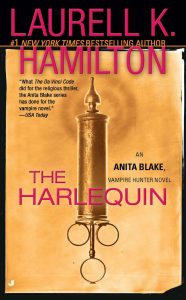
The Harlequin

Here is why The Harlequin was disappointing to me. It was neither tragically horrid (despite a fleeting mention of the worst-named vampire lord of all time, Auggie) nor blandly boring. I mean, don’t get me wrong, I’ve got a complaint, big enough to fill a paragraph, and that’s enough for me to be satisfied that it wasn’t a complete waste of my time. But the thing is, it was actually kind of good. If Hamilton hadn’t done this to me once before, I might actually believe that the series could be in the midst of an upswing again. I mean, I did think the first several books were pretty okay. Still, I have good defenses now, and will not be tricked this time!

The point of the book, anyhow, is that vampire enforcers so secret and scary that big, powerful vampires like the ones Anita Blake hangs out with (and let’s not forget ’causes to be as powerful as they are’, by virtue of being a special necromancer with multiple strains of lycanthropy (none inconveniently active, though, as that would cause actual difficulties in her life, due to the many prejudices that abound) and also inexplicable vampiric powers that really don’t seem to benefit her much, just to act as an excuse for the author to throw lots of sex into the story without Anita feeling bad about herself (which I’ve probably already said any number of times by now in previous reviews) while giving the big, powerful vampires some of their power, which I believe is where we came into this parenthetical) are afraid to even mention that they exist have come to town to investigate a local vampire church that is not following the rules of how vampires work. Which is not a legal issue, just a traditional one; they have no lord to whom they all owe allegiance and whatnot, they are their own people. It’s a very American kind of thing, in its way. And of course, while these unnameable Harlequin are in town, they’ll want to see what’s up with the weird necromantic[1] lycanthropic vampiric entanglements that exist here in St. Louis but nowhere else. And that, of course, leads directly to the kind of danger that Anita Blake and her friends are uniquely qualified to shoot and/or (at least, more recently) fuck their way out of.

Except, you see, the sex is actually toned way back, both literally (which, whatever; I am neither particularly pro- nor anti- it for itself) as well as in terms of its plot relevance. Which is step one of how I am impressed with the upswing of the plot. It’s been… yeah, I don’t really know how many, nor do I care to go back and check at this point, but it’s been some number of books in which nothing happened except that Anita learned to control the way needing sex to keep herself alive (yes, literally) affects everything and everyone around her, during which twenty pages of an unrelated plot took place in the background. And that number was too high. So, definitely a nice change of pace, here. There’s still lots of relationshippy stuff, and not all of it of the romantic variety, but I’ve always been pretty okay with how Hamilton portrays her characters, so that’s alright. …although technically I’ve just perjured myself there. But let me catch up.

Decent plot, decent characters, improved percentage of sex fluff. Where, then, are my complaints? They are here! The lesser of them is that, Jesus, there are too many characters to keep track of! Maybe one of these times a ginormous and heretofore never mentioned threat, as seems to show up in more of these books than not, could handily kill off maybe a half- or a dozen characters that do not have speaking lines in more chapters than not? Just so random people can not walk-on soliloquize, and then vanish for another book or two. And I mean, even that wouldn’t be so bad[2], except that there Anita is, all first-person remembering who the person is, when she last had sex with him, and why she continues to care that he is alive. So I can’t even just pretend they’re random new people every time, like I might otherwise try to do. So, yeah, they need to die now, a lot of them. It is okay for her to go back to not knowing the names and penis sizes of her bodyguards now. All I’m saying.

But the bigger complaint was… okay, I’m going to delve into spoilers here. I don’t care enough to make a cut, but in the unlikely event that you do, I’m probably not going to make any further points from here, so you can stop reading now. Okay? Okay. So there’s this werewolf on-again off-again boyfriend of hers, Richard. And he’s been pissy for a good long time because she keeps having sex with more and more people and gaining more and more inexplicable powers, whereas all he ever wanted to be was a normal happy human. And he’s grown gradually more emotionally abusive toward her, which at first didn’t bother me because it started out as genuine confusion, not abuse, but the willful disregarding of anything she’s ever said to explain, which honestly may just be a symptom of how repetitive of an author Hamilton is but I will choose in this instance to take as evidence that he either started out abusive after all and it wasn’t obvious to me or else he got that way as he realized that there were never any consequences for it, has removed my small sympathy for his position. And now, he’s moved on to physically abusive, and I can’t tell if I should be crediting Hamilton with a subtle transition instead of the misogyny I’m seeing, but Anita again tells him it’s okay, more or less. I think you’d have to read the chapter or two to understand why it’s a fine line and I can’t actually be sure which is going on, but it looks more like physical abuse than sexual kicks to me. Anyway. He then piles on more emotional abuse, and eventually, at the climax of the confrontation with the Harlequin, the state of their relationship is a key component of the outcome of that battle.[3]

And at this climax, her magic sex power is turning into magic love power, which is again a nice thing; but Richard, in his role as stand-in for the audience, is justifiably paranoid that as soon as he gets involved, letting his guard down and all you see, it will turn back into sex magic, and there he’ll be, trapped in the middle of yet another deus ex orgica. And she gets all pissed off because he doesn’t trust her to know what her magic is like, even though she actually hasn’t for books on end and also never got mad about any of the abuse, but apparently this is where the line is. So, anyway, still in his stand-in for the audience role, she lets him have it for not being willing to accept her for who she is, multiple live-in boyfriends, powerful sex magic and all. And the so-thinly veiled goal of this is to say, look audience-as-Richard, Anita has done nothing wrong and she’s a good person and you should maybe stop judging her so harshly now that I’ve done my part by at least remembering that the plot should exist as more than atrophied connective tissue for my sex magic scenes. So, give a working girl a break, huh? And at first I was pissed off in the way that people get when they’re going to be ashamed but they’re not ready to embrace that yet. Except, no, wait, I realized: I was never annoyed with Anita for being immoral, the way Richard-not-quite-as-audience-like-as-he-thought would have me believe of myself. I always would have been more okay with her if she had embraced her sex magic right off the bat instead of being so negative about it herself for so long. No, what bothered me was that the writing was so clearly designed to justify her shift from mystery-solving necromancer to… well, whatever she is now, when the fact is, it shouldn’t have needed justification in the first place. So for Anita-as-author to justify it to Richard-as-audience now, and try to excuse hundreds of pages of truly awful prose in the same gesture?

I guess I had a little bit more than one paragraph’s worth of anger after all! Which, in a mistaken way that I simultaneously acknowledge and disregard, makes me feel better about the book after all.

[1] A pun that, I assure you, I never grow tired of.
[2] Seriously, who am I really fooling here? This must be what Stockholm Syndrome feels like.
[3] Which should also be a thing in my complaints list all by itself[4], but I’ve pretty much just accepted that metaphysical confrontation is Hamilton’s shorthand for mixing relationship drama with plot drama and moved on, because at least it’s better than all the sex-as-plot that had previously been going on.
[4] While I’m speaking of stuff I forgot to complain about, Jesus, the repetition. I mean, yeah, plot repetition too, and I know I’ve said this in previous reviews, but how can you write, again and again and again, ‘He was wondering why I did that.’ “You’re wondering why I did that, aren’t you?” He looked ashamed, but nodded. “I was wondering why, actually.” “Here’s why I did that:” …and so on. And, okay, as offended as I am by my question above, a better question is, how can you fail to edit that out, again and again and again? Jesus!
The Losers (2010)

I think that I had been vaguely aware that The Losers was based on a comic book title of some kind. But even if I hadn’t been, the editing wastes no times providing that information, and the plot doesn’t wait much longer to clear up any lingering doubts. Another thing about the plot is that it would have been pretty reminiscent of the A-Team premise even if I hadn’t seen a preview for that summer movie shortly before the credits rolled. On the bright side[1], this is likely to be the better of the two iterations of the same premise for this particular Hollywood season. So, anyway, comic book movie about a group of commandos on the wrong side of law and order but the right side of morality. With me so far?

This particular plot revolves around said commandos finding themselves in a lot of trouble on behalf of a shadowy government agent known only as Max, after they defy his orders to blow up a druglord’s house on the grounds that it happens to be full of Bolivian children. And then, in typical action movie planning montages and execution vignettes, they proceed to fight back against Max, who is the kind of cartoonishly evil villain that lets you know that absolutely for sure, this was once a comic book. In any event, it’s a perfectly fun action movie that may or may not do a good job of translating its source material but has left me interested in both that material and any sequels derived from the film itself or the source material.

[1] At least, for this month. Later, when the other movie is the current one, the side will be less bright if I’m right, or on the other hand both sides will be pretty damn bright if I’m wrong.

Fables: Wolves

The very fact that I’m still reading Fables says[1] I’m predisposed to like it. Which makes it hard to reach any particular objectivity, eight volumes in. Still, the title helps indicate for anyone who may also be reading the series that they will probably enjoy this particular one. Because, really, Wolves? There’s no better way to hint that we’re back to what I at least consider the central part of the story: Bigby Wolf, Snow White, and the fruit of their relationship.

I no longer have a clear idea of where the plot may be going, but I’m less concerned about it than I was last time. Or maybe that’s because I got more Mowgli and Cinderella, just as I had requested! Certainly the part where the characters, good, evil, power-hungry, or indifferent, are universally well-drawn[2] and entertaining helps things, though.

[1] I know what you’ll be thinking as of my next book review, but there are special circumstances in that one case.
[2] Ha ha. But, yeah, both ways.

The League of Extraordinary Gentlemen: Volume II

It is a pity that I read the League of Extraordinary Gentlemen before I was reviewing things, and probably moreso that I don’t really remember what happened in it. I mean, I certainly remember the premise, that characters I would normally claim to be fictional residents of the late 19th Century have banded together to defend England and/or the world from a threat; it’s just that while I remember the characters, I don’t really remember the threat (by which I would otherwise mean the plot).

On the bright side, this has not prevented enjoyment of the second volume in the apparent series. Possibly familiar characters such as Captain Nemo, Edward Hyde, and Allan Quatermain join forces once again under the leadership of Wilhelmina “Mina” Murray to battle the forces of Mars, who are invading in a manner with which you may be familiar thanks to the narration of Orson Welles. There are twists and turns, sure, but the fun isn’t really in the plot so much as the cleverness of the concept and the character interactions. Everyone is written well enough, though I admit to some uncertainty about Hyde. Still, nothing that made me mislike anything I saw.

After the end of that story, in any event, is an extremely long travelogue explaining the various mystical locations and peoples of the world circa the turn of the 20th Century. It started out slow and dry and a bit of a beating, but then finally found the voices of Mina and leaders of other incarnations of the League throughout previous centuries, and to my surprise I found it highly enjoyable by the end. The theme is still primarily a clever integration of various fictions into the world we know, and although it is possible to get allergic to Moore’s smugness, it worked out for me, like I said. And then a few bits of fluff (including a board game!) round out the volume.

Also, there are a couple more written that I didn’t know about? I am cautiously optimistic, not being allergic to the possible smugness of the concept.

Ultimatum: March on Ultimatum

Even though there’s still one book left that predates the events about which I am now reading, it has yet to be released in trade paperback size to match all the rest of what I have, so apparently I’ll have to actually find out what’s up with this whole Ultimatum thing, now. Except, technically not quite yet, because despite the branding, March on Ultimatum is really just a handful of new annuals featuring mostly the usual suspects doing mostly the usual things. Still, there is a little big of a finger waggle pointing out that this whole Ultimatum thing is just over the horizon now, which since I’ve known that for months of my time as I’ve been reading along means it must have been excruciating waiting on these titles to release a month at a time, and all of them going on about the inevitable doom for a year or so.

The first pair of stories is the most relevant: the X-Men travel back in time[1] to prevent Reed Richards from doing something that has ruined[2] their future. Although this honestly doesn’t seem to have much to do with the Ultimatum, they at least mention it as an inevitable event in the near future from which these other problems sprang forth. But it’s okay, because I enjoyed the story on its own merits as well as for the characterizations of Ben Grimm and future-Sue Storm. Then there’s a Black Panther story which seems to exist only to retcon my racial concerns from The Ultimates 3. It I suppose accomplishes that, but at the expense of taking a pretty cool character and rendering him meaningless in the Ultimate universe, at which point, how about just not using him instead? Also, there’s a Hulk story that for some reason includes one of the Squadron Supreme character from Ultimate Power and (for that matter) that for some reason includes the Hulk; the less said about it, the better. (I exaggerate, in that it was mildly amusing. But mainly it was spectacularly unnecessary.)

The best of the bunch[3] was the Spider-Man story, which had no apparent tie to anything else at all and was just another large-sized Spider-Man story. It’s just, as usual, Bendis shows a world full of meaningful progress and understandable consequences while everyone around him is scrabbling wildly for plotlines from miserable futures or annoying side-dimensions or the drips and drabs of 45 years of bloated Marvel continuity. For example, the police? They have noticed that Spider-Man usually accomplishes things and are glad of his help. Will that ever happen in mainstream Marvel continuity? Not as of issue 91, I can state with great current authority. (And, okay, this third annual postdates a higher issue number in Bendis’ run, so I’m not being perfectly fair here. But I still don’t expect anything to suddenly change.) Bost mostly it’s a relationship story punctuated by the arrival of Mysterio[4], who plays such a small (and unresolved!) role that I fully expect him to matter quite a bit in the next full Spider-Man graphic novel, predictably named Ultimatum.

[1] Is it just me, or are future timelines just littered with X-Men possessing time machines? Time travel is never a mutant power, and one dark future is never described the same way as the next. Nevertheless, back they keep coming. Persecution complex, much?
[2] And while I’m on the topic of things that are just me: is it, or does Reed Richards destroy every alternate universe / dimension / timeline he gets his grubby paws on? That guy is just a colossal dick. (Though the younger Ultimate version is at least endearing about his galactic failures.)
[3] Prepare to feign shock in 5… 4… 3…
[4] In mainstream continuity, he’s a special effects wizard turned supervillain; here, it is way too soon to tell who he might be or what he wants. But I expect him to not be a mere villain retread, not this late in the game.

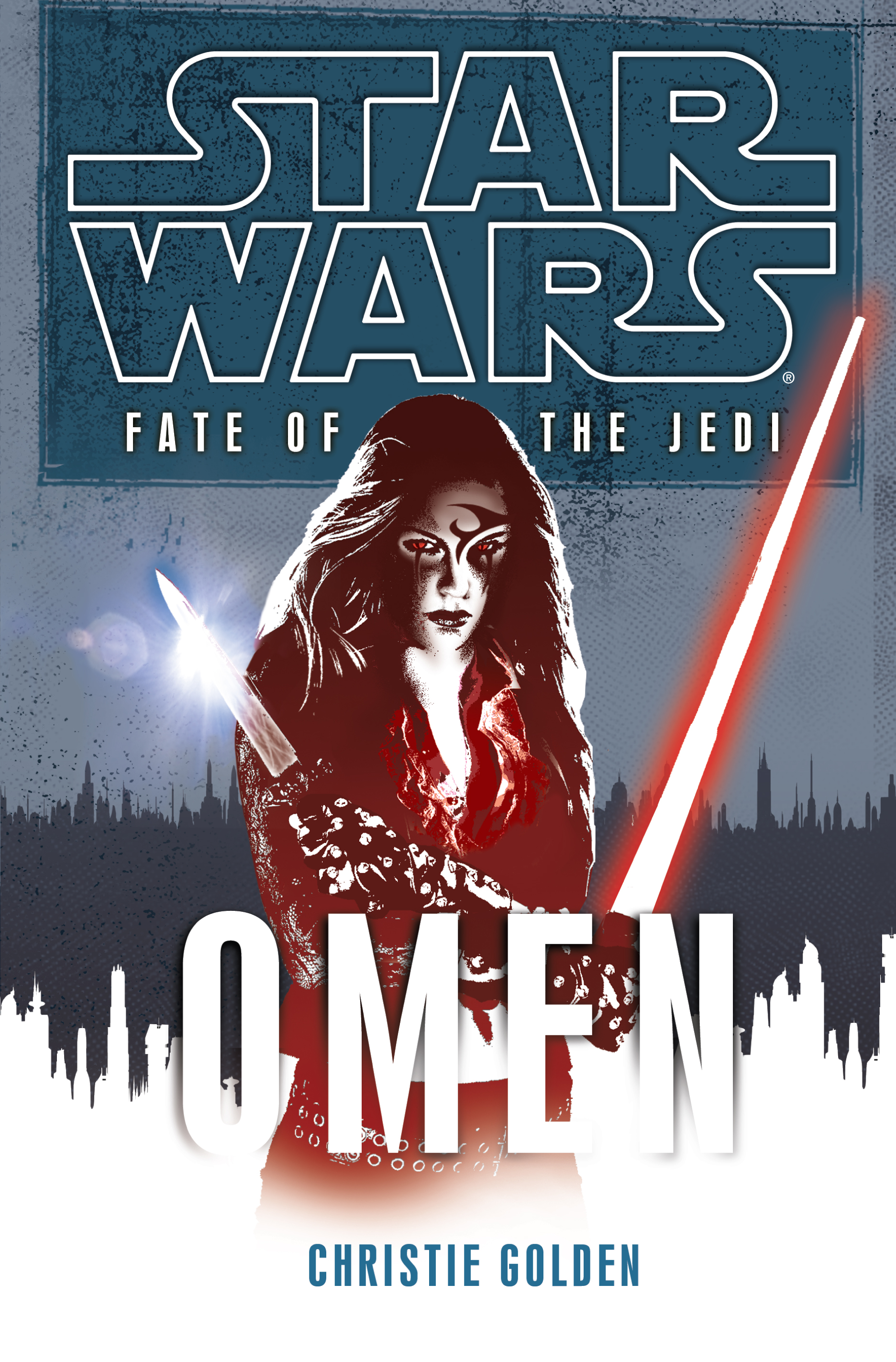
Omen

Omen_front_bgIf I had not read Outcast first, or[1] if it had been a different book, I would have liked Omen a lot better. Because, Omen was almost exactly the same book, it was just written a little more tightly. Two plot elements were identical, in fact. Luke Skywalker and his son are wandering the galaxy in search of non-Jedi Force-sensitives to learn from them and find a way to guarantee that he’ll know the next time one of the Jedi is slipping toward the Dark Side. And meanwhile, more and more Jedi are experiencing the Capgras delusion, wherein they are convinced that everyone they know has been replaced by perfect impostors. I’m saying, the prose was different but large swathes of the plot have literally not moved.

The only thing that is really new is that the extraneous third plot from the previous book has been replaced by dire rumblings of a new Sith ascendancy troubling the galaxy. Like, old school Sith from thousands of years ago, before even the Old Republic; a last remnant that has been cut off all this time, back from when they were a species more than a lifestyle. So that part was pretty cool, as was the prose I mentioned, really, and all in all it’s like I said at the start. I’d have liked this book a lot better if most of the events of it had not been duplicated from the inferior first book of the series.

Dear stable of Star Wars writers: it is okay to write fewer, more tightly plotted books to tell a story. Despite the fact that people will pay for nine books when only a three book series is needed, you should write three books anyway and consider the lost money a write-off on your soul. It will be worth it! …to your soul, I mean. Also, to me.

[1] More rationally, since this is a series.