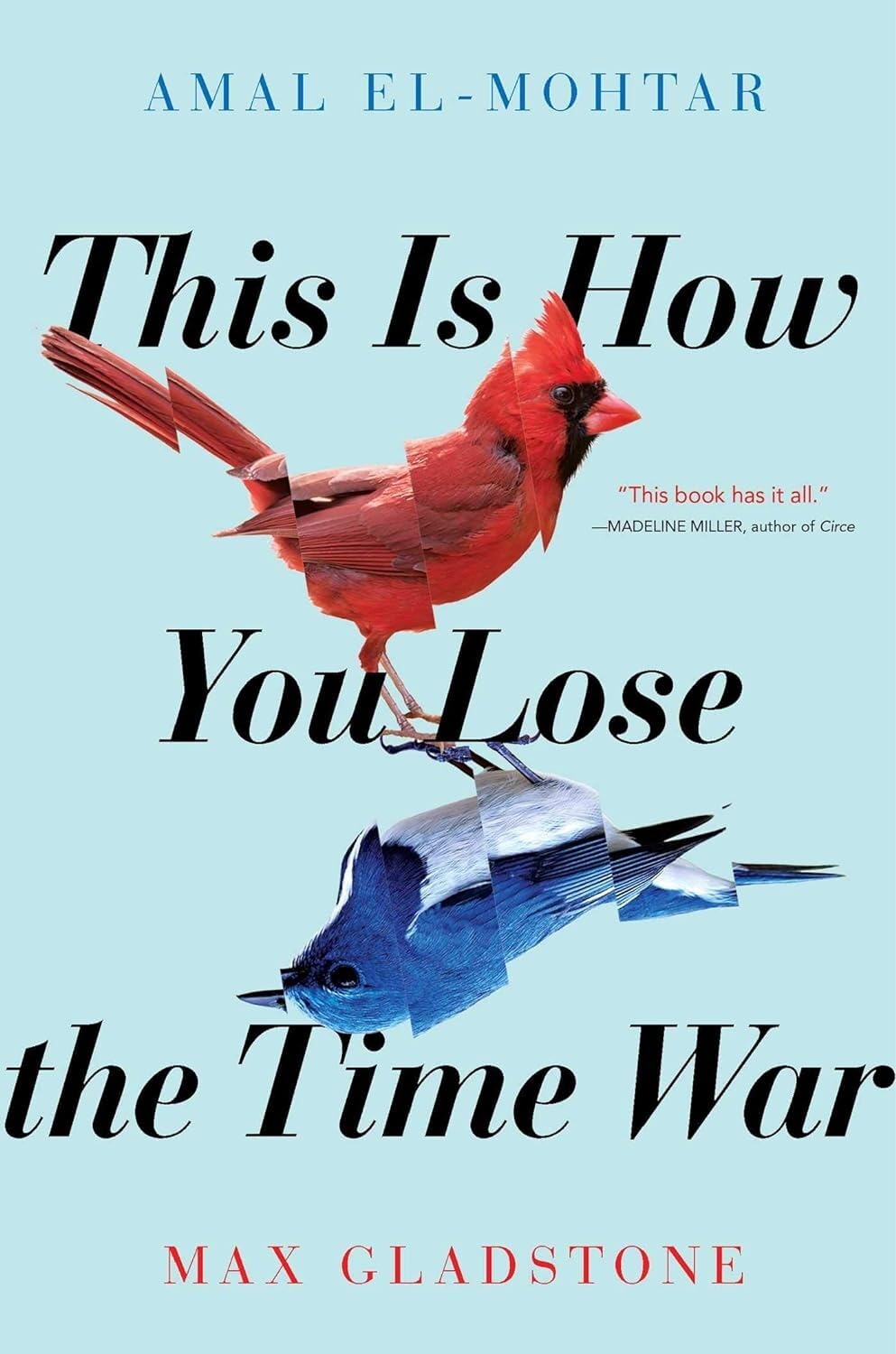
 Supposing you were on one side or the other of a war being fought throughout the whole of time, with realities popping into existence and being ruthlessly erased, each side trying to bend reality to their preferred outcome for humanity. And supposing you were a time spy… agent… enforcer… thing, tasked with carrying out those small missions that turn into large effects, pushing things in your direction and away from your opponent’s. And supposing further that a different agent, not on your side, had made themselves known to you, by talent and results, and you likewise had made yourself known to them.
And supposing they decided to start a correspondence. This, I think, is how you might lose the time war.
They’re calling it a novella, which probably has a precise publishing definition, but it seems to me more like a short book. It’s romantic and eloquent and thrilling, and honestly it’s only the third of those that falls a little flat for me. I wish I had a better understanding of, well, the time war itself. But doing that would have made for a much longer book that would have ultimately outweighed the eloquence and romance of the central relationship. So I get it. But I wish I could, I don’t know, have the authors’ knowledge of all the underlying backstory just downloaded into my brain, as I think following along better could only have enriched the experience.
Still and all, recommended. I can understand how it won a Hugo, five years ago.[1]
[1] Don’t let that number fool you; this is probably one of the most recent science fiction books I’ve read in ages. Go, um, me.