Category Archives: Words

Fables: The Good Prince

I am having trouble coming to grips with The Good Prince. Not because there’s any question of it being good; if anything, it was the most fable-like story of any long arc I’ve read in the series. I started to point out that there’s a twist where the most unlikely character of all blah blah blah, but the truth is, that is as fable-like or moreso than every other aspect of an extremely fablicious storyline. But at the same time, that’s my problem; if it looks like a happily ever after is in reach (and I’m not saying one has happened, but I can see the road from here to there), does that imply[1] that there’s going to be a sudden, dramatic (and rather unlikely) reversal of fortunes? Or is the series going to be about something else entirely than what it has been about for the last good while?

Then I remember that it wasn’t about this war with the Adversary for the first two or three books, and I liked them plenty, and I stop worrying about it. So maybe less grip-trouble than I thought?

[1] I should add here that there are a lot of books left in the series before I catch up to present time, and it’s still being published.

Ultimate Spider-Man: Death of Spider-Man Prelude

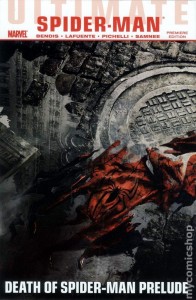
1160287They certainly don’t pull any punches on the spoilers when they have a big event coming up, do they? That said, I’m not going to go into any of the future spoilers (of which I know somewhere between one and two) in this review; all I’m going to do is take them at their [notoriously untrustworthy where death is concerned] word that the title is accurate, and go from there. Because, while the story in the Ultimate line’s prelude to Death of Spider-Man was good[1], it’s hard to get very worked up about it with such a huge shadow looming over the future landscape. But I shouldn’t sell it short, because it was a really great book, pulling together just about every extant plot thread and weaving them all together seamlessly. More about Mysterio, Spider-Man’s biggest foe since the Green Goblin? Check.[2] Fallout from… I mean, whatever you want to say about the way Stan Lee created the first superhero with human problems, and that being what made Peter Parker special, sometimes that boy has problems that nobody else has, because he’s a superhero. So, as I was saying, fallout from the most literal form of identity theft I’ve ever seen? Check. When the Ultimates hold a coffee klatch about whether you and/or your image can be reformed, you know things are serious. And that’s leaving the girls out of it entirely. My point is, Pete just had a really bad week, and this week wouldn’t be looking so great either, even without Mysterio’s latest gambit or the newest and arguably most dangerous holder of his secret identity.

There. Review out of the way. Now, let’s talk.

I’ve been thinking about this upcoming “death of” storyline for a couple of months now, basically since I received this book and then moreso a few weeks later when spoilers erupted in the media based on the release of a relevant comic (to be portrayed in a graphic novel somewhere down the line, I reckon), but the thoughts didn’t coalesce until after I read this one. We have this guy, Spider-Man, right? He is freakishly strong, although not much stronger than the strongest man without special powers. He has designed a web fluid that lets him swing around to get places faster[3] and that makes it easier to trap / blind / distract opponents or make a safety net for himself / bystanders. He can stick to walls. And he has a danger sense that tells him if something bad is about to happen. Not a bad little list of powers, and he makes good use of them. But all in all, if Spider-Man died, what would change? The Ultimates still take care of alien threats, large-scale terrorist activity, the really high-powered villains, that type of thing. And the Fantastic Four still takes care of random dimensional incursions, or would if they had ever gotten back together. But at least they used to, and their being missing now doesn’t really mean Spider-Man could take up that slack. More inventors with delusions of evil grandeur would get away with their initial schemes, until they got rich and powerful enough to attract the attention of the big boys, at which point it all ends up in the same place, just with a few more people hurt along the way. I’m not saying that’s nothing, but new superheroes come along all the time. It honestly isn’t a whole lot, you know?

But then we have this guy Peter Parker. Pete’s done a lot of things. He’s received random powers for no apparent reason, and even though he’s one of the smartest people on the planet, the freak genetic accident didn’t turn him into a super-villain. How many people can say that in any Marvel universe? Answer: few indeed! When New York was underwater, and most people were either trying to track down the perpetrators or else just get to safety, he was the only hero I remember who was actually running towards the devastation (well, diving towards it) and trying to pull people out. Over the past year or so of comic continuity, his aunt has changed from an angry and somewhat resentful aging widow to a strong mother figure to a lot of other heroes in the teen set, who can and will stand up to S.H.I.E.L.D.’s top agent if it will help her kids. He’s taken Nick “it’s the one that says Bad Motherfucker on the handle” Fury to task over poor ethical decisions, and even more amazingly, been successful at it. Pretty much every superhero he comes across respects him, and the exception (Captain America) is the very one whose place I see him as taking in the Ultimate universe, even if Cap almost never lives up to those aspirations in Marvel’s main continuity either. (Well, at least not as of 1976.) I see some arguments that Superman does this in a few of his movies and perhaps in limited comic runs, and Captain America in the recent movie did exactly what I’m talking about. But in long-form comics, the only character I’ve ever seen that makes everyone he comes in contact with a better person, who basically makes the world better with his every action and makes it worse with virtually none of them, is barely sixteen year-old Ultimate Peter Parker.

On the one hand, death is a very fleeting even in superhero comics. Always has been, probably always will be. But on the other hand, I’ve seen only a bare handful of people in this particular continuity come back from death, and most of them were via special cheats written into the original Marvel storylines the authors were covering. So I don’t really know what to expect, and I give you my ironclad guarantee that I have no special knowledge of what is to come, beyond the aforementioned one or two spoilers that I’m avoiding here. What I do know is this. If Spider-Man dies, as they are so strongly implying, I’ll miss a cool character, but it won’t be a big deal in the scheme of things. If Peter Parker dies, as he would nearly have to for Spider-Man to do the same, his world will be the worse for it. I’m invested in the Ultimate universe, pretty obviously to you who have read me review every last one of their releases. I’m not going to stop just because they make a choice I’m not okay with, at least not right away. But it could be that before this time next year, I’ll really want to. Why would I keep forcing myself to go back to a darker, sadder place?

[1] Isn’t it always, though? I was wondering recently whether there has ever been a 160 issue run by the same author for a shared superhero character like this.
[2] And let me tell you, I am impressed at how well they’ve rehabilitated a mostly lame smoke-and-mirrors guy from the original run.
[3] Though once he leaves or before he gets to Manhattan, what are his web-lines attached to? He’s always way too high outside the City, you know? I have no point here, it’s just always bugged me.
Pony Soldiers

I am kind of relieved to see some errors cropping into the Deathlands series. It’s not that they’re great literature; they are little more than fun sci-fi romps that would make a great 80s TV show[1], but in a way, that’s kind of my point. They have no business being as forward thinking and well-constructed as they are, considering their genre and their publication era alike. So it’s nice to see Pony Soldiers come along and suddenly provide a recurring villain as well as letting the characters act uncharacteristically foolish toward him now that he’s finally on the scene. Of course, then I think, no wait, they don’t know here in book five that the series is going to get into triple digits and still have new books coming out even as I castigate them for that lack of foresight, and most of those same 80s TV shows waited less than a year between recurring villains, which is about the length of time between the first and fifth books being published, so really this probably isn’t an error after all. Dammit. Fine, but I’m holding on to the part about them acting foolishly around him, instead of him just being so clever as to avoid his fate. At least it’s something?

In addition to all that, the story delves a little bit more into the concept of time travel that has been looming over everyone’s heads, by virtue of apparently dropping General Custer in the middle of a pitched war with the post-nuke Apache somewhere in the mostly radiation-free Southwestern deserts. Between that little mystery, viewpoints from a few more characters than we’ve had before, and ever-greyer moral quandaries, the series is definitely getting more interesting the further along it goes. And that’s not just my relief over the misstep talking.

[1]  Think A-Team, except with more continuity than they ever could have dreamed of in those days. And more female characters outside refrigerators than they ever could have dreamed of, for that matter.

Powers: Anarchy

The thing that is sad about my review of Anarchy is that it will sound like I didn’t like it, when the worst I have to say about it is that I didn’t love it. The characters are still top-notch, or I should probably pass that through my filter of liking things too strongly and say instead that I continue to find them compelling. But the plot of this particular issue was really just forgettable. It was tasty forgettable, don’t get me wrong, but like when you eat light popcorn and then later you suddenly want actual food? It’s like that. I know that there were some superhero murders that tied back into the comic’s earlier days and that may well become very important later for that matter, but in the moment, it was just a glimpse of places we’d been before with people I’m happy to accompany, sure; and restoring the status quo (which had been really strongly upset by the end of the last book) was probably a good idea, but I could wish it had been more exciting to get there.

On the bright side, the book isn’t a thousand pages long and I didn’t have to wait two or more years to read it, so the standard complaints really don’t apply.

Ultimate Captain America

It’s funny[1] that I was just talking about the clever storyline from the Marvel universe where they explained how Captain America could have been both frozen in the Arctic Ocean after World War II and also fighting Communists in the 1950s. Because Ultimate Captain America tells an analogous story, albeit without the need to justify the continuity issue the original guys had. Only, you know, quite a bit darker, as Ultimate Cap has always been. I shan’t say any more, because there isn’t a whole lot of story in there. But I definitely liked what there was well enough, and I’m still definitely in the mood for short-form fiction right at the moment.

[1] Although not that surprising, since it was during my review of the character’s recent movie.

Blood Noir

I’ve had a revelation. It may not be a new revelation, but I can only read books in this series so often without my brain turning to cottage cheese, so forgive me if I’ve lost track of the various ones over the years. No, see, my revelation is about the true irritant of this series. It’s that every now and again, if I can manage to scrape enough of the crap off the pages, there’s something like a decent storyline buried in there. I mean, yes, she’s been padding things with the hypersexed “relationship” plots for a long time now, and that squeezes out all but about usually 30 pages of story. But okay, that’s the book she’s writing, and if it wasn’t for the sheer gall of the packaging, I think I’d have gotten bored and moved on a long time ago. So I can accept that for what it is, it’s not the crap I’m referring to.

Let me explain. So, here’s Anita, and her good friend Jason is having a family crisis, and needs help, which is to say, a visit home with a girlfriend so everyone will stop calling him gay (which would not be as bad as all that, except he isn’t, so it’s annoying that nobody believes him). And she agrees to go, except they get caught up in (for once) human politics, and things quickly blow out of proportion, and all of that is before the vampires get involved. And sure, you could write a whole book about that, but our author cannot because she has to leave room for the porn scenes[1] and the random friend and/or stranger (but always at least one stranger, and always at least two people) that Anita will accidentally bind to herself metaphysically[2] in this particular book.

And my point is… well, it’s this. I’m not trying to say that the actual pornography and the implausibly repetitive growth of “power” and were-menagerie via sex don’t grate on my nerves. I’m not saying that the constant mentions of things tightening low in her stomach and what just does or doesn’t do it for this or that person don’t also grate after a while, but if I’m being honest with myself, all long-form authors eventually have turns of phrase that get old. I’m saying, reluctantly, that the kernel of mystery still remaining in most of these books would be enough to keep me going in the series; well, that combined with certain intangible benefits that I get from complaining about them, volume after volume. Except, well, the writing is getting objectively worse, by leaps and bounds. It’s not enough for people that she’s been friends with for a long time to have the same thought processes as she does. Well, no, that’s not true. As written, it’s easily bad enough.

“He looked like he was thinking about ponies. ‘I’m thinking about ponies!’ he suddenly declared inexplicably for no obvious reason besides the fact that all of us have exactly the same brains and the same voices, and I wanted to be sure you noticed that by showing how my thoughts and his words match up, for some reason even less explicably than the last thing that happened earlier in this sentence. And then we talked about how ponies make me angry (if Richard was the person who was talking earlier) or about how much common love we share for ponies (if anyone else was talking earlier) or about how I’m not sure sure that ponies should be involved in my sexual life, but they flat did it for him, so I would keep an open mind (if Nathaniel was talking earlier).”

But now it’s happening with perfect strangers, because writing more than one voice is really, really hard. Unless it says things in French sometimes, I guess. There was a literal, real, I’m not making this up even a little bit moment, wherein over a span of three pages, Anita makes a metaphorical leap about the situation feeling like the Twilight Zone, then a random new chick character makes a similar metaphorical leap about an unrelated situation feeling like the Twilight Zone. (Hold on, I’m nowhere near done yet.) Neither of these situations was in any way actually creepy or inexplicable or even subtly twisted, it was just the way people talk about things outside their experience. So these two different people make the connection to the Twilight Zone from two completely different experiences, and then, in the same three pages I mentioned earlier, Anita thinks to hrself about how she and this other chick are of diametrically opposed types that could never understand each other in any way.

Perhaps I’m being unfair. It could be that when the series ends, we’ll learn that she’s been captured via vampire magnetism for a dozen years or more and that all of these adventures are things her subconscious mind came up with while it had nothing better to do. That would justify almost every ridiculous thing that has happened, you know? Except Auggie the ancient master vampire that everyone has a ton of respect for and also they call him Auggie. Nothing will ever excuse that.

[1] No, seriously, at this point you could only film these books with a porn script, with the expectation that people would need to fast forward through maybe 15 minutes of plot to watch all of the sex in the maybe 70 or 80 minute movie. Seriously.
[2] And by “metaphysically bind to herself ” I mean have a non-puritanically excessive amount of sex with, which by fiat means they are tied together forever, and that is a twisty maze of passages through LKH’s psyche, all alike, if ever I saw such a maze.

The Walking Dead: No Way Out

Here’s the thing. For the last few books, Kirkman has been losing me. First there was a big mislead about the possibility of resolving the zombie threat, and then he started exploring themes he’s already explored before. Yes, he finds ways to invert them and make them new, I admit that, but if he’s already holding mirrors up to his thematic territory, I can’t help but notice that the plotting has dragged for a long time. And as the herd comprising his original characters has thinned and new characters join up, only to be lost to the rightfully dangerous environment themselves, I’m having an ever harder time even recognizing the characters; and that only makes it harder to care about them. But back to my main complaint, about the dragging plot: for instance, in No Way Out, the characters find themselves threatened on all sides by a) rampaging evil humans looking to take advantage b) a horde of zombies c) weather-based food shortages, I guess?, just when things were starting to feel safe and human again. Whichever one you pick, we’ve been here before. A few people die, the threat passes and/or the survivors pick up and move on, and soon we’ll be back here again.

And yet, every damn book there’s either a huge cliffhanger or else some kind of plot- or character-based epiphany that makes me think he’s finally gotten the story to turn a corner and something new is on the horizon, or in this case both, and either way, I have to at least find out what happens next to decide if the series is worth it anymore. You’d think I would learn.

Ultimate Doomsday

51iy4c9sUqLSomething like a year ago (in graphic novel time; longer ago in single issue time, you understand, but I bet that the ratios work out about the same), the Ultimate universe came to a crashing halt or I suppose more appropriately was swept away on a tidal wave. I may have mentioned it. And then new stories began to trickle in, from Spider-Man, the Ultimates, and their black ops cousins the Avengers. Notably missing were the Fantastic Four and the X-Men, though in the latter case the fact of worldwide mutant hatred due to their ongoing terrorism made sense of that part at least. So, in the meantime, Amazon had this link to a book called Enemy that was meant to be coming out last fall, and it was the next big event in the Ultimate universe. I pre-ordered it, as you do, and then watched in dismay as it was pushed back further and further and further still.

Then, sometime in May or June while I was waist-deep in both ice and fire, suddenly I get a shipping date. Only, now the book is selling for $40 list under a new name, even though my cost never changed from $13 or so. So that was weird. Then Doomsday arrived, and it turns out to be a collection of three separate never-published graphic novels making up the entire story of which Enemy was to be the first third. I appreciate your commitment to low prices on pre-orders, amazon.com! And now, months after that, I have finally come up for air long enough to read something new. Which is nice.

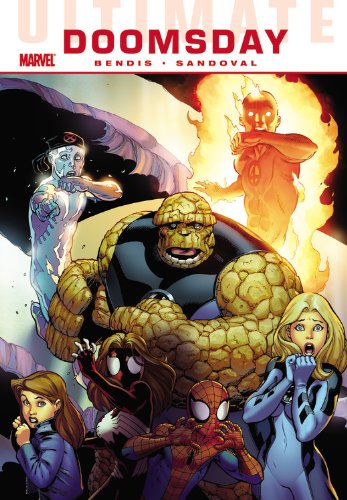
So, anyway, the Fantastic Four are back, more or less, although they’re by no means the only people around. This is one of those stories like the Ultimatum or the big Galactus trilogy a number of years earlier where just about everyone gets a piece of the action. The story starts with a bang, almost moreso literally than metaphorically, when many different heroes and also, somewhat inexplicably, the occasionally nefarious Roxxon corporation are all targeted for destruction on the same day at the same time, with varying degrees of success. Then the survivors must come together to solve the mystery of who is out to get them and what to do about it.

I shan’t say more, except to allow as how I’m really suspicious of the outcome being the real end of the story. We’ll see, though! Eventually.

A Dance with Dragons

So, yeah. That was a long time coming. And boy do the internets ever reflect it. But anyway, I have come to a realization (that I may have already mentioned recently? I’m not sure) about myself and long-form storytelling, and also about other people and long-form storytelling. It is this: if you make a checklist of what details you expect to be addressed or wrapped up in a book of a series, you are doomed to disappointment. Because unless you happen to be the equivalent of that one chimp out of the infinite typewriter owners out there, your brain and the author’s are not telling the same story. This is not to say that there aren’t plenty of valid criticisms of the form and especially of specific presentations of it, but “the story is too slow” or “it has gone off the rails” are somewhere between barely valid and not valid at all. I know this is true for me, at the least, because I can find that I am disappointed a lot less in books that I thought had gone wrong the first time through when I was measuring from my expectations than I am upon a reread.

So, I have a new measurement now, as of A Dance with Dragons. (Technically, as of my reread of A Feast for Crows, the first book in this series that I had been disappointed in. But this is when I got to actually use the measurement, so you see.) In step one, I turn my brain off, watch for foreshadowing and decide what I think is cool, sure, but like I said to start with: no checklist. In step two, I only concern myself with when viewpoint characters bore me, as opposed to how cool or horrible or off-rails they are being. By that measure, I liked this book quite a bit. There’s a character that never did a lot for me, another that I have never liked and probably will never like, even though towards the end he was at least doing interesting things maybe, and a character I have historically liked that I did not care for until her final chapter this time around. Everyone else was entertaining all along, whether I was cheering for them, yelling at them, laughing, or just along for the ride. And that’s my real point, it is a ride, and it’s not my ride, so as long as I’m still enjoying the ride itself, why would I possibly complain about choice of routes or the occasional pause to slow down and look at the scenery? That gets saved for when my ass is starting to hurt and the roadsigns indicate we’re on the outskirts of Gary, Indiana.

As for the plot itself, well, you didn’t actually think I was going to talk about it, did you? Or mention the climactic event of the previous book just as though nobody could be running behind? (Not that I’m bitter about a massive spoiler I read yesterday for an unrelated series or anything.) But I will say that the title is a good stand-in for half the book, and the same kind of metaphorical dance without dragons covers the rest of it. There is still a part of me that will be unsurprised if the series ends with everyone dead and the planet encased in a permanent block of ice. And I cannot say I will find that outcome unsatisfying, in a “Decline and Fall of the…” kind of way, as long as the ride to get there maintains its general B to B+ quality. One piece of ambivalence I should report, though, is that Martin has a problem with the pacing of the ends of his books, or at least this one. ‘Cause you know how in a lot of long series[1], the last hundred pages or so turn into a downhill race where you couldn’t stop if you wanted to? Martin has a thing (sometimes close to the end, sometimes far enough a way from it that you think maybe he pulled a fast one and it’s not really true) where he likes to build a brick wall across that particular part of the road. It’s effective as hell whenever it happens, but man does it make me want to stop reading for a while. And since I really like that mad downhill rush, it’s a little off-putting. Whether the trade-off is fair is left as an exercise to the reader, I suppose.

[1] Jordan was a master at this.

A Feast for Crows revisited

Geeze, this took too long. Do you know that by the time I opened the new book I’ve been pushing towards all this time while not reading anything else at all (I even stopped the comics at the end of 1975, this is serious business is all I’m saying), it had been out for a full week? All the discussions are nearly finished! But at least I’m in it now, so that’s pretty cool. Back to the topic at hand, I should note that I remembered almost nothing of this book[1] except that I hadn’t liked it all that well. It wasn’t bad, but it was disappointing for the gap, and that had loomed larger in my mind over the intervening years awaiting another new one.

There’s a lesson in that, and the lesson is this: don’t read long doorstop series until they are completed! I know people say that a lot anyway, but my reasoning is potentially different? At the least, I’m definitely not talking about the fact that the author may suddenly die and you don’t get to find out what happened. It’s more that I have found that books I disliked in the middle of a series read a lot better when there’s no pressure on them to be “oh thank god, the new book”. This isn’t a panacaea by any means, but it’s happened often enough for me to take the hint. I mean, no, I won’t change my habits, but I’ll at least have a better idea of what just happened. The point is this: the parts that bored me were less bring than before, the parts that I liked okay were almost universally really good. But what was A Feast for Crows about, you ask? Memory, I think. Nearly every character in every arc spent some huge portion of their time considering the past and its influence on the present, to a really strong degree. Much moreso than in any other book (excepting Ned’s memories of Robert’s Rebellion and his intertwined personal stakes in the first book, which, well, I suppose there were good reasons to not save that part ’til this volume). Pity it wasn’t a feast for ravens, lest I should have been able to make a pretty cool Norse reference here.

And, that’s all I got.

[1] That review, I should warn you, is shockingly spoiler-laden if you have not read the rest of the series up to it.