Category Archives: Words

The Boys: We Gotta Go Now

618Jw8k7spLIf it looks like I’m reading slowly, it’s because I’ve been hyper-focused on old Marvel stuff, both the ongoing acquisition and consumption thereof. But I finally read the fourth volume in Garth Ennis’ The Boys series, so that’s nice at least. It occurs to me that this is an incredibly aptly named team, insofar as its one female member (cleverly named “The Female”) never speaks and has yet to actually do anything that was her own event on the side, unlike all the other team members. I pretend to myself, each new book, that we’ll suddenly learn something about her. Maybe a name of some kind. (I will say that she’s not also sexualized, so that’s… something?)

But anyway, though, the ongoing war between Butcher and his team versus the supes continues on, this time extending to Ennis’ X-Men parody, with its vast number of teams and splinter groups. Which made a fine, albeit occasionally horrific, story. But I’m really ready for the meat of this series. Our main character, Hughie, who I probably mentioned is based on actor Simon Pegg? He and his girlfriend have been carefully concealing themselves from each other this whole time, and it’s a ticking time bomb, and I really want to see what happens when the truth gets revealed. Downside: probably that will start the roller-coaster ride toward a series climax, and Ennis probably isn’t done poking fun at superhero comic tropes and standards just yet.

So, okay, but at least give me some character development on the Female and the Frenchman. ‘Cause seriously, especially that Female thing I mentioned back at the start? It looks bad. (It probably is bad instead of just appearing that way, and probably having the whole plot laid out in front of me would not change that, but since it isn’t yet, it feels premature to judge. He tricked me on the homophobia. Sort of.)

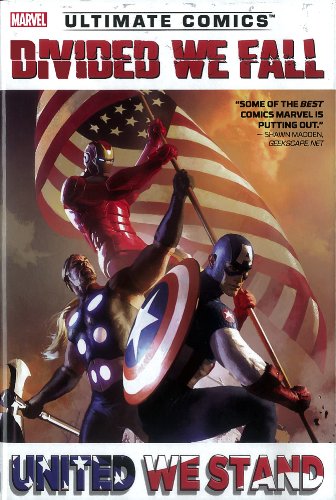
Ultimate Comics: Divided We Fall, United We Stand

The latest Ultimate crossover event was pretty exciting to read, but will I think be hard to review. Every story affected the others, but every story distinctly belonged to its own group and had its own thematic resonance, none of which the other stories were involved in. Which is to say, it was truly a crossover instead of just a big event affecting everyone. I’m not sure the Ultimate universe has done that before, not really.

Also, man, I feel like there are a lot of spoilers down there. I’m trying not to, but it’s basically impossible to say anything useful without a few, especially for events in recent books. Also, this turned more into my thoughts on the state of the universe in general than on the story told in particular, which I guess was inevitable considering the subject matter? Either way, if you’re leery of spoilers, catch up to issue 18 of each line first (or this book, obvs), is the best I can recommend.

I’ll take them in order, mostly because that is the order of scope reduction, and the title is nothing if not sweeping and grandiose. Divided We Fall, United We Stand is both an accurate description of the situation in the United States and a spoiler for how things will turn out (although, in keeping with the darkness that has fallen over the Ultimate universe since Magneto’s Ultimatum, I have not expected things to turn out as happy as all that in quite some time). And the Ultimates’ section of the story, which is mostly focused on the until-recently absent Captain America, is about the big battles in the wake of the country’s collapse. Because, see, the Sentinels have taken over the Southwest on a mutant extermination spree, and several other states have splintered off as they realized that the government was ineffective and also had been nuked. In addition to being big and sweeping, it is also (like Captain America, really) fairly unsubtle, so I will leave him to his explosions and big shocking events and move on to the mutants.

So, Kitty Pryde, right? It’s weird, because she and maybe Rogue are big important characters to me in the Ultimate universe, and yet (as of December, 1978) I still have yet to meet them in mainstream continuity. Therefore, uniquely in this experiment, their new incarnations will impact how I see the originals instead of the other way around. And I’ve got to say, I am a really big fan of Kitty Pryde right now. I can’t say for certain, but I expect this to be an unpopular decision from the other direction. I think it’s mainly that, for all that mutants have been at the core of everything that’s happened in the last few years (well, except the oddness with Reed Richards), almost nobody in the mutant storyline has been the least bit sympathetic. Karen Grant is an enigma, Quicksilver is a puppet, Wolverine Mark 2 hasn’t done anything meaningful yet, and Storm has not evidenced the least bit of agency. So a natural born leader who wants to go out and make a difference, and better still, seems capable of it? Yeah, that’s what this plot has needed for a good long while. The only downside is that her story should have been spread out over a couple more issues instead of being shoehorned into the deadline set by the main plotline over in the Ultimates.

Side note that fits here as well as anywhere: one of the absolutely strangest things about the Ultimate universe is how insignificant the Fantastic Four are. Even back when they were an existing concern, they were bit players outside of the Galactus story, and now that they’ve disbanded, it’s like people don’t even know who they are. When I compare that to mainstream Marvel, and especially the year plus break-up of the team that occurred across 1978 and how each individual was still really popular in the public eye regardless? It’s almost confusing, and certainly indicates how divergent the Ultimate story has become.

And, lastly, Spider-Man. I’m glad to see that Aunt May is still one of the best characters in Ultimate Marveldom, I’m glad to see Mary Jane at all, I want to see more of Jessica Drew now that they seem on the verge of making her interesting again in a way she hasn’t been since she stopped interacting with Peter. None of that really has to do with Miles Morales, of course, but that’s because they were all at the fringes of his story, which I don’t want to get into all that much. I guess the short version of it is this: just like the X-Men, a little more time should have been spent here, because this is the first new take on the death of Ben Parker and the power/responsibility shtick in fifty years, and Bendis did a pretty good job; but I think if he’d had a little more time to spread his wings and a little less necessity to shoehorn that into this crossover, he would have done an amazing job instead.

Okay. That was a lot of words.


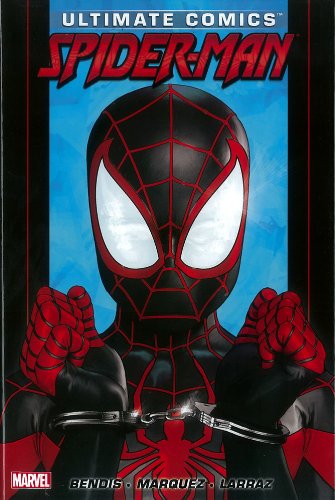
Ultimate Comics Spider-Man – Volume 3

I’m about to read a large crossover event in the current greatly-reduced-in-size Ultimate Universe, and it turns out that 3/4 of the current Spider-Man book (cleverly titled “Volume 3“) is also in the crossover book. Why they released a crossover book for the X-Men and Ultimates but then still let Spider-Man be published separately was a mystery to me, and now that I’ve read the opening section that isn’t in said crossover book, the solution to that mystery seems to be “publishing mistake”.

Because, seriously, the two issues I am reviewing are solely about wrapping up the Prowler and Scorpion plotlines from Volume 2. Not only did they belong there thematically, but they also made for one hell of a cliffhanger! It’s hard to review this any better, because it’s so short that I can only get into spoiler territory, so let me just say this: you know how I was intrigued by the “dark uncle” mirror that Miles is facing? I cannot really imagine a more impactful moral resolution to that mirror than the one I was presented with, and I am once again really looking forward to what comes next.

Oh, also, the thing where every time I read one of these books, I’m caught up in missing Peter Parker too much to appreciate Miles’ story for what it is? I guess that has ended! Either it was the year off or Spider-Men bringing the two characters face to face or me reading three different Peter Parker books in 1978 continuity, but whatever it is, I’m settled. So that’s nice!

Joyland

Is this a good idea that I should be pursuing more consistently? Or a terrible idea that should never again see the light of day?It is known that I was already going to read any Stephen King book, and approximately on publication day. But a Stephen King book that is also about carnies? It’s like a match made in my heaven.
Joyland is a mish-mash of a coming-of-age story, a ghost story, and a hard-boiled mystery (hence the Hard Case Crime imprint), and of course I think that works; I’ve always thought King was the best fiction writer around, even though he mostly gets pigeonholed in horror[1] and people fail to think of him in a more general sense. Anyway, to rate it on each of its parts: the mystery was perhaps the weakest aspect, though I’m not a big mystery fan so I’m not sure that’s fair of me to judge. Perhaps the mystery is solvable, but it was not by me, and anyway, perhaps that should not really be a criterion? The ghost story was just the amount of spooky that you can get out of real life, or at least just the amount I’ve ever managed to eke out of real life, which is to say, not nearly enough. But strangely, this is not a criticism. Or at least, I criticize real life for this more than I criticize the book.

As for the coming of age, that is both mine and King’s bread and butter, and while I can’t say this is the best he’s ever handled it, it’s probably the best he’s handled it with college-aged characters. (Which, okay, the only comparison is Hearts in Atlantis, which was really good as well, but I don’t recall it being this poignant, introspective, or personal in scope.)

Also, if you care about such things, you could easily read it over the course of a single rainy afternoon.

[1] Which, to be clear, this book was not.

The Boys: Good for the Soul

Each volume of The Boys (okay, out of three, so what do I know?) has gotten better by, er, leaps and bounds. Good for the Soul was exactly that, for Hughie who is finding a little peace in the midst of his overturned life as a member of the Boys, the group of folks who watch the watchmen; for Annie, who is finding some small sliver of the same peace even as her eye-opening stint with the world’s premiere supergroup, the Seven, is leaving her more and more jaded; and especially for me, who is relieved to find that Ennis was not a one trick pony and can still plot with gradual subtlety instead of just gay hamster jokes. (Man, the first book in this series really didn’t sit well with me, did it?)

Also: cool backstory sequence! But mainly I’m excited to watch the endgame I can already see coming, when it’s Romeo and Juliet against both the Montagues and the Capulets; and just like Shakespeare’s tale, neither side has exactly covered itself in glory, which makes it all the more pleasant that Hughie and Annie are actually good people in the eye (for now) of this still-brewing storm, and not just flint-and-tinder angsty teenaged plot-devices.

Hack/Slash: Torture Prone

I have three problems with the Hack/Slash series. The first is that the last few books have seen a lot of effort to get away from episodic mayhem in which chronically under-dressed teen hunter-of-killers Cassie Hack smashes and outwits her way through one supernatural slasher rampage[1] after another, in favor of there being a secret society that causes these guys to live again in the first place. I cannot tell if this is unsatisfying to me because I don’t like the way it’s written or because I don’t want them to tie in an overarching plot and take away the possibility that the adventures continue forever. Either way, I’ve not so much been a fan.

The second problem is that I’m just not that attached to all the secondary characters. Give me Cassie and her misshapen companion Vlad, and I’m perfectly happy. Page after page of teen detectives and unhappy Indianan couples and romantically dissatisfied strippers and… well, okay, the skinless, speaking dog from another dimension is pretty cool, I’ll grant them that one. My point was, every page of those characters is a page that doesn’t have Cassie in it, and I’m pretty enh on the whole concept of her not being the focus. The good news is, Torture Prone is perhaps taking me in the direction I want to go, here.

The third problem is that if you take away the significant cheesecake quotient and consider that I don’t much care for the plot I’m being presented with, there’s almost no reason for me to be reading these. Cheesecake quotient, by itself in a vacuum, really isn’t something I can justify. I mean, I don’t have to justify it, so there’s that, but if this is a thought that I’m thinking, you know something has gone wrong. Upshot: I’m really hoping I was right about the second problem being on the path to resolution, because there are still four or five books before the apparent end of the series.

[1] Jason Vorhees. Chucky the Doll. Freddy Krueger. You know the drill.

Spider-Men

Remember back when Mysterio finally showed up in the Ultimate universe, and Spider-Man (still Peter Parker at the time) did… well, something to defeat him? As you can see, I don’t precisely remember either. Whatever it actually was, Ultimate Mysterio ended up in regular Marvel continuity, just long enough to toss regular, 30-something Peter Parker into the Ultimate universe, where he confronts all kinds of unexpected new realities, such as his own death and its attendant fame, not to mention newcomer Miles Morales.

Then other things happen, but really the premise is enough. I think what I got out of this book, and not only because quite a few of the characters in the book got it too, was catharsis. I have, quite a number of times, complained about what was done in this series a few years ago. Maybe what I’ve really needed to swallow those complaints is a sense of closure. Maybe I’m just finally ready to move on and accept the world as it is. Whatever the case, this was a good bookend on Ultimate Peter Parker’s life, and I’m glad the story got told.

Also, though: it’s time to stop squandering Mary Jane. She should ought to be part of the story again, somehow, if only so that the last time I ever see her (and this is true at least twice over!) isn’t steeped in insurmountable misery, forever. Girl deserves better.

This Book Is Full of Spiders: Seriously, Dude, Don’t Touch It

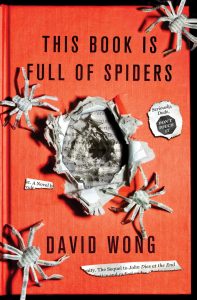
The thing about John Dies at the End is that, despite the highly visible spoiler, it still left some room for a review. Who is this John fellow anyway, for example, and what kinds of emotions will I experience when he dies? The problem with David Wong’s finally-arrived sequel, This Book Is Full of Spiders with its helpful sticker warning of Seriously, Dude, Don’t Touch It, is that pretty well sums the book up. It is very much full of spiders, that book. Invisible spiders, on the bright(?) side, unless you are like David and his friend John Cheese and have been dosed with an alien drug called Soy Sauce on the street, which gives you all kinds of time-and-space-spanning knowledge and also allows you to see all the invisible things in the world that your brain usually protects you from, like (in this case) giant far-too-large spiders that intend to crawl into your brain and take over control of your actions and decisions, possibly while leaving you unaware of this fact.

The good news is, that’s pretty much the only problem with David Wong’s new book. Just like JDatE, it is funny and terrifying and occasionally entirely sweet, only this time it was plotted as a novel instead of a long, rambling series of internet stories that got turned into a novel at the last second, which means it works a lot better structurally, with all manner of foreshadowing and sinking “oh hell, that really just / is about to happen/ed” feelings, and he even got to toss in another mention of the Monkeysphere.

Shorter version of this review: man, I’m happy I read this book, and man I’m sad that there probably won’t be another one anytime soon[1], considering the five year gap between these two. Also, I’m glad I finally reviewed it, because I’m caught up again and, not that reading tons of old comics isn’t gratifying in itself, but it will be nice to be reading actual books again also. Truth.

[1] I wonder if there will be a movie, though? That wouldn’t suck.

The Boys: Get Some

Lastly, I read the second book in The Boys series. Considering that I’ve also finally started reading old Marvel comics again (April, 1978 presently), three graphic novels between every book may very well be too many comics in a row. ‘Cause, I mean, jeeze. I was actually getting tired of the whole shebang last night, and I don’t think it was because I disliked Get Some.

For one thing, Ennis seems to have listened (through time!) to my complaints about the presentation of homophobia in the prior volume. The book is still 100% definitely written (as the name perhaps implies) for teenage boys smoking behind the dumpster[1], but at least the joint got classed up a bit. The downside is that this series feels really episodic, at least right now. Yes, there’s no question that an arc exists, and in the style of Joss Whedon where every episode has some callback to either the ongoing plot arc or ongoing character arcs rather than the Chris Carter style where three times a year the Smoking Man shows up in the credits and you can multitask through every other episode. And I was okay with both episodes presented in this book (although the Batman / Nightwing knock-off was pretty trite overall), but after how excited I was to see multiple sides of the “superheroes are all destructive, narcissistic douchebags who need to be controlled, or better yet, killed” argument that was set up last time, having the relevant characters only show up a couple of times on the far end of a phone definitely knocked the wind out of my sails.

Contrariwise, that was the pilot, and these are the early days. Preacher taught me that Garth Ennis can plot big, so he gets a pass for now. (Plus, despite having never smoked behind a dumpster, I am secretly still 13 some of the time.)

[1] Or more likely for the significantly older males in arrested development[2] that said teenage boys eventually become, considering the age warnings that must surely exist on anything Ennis has ever written
[2] This month!

The Walking Dead: Something to Fear

That show’s pretty good, huh? Well, I guess a lot of people didn’t care for the most recent season; I share their opinion, but for different cause. Oh, Andrea, why did they have to make you so hateful? Anyway, though, the show is like a dozen volumes behind right now. I can’t recall exactly where they are[1], but I do know I just finished volume 17. Which is a lot of volumes you guys.

I stand by what I said most recently. I continue to be compelled by this current plot, and I will keep reading until it is run into the ground regardless. But… and okay, here’s where I get a little wishy-washy. I can see ways to extend the current storyline at least two more books, without even half-trying. And I do not even mean they’d be stretched out or bad. Rick’s most recent and most shocking decision in a long time just has a lot of character potential, that’s all. And plus of course I should have known it couldn’t wrap up in this current book, because we hadn’t had an “oh no holy shit” moment recently enough, and that trumps plot progression.

So, my new claim is this: The Walking Dead can no longer tell a compelling tale past the resolution of the current storyline. Because, like I’ve been saying, they’ve already been down every road they reasonably can, without taking huge steps backward in character growth. I just hope Mr. Kirkman is paying attention to me over here, and gets while the getting is yet good.

[1] The people in the show.