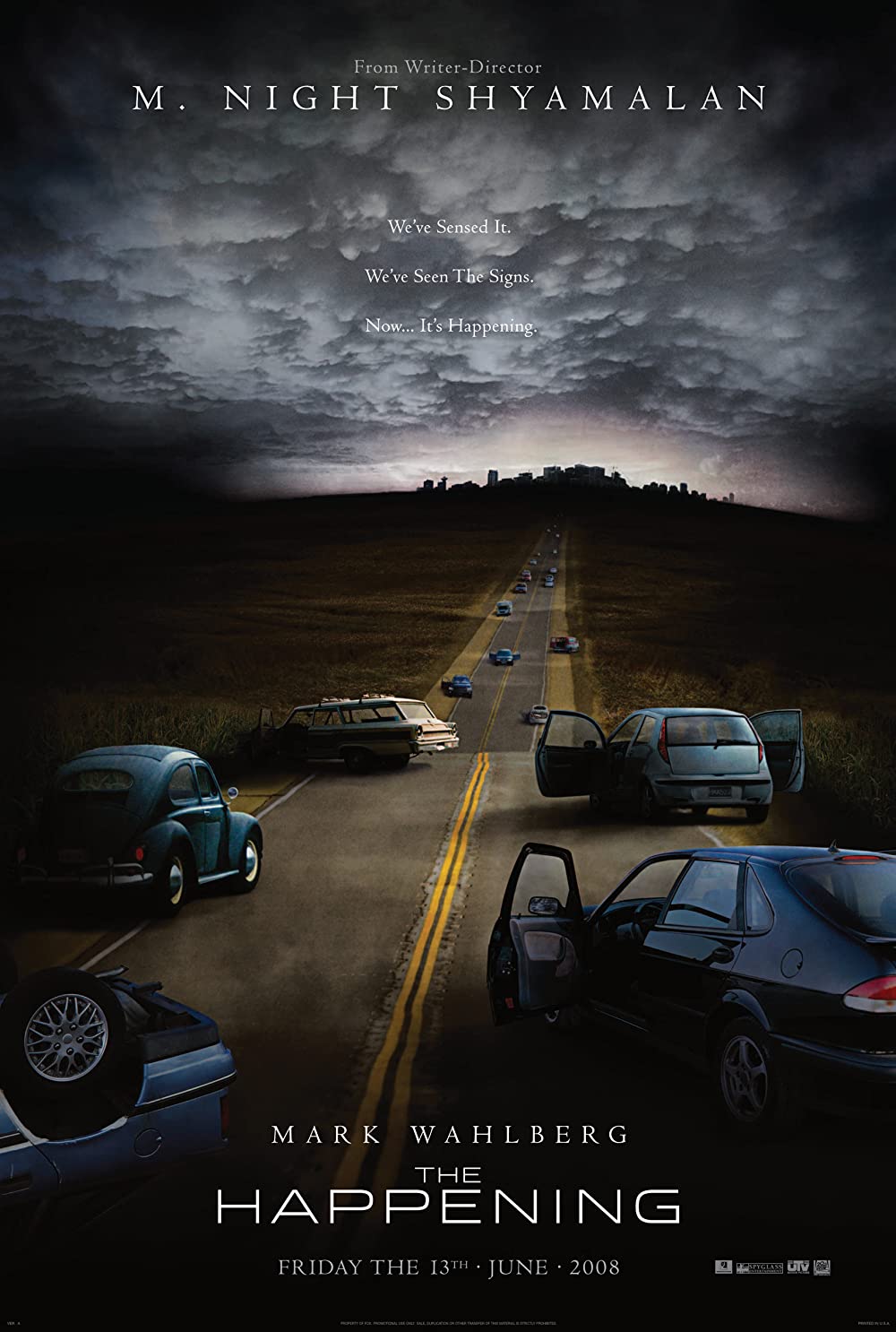
The Happening (2008)

Yesterday, I said to myself, hey, let’s go see a movie! And then I looked up times, but the dollar movie I want to see (even though I found a second dollar theater, and right across the highway, not far away like that other one (where “far” in this case equals about 1/3 of my daily commute. Help.)) was only showing in the evening, and I already had evening plans. So then I poked around at what was out in general, and settled on The Happening. And then I saw it, which just goes to show you the value of a plan.

The movie itself was an odd mix of satisfying and cheeseball. I went in knowing nothing beyond what I’d seen in a couple of previews, which as it happens is sufficiently little to make the thing work; I have to assume that without the mysteriousness pulling you in, the satisfaction would have been nowhere to be found. The premise is straightforward: one day in Central Park, people start acting mentally and physically confused, and then they start dying. And those scenes which open the movie? Creepy as all get out, I tell you. Next thing, a teacher and his wife and some friends are headed out of town because of their concern over the TV-reported terrorist attacks that have just occurred, and the film turns into about one-third mysterious deadly event and two-thirds marital drama. Or maybe fifty-fifty? I was never annoyed that the scary mystery part had vanished, and the drama part was pretty decently done.

Unfortunately, this was billed as M. Night Shyamalan’s first R-rated movie. I call this unfortunate because, aside from a ridiculous chase scene about which I cannot divulge more that would otherwise assist me in mocking its ridiculousness, the biggest problem the flick had was its focus on gore. It just wasn’t the right kind of movie, in mood, to be concerned with over-the-top death scenes; and there were a few. It’s like M. was just trying too hard, to no good effect. Well, the acting was a little iffy, too, which is odd, because I’ve seen both leads do far better jobs elsewhere. All in all, though, it was a decent, scary movie. It was not the best movie I saw yesterday, which is kind of funny when you consider I had only planned to see the one. But anyway, just don’t go in expecting Shyamalan’s previous brilliance, and you should be fine.
The Walking Dead: Made to Suffer

If you’re wondering why I’m so out of my standard rotation on graphic novels, one reason is that the Marvel stuff reads very quickly and another is that the Stick book was borrowed. But you were probably talking about the actual rotation, not all this side stuff, right? Right, you pay attention to that as closely as I do, so of course you were! Well, the answer to that is that the newest Walking Dead volume has been delayed for months. (And the next one will be delayed even further, as Wikipedia Pete informs me there are only two out of the standard six that have even been published as single issues, thusfar.)
But the important part is, the aptly named Made to Suffer finally did publish, and then I got it and read it. Yay! For values of yay that mostly relate ironically to the title, because, damn, that was a brutal book. The two civilizations we’ve seen in the series have been on a collision course for about half of its length, and this book marks the payoff. The zombies have a front row seat to a mini-armageddon in which nobody is safe, not least because said zombies forgot to bring their popcorn, if you know what I mean. (And I think you do.)

Made to Suffer may also mark the first time I’ve seriously considered the forthcoming zombiepocalypse as an extinction-level event. But if people act like this (and if there’s one thing I can say Kirkman seems to have access to in spades, it’s the human psyche), we’re all doomed, no matter how well prepared we may feel. I guess the moral of the story is “Don’t be a dick,” which would be more comforting if people who are dicks were so easily able to recognize that about themselves while also trying to stave off the end of the world.

The Order of the Stick: Start of Darkness

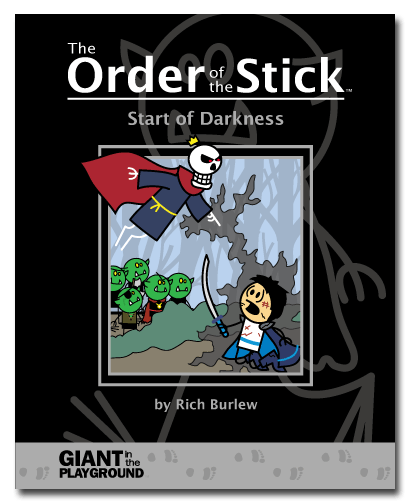
OOTS99_7in72dpi_RGBdsFirst of all: if you now or have ever played Dungeons and Dragons, why aren’t you reading the Order of the Stick? It’s a long running webcomic that combines humor based on the role-playing game, actual humor, and a globe-spanning epic quest to save or destroy the world, depending upon what character viewpoint any given comic is following. And the art, you will be retrospectively unsurprised to learn, is based around stick figures. So now you know, and you should read it!

But you probably already are, and like me, you probably never got around to buying the prequel graphic novels that are only available in published book form. Luckily for me, I know people who did, and I performed a borrowing of opportunity while at a fireworks show a couple of days ago. Start of Darkness is a quick (if not light) read chronicling the rise of the douchebag lich and the sympathetic but ultimately flawed goblins who follow him in his quest to destroy some gates that will in turn destroy the world. You know how these evil mastermind plans go. The point is, though, the stories here are just as funny, though a bit grimmer than the online version. It is about bad guys, and all. And the stories are definitely as affecting as the online version. (Did I mention that between the humor and the D&Dness of it all, there’s a genuine story here, with emotional highs and lows? My hand to God.)

Plus, secret bonus for long-time readers: Rich finally turns a spotlight on the scary monster that’s always hiding in the dark!

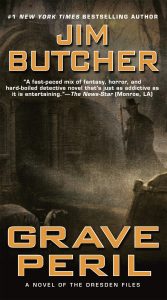
Grave Peril

Back in May, I decided it was time to get back to the Dresden Files. So I grabbed the third book off my shelf, stuffed it in my luggage, and flew off to Michigan with it. At least, I assume that’s what happened, because I remember the intention to do so, but somewhere in the course of that weekend, the book disappeared into a mystical vortex or fell through a hole in reality, or something. You know how you’ll walk around life, and occasionally when you open a door you’re certain that instead of leading to wherever it’s supposed to lead, it will instead be a portal to someplace else entirely? That is what happened to my book, is what I’m saying.
Luckily, it only took a little over a month to find a replacement copy. So now I’ve read Grave Peril, and dude, this series is really maintaining its awesomeness. Only now, there’s added depth. We learn a little more about Harry Dresden’s possibly-dark past (but only a little), while he tries to figure out who or what is riling up all the Chicago-area ghosts; plus, he’s got to sort out his relationship issues with tabloid journalist Susan Rodriguez and represent the White Council (wizards who are also good guys, and all organized, and maybe a little to strict about the good guy thing for the realities of Butcher’s magical world) at the promotion party of local vampiric queenpin Bianca, with whom he has a tenuous relationship at best. (But still not the Anita Blake kind. Yay!)

All of those ingredients rate pretty well for some tasty plot soup, although I could wish that… well, there’s no way to clarify without massive spoilers; but one aspect of the mystery was heavy-handed, yet I’m not sure how it could have been handled differently without writing an entirely different book, so I’ll let it go. The mystery really is the least part of these, what with the continued greatness of Harry’s narrative voice. And now there are signs that the books are tying together into a slightly less episodic format, which also fills me with glee. At least, until I get to a book with a cliffhangerish ending and don’t have the sequel published and sitting on my shelf, waiting for me. But that day is a ways off, so for now: glee.

Lucifer: Children and Monsters

The second volume of the Gaiman-inspired, Carey-created Lucifer series picks up almost immediately from volume one. Lucifer has been given his requested gateway into the void, and now he simply has to work out what to do with it while simultaneously fending off the varied forces (including everything from ancient beings beyond time and space to the assembled might of the Heavenly Host) who wish to steal it from him, and optimally kill him in the bargain. As before, though, what makes Children and Monsters shine, for the most part, is Lucifer himself. He’s perhaps not evil, but unquestionably self-involved beyond all human measure. He never breaks his word, he practically never lies, and he mostly offers people what they want, freely. And yet, nearly everyone who deals with him comes out far the poorer and looking at least a little bit like the bad guy, to boot. That takes some pretty meaningful talent.

Unfortunately, I fear that I’m not making sense. Anyway, the story stuff continues to feel deeper than I’m going to fully comprehend on the first pass, but it certainly already tied together some things from the first book. Plus, it introduced a long-term (I presume) adversary and solidified a long-term ally, both of whom I look forward to seeing more of. Even if wanting to see the adversarial one is mostly based on a comeuppance thing. (Which is funny; I mean, the guy is a dick, but I feel obscurely bad about primarily disliking someone because he’s being a dick to, y’know, the Devil. Well-written character, is what I’m still trying to say.)

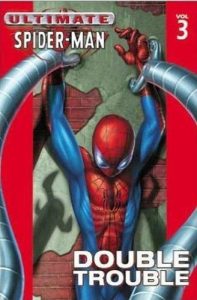
Ultimate Spider-Man: Double Trouble

For the most part, the third volume of Ultimate Spider-Man is more of the same. But when you consider what a high watermark that is, the phrase turns out to be praise rather than pejoration. Pete’s got a handle on his powers, he’s sort of got a handle on how to use them, and he has a solid ally in his corner. Naturally, therefore, the stakes get ratcheted up commensurately with his new stability. Not only is there a person at school who believes he’s seen though Spider-Man’s secret identity, not only is a philosophical, attractive, and anti-bully switch-blade wielding Gwen Stacy causing tension between Peter and Mary Jane; on top of these, one of the people who worked in the lab where Peter was bitten by the genetically-modified spider that started all the upheaval in his life has awakened from a coma with strange new powers and a grudge, and Australian Animal Planet personality Kraven the Hunter[1] has decided that a defeated Spider-Man would make an awesome trophy, not to mention bolster a flagging career.

As usual, though, it is Spider-Man’s gradual ascent towards genuine super-hero talent, Peter Parker’s lightning-quick banter, and Aunt May’s struggle to keep rein on a boy about whom she knows far less than she thinks (though far more than he thinks) that combine to steal the show. (I seriously cannot say enough good about May Parker in this series. With appearances in fewer than half of the twenty-one individual comics I’ve read over these three volumes, she has managed to redeem a character that I expected to dislike forever.)

[1] If this sounds kind of familiar, well, I expect it’s supposed to.

Ultimate X-Men: Return to Weapon X

The X-Men are still the clear also-rans in the Marvel Ultimate universe, although Return to Weapon X marked a substantial increase in series quality. It turns out that in addition to Professor X’s eponymous X-Men (dedicated to peaceful co-existence between humans and mutants) and Magneto’s Brotherhood of Mutants (dedicated to a world where homo superior reigns supreme, either through conquest or extinction of homo sapiens), there is a third organized group of mutants in the world: a black-ops division of S.H.I.E.L.D.[1] called Weapon X kidnaps mutants, adjusts them genetically and psychologically to fully weaponize them in defense of freedom, justice, and apple pie, and throws them away like so many apple cores when they’re of no further use, which seems to happen within months or less for most such kidnapped mutants. And now they’ve got their eyes on the X-Men.[2]

Yeah, on the whole it was pretty good. There are characters I disliked, though I have trust that it was often on purpose and some of them will be redeemable in the course of time. Most egregious of all was someone who thankfully will not be involved in the X-Men stories much: Nick Fury (you may remember him as Samuel L. Jackson in the Ultimates comics as well as the Iron Man movie from earlier this summer) is supposed to be a hard-bitten, tough-as-nails spy who can be covert but is more comfortable punching commies (or whoever) in the face. Whereas this guy was a particularly poncey version of James Bond who, even worse, looked nothing like Samuel L. Jackson! So every time he was on-panel, I wanted to punch a commie my own self.

[1] Shield are the people who set up the Ultimates that I’ve reviewed elsewhere, and in general they’re movers and shakers in the Marvel universe who tend to combine the best aspects of the CIA and NSA into one unstoppable unit.
[2] The return in the title refers to the fact that Wolverine escaped from Weapon X before the events of the previous volume, the only mutant ever to have done so. Because he’s awesome.

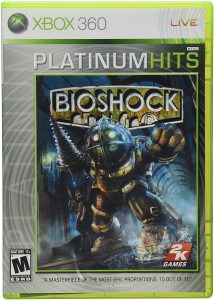
BioShock

It only took me, what, 8 months to finish BioShock? 10? And yet, that puts me well ahead of any number of games that I still intend to finish, much less the ones I’ve long given up on. At any rate, it was well worth it. On top of fantastically fluid gameplay that allows for practically any tactics you can imagine, the enemies vary from simplistic to extremely challenging but without the penalty of being unable to proceed because of constant death-resets. It may not be my favorite gameplay, but it’s easily in the top ten.

Where BioShock shines, though, is in the storyline. I’ve never read Atlas Shrugged (though I intend to retry someday), so I can’t tell you exactly how stood on their head Rand’s theories are, but I can certainly tell that she would be entitled to quite a lot of energy generated by her grave-spinning corpse, were she ever to see it in play. The premise is simple: while on a trans-Atlantic flight in 1959, your plane crashes near the entrance to an underwater city commissioned in the mid 1940s by suspiciously-initialed industrialist Andrew Ryan, who built Rapture to escape from the communists, governments, and religions that wanted to steal his money and ideas. The sole survivor of the crash, you naturally enter the city as it’s the only place to find shelter from the elements. Before you can draw a breath to admire the fantastic art deco architecture, you’re plunged into the middle of Rapture’s civil war between Ryan and newcomer Atlas, who seems to be a rallying point for the people but now only wants to escape with his wife and children. And everyone you meet is infected with plasmids that give them strange biological powers, such as the ability to shoot fire and lightning from their fingertips. (Plus, they’re infected with Randian libertarian philosophy, and half of them appear to be undead; hooray for Objectivist zombies!) And then, things start to get mysterious.

So, much as I loved Portal, this game here? Best game I’ve played not merely in 2007, but probably in most of the decade. I cannot realistically praise it enough. I know I’m late to the party here, but if you haven’t played it yet? It’s on the “must” list, I promise. It’s even forgiving to people who do not play first-person shooters.

Kushiel’s Justice

Something more than a year went by after I read Kushiel’s Scion, mostly because I read it so close to publication and that’s the approximate schedule for these books, before I found Kushiel’s Justice in the used bookstore. It had no cover, which has been a constant source of annoyance since; and in fact, if I’d known I would wait this damn long to actually read it, I would have left that copy sitting on the shelf. In further fact, while reading this one I learned that a friend was slightly further into the third one than I was into the second. Which was a little bit embarrassing, but I at least avoided big-huge spoilers, so yay! Anyway, though, I actually did read it, so you may be expecting a review?

Now that he’s home from college, Imriel is forced to face the truth that sent him fleeing to alternate-Italy in the first place: he’s in love with the heir to Terre d’Ange’s throne. Which doesn’t sound so bad, as he’s a prince of the realm himself, and in any event the only law laid down by their god, Elua, is “Love as thou wilt.” Things are always a little more complicated than that for Carey’s characters, though: Imriel’s birth parents (one of whom yet lives in hidden exile) hatched a plot before he was born to steal the throne for him outright. So naturally, there are a number of people who would not look kindly on his winning it through marriage.

So he and Princess Sidonie keep their infatuation secret and do their best to quell it, now that Imriel has been promised in a political marriage to an Alban princess (alternate-England, that is). This seems like the right thing to do, except that in being sensible, are they violating that self-same lone law to which they should be bound? The rest of the book is an examination of the repercussions of love, future foreknowledge, and bloody revenge, with more focus on Alba than has been provided in previous books, as well as new travels across northern alternate-Europe. It runs slow at the beginning, but I devoured the second half of the book around work in two short days: the moment past which stopping is impossible came barely halfway in, which is a pretty neat trick.

One spoiler after the cut. Continue reading

Get Smart

I know I used to watch the old Get Smart TV show, and that I maybe even saw a previous theatrical release with a nude bomb, which strikes me as a hilariously ’70s conceit, thinking back on it now. What I remember of the show is pretty limited, although I have access to all manner of catchphrases and signature devices in my brain. I think I’d be willing to watch it a couple of times, just to see how it holds up, but my expectation is that it’s one of those shows where the heroes win implausibly despite being consummate bumblers for the most part. Funny and definitely influential, but probably an ultimately flawed product of a less advanced television environment.

But I wanted to see the movie anyhow, because Steve Carell is awesome and Anne Hathaway is both hot and has performed well in every role I’ve seen and Dwayne Johnson deserves to be supported for any role he takes that isn’t family-oriented, so that he’ll go back to making cool movies. (See also: Diesel, Vin.) So when I learned that the Dallas contingent was going to see it on Saturday, and in my neck of the woods no less, I was in. Plus, bonus massive serving of Shiner Bock available at the theater. Worst case, good company and beer, right?

Here’s the thing, though. This was decidedly best case. I cannot tell you the last time I’ve seen a more consistently funny movie, plus it was neither one of the infinite disposable parody movies we’ve been blighted with lately nor the much better (though still not quite to my taste) gross-out comedies that seem to fill the rest of the slots. And on top of being a purist comedy, it had a fun, non-throwaway plot and characters chock full of heart. Like I said, I think of Maxwell Smart as a bumbler who manages to win despite his dubious talents rather than because of them, a la Clousseau or Inspector Gadget. Whoever wrote this saw a much more earnest character; Carell’s Smart is overly enthusiastic and incredibly green, but with genuine spy talent buried underneath that, and limitlessly optimistic. I just love homages, adaptations, or remakes where you can tell that the person in charge has genuine love for the original work, rather than just a desire to cash in. In this case, I have the impression that it was not just the people in charge, but everyone involved from top to bottom. And they done good.