The Time of the Dark

It turns out, and probably unsurprisingly, that the landscape is littered with old fantasy series that never struck my fancy or I otherwise never got around to, and that’s nevermind the many current(ish) ones I’m interested in. So what brings an otherwise random element of that book-studded landscape[1] to my attention? I think more unsurprisingly than the last not very surprising thing I said, I started reading the Darwath trilogy on the advice of a pretty girl.

The Time of the Dark is very much the picture of a book that was written for me.[3] It has a couple of people who more or less stepped through a random portal in the universe to end up in a fantasy realm, much as I’ve wanted to do since I was in high school, and that realm is threatened by eldritch[2], floating Lovecraftian abominations that avoid the light of day, not unlike the premise of Pitch Black. And there’s even a proto- Chain of Dogs situation that informs the final third and climax of the book. Ultimately, the only bad thing I can really say about the book is that the me it was written for is probably ten or fifteen years less experienced, minimum, in the elements of fantasy and horror that it describes. But it’s quite easy to recognize all the holy wow moments I would have had if I’d read it at around the same time I was reading, say, Eddings.

In addition to the cool plot and setting tricks, there seems to be some veins of philosophy beneath the surface that I expect to show up a lot more strongly in the second and third books. And also, there are some mysteries yet to solve, even aside from the central one of whether humanity can be saved from the Dark Ones. (Oh, right, speaking of things that are designed to lure me in, civilization is on the brink of utter collapse. So, yeah.) Good stuff, and I am pleased to be reading more soon.

[1] I’m really loving this imagery, by the way. I mean, not my portrayal of it, just the idea that you’re walking around, and there are these piles and drifts of book every which way, scattered about like a nine-pins. Except for the problem of rain, that would be a pretty sweet world.
[2] You pretty much always have to say “eldritch” in these situations, you know?
[3] Aside from the ridiculous cover art, that is, which I feel obliged to mention since it’s the only literal picture in sight. In its defense, that is (inexplicably on first blush) a literal portrayal of a scene from early in the story.
X-Men Origins: Wolverine

Summer arrived at last. Technically, it arrived in the form of a horrendous downpour that was among the worst I’ve experienced from the driver’s seat. But the important thing is, I and my companions got to the theater in time, so none of that matters. What does matter is having seen the Wolverine movie, and having it work pretty well. Explosions: check. Pathos: check. A few new mutants, both familiar (to me, that is) and un-: check. Matches current movie series continuity: check. Matches current Marvel continuity: well, okay, that part not so much, although it could be that it matches some Ultimate continuity I have not yet exposed. However, I do not care that it didn’t, because all the other parts were done pretty well.

In the end, it was a nice little summer comic book movie, better than some that have been released over the past decade; and I have no driving need for more. Though if they want to give me a simultaneously hysterical and horrific riff on the Superman origin story while they’re at it, I am willing to laugh and cringe appropriately, and with a song in my heart. Well, y’know, sort of. Maybe less so during the cringe?

Ghosts of Girlfriends Past

This is a really easy review, because of how the story is well-covered ground. You know, A Christmas Carol? Or the Disney version, or the Muppets version, or the Bill Murray version? I’m saying, you know this story, and Ghosts of Girlfriends Past does itself the service of not leaping out with a sudden surprise twist that leaves you wondering if you’re watching the right movie after all. The question, then, is what’s the point of watching a romantic comedy remake of an old story you’ve already seen (or read) several times? The point is this: it’s very, very funny. Funny via quite a few different genres of humor. It’s also a little bit sweet, like you’d expect from the “romantic comedy” tag, but it’s not cloying by any means. Mostly, though, funny. If you like laughing for an hour or two, check it out!

Friday the 13th (2009)

Without meaning to, I let a good two months slip by before I finally saw the Friday the 13th remake. And when I did see it this weekend at the dollar theater, it was by myself and a little bit creepy. I mean, not the movie, which was every bit the traditional slasher flick. No, it was the theater crowd. Five minutes before the movie started, there were four men scattered in various parts of the non-stadium theater with decaying seats. It was starting to feel like I imagine a porn theater did, back when those were still around. But yay, some people finally came in together, even a woman in one case. And thus the day was saved and I was able to focus on the plot.

Basically, this is a reimagined Friday the 13th Part 2, after a straight port of the original movie was covered in black and white flashbacks prior to the title screen.[1] The reimaginings are a bit of a mixed bag. On the one hand, it’s pretty smart to have the new victims not be a batch of camp counselors come to reopen Crystal Lake a few years after a series of brutal murders. Because, that would never happen, right? Much less four times in a row as in the original series. On the other hand, it’s strange to have an explicit hero character in Jared Padalecki[2], roaming town and environs in search of his missing sister. One of the brilliances of the Friday the 13th series was that the characters were almost always on an equal footing going in, such that there was no way to guess who might live.[3]

The important part, though, is that they waste no time getting to the action, which follows the formula almost to a tee. A large number of TV-recognizable[4] young people in the woods who take drugs and engage in premarital sex are punished by a deformed, avenging spirit with a machete. Do heads roll? Are pokers shoved through faces? Are feet liberally stabbed? Are minorities slightly more likely doomed than everyone else? Yep, it’s a slasher movie. 14 bodies. 6 breasts. Drive-in Academy Award nomination to Julianna Guill for flirting so hard with the Asian kid that she literally burned his lip and then having the grace to be hung from a pair of antlers in penance, and also for her “spectacular” talents.

[1] Not that it matters one way or the other, but I’m almost surprised they didn’t take the color out of the original’s footage and use that, instead of filming their own version. They added some new footage right at the end, sure, but it still could have been done.
[2] That guy from Supernatural. Yeah, that one.
[3] Caveat: the We Have Seen Your Breasts, You Must Therefore Die rule was of course always in effect.
[4] Sam Winchester[2], Dick Casablancas, Kira the Bajoran (not technically young, her), and a handful of others from shows I don’t watch.

Ex Machina: Power Down

Even though Power Down had been published for more than a year by the time I read and reviewed Smoke, Smoke, it feels as though the creative team saw my pacing and thematic concerns and leapt to address them. Which is not to say that the latest Ex Machina suddenly revealed all kinds of backstory thusfar unbeknownst even to Mayor Mitchell Hundred about how he acquired his power over all things mechanical. The story has only just reached its midpoint, after all. But with new rumors of the (still potentially alien) forces behind Hundred’s powers, not to mention transdimensional Communism, it’s pretty clear that the writers have finally and explicitly acknowledged there’s a lot more going on here than simple politics with a superheroic twist. And all this fails to even address the continued interior sabotage of Hundred’s political career, or the sinister truth behind New York’s 2003 blackout and its effect on The Great Machine. So, don’t give up just yet!

Ultimate Spider-Man: Hollywood

I’m officially a broken record. All the same, the Ultimate Spider-Man series continues to impress. You really wouldn’t think that another fight with Doctor Octopus would be all that much of a much, but where Hollywood shines is in all the gaps and cracks getting filled in with juicy, delicious plot. And also, in this case, heaping doses of meta-humor. Because, you see, there’s a certain movie about a certain urban superhero, filmed by a certain Sam Raimi and starring a certain Tobey Maguire. And it’s being filmed in Manhattan without the permission of or payments to a certain Peter Parker.[1] As if that (and let us not forget Doc Ock) wasn’t enough, longtime Parker houseguest Gwen Stacy reaches a critical turning point!

[1] I think that said movie, in reality, was one of the inspiring forces behind the Ultimate universe reboot of Marveldom in the first place. Which takes the metaness to a whole new level.

Ultimate X-Men: Cry Wolf

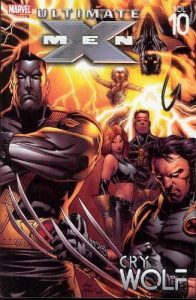
I am really ambivalent about my latest X-Men, Cry Wolf. On the one hand, it was a good story that hung together well and shifted around several of the character elements in new ways, such that I am looking forward to what comes next. Also, unlike the last time he showed up, Gambit got a proper introduction and seemed like a real person. Which is good, because he’s apparently a favorite, but I don’t really know of him from anywhere but these books.
But on the other hand, too many of the events seemed forced for the sake of hitting key plot points from the original run. It’s all good and well for there to be a triangle between Bobby Drake and Kitty Pryde and Rogue, but build it up a little bit, yeah? I’ll care more if it doesn’t seem to be performed by rote. I’m willing to reserve judgment on the Fenris Corporation, as I assume they’ll be relevant later and this wasn’t just a whirlwind but ultimately pointless mention.

(I’m not leaving out the actual plot on purpose, it’s just that it was a hanger for the character interactions and changes, and thus seems less important than the other stuff I talked about.)

Millennium Falcon

I’m not entirely sure why I bother to review Star Wars books at this point, except that it’s expected of me to review everything. It’s just, the context is pretty small, or something. Nonetheless, I’ve typed this much, so I may as well finish up! Millennium Falcon performs a few duties for the Extended Universe. Primarily, it puts together a history of one of the most famous starships in science fiction from before the days when Han Solo owned her (starting with a fairly cheesy Christine-on-the-assembly-line homage and, thankfully, improving from there). Secondarily, it provides a plot hook for a treasure hunt, and then places the Solo family on that hunt as a way to heal some of the still painful wounds brought about by the most recent Sith assault on the galaxy. Lastly, and probably most importantly to the ongoing storylines, it sets up the newest political threat to the Jedi Order, albeit behind the scenes and in throwaway moments.

The book itself was good but not great. I can’t really recommend it as a standalone, and if you weren’t planning to read it in that sense, you probably will regardless of anything I say on the topic. But the secondary characters were all pretty decent, and the stories-within-the-story format reminds me a lot of World War Z.

Adventureland

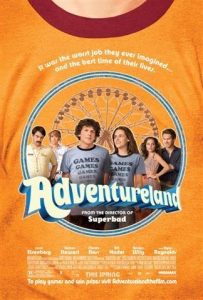
Have you noticed how practically everything that’s going on in Hollywood in the past three or four years isn’t more than a degree of separation from Freaks and Geeks? Which was a short-lived NBC coming of age drama, in case you entirely failed to be aware of it. But then I doubt you’d have noticed this new thing. I’ll tell you who has, though: Terry Gross, that chick from Fresh Air.

The latest such endeavour connected to a failed-but-brilliant decade-old high school show is Adventureland, a nearly perfect fusion of coming of age drama and romantic comedy in which a kid whose failure to be Michael Cera I could only rarely get past loses his chance to explore Europe and find himself in the summer of 1987 between college and grad school, when his father runs into an economic downturn. Instead, he comes home to Pittsburgh and takes a job at the local amusement park. Hijinks as well as self-finding ensue.

There are two things that make the movie better than it has any right to be. The first and more universally applicable is that the characters are so fully realized. Lots of them are annoying as all get out, but even the ones for whom the audience feels little or no sympathy are still completely believable, with nary a caricature to be found. And the main characters are as flawed, sympathetic, and nuanced as you could really ask for. (Particularly Ryan Reynolds’ lothario of a maintenance man, who could easily have been one-dimensional with little to no quality drop-off for the film.) And the second thing is that the female lead hits all of my buttons for The Right Girl.[1] I know a movie can only give a cursory character study at best, but, yeah.

If you’re wondering why I’m leaving the Not Michael Cera guy out of this review? It’s mostly because I don’t want to spoil the experience of him.

[1] Also, I am not alone in this assessment, though this is not the first time Ryan and I have agreed on such things.

Knowing

Nicolas Cage, right? Right?![1] So, he’s an astrophysicist, and his son comes into possession of a sheet of paper full of numbers. Said numbers have been locked in a time capsule for the past fifty years, but they also have predicted every major disaster worldwide over that period. And now that there are only a few numbers left on the list, Nic has a few mysteries to solve. Plus some overacting to perform, including some seriously iffy drunkenness that I actually know he’s capable of in other circumstances. And an out-of-place religious subplot to adhere to.

It’s not that Knowing was actively bad. It had a pretty decent hook, above-average effects, and a whole lot of angel-seeming dudes that all looked like Spike.[2] It’s just that the iffyness sticks out in my head far more, after the fact, than the upsides did. Also, the conclusion was a bizarre departure from the rest of the movie. It’s not really that I can say it contradicted the rest, there were just too many genres for one movie. Someone, somewhere, is far more pretentiously impressed with this movie than they have any real right to be.

[1] I really, really wish I had it in me to stop the review right there, including not having added this footnote.
[2] Said confluence of role and appearance leads to a pop-culture pun which pleases me to no end.