Dragons of the Highlord Skies

I am four books behind right now, until I finish this review. On the bright side, that won’t take long because, on the less bright side, I’m having a really hard time to holding onto reviewable information about Dragons of the Highlord Skies. I mean, it’s another DragonLance book set concurrently with the second one from the original trilogy, in which the knights and the elf chick fight a war at the South Pole while the evil chick struggles to improve or maintain her rank within the evil armies. Both stories are pretty decent examples of what I like about the series in general: sympathetic characters, occasional comedy, good action. Mythic resonance, not so much, but that never works right when rehashing old events that have previously been mentioned off-screen.

The framing device kind of sucked, and I hope they don’t use it again for the third book. But other than that, it’s still basically recommendable for fans of old-school Weis & Hickman.

Tropic Thunder

A little while back, I had a brief period in which I found myself out of work. It was pretty hard. I lived out of my car for something like half the time, spent some time in theaters watching movies “for free”, hit a bar for the kind of beer-drinking that only the out-of-work can really experience. You know how it is. Eventually, I got back on my feet, slept in an actual bed, and then I had to get up ridiculously early the next morning to start my new job. (And since then, I have been way too busy to write anything, for ages without end. Which explains this two week delay, you see.)

This is the story of that movie.

So, anyway, free preview, right? I glanced at it, then decided I had to work and couldn’t go and promptly forgot about it. Except then someone besides me wanted to go and other people got involved and my last day had slightly shifted hours, such that I ultimately was able to, plus it was free, right? Yay, Studio Movie Grill! A reasonably short-lived line followed by a good long sit-around eating buffet pizza and drinking moderately buffet Shiner later, Tropic Thunder started.

The premise really fails to capture it. Three successful actors are trying to break out of their pigeonholes by making a Saving Private Ryanesque true-life story of a rescued soldier escaping from Vietnam, but problems with egos and the budget are quickly making a hash of things. So the director decides to drop them into the jungle to film the middle portion of the movie Blair Witch style, with some cameras scattered around the forest for most of the shots and the director shadowing the for the rest. Only, the part of the jungle they land in is being used to grow and process drugs, and the natives are not too happy to find “heavily-armed” intruders in their midst. Also, Tom Cruise played a role that indicates every once in a while he remembers he’s a decent actor with a sense of humor, and not just the face of Scientology. Wacky hilarity ensues!

This sounds no more than a mile north of totally dumb, I know. But in practice, I have not laughed so hard at a movie in ages. If you like things that are funny, you should go see it. In the meantime, though, something pretty awesome happened at the theater. Ryan and Laurell and I were having a discussion about gender disparities launched when a male member of the waitstaff set the first pitcher of beer down in front of her. We ultimately concluded that (in the heteronormative world), people with penises and people with vaginas are in competition for scarce resources, and that if our waitress had brought the beer instead, she would likely have (unconsciously?) given it to one of the guys instead of the girl. None of which would be all that interesting to relate, except that a woman at the table in front of us finally got fed up with all of our foul, penis-ridden language and asked us if we knew that there were children here, indicating the 14 year-old next to her. Although I personally believe that a girl of that age has likely heard the word before (and in equally conversational contexts; we were being uncouth neither in topic nor actual verbiage), it was a point well-taken about how some people don’t want to expose themselves to such topics in some contexts, and I felt a little bad; I think we all did.

That is, until we remembered and later observed that this was an R-rated movie with all manner of violent, sexually-topical, and otherwise far more inappropriate material than anything occurring in our conversation. Jack Black, in particular, made reference to a penis (though I am forced to admit that he never used the dreaded word itself) that I actually think I would be leery of having a 14 year-old hear. Our heroic parent and/or guardian, of course, took her delicate child out of the theater within five minutes of the opening reel, once she realized what a mistake she’d made. Because that would be the only logical decision after having made such a scene in the theater a mere half an hour previously. Right? RIGHT?

OH WAIT NO SHE STAYED FOR THE WHOLE MOVIE!!!
Y: The Last Man – Whys and Wherefores

As promised, I’ve finished Y. Whys and Wherefores felt very much like the last volume that it was, from start to finish. Although there are certainly plot elements left to resolve (not least among them Yorick’s years-long quest to reunite with his girlfriend, Beth), the primary purpose of the book was clearly the tying up of loose ends and general denouement, which is appropriate after a series this long. It worked just as you’d expect, structurally.

What I’ve been trying to decide since I read it (and in the handful of hours I spent staring at the mostly blank screen after I wrote the first sentence this morning) is how I felt about the ending from a purely story-driven perspective. And of course, spoilers mean not being allowed to really go into details, nor even wanting to. Whatever else it was, it was a powerful finish. Which I guess answers my question pretty well all by itself. It’s also a very thoughtful finish. I’m not sure if introspective is the right word to apply to static history imprinted onto dead trees, but even if I cannot apply it to the book, it certainly applies to my mood after the fact.

Shakespeare has been on my mind all along, of course, and well on purpose. I’ll have to reread these someday as a single unit while watching for Shakespeare in general, all English-majory and analytical, but my point right now is that it has occurred to me, with surprising belatedness, that Yorick certainly qualifies for the descriptor of a fellow of infinite jest, which is good: played differently, The Last Man‘s potential for unrelenting grimness would have overwhelmed any other possible message. In retrospect, I’m starting to think that the Walking Dead series might suffer from a terminal case of the same disease.

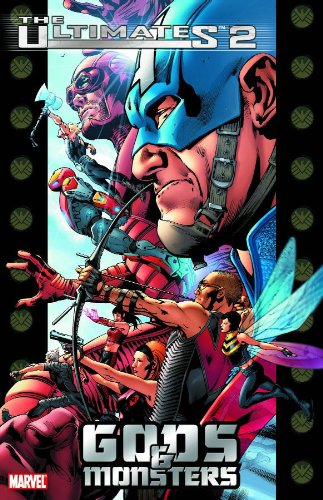
The Ultimates 2: Gods and Monsters

61rnRASuyiLFinally, something good out of the Ultimates universe again! I’m reading the four series, and Spider-Man has been great for the teen set while Fantastic Four has been okay, and X-Men feels adult even though they’re all teens too, but it’s been the not-that-good cousin to the clearly adult and clearly good Ultimates. My point in all of this, aside from the subtle recap, is to express my relief; the last few books I’ve read have been iffy.

Not so God and Monsters! I mean, it starts off all soap opera with a recap of how the various government-sponsored superheroes have been pairing off, and how the remaining unpopular heroes have been doing. (Giant-Man has been having the kinds of marriage problems that do not result in paparazzi wondering who you’re being frisky on the beach with, and the Hulk murdered a lot of people, so.) But after all the stage-setting is in place, it immediately turns into Schrödinger’s plot, wherein one of two possible things is happening. Either Thor really is the Norse god of thunder, and his brother Loki is altering reality to torment him and Midgard in general, or else Thor is a delusional Norwegian hippy who has become incredibly dangerous because of his unbalanced ratio of powerfulness to sanity, and meanwhile the Ultimates are being gradually turned into yet another military arm of the United States government. For my part, I’m honestly not sure which possibility is more dire for our heroes.

Also, there’s a downright hilarious sequence revolving around a group of second tier superheroes of the type you’d expect to start crawling out of the woodwork in this kind of world, looking to feel special without any pesky powers or skills getting in the way. And the Ultimates contain a secret traitor! Maybe! (Like I said, it has a lot of soap opera elements to it. But I am okay with that kind of thing.)

Ultimate Fantastic Four: Inhuman

The fourth entry in the Ultimate Fantastic Four series was mostly of the ungood. The first half of the surprisingly short book revolved around a character whose plot and disposal were both extremely predictable if you’re familiar with the Mad Thinker from the FF’s original run, but who appeared to be annoying and pointless if you aren’t. And the the second half was even more of the same, as though the only purpose of the series is to hit all the highlights from the 1960s version. And as much as I’ve complained about the Ultimate X-Men run, they’ve never once seemed blandly formulaic. On top of which, the art reminded me of someone who was not very talented trying to copy the character-style of Girls (which style you will no doubt recall I already found unsatisfactory) combined with repetitive backgrounds and heavy reliance on “characters in shadow”, as though the strain of cranking out such minimalistic-yet-bad art got to be too much, and only having to do shaded in outlines on some pages was a rest break from that.

On the bright side, none of the other books have seemed this bad, so there’s every chance that the quality will swing right back up again? (Plus, you know, the art may have unfairly lowered my overall opinion of the volume. If anything, I hope that’s true.)

Summer Knight

I’m rapidly running out of wonderful things to say about the Dresden Files, because there are only so many forms of praise available. It’s just, read them, right? You will be pleased by how in each and every book, Butcher’s writing improves, his one-liners get funnier, Harry feels more and more like a fully realized person of your acquaintance telling these stories to you, and all at the same time, the plots and characterizations get more subtle and pitch-perfect.

In Summer Knight, after battling demons and renegade wizards, then werewolves, and most recently vampires, Harry is forced to confront the faerie realm to solve a murder that holds the key to his own survival and possibly to things far more important.[1] Without going into the plot any further (because spoilers for previous books would abound), I am starting to notice slight discrepancies in Harry’s narration. I mean, he’s always held back, hard, about his past. But his descriptions of how useful and/or powerful his magic is versus his factual descriptions of it in use in battle[2] show either an unreasonable amount of modesty, a misperception of his own skill (possible, but unlikely, since he has so few other blind spots and is, after all, a detective), or else some amount of active deception. And if he’s an unreliable narrator[3], then I may well have to go back and read these books straight through without interruption someday, trying to ferret out the truth. This future task fills me with no small amount of glee, I should point out.

Also, though, some food for thought. Why is it that in the urban fantasy genre (okay, mostly just these and the Anita Blake books, but I have some other stuff coming up pretty soon, and I bet it also follows the pattern), events take place over such a short period? The Bones book I just read was spread out over a couple of months of police work. But Harry’s adventures rarely span a full 72 hours, and Anita’s are wrapped up before the weekend, on average. And then months go by off-screen in which various new plotlines start up while old ones drift away or reach a critical mass of interaction with the new ones, and suddenly there’s a new book spanning another handful of days in which all of the pressure is released in one huge gout of steamy awesomesauce, and it’s right back to waiting for the next one. I don’t mind per se, it just stretches believability as a genre convention, enough so to give me pause while I wonder about it. Is it just me?

[1] Even to him, which just goes to show you the quality of good guy that you’re looking at.
[2] This book certainly marks the most diverse battle magic Harry has ever wielded, which is at least as cool as it sounds.
[3] Other examples include Vlad in Brust’s Vlad Taltos series and Severian in Gene Wolfe’s Book of the New Sun, both of which are fantastic, though the latter might be a bit dense.

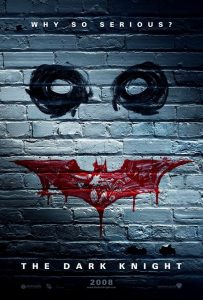
The Dark Knight

mv5bmzyxmze1nzy4nl5bml5banbnxkftztcwmtcxoti2mq-_v1_It is, I retroactively declare, a good weekend I think for seeing a new movie premiere. After spending a couple of hours around a pizza and an airing of Batman Begins, we rushed off to the theater for a Friday night showing. I’ve spent some time thinking about what I could possibly say about The Dark Knight in the subsequent 48 hours, and I honestly don’t have much better of an idea right now than I did walking out of the theater.
First of all, there’s the story route, but I refuse to do more than thumbnail it, because there are massive spoilers both for fantastic individual scenes and for the highly detailed and brilliantly executed plot. Anyway, a little time has passed and Batman hovers in a precarious middle ground between hated vigilante and police-sponsored hero. Gotham is gradually coming out of its dark age, and district attorney Harvey Dent’s hardline stance against the crumbling mob families is the best evidence of this fact. But there’s a bank-robbing clown who calls himself the Joker who has other ideas on that topic; and he has a plan.

All of which is stage-setting that’s clear within the first 15 minutes or so. If anyone wants to tell you more than that, don’t let them. Although Batman Begins was a lot more of a traditionally mythological hero’s journey, it had nowhere near the psychological depth of The Dark Knight. Christian Bale understands Bruce Wayne in a way that nobody but Michael Keaton has ever come close to, and Heath Ledger’s death was nothing short of a fucking tragedy for movie-goers everywhere, even if his portrayal of the Joker would have been the pinnacle of his talent. I would not have ever guessed I’d say someone surpassed Nicholson, but the writing was probably as much to blame as the acting. They really were two different characters, and the current one the darker and more insane by far.

My point being, with two such powerful leads, an equally strong supporting cast, and additional psychological elements from legal crusader Dent and returning ADA Rachel, Bruce’s love interest and Dent’s current girlfriend… with all of that going for it, there is a lot of room to play in and with a lot of interesting characters’ psyches. And this occurs in spades, to the point where it might be fair to describe the ride as an emotional wringer. But it is also the best movie I’ve seen all year, easily.[1] Juno and Iron Man come close, each in their own ways, but this hit all my buttons just right.

In summary: wow. Now go see it. (Yes, again. I know I would have tonight, if I hadn’t been at work instead.)

[1] Well. Zombie Strippers. But otherwise.

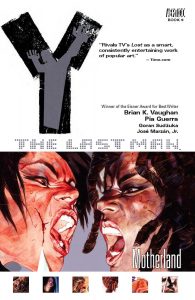
Y: The Last Man – Motherland

If memory serves, the most recent volume of Y: The Last Man ended on a bit of a cliffhanger, in which… well, okay, I guess I can assume you may not have read Kimono Dragons and therefore not spoil you. But you really, really should. (I mean, and the others ones first, right?) This is noteworthy because of how Motherland starts out offset by about an hour earlier in time, or possibly with a little bit of a ret-con. I spent the first dozen pages wondering if I had misremembered things entirely, but they eventually got back on track.

And then… answers. Answers about the ninja.[1] Answers about humanity’s future. Possibly answers about the ultimate cause behind the now four year old mass male die-off , though I’m not sure whether I trust them, nor whether I like them if they’re true. But don’t worry, because all those answers are revealed with the series’ standard mix of action, drama, and panache. This is by no means an infodump devoid of any plot or character development. Plus, there are a couple more framing stories about how characters in the series’ past are getting along now.[2]

You really can tell that the series is drawing to a close, because at least one storyline has ended here. (Two, if the answers behind the extinction were factual.) The only thing left now is for Yorick to resolve his long-running emotional turmoil for a girl who, notably, he has never been on the same continent with since the series began. Well, okay, and there are a few other odds and ends as well, but the thing with Beth is the heart of the primary dangling plot, and anyway, the other stuff probably all falls under the spoilers heading again. In any event, I’ll be reading it quite soon, so that’s good news.

[1] Have I mentioned how much I love that there’s a ninja?
[2] Well, they were both at the end, but since their release order would put the very final issue at the beginning of the book, I’m calling them framing stories regardless. I’m torn, because putting that story first would have worked a lot better literarily: both because of the framing thing and because the last couple pages of the previous issue / closing frame would work so well as the end of the book, if they’d been there. But on the other hand, there’s a spoiler in the “opening” framing story (due to it being out of the chronological sequence they ultimately decided upon instead) that would have removed some tension from the primary arc of the book.

Ultimate X-Men: World Tour

In World Tour, Professor Charles Xavier takes his X-Men on the lecture circuit, while Mark Millar reminds me that I find this to be the least good series I’m reading right now. Basically, human-mutant relations are on an upsurge since the defeat and death of Magneto at the hands of the X-Men, so now seems like the time to capitalize on that by showing off that mutants can be pretty good people too. Only, dark secrets from Professor X’s past and present conspire to not only ruin all of his grand plans but also to tear the X-Men apart. If that sounds pretty cool in summation, it suffers in execution, most notably because every character in the Xavier-centric storyline is annoying, and Professor X the most annoying of all.

Also, there’s a two-parter at the end of the book about mutant Wildcard (I think), who throws playing cards around and makes them explode. I suspect that if I was all into him from having gotten to where he is in the original series, this would have been a big, revelatory introduction. As it is, it was still the best part of the book, easily. Which is probably not a very good sign, but it could be that I’m wrong and it was just strongly written.

The Order of the Stick: On the Origin of PCs

The convenient thing about having a friend who owns and is willing to lend out the second Order of the Stick prequel novel is the increased likelihood with which he will own and be willing to lend out the first one. (Signed by the author with a drawing of Belkar, no less! Which, if you knew the guy, Belkar was definitely requested art.) The upshot of which is that I snagged and read it as well. And will return the book no later than Friday, if you happen to see this, Ryan. And, y’know, because of the borrowing, I read it way out of the order I would otherwise employ. Which is cool, as it provided good perspective between the books.

On the Origin of PCs does the same thing as Start of Darkness, except for the good guys. What motivates them? How did they meet? Why are they on the trail of a douchebag lich? The stories are every bit as funny as in the other book and in the comics themselves, but there’s one stark difference between the books that also highlights a difference in the comics. When the PC prequel was written, the comic was a lot more about humor and a lot less about story depth. Which is not to say that the comics have grown less funny, only that the plot has become increasingly more important. But it happened so gradually that, without a comparison point such as between these, highlighting how much better of a story was present in the other book, it would be difficult to see how much the main sequence comic has improved.

Still, though: this one was funny and had nuggets of pretty awesome information that have yet to pay off in the comic itself, years later now. That is pretty good news, if you ask me.