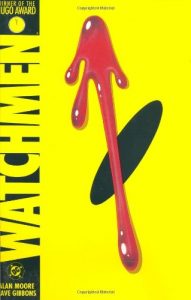
 And so I continue through my list of genre greats. I avoided reviews of stuff while I was reading these, because I’ve mostly been able to not spoil myself on any given comic up to now, and it would be pretty awesome to not do so now that I’m actually reading lots of them. But I’m pretty sure that any random review of Alan Moore’s Watchmen will tell you that it’s a seminal masterpiece, or a watershed moment for the genre, or some other such reviewer-speak for ‘I liked it; now, you must also like it’. So, I’m going to cut to the chase: I liked it. I am enlightened enough to know that my tastes are not universal, for some inexplicable reason, so I will not proceed to tell you must also like it. But you probably will.
Now is where a weekend of debauchery is causing me to struggle to remember what kinds of things I can say about it. In short, it’s an alternate history where the comic book heroes of the late 1930s caused real people to start donning masks and outfits and engaging in enlightened vigilantism. Which was all well and good until the second generation of costumed heroes in the 1960s changed the world in drastic ways; by 1977, nearly all of them had been outlawed. Now, in 1985, the world hovers on the brink of catastrophe and, as ever, only the heroes can save the day. The problem being, most have retired; one still operates due to his uncompromising moral code, despite being more wanted by the law than most of the criminals he continues to take down. And of the two who are still government-sanctioned, one has just been murdered. The most important question being, was it random, or was it part of a far-reaching plot to neutralize any and all of the heroes who might yet be willing to step in and stop the clock before proverbial midnight?
Okay, I’m forced to admit that wasn’t short. And yet I’ve barely scratched the surface. That’s because the book is about almost everything: the relationships among heroes, of course, and between heroes and the public they serve or menace (depending upon who you ask); from where power most justly derives, and to where (“Who watches the watchmen?”); whether governments or lone vigilantes, either one, can justly use the power they have rightly or wrongly acquired; and whether it is permissible to sacrifice the few to save the many, at both the macro and micro level. Less thematically, it’s about how close to the brink of nuclear war we really were in the 1980s, and about noble last charges, and about allegorical pirates. In the words of a certain pirate in the current popular consciousness that, when taken allegorically themselves, very nearly fit: “You’re off the map. Here there be dragons.” And as much as I really approve of maps, the most interesting things happen when off them.
 Hard to believe, but true: I actually haven’t done anything in the past month or so. Well, okay, completely untrue. I’ve done lots of stuff in the past month or so. But they’ve all involved being at work a lot or hanging around the house catching up on my TV watching (alas, not reviewed here; but you should be watching
 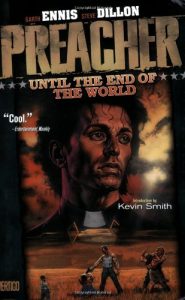 When last we saw our hero, preacher Jesse Custer, he was on his way back to Texas to follow up some leads on the whereabouts of God, who to Jesse’s way of thinking owes him an explanation or three. But if there’s one thing that can get in the way of a perfectly good spiritual quest, it’s family business…
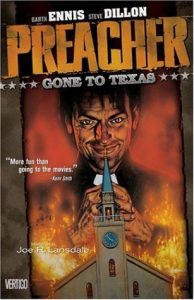 When I received all of these graphic novels, it was in response to my thinking aloud over a period of time as to how I have so little grounding in especially the history and high points of the comics universe, despite knowing pretty well what’s going on in any given movie. So, I got some old stuff as well as some landmark entries. It could be that the Preacher series is such a landmark, but it could also be that