Behind the Mask: The Rise of Leslie Vernon

You know what there are not a lot of? Documentaries about serial killers. Well, no, that’s the opposite of what is true, there are actually like a ton of those. By literal film-reel weight, I mean. But there aren’t very many documentaries about uncaught serial killers. Well, that might not be true either. Because, like, Unsolved Mysteries, right? I’m pretty sure that show became a genre once there was a Court TV. But, okay, this time I’m going to be right: there are very few documentaries about uncaught serial killers from the perspective of the serial killer. Including, you understand, interviews and other literal documentary footage.

Before yesterday, as it happens, I would have said there were actually no such documentaries. But now I have seen Behind the Mask[1], and I can say that there’s one, anyway. It actually starts off playing for comedy to some extent, both because our slasher[2] is personable and funny in the confines of his soulless psychopathy and also because the very concept of a documentary crew following around a murderer is kind of laughable. But the moment when the horror of what they are witnessing (and, let’s be honest, doing) finally begins to sink through, the movie shifts from comedy to the finest example of post-modern horror I’ve seen since Scream. This is definitely a must-see for genre fans, and I’m sad I had never heard of it until a month ago!

[1] I should note, incidentally, that the mask itself is in fact at the intersection of cool and creepy to such degree that I’m very slightly surprised there hasn’t been a sequel based on that alone.
[2] Oh, right, I lied a little bit. “Serial killer” is the best way to portray the type of person I mean in a documentary setting, but truthfully this guy is a slasher; some famous previous-movie slashers are his heroes, and there’s obviously some nod to the idea of, if not the supernatural, at the very least that these guys work damn hard to appear supernatural.

Thor

I’ve been reading old Marvel comics for, well, a few years now. And also the Marvel Ultimate reboot series, for about the same number of years. In that time, I’ve gotten through 10 or so years of the newer version and 13 years now of the older version. Over those “years”, I’ve had characters I’ve liked and characters I’ve disliked, as you do. For instance, I will read as little about the Submariner as humanly possible, and I’ll be glad of it. Anyway, my point is this: I’ve seen a great deal about Thor as an ensemble character, and only a very little of him as a main character in his own stories. Everything I’ve seen of the latter (except for a few Loki-centric stories in the Ultimate version) has led me to be bored at the idea of picking them up, even when virtually every other major Marvel character has eventually won me over.

All of this to explain that I had pretty low expectations when I heard that they had a Thor movie in the works as part of the build-up to the Avengers franchise. Often, of course, correctly lowered expectations are the key to enjoying something that you otherwise might have rolled your eyes at or even actively hated. But the thing is, I don’t think that’s the deal here. The opening narration doesn’t give the slightest amount of delay in explaining that these aren’t really Norse gods, they’re just really advanced aliens who happened to choose Earth as a battleground, naturally confusing the natives. (Arthur C. Clarke is referenced so many times you’d think he got royalties.) And once that’s out of the way and we’re caught up to modern times, the story they’re telling is pretty much exactly the story I wanted to hear, without any of Thor’s old-school enemies who bore me so, without more than a smattering of his over the top formality that bores me even more; instead, it’s a sibling squabble between Thor and Loki, of exactly the type that has so enthralled me in all the new Ultimate stories. Except, you know, with cosmic implications and a few interesting earth people involved.

But other than the Loki thing, and I have decided over the past couple of years that in the hands of a capable writer, I could happily read or watch him doing just about anything, the main draw versus the comics that I was so leery of is that they took an overly formal prig with a stick wedged so solidly up his ass that it made Mjollnir look about as unmovable as an empty plastic bag in an independent film about existentialism and turned him into a jovial, likable, and best of all, overly rash hero among men. If someone tries to convince me that the Thor in the (non-Ultimate) comics eventually turns into that guy, I’d probably be willing to pick up his stories. Not until then, mind you, because I just don’t care enough about the backstory. Not this time.

Fables: 1001 Nights of Snowfall

The title is so obvious in retrospect, and yet I really didn’t anticipate the Arabian flavor of 1001 Nights of Snowfall until I read the first page of the book. After that, of course, I got to sit back and enjoy several stories of the history of the Fables before and during the War with the Adversary, even if not four (or, okay, even three) figures’ worth. And there’s not a whole lot more to say after that, though I found the secret histories of Snow White and Frau Tottenkinder[1] to be very entertaining and fully worth the price of admission. That there were in fact several other good stories, well, that’s good news too.

[1] That may not be her right name,and you may not know who I mean anyway, but she was once a witch who lived in a gingerbread house, if that helps.

New Ultimates: Thor Reborn

A thing I have noticed about the Ultimate series in the wake of their big climax a couple of years ago is that most everyone has seemed adrift. Sure, Nick Fury put together a new black ops team, but that dude always lands on his feet. Everyone else, though… mutants are outlawed and being hunted to extinction, the Fantastic Four broke up, the Ultimates are in an unsatisfying holding pattern, and Peter Parker, well, he’s doing okay I guess, but his personal life has been teetering on the brink of shambles for a little while now, and since his stories have always been strongest on the personal side, I think he gets to be included in the general malaise of the series after all.

My prediction is that Thor Reborn, nominally about a new plot by trickster god Loki (and with a sideline into a truly horrible version of the Defenders that I really just wish had never been involved in the plot at all), is really positioned to be the start of returning the Ultimate universe to some kind of status quo, where things can seem appropriately light-hearted and/or epic[1]. I mean, without discussing anything that happens in the book at all, just look at the title! Once dead characters start coming back, there’s no surer sign in comic booklandia that things are getting back to normal.

[1] Those sound contradictory, I know, but for comic books, they just aren’t. And the whole run has felt, well, pretty heavy for a good long time.

The Alienist

On recommendation of one of my graphic-novel-sharing friends, I picked up a turn of the 20th Century mystery book, The Alienist. (And, seriously, it was recommended several times, and has been mentioned several times more while I’ve owned it unread. Which is not a complaint about my pushy, pushy friend, it’s a wry nod to my massively overflowing bookshelf.) But the point is, I got to it, only to find (unsurprisingly) that everything I heard was true! It is in fact a pretty darn good fiction about the genesis of modern police procedure set against the trashy, immigrant-filled slums of New York City’s 1896. It occasionally bordered on feeling too modern, but never quite got there, all while managing to have a shockingly strong female protagonist in the cast, an occasionally Holmesian feel, and special guest appearances by Theodore Roosevelt and Charles Ranhofer. Oh, and “the first” serial killer. That may not actually be something for everyone, but it’s something for just about everyone I want to know.

Source Code

I knew Source Code was a sci-fi movie, but I think if I had known that it really was full-on science fiction, instead of just with the trappings, you understand, I would have pushed myself to see it sooner. As it is, there’s hardly any time left to recommend it to people, what with the summer movie season having started yesterday. And that’s downright unfortunate, because it’s the kind of workmanlike, personal sci-fi story that people should ought to see, and that really should ought to be made more often in the first place.

Jake Gyllenhal plays his affable everyman self, military edition, attached to a top-secret project called the Source Code.[1] Using the brain patterns of a train-bombing victim, the project coordinators are able to place him into the last eight minutes of that man’s life, again and again, to determine the identity of the bomber before he can strike again. All of which is enough by itself to make for a rollicking good sci-fi / action movie, but then they went and focused on Captain Stevens’ experience in the virtual reality: his growing attachment to his fellows[2], the physical and mental agony of each failure, and his rapidly growing disillusionment with… ah, but that would be telling too much.

The important thing is, they’re telling a much deeper story than the one that might have fit in an hour of zippy television in the Seven Days, or, yes, Quantum Leap vein (and if you manage to catch Scott Bakula’s cameo, you’re a better person than I was). It doesn’t strike me as being among the very best genre movies of the (well, previous, now) decade, and here I’m thinking of Children of Men. But this is a new decade, and it’s the best one so far, plus also it’s every bit as good as another recent example of the personal sci-fi genre I’ve seen (which I shall avoid mentioning here because the comparison could be spoilery to either film), even if it didn’t manage to live up to a global-scale story that is among my favorite movies ever.

[1] Caps implied every time the name of the project-slash-device is mentioned.
[2] Especially, it must be admitted, the pretty one sitting across from him.

Portal 2

A handful of years ago, a game came out that did something entirely new in the genre of first-person shooting. This was not a surprise in the scheme of things, Valve having been long known for such innovations.[1][2] But the degree of new was pretty surprising. Sure, the Half-Life games have always had an element of puzzle solving, but Portal was purely puzzle solving in a way that forced you to think of spatial relationships and three-dimensional physics as you had never done before. And it had a great deal of humor and plot crammed into its several hours of gameplay. Now, I can’t say a whole lot about Portal 2, but I’ve figured that I can almost certainly say more than most reviews I’ve seen, which are that it’s amazing and you should play it and anything else would be a huge spoiler.

Mind you, I am saying a good deal of that, I’m just working my way around the last part. Since it’s my job to, and all.[3] So, basically, in the recently-updated ending to Portal, you are dragged off by robots at the conclusion of your apparently-not-so-successful-as-all-that escape from the Aperture Laboratories facility. After a non-specific but implied period of time passes, you wake up and some brief plot occurs, followed by a nod to people who never played the original or who haven’t in a very long time, in which you learn controls and physical concepts. And then, well, then you are launched down a rabbit hole full of history, psychology, morality, and, just like last time, really a lot of puzzles and humor. And all manner of troubling revelations, also just like last time. And, well, okay, there’s a lot of just like last time to this game, although rest assured that the puzzles and the plot alike have significant updates as well. The point is that it’s not a brand new game that will leave you amazed nobody ever did this before.

It is, however,  the best interactive story I’ve ever seen, from both the interactive and story sides of that equation separately. The fact that they’ve been joined into one game? I guess it’s like this. I don’t imagine it’s the best game that will ever be made, and I would easily accept arguments from people saying the first game is better; it’s all down to taste and what you want from your experience. But I cannot imagine a way that a game named Portal 2 could have been better than this one. As best I can tell, it is entirely without flaw.

And if you care about the mythology of that shared dystopian future world (which I do), I was impressed anew today by how I can take a joke line about the Black Mesa research facility from the first game’s closing song and both extrapolate very nearly precisely when Portal occurred in the shared timeline of the multiple game series and also a good deal of information about… well, and there’s that rabbit hole full of spoilers again. Because I actually don’t want to provide the hint about what else I was able to determine from that line of song, lest it simultaneously hint at events in the game you might otherwise never have anticipated. Because seeing this stuff cold? It has always been the best way. The point of this closing digression, I think, is that I expect more insights into both this game and the world of shared games as I think more about it all. And also, there’s an entirely separate two-player cooperative Portal experience that I have yet to touch. But I wanted this review while things were still very fresh; if there’s enough innovation or storyline revelation to warrant it, I’ll just have to revisit the game with another review sometime in the uncertain future.

[1] For innovating the way storylines and characters are handled in the genre, there’s the original Half-Life.
[2] For innovating the ways in which you can interact with the random detritus of your environment, look no further than Half-Life 2‘s gravity gun.
[3] And anyway, if I can’t work my way around seemingly-insurmountable obstacles in a review about a game derived from Portal? I’m clearly doing something wrong.
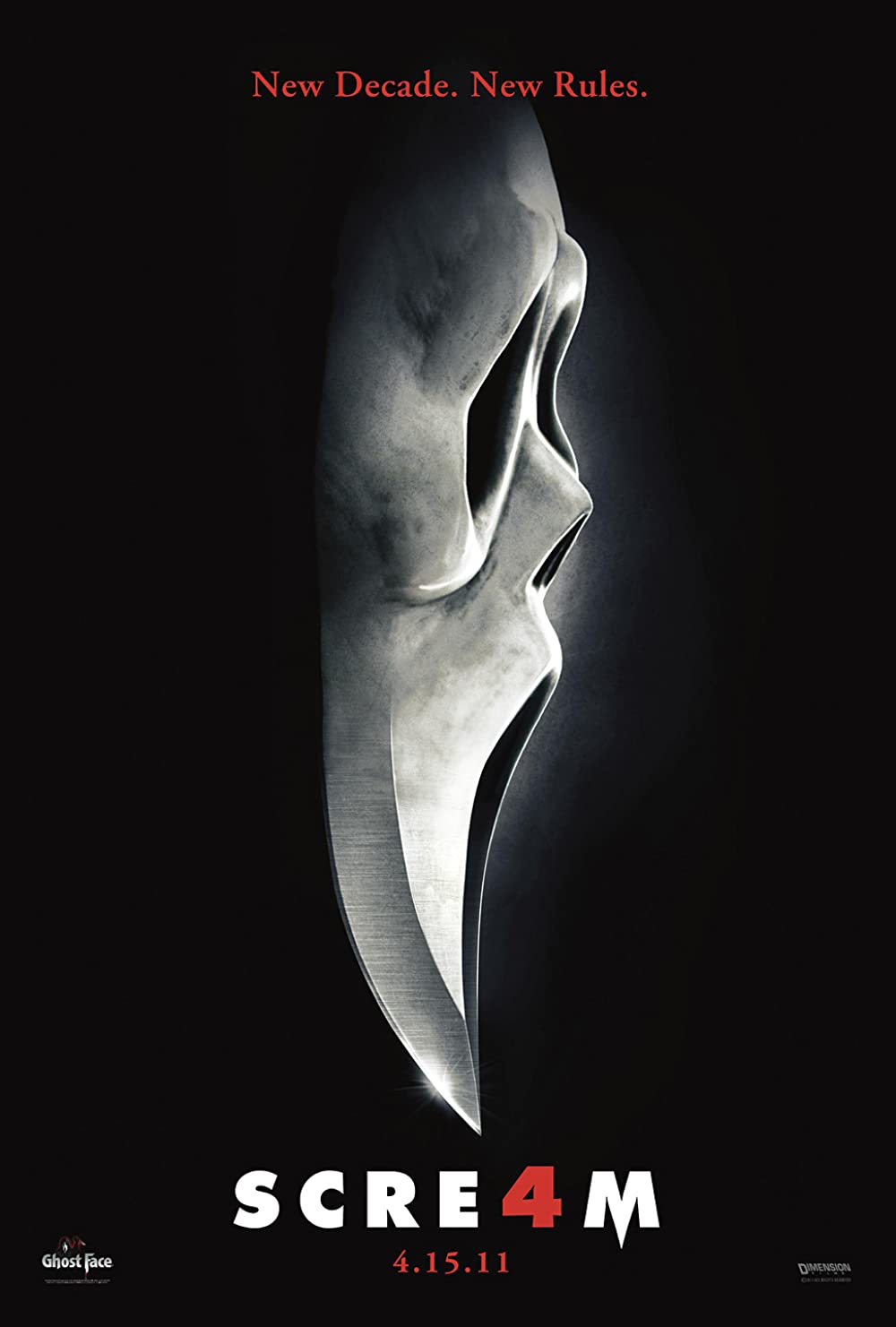
Scream 4

A good long span of time has passed since the last Scream movie. In case you don’t remember, they are popular for reinventing the slasher film via clever, self-aware postmodernism at a time when the genre had very nearly died. Also, for stabbing really a lot of people and creating a brand new interchangeable killer via a consistent ghost-faced mask and voice modulator for perpetual victim Neve Campbell in every movie.

Which actually is where Scream 4 comes into play, with Sidney Prescott returning home on tour, on the heels of a successful book about her quest to stop feeling like a victim. It’s too bad, really, about the new person-or-people who have grabbed onto the same M.O. to start threatening a new batch of teens, including Sidney’s cousin, along with the woman herself and also perpetual co-stars Deputy Dewey and Gale Weathers.

I can’t detail more, both because horror movies don’t lend themselves to fine detail in the first place and especially because this series has continued its unbroken streak of leaving me unable to guess at the identity of the murderer-or-murderers[1], and I’d hate to remove the fun of it for anyone else. The writers definitely took the self-aware schtick to a whole new level, which did not bother me, though I can imagine it having played a little stale to some viewers. As usual, also, my companion and I were in the vast minority of laughers at the showing. I know sometimes I laugh at things a movie didn’t intend, but I also know the Scream movies are the kind that do intend more of the laughs than not, and as usual, I have to wonder why so many people are watching different movies than I am.

[1] That’s the second such reference, so I will point out that it is not meant to be a spoiler of these events, only an acknowledgment of the trend from previous entries in the series.

Ultimate Thor

I’m excited by the fact that the Ultimate Comics imprint is finally wrapping up enough storylines to have started publishing graphic novels again. After so many months of a limitless supply (that has finally dried up this year as I caught up with the line), I finally have an inkling of what people who insist on watching TV episode after episode all in a row must feel like waiting for the sixth (or whichever) season of House (or whatever) to finish up. While I will be saddened sometime in June by the speed with which I ran through my glut, for now, I can bask in the existence of two more books in my house after this one, both of which will tell me more about the future of that world.

Unlike Ultimate Thor, which is wholly comprised of backstory and origin on the Norse god turned Ultimate who we most recently saw… well, that would be a spoiler, I suppose, so I will say no more than that he hasn’t been in any of the books since Magneto’s ultimatum played itself out, culminating in the devastation of New York City and ensuring the destruction of all mutant rights for years to come. Though that is the subject of another book. Anyway, my point is that Thor’s story here tells only of the past, spanning the history of Asgard and his divine family, the unexpected enmity of Baron Zemo in World War II, and his re-emergence in the modern world some months ago, around the time that the Ultimate universe started reckoning time. On the one hand, it’s a good story (and perhaps a necessary one, after the way that reality was toyed with in The Ultimates 2). But on the other hand, of course I’m eager for more aftermath and new storytelling instead of retreading the past. Which is why it’s so lovely that the two more books on deck freed me to enjoy this one for what it was.

Tiassa

Man. I love reading series, because you get the continuity of setting, and characters grow and change and develop over time and you get to see the outcomes of those as well. It’s I guess like the difference between a snapshot and a film. Or more accurately, between a film and a lifetime. But every time I need to review a book in a series, and that series has gone on longer than a trilogy or so, well, those times make me pretty frustrated. Because it’s virtually impossible to provide much information that isn’t rife with spoilers. I’m sure this isn’t the first and won’t be the last time I make such a complaint, but it bears saying.

Anyway, though, Tiassa, which title in the Vlad Taltos series has been one of the most anticipated of which I am aware, thanks to the main character of the Khaavren Romances series that parallels Vlad’s own being from the Dragaeran House of Tiassa. This either makes perfect sense to you if you’ve read either series or none whatsoever if you have not. So you see my dilemma. But if you have, you won’t want me to say much more, and if you have not, I think I can pretend like I would be telling you what to think about the book, sure, beyond the obvious statement that you need to go read Jhereg instead. See, there’s this guy, Vlad Taltos, who has at various times in his life been a crimelord, an assassin, a husband, a defender of the world, and a man on the run. And a number of other things as well. He lives in an empire peopled mostly by another species who deem him a second class citizen on good days. And these books tell the story of his life and/or the empire in which he lives. This particular book tells a story about a silver tiassa statue[1] and the swath it cuts through various events in Vlad’s life and through the future of the Empire. Also, Vlad and his fellow guest narrator each have fantastic narrative voices, which are not to be believed ever, even though sometimes they accidentally present an accurate picture of events.

You know, I really think I’m going to start re-reading these books. It has been way too long on most of them, and I’ve forgotten way too much, and it will be by-gum worthwhile. (Yeah, I have no idea when either, nor whether the previous statement will result in anything like accuracy. Which is not unlike listening to Vlad, come to think of it.)

[1] The Houses of the Empire are named after and share certain traits with animals that have been previously anthropomorphized by the Empire’s progenitors.