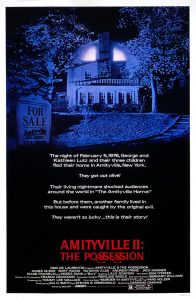
Amityville II: The Possession

I have arcane rules for when to review a movie, rules that I only barely understand myself. I try not to break them, though. It has to be an event movie, like if I go to the theater, or otherwise sit down by myself or with a group of people specifically to watch the movie. If it just happened to be on the TV, no. I have to stay awake all the way through it. (This pitfall is usually not based on quality, but just on tiredness, and I’ve broken it once so far. No, I’m not saying when. I will say that this pitfall is what will prevent me from reviewing The Amityville Horror (original), which I watched on the same night as this one.) If it’s something I’ve seen before, the scrutiny gets worse, because how much can I reasonably take out of a movie on repeat viewings? Then I have to really feel it before writing anything down. This is in contrast to books, which I intend to review every time I read through one, first time or not. Because there’s more of a personal investment to it, I guess. Games would be on the book end rather than the movie end, except there are way too many games for me to replay any.

The sad part is, I broke my rule and wasn’t going to review Amityville II: The Possession despite it meeting all of my criteria. But it keeps tumbling about in my head, and so I must. Let me start off by making this perfectly clear. This is a bad movie, a terrible movie, really. The acting aspires to golden moments of competency, but rarely succeeds. The storyline is really no worse than most schlocky horror films, but it ends about an hour in, while the movie drags on for thirty grueling minutes beyond that point. There’s absolutely no reason you should watch it, other than if the review makes you curious. That said, if you do plan to watch it of your own accord, don’t read any further, as I am going to spoil the hell out of it. (I wish I could say ‘no pun intended’ here, with a fake little laugh that proves the opposite; unfortunately, I can’t, because there’s no actual pun here. You’d think so, in a movie about demonic possession and the grisly murder of an entire family. But, no.)

So this family moves into a three-story house in New York, in the 1970s. The father is kind of an asshole, the mother shows classic Edith Bunker signs of abuse, and then there are four kids, two of them young, plus an older son and his live-in girlfriend. There’s some kind of mysterious underground chamber which opens and closes at will, blows out cold air, and dripped blood and flies all over a repairman. Much to my personal frustration, though, nobody ever investigated it extensively. Also, the son starts to be possessed by a demon, the symptoms of which include setting up a pretend sexy photoshoot with his girlfriend, acting sullen and withdrawn around his parents, occasional bursts of anger, and lots of sly sarcasm. Well, and sometimes his skin starts pulsating and turns green, but only ever when he’s by himself and nobody else can see it happen. Then, later, the family’s priest goes off with his porn-moustached “friend” on a “camping trip”, instead of responding to their pleas for help about the weird things going on, and the son kills everyone in the house before the priest can get back in time to save them. Feeling guilty over the whole fiasco, he breaks the son out of protective custody and then exorcises the demon from the son into himself, thus removing the kid’s one good trial defense. Then the movie ends, with the priest sitting up there in the corner of the attic, twitching with demonic angst.

So, yeah, that was weird. But you should know that I lied at one point in the above narrative. It was for effect, but it was also because I got fooled in this exact way, until someone pointed it out to me. The live-in girlfriend? Actually, she’s the eldest daughter. But there they are, in the first scenes of the movie, way before any of the demon-y stuff starts up, flirting like mad. That probably should have been a clue, I guess. You don’t get that level of sexual tension out of people who are actually involved with each other. But right from the start, neither the direction nor the acting give any indication that they’re related to each other. It’s not that I’m outraged here over the lack of making incest feel icky factor. It’s that every expository indication from the film is telling me that it’s supposed to be icky, but at the same time there’s this dissonance in that it’s filmed as straight-up, regular, completely run-of-the-mill behavior between the two of them. Even by the time the nude photography role-playing scene comes along and it’s clear they’re brother and sister, well, by then he’s all demonic, but she looks like she’s uncomfortable only that she hasn’t yet come up with an excuse to say yes to everything he wants to happen. Then later when she’s confessing to the priest, her big sin in her own mind is premarital sex, not incest. It seems like she wants the priest to help out so that her boyfriend will stop acting weird, and that’s it. Allow me to reiterate that there’s never any hint she’s being controlled by evil, either.

So, what you’ve got is a tremendously bad bit of film that has only two characters with any free will, both of which I found deeply compelling yet impossible to really understand. One of them a priest who makes consistently bizarre, nonsensical choices about how to deal from moment to moment and is wracked by guilt over each one, and ultimately ends up filled with a demon and with no hint of what becomes of him after. The other a teenage schoolgirl who is to all appearances in love with her older brother, demon or not, and who the film treats as not in any way out of the ordinary.[1] Yet, somehow, the demon thought she was just as worthy of death as the rest of the family, so she takes a rifle shot to the gut, just like everyone else. I wish I knew if they’d be equally compelling outside the context of this particular movie, because I’m probably going to steal them someday, if it’s at all feasible.

[1] Untrue: at one point, her brother hugs her on his birthday, and despite the hug being almost completely normal except that it might have lingered for no more than a second too long, the mother immediately figures out what’s going on somehow, and then later when the sister goes inside to find him since he’s the only person not outside celebrating his own birthday party, in favor of another bout of turning green and pulsating under his skin in the privacy of his attic bedroom, she gets slapped by the mother for her trouble. There was really no reason for the mother to figure out anything there, nor did the scene have any consequences. Based on the rest of the movie, my only conclusion is that the slap was borne out of jealousy rather than anger at sin.
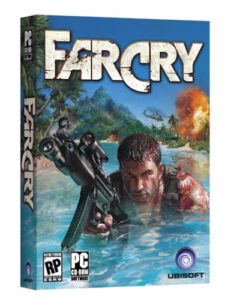
Farcry

I’m probably not done yet or anything, but my spate of first-person shooters is at least slowing down a bit. Which is good, because there’s lots else I want to play, but since there’s already both a Doom 3 expansion released and a Half-Life 2 expansion scheduled for this summer, I’m sure I’m still stuck in these same woods for a bit longer.
Which made Farcry a welcome entry. No demons from hell that required a clumsy flashlight-or-weapon paradigm to fully unlock the fright potential, no transdimensional head-sized ticks waiting to leap out at you from the shadows… well, no, it really isn’t as good as the Half-Life series, so I shouldn’t deride. But it’s definitely the next best thing.

You play as Jack Carver, a Caribbean tour guide (or South Pacific? Well, somewhere with palm trees, sparkling blue yet crystal clear waters, and the occasional Japanese army skeleton or half-sunken battleship to break up the monotony…. so, yeah, probably the Pacific after all, then. Seems obvious, now that I’ve thought about it.) hired to take a beautiful young reporter on a tour of a nearby island chain. Only, before you even get there, someone decides you’ve trespassed a little too close, and blows up your boat. After that, the only thing left to do is penetrate the net of mercenaries, stop the mad scientist’s evil scheme, and save the girl. I mean, that was your best boat!

But, seriously, for the railroad scenario that all FPSes must be, this one does a pretty good job of making each next “choice” seem like the only reasonable one and even of sometimes providing multiple solution paths to each objective. But, shooting different things with different weapons, and each thing takes a different number of hits to kill it? *yawn* We’ve been here before, of course. What makes it work is the interesting storyline coupled with the deadly paradise motif. You genuinely want to pause now and then and take it all in, but more often than not, this is a bad idea. Plus, there’s a pretty good vehicle system, with everything from an inflatable raft with an outboard hooked on to a hang-glider.

I felt like it got a little too hard right at the end. I know, it’s supposed to and all, but this was essentially post-climax, which made it feel unfair. Both because I wanted to see how it turned out and because, well, I was ready to move on to the next thing. Which I will, but I only wish I knew how soon. My gametime is at a premium these days. Probably June, if all else fails.

Sahara

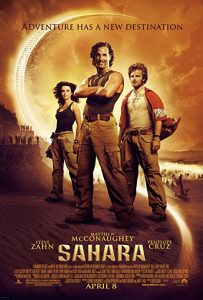
The thing about buddy action-adventure flicks is: hard to talk about. Because, we’ve seen it all before. In Sahara‘s case, it’s James Bond (they nearly always are), but if he had retired from the secret service to become a deep-sea diver, and also if he had made friends with some guy at some point in his life.
The rest of it is exactly what you’d expect. Is there a pretty girl in danger because she’s stumbled across a secret that could threaten the fate of the world? Is there a power-mad industrialist willing to protect that secret at any cost? Is there a boss somewhere that wants the world safe, of course, but wishes his stuff would not get destroyed quite so often? If you don’t know the answers to these questions, then there are more seminal works that you ought to see instead. If you do, though, this one is pretty good. They found the right balance of drama, comedy, and explosions. Plus, there’s a civil war treasure hunt, just to add a new flavor for the palate.

This Dirk Pitt guy seems alright. If I can figure out what the first book of the series is, I’ll probably pay Half Price Books a visit and attack the stories from multiple angles. The problem being, my to-read shelf is failing to get smaller. You’d think with the moving and packing things up, I’d have a little bit more discretion. Well, maybe you wouldn’t, but I really thought I would. In fact, though: I would not.

Sin City

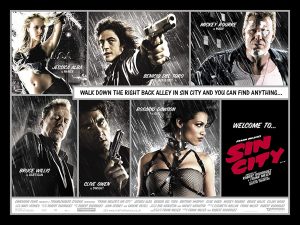
After the fact, and thinking over the body of work that each of them has produced, I’ve decided that Robert Rodriguez is being unfairly eclipsed by Quentin Tarantino. They both have the style thing down cold, but it seems like Quentin has few other true strengths, whereas I’ve seen Robert hit several other notes, and all of them well done.
Be that as it may, Sin City only hits the style notes. That’s okay, though, because sometimes a dark and stylish bloodfest is exactly what you want. There’s morality, but no moral lessons that would really apply to any other world than that one. There’s good and evil, but much more often there’s necessity and expedience. (Plus bullets, booze, and boobies.) You wouldn’t want to live there, but it’s definitely fun to watch the people who do.

If I ever grab the graphic novels, I bet I’d say the same thing. I know everyone says that it matches a few of the storylines, but it could have been completely fresh material in the same world and I’d still make that bet. Never have I seen anything on the screen that looks so much like a comic book. Ultimately, I hope it’s too expensive to catch on, though, because kids need comics to encourage their reading muscle. That is my only complaint, and it’s as minor as it sounds.

Hotel Rwanda

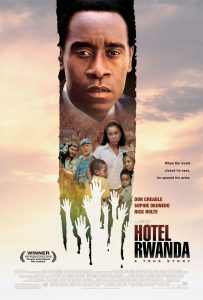
It’s a lot to take in, is the thing. Sure, you’ve got the whole Germany and the Jews thing, but that’s so internalized into our culture that it doesn’t pack the same visceral punch. I didn’t know that yet, at this time yesterday. But, back a couple of months ago, the girl told me I should go see Hotel Rwanda. I doubt it would have crossed my mind to, on my own. This, also, is part of what there is that’s a lot to take in. So I looked for it, and kept looking for it, but it was a small distribution and was never local. Until last night, when the dear, dear Alamo Drafthouse started a three day run. I managed to escape work early enough for the run to downtown, so I got to go.
Really, there’s too much to tell about what went through my head while I was watching. It could be that there’s be too much to get it all out even if I waited a week, but I’m going to see another movie tonight, so now is the best time. Therefore, I try.

It’s a true story thing in Rwanda during the genocide in 1994. The comparisons to Schindler’s List are inevitable, but I’ll try to avoid them. I haven’t seen that movie since before the events of this one actually happened, so it’s possible my memory of it is flawed. On top of which, like I said earlier: Unfamiliarity has bred a deeper reaction, maybe. As for the film elements, they’re all fine. Unobtrusive cinematography, just as I prefer. Excellent acting, never over the top despite subject matter that would all too easily create that kind of thing. A script that only crossed the preachy line once, so that’s forgivable, and it made up for it by humanizing characters that could have been too noble or too tragic or too evil.

Anyway, though, it’s a film based on a true story, and the story is probably easy to learn about, so I need not go into it here. I say probably easy to learn about, and that’s the part of what’s in my head what I will go into. I feel bad about myself, that I’d have to poke around to see how well-documented things are. I remember it happening, and sure, I was in college, but hell, that’s exactly the time I ought to have been the most fired up about it. And it barely registered. Now, it has registered. I got a little choked up looking at a billboard on the way up to Dallas today, because the subject matter reminded me of a line from the movie despite an only tenuous connection. I’m pretty sure I’ll have a nightmare sometime in the next week where a man will tell me to “Take the river road; it’s clear.” I feel bad about myself all over again for the things I thought would be pretty good ideas, for a few hours on a Tuesday in 2001.

Despite all that, I doubt my life will really change. The way I think about some things has changed, and I hope I keep that. I’m going to pay more attention, and maybe I’ll find a way to do something that would make a difference, someday. Probably not, and I won’t feel bad about that, because the main thing that makes heroes is circumstance. And no matter how I may feel about myself for never making that kind of difference, having the circumstance to allow for it would be far, far worse. That’s where the paying attention and the seeing things differently comes in, is by helping to avoid that kind of circumstance in the first place, maybe. And I can definitely get on that bus.

Ilium

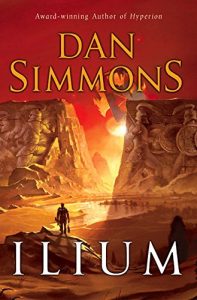
The problems with having no real standards are two-fold. 1) When you find something that’s really cool and worthwhile, people who let themselves be guided by such factors as quality or entertainingness will naturally suspect you of being up to your old tricks, and 2) you’ll find yourself being given to greater flights of hyperbole as a natural result of the first thing. Hyperbole is absolutely, positively, and I mean this 1000 percent, never effective. So, naturally, both of these are concerns of mine after having finished Dan Simmon’s Ilium.

Okay, the easy stuff. I came into it knowing it was about the Iliad, and basically not knowing any more than that. This is okay, because both the title and the first couple of paragraphs make the same point. A couple of more things that I didn’t know coming in are that it’s also about Shakespeare, and H.G. Wells, and Proust (and a little bit, I claim, about Arthur Conan Doyle), and sentient robots living in the shadow of Jupiter, and pampered people living in an idyllic golden age on Earth. It’s about knowledge, and whether knowledge has value, and whether knowledge has intrinsic value. Most of all, it is about what the very best in science fiction is always about, what it means to be human.

Ah, you ask, but is it any good? Well, obviously you’re not really asking that, because a) you don’t trust me to know anyway, b) I already basically said it’s good, and c) how can that mix of plot, character and theme not be good? I mean, really, did you even read the second paragraph at all? Seriously, though. It’s great. When I finished it, I would not have hated the author if it had been almost exactly the same[1] and been one book instead of the first of two. At the same time, if the second book were out yet, I would go buy it and be reading it now, in express violation of my policy of not reading / reviewing books consecutively. I kind of resent having to wait until early July, as Amazon implies.

Thinking it over, I can’t even say that I miss the lack of frozen zombies. Thinking it over a little bit further, there’s a case to be made that it has the potential for frozen zombies after all, and that makes me feel better about myself. At the least, I can’t say I needed them in volume one, and that’s still saying a lot.

Incidentally: Can someone who has read this book contact me external to the site? I have a question that falls outside the scope of the review, about faxing and whether there was an authorial misstep or hints for the second book. And, can everyone who hasn’t read this book go ahead and read it? The world will be a better place. I actually kind of want to read the Iliad again now. No, really.

[1] Because, being two books, there are elements of the narrative barely alluded to that are sure to come into full relief in the second book. If he’d covered everything, then a second book would be silly.

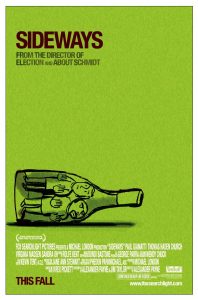
Sideways

So, early this week, I saw Sideways. Without a doubt, the best thing about it was the bleu cheese burger that accompanied it, since I was at the Alamo Drafthouse, prince among movie theaters that it is. Other than that… this review is going to have spoilers, because it’s hard enough to come up with anything to say even if I don’t worry about them.
Continue reading

The Ring Two

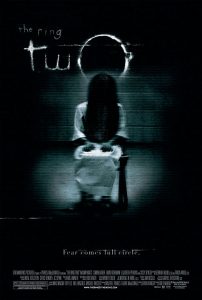
MV5BMTY2ODc2NTQ2OF5BMl5BanBnXkFtZTYwNzA4OTU3._V1_I finally got out to a movie again, which is nice, because I was starting to feel bad about how few I’ve seen this year. (Barely more than one per month!) Despite the overcrowded and subsequently hot theater, I went for the one I wanted to see the most out of my available choices, The Ring Two. The title really bothers me, and I don’t know why. Is it because it’s too short or monosyllabic to have the number appended? Is it because it’s written out instead of numeralized? Maybe it’s just because the posters with Two written out and the o matches the Ring imagery from the original movie is so brilliant that any other vision of the title pales by comparison. Seriously, good poster. I kinda wish I collected movie posters. Perhaps once I have a bigger house I’ll make a poster room, and spend a lot of unnecessary money on eBay.
So, yeah, there’s this movie. The first one was really scary, despite the ridiculous premise that people are still watching anything on videotape. As the movie opened, and I know it’s only supposed to be six months later by plot, but it’s been several years in real life, and also the kid is the same actor, so he looks several years older, and my point here is even if I could handle it in 2002, no way am I going to buy into the videotape thing in 2005, and as the movie opened I was already rolling my eyes. (Also: I was starting to think that opening night is a bad time to see a horror movie, because too many people were too amused, but that faded at the same time my eye-rolling did, so I instead take this as proof that the rest of America agrees with me on the ridiculousness of anyone watching a videotape, or probably even owning a VCR.) Luckily, the people making the movie seemed to get that, and the plot unleashed the scary drowned spider girl into a different, somewhat less scary[1] but more emotionally resonant and symbolism-filled world.

Symbolism and to spare. Lots of iconic ring and related images to be found all over the place. (I can’t go into detail there without spoiling the first movie.) Lots of water imagery. A distorted reflection of the maternal themes in Aliens, which now that I think about it was also less scary but more emotionally resonant than the movie it was a sequel to. I like this thing where horror movies are deep, but still manage to get in the scary cinematography, oppresive musical score, and sure, occasional cheap thrill. It’s kind of like science fiction in the literary world, in that there’s room to explore pretty much anything you can imagine, yet it’s all lumped together in one critically dismissed (although increasingly less so, in both cases) category based strictly on a setting that everyone assumes isn’t adult enough to care about.

Scary? Sure. Good plot? For the most part, although I still don’t really get what it is that Samara actually does to her victims. I think this is a Japanese horror trope, the idea that you can be scared to death without worrying about what was so scary, so I’m willing to let it go. It is creepily effective, so it’s easy to not mind. Extras for people who just want to see boobies and cameos? Naomi Watts is the star of a movie filled with water-related events, so you do the math there. Also, Bingo Bob has an amusing turn as a real estate agent. (And gets fourth or so billing out of basically a cameo-sized appearance, which surprised me; but the cast is small and therefore more personal, which is a good thing for the story as written.)

[1] With the exception of Halloween 2, all horror movie sequels are less scary. And it’s only as scary, because no horror sequels are more scary than the original. Can’t be done.

Captain’s Blood

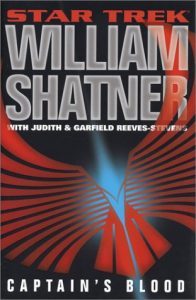
Along with some equestrian obsession I don’t fully understand and a successful re-invention of himself as a kitsch icon, Bill Shatner (yes, that one) has been spending his time in collaboration with a couple of other writers going about the business of crafting Buck Rogers in the 25th Century stories, only with James Kirk instead of Buck Rogers. To be fair, this makes a lot more sense than if it were actually Buck Rogers, because there’s really no link there.
I can appreciate this desire, I think more than most. I know what it’s like to get inside the head of a character and then feel like I could tell more stories about the character after everyone else is done. The problem, of course, is that Kirk eventually died. Inevitably, the bringing him back to life and putting him back in play in the new Federation part of the story was complete tripe, because of the degree of self-indulgence required. (If another person had written exactly the same thing, would I be calling it self-indulgent tripe? Well, since I maintain that nobody else would have done, I’m giving myself a free pass.)

Here’s the thing, though. Once you get past the two books worth of that, there have been about four more since (and at least one more next year) that have been on the high end of the Star Trek novel spectrum. I know this is not a high mark to reach, but I’m already on record of reading treasure and trash with equal abandon, and this stuff is by no means the trashiest.

Which brings me to the latest book, the middle-of-a-trilogy Captain’s Blood. It has a lot in common with the first book of the trilogy, Captain’s Peril. Both wrap hints of an extra-galactic invasion force that are sure to pay off in the final entry around the meat of the plot, two murder mysteries. This one is more engrossing by virtue of the size: The murder in question is Spock, blown up in the midst of a unification speech furthering his efforts to bring the Romulans and Vulcans back together. Naturally, Kirk, his old-school pals who managed to still be alive into the 24th century with him, and his next generation chums gather together to investigate.

That covers the first couple of chapters, and, well, the twists and turns are well enough plotted out that I’d prefer not to dig deeper. Like I said, after you get past the self-indulgence bit, he (and his under-writers, I expect) writes some pretty good books. Plus, the next book with the extra-galactic invasion will probably be self-contained, just as these two have been, and that will save you really a lot of time over reading the 21 or so volume Star Wars extra-galactic invasion series. (I don’t even know if I’m serious there, so probably it’s not worth asking.)

Door to Alternity

If you’re in any way interesting, you don’t remember that I read the first book of a Buffy/Angel crossover trilogy in December (at least, not before I reminded you just now), because you’ve had other, better things on your mind. Like, say, tax season, or how the Iraqi election contributes to the stability of that region.

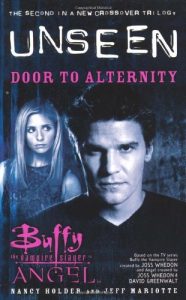
A few days ago, I finished reading the equally engrossing second book of the Unseen trilogy, Door to Alternity. (As before, there are inevitable spoilers through the first several seasons of Buffy, so stop now if you want to avoid them.) Much as The Burning had lots of fire, this book has lots of doors to alternities (which, sensibly, are alternate realities but without so many syllables). This third of the trilogy combines the thrilling danger of randomly appearing monsters swarming over Sunnydale, teens (disaffected and affected alike) disappearing into glowing portals all over LA, and a turf war between Mexican street gangs and the Russian Mafiya.[1] Against this thrillingly dangerous backdrop, the authors have included the kinds of Buffy tropes you’d expect of a Scooby gang frozen in emotional time for the summer: Xander and Anya sure do talk about and have lots of sex, Buffy, Riley, and Angel sure do spend a lot of angsty thought over their non-existent triangle, and Spike sure does want that chip out of his head.

It was approximately three months between when I read the first book and the second. By comparison, it was approximately two months between when the two books were released. I can’t say I know they were written two months apart as a result of that publication spacing, but I also can’t say I’d be surprised to learn that it was so.

[1] As you can see, only a couple of key changes have occurred in the greater Southern California area in the ten years since the events chronicled in Grand Theft Auto: San Andreas.