Marvel Zombies 3

At some point, the continuity in which Marvel superheroes were infected by the Hunger, a flesh-craving virus that specifically targets “capes” and “masks” because of their facility with destruction[1], has become its own relevant parallel universe. Not as important as the one that started in the ’60s, not as important as the Ultimate Universe, but probably more important than any of the other parallels that have come and gone.[2] For evidence, I present Marvel Zombies 3.

Featuring a significant number of secondary heroes and villains I’ve only recently become aware of in my original-Marvel readthrough (currently February 1975), the book brings the Marvel Zombies (well, those who aren’t on a 40 year tour of their local galaxies) to that main Marvel continuity, circa 2009. Being over 30 years behind means they had characters I’ve never heard of (including the prospective heroes of the piece, Machine Man and Jocasta), but seeing the highly regimented post-Civil-War-era regular Marvel characters deal with the Zombies? Pretty cool, nonetheless. It was like giving myself odds and ends of spoilers. I wonder if that made it cooler than being only 20 years behind (or, dare I say, caught up) and catching more of the references would have been?

[1] It occurs to me that a virus that is trying to destroy all life doesn’t seem to have a very good evolutionary endgame. I wonder if a) a writer didn’t think it all the way through, b) the virus was created by someone with a larger goal and that backstory is yet to be revealed, c) it’s not a virus at all, which, to be fair, it’s not like the very few people still “alive” are good at science anymore, or d) other?
[2] I’d say that, though, wouldn’t I? After all, how many of them am I really aware of? But still.
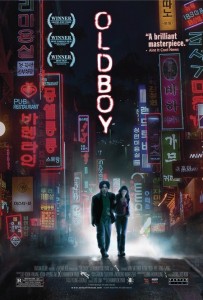
Oldboy

MV5BMTI3NTQyMzU5M15BMl5BanBnXkFtZTcwMTM2MjgyMQ@@._V1__SX1859_SY893_This movie night thing I mentioned, it seems to be real. At least, I’ve already been to it again and seen another movie, which is a pretty good sign. Then again, if it burns brightly and flares out, I won’t be offended by that either. In the meantime, it gives me the chance to catch a few things I missed or wouldn’t have known to look for, and in a setting where I can focus on my thoughts and perhaps give each film its due. (Horrorfest kind of kills me each year when it comes around, for true. At least next weekend, I can maybe take notes or even dash out a quick review between each entrant to the festival?)
But enough of that, it’ll be focus enough when it gets here. The night’s movie was Korean, which I assume to mean South Korean since there was no point at which the Glorious Leader was praised, nor did he descend upon a golden rainbow to render judgment or justice. Oldboy follows the tale of a gravelly-voiced narrator who, in diction rife with significant pauses[1], tells a tale of his horrible fate. He was kidnapped off the street, stuffed into a sealed-up hotel room, and kept there for fifteen years. He spent this entire period going gradually insane and/or training for his shot at revenge, with a side dose of tunneling his way to an exit. But on the very night that he broke through the wall into open air, he is suddenly released and given the wherewithal to divine and then hunt his antagonist in a brutally disturbing game of cat and mouse.

Or the whole scenario is a total mindfuck. Or both! All I can say for certain is that it was too engaging to turn away, and I don’t mean that in the train wreck sense.

[1] So, I’m sure this was dubbed instead of filmed in English, and it’s kind of unfair for me to judge a movie based on something that isn’t the original version. All I can say is this particular dub artist made the role his own, whether by entering the original voice or choosing a new one.

Moving Pictures

I have no point here but to warn you that it’s coming sometime pretty soon, but I very nearly read the next Anita Blake book here instead of Discworld. (In both cases, I only found out Tiassa was about to be released after I had / would have already started. Oops.) The plan fell apart when I realized I no longer owned “the next Anita Blake book”. I’ve corrected that now, but it came as quite a shock! So, y’know, pretty soon.

So, anyway, what I did instead was read Moving Pictures, in which Terry Pratchett uses the comedic voice that… okay, the truth is, I have either read zero or at most one book later in the series than this one, so I don’t know whether his voice gets funnier or not. I only know that it’s as funny as I have ever seen it to be, and that level of funny is entirely pleasing to me. So, there’s my caveat; let me try this again. Ahem. …in which Terry Pratchett uses the comedic voice that he has perfected over the last several books of the series to tell a story whose point, well, I really didn’t get.

Essentially, through the employment of an extremely subtle metaphorical representation of early Hollywood[1], he… well, he seems to be saying that it is dangerous for people to get wrapped up in fantasies while the real world is happening around them, since heroes will not actually appear to sweep them off their feet and/or save the day. Except, he’s writing escapist literature which gives people the same fantasies, only with words instead of frames of film. And as if that isn’t enough to undercut the entire thesis of the book, things go really off the rails once the Lovecraftian monstrosities take the stage.[2]

So I guess my point is… am I crazy? Does the book have this entirely unrelated meaning that I failed to comprehend? Am I right and it’s both inherently and internally contradictory? Either way, it was funny and had new characters I’ll probably never get to see again but will at least be excited if I do, so that’s not too bad. And everyone still says the best run of the series is ahead of me, which is even better news.

[1] Get this: he removes one of the Ls and replaces it with a space, only the space, the space isn’t in the same spot as the missing L was. Genius!
[2] On the one hand, there’s only one way I can see to interpret this complaint, which makes not actually spoiling it seem like a cowardly act. But I could be wrong, and I’ve already spoiled plenty enough already, old book that everyone except me has read or not.

Insidious (2010)

It’s not that I mind, but there is a school of thought (I assume) that states the recent spate of video camera / haunting movies is starting to get played out. See, the way I figure, as long as they keep being good, why should I get tired of the subgenre? (Well, and either actual genre, really, there are plenty of good entries to either side of the intersection too.)  Enter Insidious, which combines odds and ends from Drag Me to Hell and Paranormal Activity into something that, if it is nowhere near new, is at least slightly novel and certainly has the spooky chops required to hold my interest.[1]

You know what would suck (I assume) as a parent? if one of your kids went into a spontaneous, medically unexplainable, coma. It would probably suck more if, after too many weeks have gone by for you to assume he’ll just be waking up again any second now, your house started being haunted. That premise, combined with a dash of a certain reality TV show, pretty much completes the movie; but either the movie people in general are getting really good at creepy or this particular style of creepy fuels my engine, because so far, nobody has done it wrong this decade in the last decade or so.[2]

[1] Anyone can make something lunge into frame and make the audience jump. It is rather more impressive to put something in frame that is subtly wrong and wait for the audience’s collective subconscious twig to it. I was most freaked out in the whole movie by a 1920s “extry! extry!” style newsboy that was just standing somewhere he shouldn’t have been and then, a few moments later, danced to the music on the record player.
[2] Concrete divisions of time shouldn’t ought to trick people. It is pretty much the equivalent of little Babby New Year pointing and laughing at the old guy in last year’s sash right before he ritually murders him as the ball drops at midnight.

Paul (2011)

This will be the simplest review I’ve written in quite a long time. or, at least, the simplest positive review. Because, you see, Paul was brought to you, as they say, by the creators and stars of Shaun of the Dead and Hot Fuzz. And what they did with the zombie and the buddy cop premises respectively, they have done with the alien premise here: and that is to look at it from all[1] of its various extant Hollywood iterations, and then send them up in right proper hilarious fashion, with digressions toward both the black helicopter set and the competition[2] between the theories of evolution and intelligent design.

My point is that if you’ve seen some combination  of the other two movies, you already know how you’ll feel about Paul; and if you haven’t, damn, get on with it already! They’re easy to find, yo.

[1] For inevitably small literal values of all, but they do what they can.
[2] I’ve said before that sometimes the jokes are written just for myself? This is an example of that. Heh heh.

American Psycho

I’ve started another movie night, which is cool and all, but I now face the challenge of reviewing American Psycho, it being redoubled by my failing to plan for it as I watched. (I think it would not have been easy to review if I’d planned for it in the first place, so.) The weird thing is that although I would have sworn I’d seen it before, I only remembered bits and pieces and nearly nothing related to plot and outcome. I wonder if I forget so much, or have merely fooled myself this time?

Anyhow, the Christian Bale of a decade or so ago portrays a Wall Street tycoon of another decade or so earlier who, in addition to his penchant for popular musical criticism and banal interactions with his even more banal circle of acquaintances, is, well, murderously insane. And the movie explores that insanity, mostly through the lens of his interactions with a private detective hired to find one of his missing banal acquaintances, whose fate I expect you can deduce from the rest of the premise as I’ve laid it out.

I was never able to discern that there was a particular theme I was meant to draw from the film, nor that a particular moral judgment was being pushed; or perhaps the problem was that there were too many options for these lines of inquiry. At any rate, I was left with more questions than answers at the higher levels of thought, and with a plot I do not feel right revealing any more than I already have at the lower levels. But to apologize my inability to commit to much of anything so far, I will say that the movie was a decently acted and sharply funny blood-soaked satire of ’80s excesses. You probably know if you’d dig that or not?

Powers: Supergroup

Superficially, the fourth volume of the Powers series appears to have borrowed heavily from the Fantastic Four mythos. Sure, the government-backed group is named FG-3 and has only the three members such a name would imply, but the long history between its members, their popularity, the wealth and merchandising, the times when the team is in some kind of interpersonal crisis? All quite familiar. The good news is that the similarities really do fall apart once the plot of Supergroup has proceeded beyond the surface. Down there in the muck, the story is chock full of dark conspiracy, several stripes of bravery, and some pretty big changes to the series’ dynamics, all while inching closer to the as-yet unrevealed underlying truths of the Powers world.

Which is a good thing: only four books in, and already most of the recognizable secondary characters have bitten it. Either Bendis intended to show a world in crisis all along, and this is a good way to make his character realize it and start working towards the solution, or else this kind of change is the only way to slow down the grinding wheel of destruction and give us a chance for alternative storylines. I think I prefer the former but expect the latter, since there are quite a few of these books left. But at least my interest in them is renewed by this solid entry, so, we’ll see!

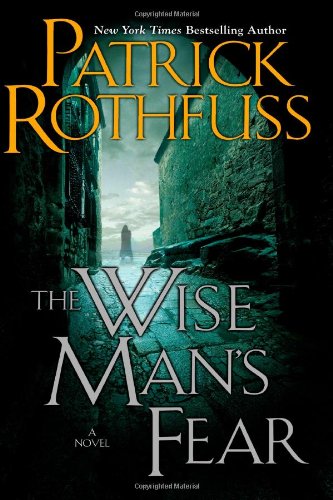
The Wise Man’s Fear

51tfhkACppLAfter what has perhaps been an unreasonably long time, the first of two sequels to The Name of the Wind came out earlier this month. It’s neither the longest I’ve waited for a sequel nor the most excited I’ve been for one to come out, but for a second book in a series and/or a second book ever, it is both of these things. And then, over the several weeks I took reading it, not to mention the several internet-famous people who had advanced reading copies, really a lot of people have gushed extensively about how good of a book it is, even better than the original.

All of which has conspired to make me nervous about my review of The Wise Man’s Fear. As expected, it continues the infamous Kvothe’s recounting of his life story to the biographer who had come in search of him, a story that contains magic, growing fame, bandits, faeries, revenge, chases, escapes, and quite possibly true love. And the thing is, on the one hand, I thought it was a fantastic story, with all kinds of internal and external twists, interesting and reasonable character development, and a storyline that, while just slightly uneven, is all the more believable for that; I was never bored, but neither was I ever rolling my eyes at the sense of it being a story rather than a man’s life. Kvothe himself has grown just slightly unlikeable, a sense I never got from the first book. But I don’t mind, because the bravery of the choice has paid off, and Kvothe-as-narrator seems slightly more reliable for showing his worse moments to us.

For all of that, there’s the other hand, where I didn’t find it to be a better book than the original, nor did I find Rothfuss’ prose to be as revelatory. Since I find both to be every bit as good as before, that seems like plenty enough praise in itself, and more than I’m used to, at least among the rarefied air of very good initial attempts. All the same, when I compare this review to the several others I’ve seen, I feel like I’m selling the book way too short. Maybe everyone else is like me, and the fact that a second volume is as good as a great first one is so unusual that it feels like it’s even better just by not having the expected drop-off in quality.

Battle: Los Angeles

I went into Battle: LA only really knowing two things. 1) It was going to be an alien invasion movie, somewhere in the range between Independence Day and Skyline. 2) Michelle Rodriguez has never in the history of cinema survived to the end of a speculative fiction movie. (Well, okay, and 2a), Michelle Rodriguez is in this particular example of cinema.) I didn’t really need to know any more than that, since, y’know, if aliens invade, things will explode, and that pretty much is enough to satisfy me on the time-and-money aspects of things.

I feel obligated to say a little more than that to you, though, not least because I already know of at least one person who would have benefited from altered expectations. The main thing I didn’t know that maybe would have helped is that it’s unlike Independence Day or Skyline in important ways. Where ID4 was a nation-spanning inspirational take on the concept and Skyline was a giant, overflowing sack of crap, this one owes more of its existence to Black Hawk Down. Gritty, hard-bitten marines have been sent to rescue civilians ahead of a massive bombing run, with only the faintest idea of what they’re up against, and the situation is portrayed pretty realistically, which is to say, with a great deal of grimness and doom in the air. But also aliens, so, y’know, that is probably easier to deal with than local insurgents. At least, it was for me, the viewer.

Couple of random thoughts to close with. The first is, if such an invasion did occur, on a rapid timeline? We’d be so boned, what with our military forces scattered all over the world. I guess that’s what happens when your nation is the most powerful one around and hasn’t faced a threat on its soil in 150 years. I’m glad the movie wasn’t about that, as it would have been a lot more boring, but I couldn’t help thinking it. The second is potentially a spoiler, depending on your viewpoint. I think not, but now you’re warned. Anyway, the second one is that I did have a brief moment of chilly fear, when one of the invaders was dragging an injured fellow out of the line of fire. These aren’t Star Trek humanoids with bumpy heads to distinguish them from us, not by a long shot, and it made the fight a whole lot more real to me, very suddenly, when the bad guys — however… well, there’s a reason why the best word in my lexicon right now is “alien”, and however unprovoked their villainy — have friends and families and care about each other too.

Take Me Home Tonight

Sometimes, I think a movie gets made mainly for the soundtrack. You could make a case that Forrest Gump is such a movie, honestly, though of course it has other charms. And similarly, I don’t really mean anything derogatory about the movie attached to the soundtrack when I say that about Take Me Home Tonight.[1] But they did just make a really big deal out of all the songs of the ’80s they were able to cram in there. As for the movie itself, well, for the most part, you’ve seen one teen sex / coming-of-age comedy, you’ve seen them all. Will Topher Grace manage to get the girl while learning something valuable about himself before the events of this crazy night are through? Will his sidekick have zany unrelated adventures that push the limit a lot further than anything the main character and his chick[2] do, because their centrality to the plot makes them somehow more pure to the audience?

Though I did find it interesting that they used the  (anachronistic?) Gen-X and -Y trope of children never managing to leave home. Maybe kids in the late ’80s were already doing that? But it sure wasn’t getting portrayed yet, so it was noticeable and odd and at the same time clearly (to me) an attempt to make modern viewers of the same age able to relate. Which, while not precisely a revelatory moment in cinema is at least a slight variation from my original claim that you’ve seen them all, right? Plus also, I’m pretty sure that Anna Faris comes-of-age during her 25% of the plot, so that’s cool, even if nobody can think of another example for me!

Oh, and additional things to say real quick, I strongly approved of proto-goth and barely recognizable Michelle Trachtenberg, and strongly disapproved of the anti-gravity bangs sported by some 60% of the female cast. Remind me why that happened, again? I just don’t get it.

[1] Bizarrely, I don’t remember that particular song ever getting played. I wonder what that means?
[2] There should be more coming-of-age comedies where the chick is the main character. Are there any? Do chicks not come-of-age?[3] I have seen at least a couple of sex comedies where the chick is the main character, though I can’t remember what right now.
[3] Obviously they come of age. The hyphens represent the fact that I may be thinking of something that is peculiarly male and 20th/21st Century American and is not therefore broadly applicable, and hence the lack elsewhere.