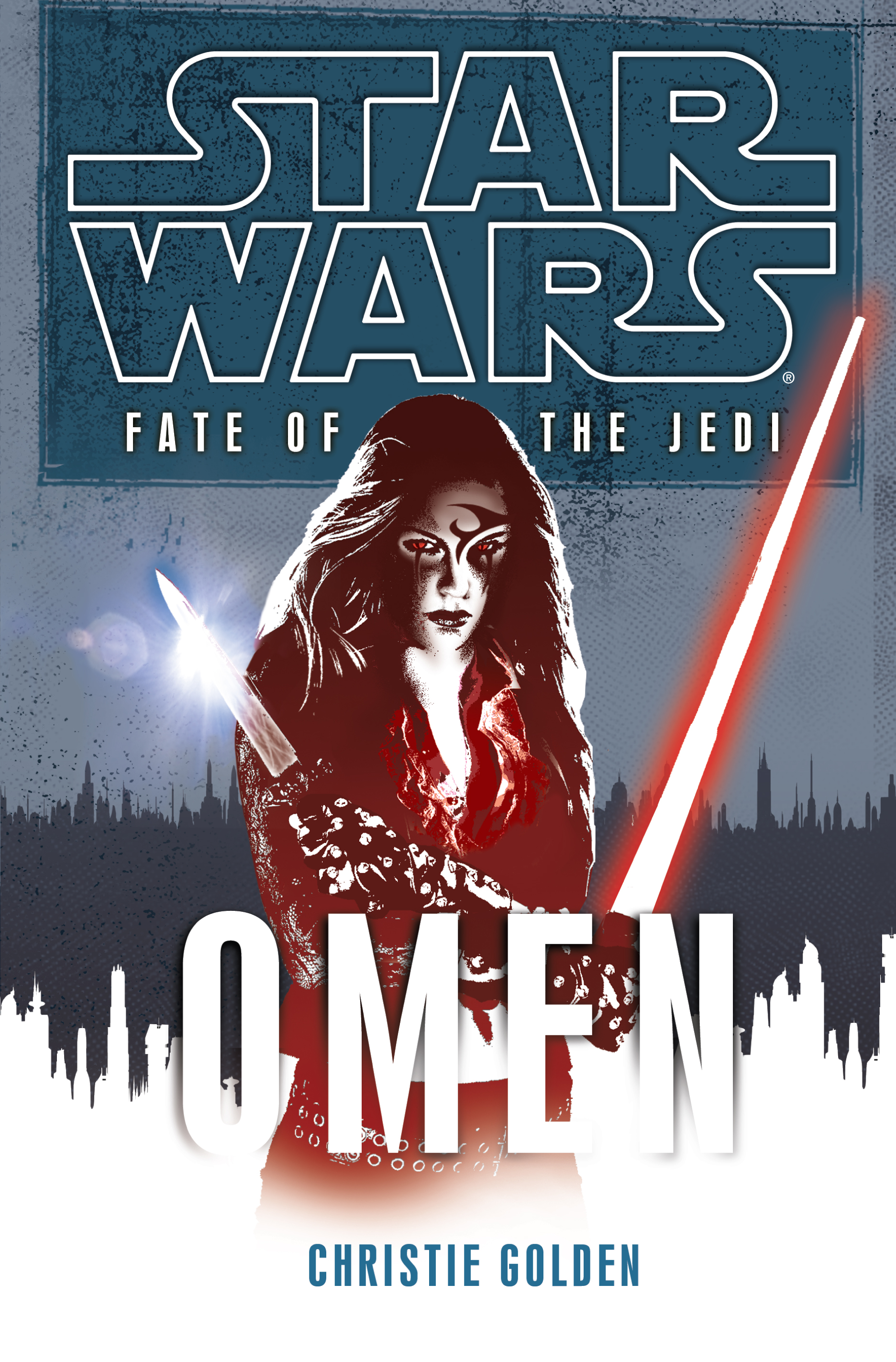
Omen

Omen_front_bgIf I had not read Outcast first, or[1] if it had been a different book, I would have liked Omen a lot better. Because, Omen was almost exactly the same book, it was just written a little more tightly. Two plot elements were identical, in fact. Luke Skywalker and his son are wandering the galaxy in search of non-Jedi Force-sensitives to learn from them and find a way to guarantee that he’ll know the next time one of the Jedi is slipping toward the Dark Side. And meanwhile, more and more Jedi are experiencing the Capgras delusion, wherein they are convinced that everyone they know has been replaced by perfect impostors. I’m saying, the prose was different but large swathes of the plot have literally not moved.

The only thing that is really new is that the extraneous third plot from the previous book has been replaced by dire rumblings of a new Sith ascendancy troubling the galaxy. Like, old school Sith from thousands of years ago, before even the Old Republic; a last remnant that has been cut off all this time, back from when they were a species more than a lifestyle. So that part was pretty cool, as was the prose I mentioned, really, and all in all it’s like I said at the start. I’d have liked this book a lot better if most of the events of it had not been duplicated from the inferior first book of the series.

Dear stable of Star Wars writers: it is okay to write fewer, more tightly plotted books to tell a story. Despite the fact that people will pay for nine books when only a three book series is needed, you should write three books anyway and consider the lost money a write-off on your soul. It will be worth it! …to your soul, I mean. Also, to me.

[1] More rationally, since this is a series.

The Black Waters of Echo’s Pond

Anyway, I was right in my prediction about having already seen the better of my two scheduled horror movies, but not just because After.Life was so good. The Black Waters of Echo’s Pond just was not so much of a much, too. And more’s the pity, it took itself entirely seriously, so there was no post-modern black humor mixed up with all the gore and mayhem. The film quality did remind me now and then of one of the ’70s movies that predated the slasher genre, when everything good was European and had a great deal of weight to it, and I can respect what they were trying to do with this and other similarities. I just don’t think they ever quite got there.

However, there were several valuable lessons to be taken away from the night’s festivities. Suppose that you have traveled with several friends, some of whom are not entirely comfortable with others, to a small island off the coast of Maine[1] for a weekend getaway at somebody’s uncle’s old house. And further suppose that said uncle has been telling ghost stories. And further suppose that the house is old and rickety and sometimes the fuses just fail. Under these conditions, I present a few suggestions for how to conduct the rest of your evening.

1) If you fall through rotted boards into an otherwise inaccessible room beneath the basement stairs, and then find boarded up within the already inaccessible room beneath the stairs a very large, ornately carved box and several ancient scrolls, you should probably leave them alone.
2) If you bring them with you up into the living room and upon examination find them to be an old board game referencing Greek mythology, most notably a handful of misnamed Furies and an iffy retelling of the doomed romance between Narcissus and Echo, you should probably not play the board game.
3) If you play the board game and it encourages several of you to engage in sexual encounters that run contrary to your current relationships with people who are right there in the room, you should… well, who am I kidding, this is a horror movie, you’re pretty much gonna do that part no matter what. But if you insist on doing it, have the common decency to actually be naked on the screen as a result of important plot developments, instead of in one inexplicably gratuitous shower scene.
4) If you have disregarded the rest of my advice, and as an inevitable result find yourself standing on a dock, looking for a way off the island and having just fought off a possessed killer who used to be your friend, but not in such a way that you are certain beyond any inkling of doubt that he is dead, don’t leave your chainsaw unattended on the dock.
5) If you have disregarded my fourth piece of advice, at the very least take notice of the fact that the chainsaw isn’t there anymore the next time you are on the dock. I mean, Jesus Christ!
6) If you are one of the last two non-murderous people on the island, it is probably okay to stop picking fights with each other until you have made it safely back to the mainland. Not just because murderous people are still unaccounted for, either. I mean, what if the one of you that you just picked that fight with goes insane? I’m just saying, it’s been kind of a trend, alright?
7) But mostly, if you are friends, maybe stop being such dicks to each other. If you are not friends, maybe don’t go to a small, creepy island off the coast of Maine for a weekend together. Not that the other suggestions are in any way unimportant, just this one would head off most of the real trouble before you got around to ignoring the others. I mean, I’d play the mysterious old board game that had been hidden away for decades, it’s not like I can really kid anyone on that point, right?

[1] It’s kind of always Maine, isn’t it? Or else maybe Washington, but mostly Maine. I think I blame Stephen King, but plausibly he is just another symptom of the real cause, which is that Maine itself is some kind of shadow dimension extruding into our rational world. I should probably ought to visit it sometime.

After.Life

Last night, I made a mad dash out of work to the one of three theaters in the area that had a late enough showing of After.Life for me to get to it in time. Yes, really, even though I am well aware of just how terrible the name is. Because the concept made up for it, and it’s not like it was a book where I would have to see the text over and over again. And I’m definitely glad I did. Of the two late night horror movies that I see this week, it will almost certainly have been the best, and by a wide margin.

What happens is this: after an unfortunate argument and a brutal car accident, Christina Ricci is trapped between life and death in the basement of a funeral parlor, at the hands (malevolent or beneficial? That is the central question of the plot) of funeral director Liam Neeson; and erstwhile boyfriend The Mac Guy lingers forever around the edges, possibly to lighten the dreamlike quality of the central interactions or possibly to add moderately unneeded melodrama to an otherwise extremely thoughtful film. Because that central plot-driven question is completely beside the point; it is the theme of crossing the veil between life and death that gives the film its real weight. There are certainly hints throughout the opening frames that Ricci is already dead long before any collision occurs, and as each interminable[1] day between death and burial gives way to the next, she looks ever more pale and bloodless and gothic; by the end, she is reminiscent of Wednesday Addams more surely than she has been in years. Despite all these indicators, she clings to her life with a tenacious grip that leaves Neeson ever more exasperated at her unwillingness to accept his assistance in letting go. And that tension between the pull of life and the inevitability of death drives the film along even farther than probably 20 minutes of nudity did[2], much less that potential horror plot I mentioned earlier.

If I may, I think I would like to see more indie horror scripts that explore the same kinds of human questions that are usually relegated to sfnal settings. Thinking man’s horror, if it were to take off, would I’m pretty sure be the first new movie genre I’ve seen in a very, very long time.

[1] To her, that is; despite being slowly paced, nothing ever felt as though it was dragging to me.
[2] Because, yeah, if you can keep me interested in the questions you are raising while Christina Ricci is naked, you’ve probably done a pretty good job with your movie.

Ultimate Spider-Man: War of the Symbiotes

The most recent (and in a way, the final?) Ultimate Spider-Man book is based on a video game. That could be a death sentence in a lot of hands, but Brian Michael Bendis has, through years of solid effort, earned my trust. More troublingly, though, it’s based on a video game that came out in 2006, which by even the least generous of publishing schedules means that its events would be months or years out of real-time date from when these scripts were being adapted. So it was kind of strange to see, at a time when every other comic in the Ultimate universe was getting ready for the big Ultimatum conclusion to everything, the Spider-Man story jump back in time by a month or two for a pretty meaningful story-insertion (or, if you feel bitter about it, a big retcon).

War of the Symbiotes tells of what has been happening with Eddie Brock, trapped inside the Venom suit, or possibly it trapped inside him.[1] The problem of course is that I wasn’t all that interested in Venom the last time I saw him, and he’s only gotten iffier since. But in my experience thusfar, a mediocre Bendis Spider-Man story still makes for a pretty good ride on average, and certainly this one got better as it went along. The end result (courtesy of an additional, unrelated retcon) is a pretty big deal, like I said. I cannot decide if I approve or not; it depends on how it gets used down the line. But I have a feeling I’m not going to find out until after the whole big Ultimatum thing, which I am beginning to realize I will have a hard time taking with perfect seriousness; it’s been looming over my knowledge of the series for entirely too long. But I guess we’ll see!

[1] Even in video games, Bendis is pretty good about providing that minimal amount of depth / uncertainty, about just who the parasite is supposed to be.

Lucifer: The Wolf Beneath the Tree

I have realized that I am more impressed by the Lucifer series the further into it I get. Although it does not have the ambitious scope of Gaiman’s Sandman series that was its genesis, the scope it has is ambitious indeed, and the depth is all but equivalent. Or maybe it just depends on what you mean by scope. Where Sandman traipsed all over the field, from myth to human nature to family, all interleaved, Lucifer keeps its focus pretty narrow. But considering that the focus is on the end of the world with heavy dollops of religious controversy for flavor, you can’t exactly argue that scope is a problem here either.

The Wolf Beneath the Tree is the culmination of months of planning. Lucifer has paid his debts and cleaned his house, and has no particular plans beyond sitting on his metaphorical back porch and watching the sun set on God’s creation. But of course things never work out that simply, do they? Not when there’s a Norse wolf-god out to destroy all of existence and Destiny is either meddling in events or fated to do so, depending mostly on whether you believe in free will. (Lucifer, unsurprisingly, does.) I could be wrong, but I feel like the series has reached the point of no return, events spiraling out of control, explosive climax and all that. It’s gonna be hard to convince myself not to just go ahead and finish up now.

Also, the first story about Lilith and her countless offspring and especially about the earliest part of Mazikeen’s backstory? I would like more of that, please!

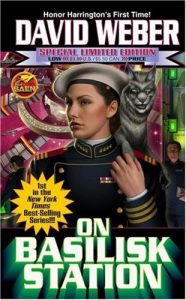
On Basilisk Station

I’m having a hard time writing a cold review of On Basilisk Station, because I myself did not come to it cold; instead, a string of reviews by Mike Kozlowski has colored my perceptions of the entire series for the whole time I’ve been aware of its existence. It is like being in your twenties and finally watching this Star Wars movie you’ve heard so much about from the thirty-somethings you hang out with. And so I’ve got the simultaneous experience of the book itself intertwined with various snickerings as I note the exact kinds of things about the books that he had previously said that are just so ridiculous, and I have to wonder if they’d have struck me as forcibly, at least in this first book, if I hadn’t already known what was coming.

In any event, a rundown for you: a couple of thousand years from now, give or take a century, mankind has spread throughout the stars, only with none of that Earth-That-Was nostalgia for a vanished planet. In fact, the Solarian League (or something like that) is one of the biggest players in galactic politics, though they play no particular role in this first book of the series. And the aliens, such as they are, all appear to be way behind mankind. But that’s because this is a very 18th-19th Century setting, only with spaceships instead of boats, and of course all the European countries were the most advanced, with the native tribes there only to be enlightened or used as catspaws, depending on whether you (like our plucky heroine, Honor Harrington) are a member of the Royal Manticoran system of planets or are one of the socialist and expansionistic bad guys, such as the Republic of Haven are mostly peopled by. Because this isn’t actually 19th C. European politics and warfare, you understand. It’s the future, and we’re in space!

All you really need to know about Honor Harrington is that she’s very very smart, both as a manager of people and as a military tactician. Possibly as a strategist too, but for now she is only the captain of one fast-response warship, the HMS Fearless, so we don’t get to see her conducting a full-scale war like Luke Skywalker does sometimes. At least, not yet, and it’s good we’re in the future, because the Force would not do Luke much good against Honor. Anyway, I may be drifting a bit afield here. The point is, Honor has lots to overcome. For example, she did a bad job in a military exercise because her old reliable weapons were traded in for new technology that only works at close range if the enemy doesn’t expect you to have it, and for some reason everyone expected her to have it in the second through twentieth runs of the exercise. Thanks to this embarrassment of the weaponry and strategic thinking behind it, she and her ship get sent out to the middle of nowhere (on Basilisk Station, you are no doubt shocked to learn) for a pointless picket duty, inspecting merchant cargo for contraband. Also, her crew is angry at her, her executive officer doesn’t respect her (even though he constantly berates himself for it, since he knows she deserves his full support, for being as awesome as she is), and her doctor is a slacker. And this career failure in the making doesn’t even take into account the Republic of Haven and their expansionism that I mentioned earlier.

I think I have never read more escapist fiction, is my point here. I will not speed through them, but I am looking forward to the next one despite myself. Because no matter how bad things get, she’ll be an impressive genius. If you dropped her naked into the middle of the Australian Outback, she would not walk out alive three weeks later. She and her Aboriginal Air Force would have already conquered Sydney by then and be making plans for how to take on China. (I mean, she wouldn’t do those things for the hell of it; we can take it as read that Sydney and China are bad guys, because otherwise they would already be plying her with fresh accolades instead of resisting.)

Also, for some reason, she has an empathic six-legged cat. The book is… well, “good” is not the correct word here. The book is entertaining despite said cat. My understanding is that it is exactly the same as reading Horatio Hornblower stories, but I have never done this thing. So if you like those, or like over-the-top awesomeness that cannot be prevented by any government-built levee, or probably if you like empathic six-legged cats for some reason, then this right here is the book (and probably the series) for you. I know I’ll read more, because even if she is too awesome for me on paper[1], it is impossible to deny the holy-shit face-splitting grins that occurred several times over the course of the last few chapters of the book.

[1] Yes, yes, but I mean it metaphorically.
Clash of the Titans (2010)

I’ll say first what most everybody else is saying first, which is that the Clash of the Titans remake is actually more of a reimagining, in which there are a lot of visual elements that match the original film, but its plot and characters are really its own, with as little overlap as can reasonably be imagined considering the sheer number of visual milestones that are reached as the film progresses. Or, in shorter monkey speak: looks about the same, feels very different. And at the beginning, I was preparing in my head to put together a reasonably clever riff on how the movie was making a sincerely bold and certainly rare stand against the gods in our society. It would have inevitably been flavored with Battlestar Galactica, of course; you can’t mention Greek gods in a modern setting for a few years yet without that being an automatic comparison. But, y’know, good company and all. I even think I might have been able to conceal for a few sentences the reveal that I was talking about Greek religion in modern times rather than Judeo-Christian religion. It would have merited at least a chuckle.

The problem, you see, is that I can’t really do that because despite scripted grumblings over 75 percent of its length, the movie actually didn’t have the courage of its convictions; when push came to shove, it completely stopped being a diatribe against man’s reliance upon his gods and a paean to man’s ability to care well for himself, even with the gods ranged against him, and far more so if they would just leave us all alone. And that is the disappointment of the movie. If it had been content to be sound and fury, I would have been content to enjoy it on its own merits. But to, all sly references aside, start that diatribe which I think we all know validly works as a modern metaphor once you disregard that the gods being impotently raged against are Greek, and then right at the turning point of the movie when things are the darkest to unnecessarily cave in and undermine what had apparently been your entire message? It doesn’t make the movie any less loud, or pretty, or by-the-numbers humorous, but it makes it a lot less satisfying than mere popcorn would have been.

Warbreaker

It is hard to start a review when you are afraid of saying too much. It is harder still when you are both afraid of saying too much and also have very little idea about what to say. I can say that I’m glad I came to Warbreaker almost completely cold[1], and that this is exactly why I’m afraid of saying too much. I can say that Sanderson has created a third completely new magic system, and that it is really hard to explain even though it was not all that hard to understand. It has to do with an amalgam of color and life-force transference, anyway.

But what I can mainly say is that the story is fantastic. So many different viewpoint characters, each with wholly realized and differing viewpoints[2], failing to communicate the way that Jordan’s characters do but for completely understandable reasons and with real and immediate consequences that aren’t four books of mounting irritation from now. (To be clear, Warbreaker is standalone.) And they exist in a world rife with religious and political conflict that has no easy answers. Best of all, every important character out of at least six is in the midst of a crisis of identity whose solutions are poised to cut to the heart of generations of barely constrained turmoil. Also, there is a talking sword that I am prepared to say is the best talking sword character I’ve ever witnessed in the genre. In short: if you think Brandon Sanderson has been doing a good job with his career to date, this book is guaranteed not to suddenly make you change your mind.

[1] There is an unfortunate spoiler in one of the reviews on the back cover, all the more insidious because it’s not obviously a spoiler until you’re mostly through the book and realize that it hasn’t been revealed anywhere else.
[2] Which sounds redundant, but I dispute that it is.

The Ultimates 3: Who Killed the Scarlet Witch?

I’m torn on this book, unlike the rest of the internet. (They seem to despise it, and I think it is only fair to calibrate expectations in that way.) But first things first: Who Killed the Scarlet Witch? is simultaneously the straight-forward murder mystery that its title implies and also a means of setting the stage for the upcoming Ultimatum that, so far as I know, I am only two books away from. I can’t think of a good way to add more to my plot summary that wouldn’t be extensively spoilerish, so I’ll move on to the controversy.

On the one hand, I really did enjoy the actual storyline. Both the pacing of the mystery’s unraveling and its ultimate denouement were satisfactory to me. And honestly I think even that, my enjoyment thusfar of the build toward this crossover event thingy they’ve decided they had to do, is a bit controversial. But so be it, some days I am an easy audience. Still, there’s that other hand, wherein a lot of the details went wrong. Like, wasn’t Juggernaut dead the last time I saw him? And was it absolutely necessary to drop in a Ka-Zar[1] cameo this many years into the Ultimate run, and this close to its end? And, seriously, the use of the Black Panther seemed racially insensitive at best. And none of those missteps was necessary to create the plot that I was happy with! So frustrating.

[1] He’s a Tarzan rip-off from the mid ’60s. Not bad as characters go, just untimely.

The Ultimates Omnibus

Note: I did not actually read The Ultimates Omnibus as my title and link might otherwise indicate; I just re-read the four volumes of The Ultimates and The Ultimates 2 that I have mentioned previously, but this seemed like the easiest way to get away with treating it as one project, so soon after I had read them individually. And in short, I want to say that I was right to go back and reread them, as seeing the Ultimates in their proper context over the evolution of that universe would have made a lot more sense than seeing everything at once right when I started, and then going back in time to see them interact with the rest of the series in progress as I variously caught up to “current”.

As for the books themselves, though? Still good, and they certainly do stand alone, if you wanted to ditch the rest of the universe to just read these. They’re by far the most adult books, both in theme and in prose. And certainly in plotting, where they occasionally seem to go above and beyond the adult theme cut-off just to show they can. But since almost every other main character in the Ultimate universe is mid-late teen in age, it makes sense for the one adult group to make a point of doing adult things. Anyway, it rarely seems to actually pander, which I guess is close enough for me. Also, the art is always good, though it strikes me funny that both the Wasp and the Scarlet Witch have violet eyes. The odds just seem implausible, is all I’m saying. So, like I’ve doubtless said in previous reviews that I don’t feel like digging up: if you like adult-oriented[1] globe-spanning events with real emotional and physical consequences, this is the place to get them. (Because Wolverine can’t be the star of every X-Men comic, and really, who else is there besides him and these guys to count as adult?)

[1] For the most part, non-pornographic.