Ultimate Power

I have thought about mentioning for a few books now as it kept getting coming up (but then ultimately never did so) that things have changed within S.H.I.E.L.D., the organization that is mostly concerned with terrorism, superheroes and supervillains, and the management thereof. Good old Nick Fury, one-eyed ass-kicker extraordinaire, based on Samuel L. Jackson for the appropriate level of badassery right out the gate, has gone missing and is no longer in charge of the Ultimates or much of anything else. And people keep talking about how weird it is that he’s missing and wondering if he’ll ever come back. I had been expecting something along the lines of Ultimate Power to come along and explain this to me, and not only was I right, but it turns out I should have actually opened it earlier in my readthrough; who knew it came out in a hardback version first? (Must definitely re-order these books correctly, once I finally have the missing X-Men volumes back.)

Reed Richards of the Fantastic Four is working on a promise to change his friend the Thing back to human form, because being a giant rock creature is just not very pleasant for some people, even when they’re stronger than just about everyone and practically indestructible. As part of that project, he sends a handful of probes into several parallel dimensions[1] in search of scientists willing to assist him, against Nick Fury’s explicit orders. Naturally, moments later[2], angry superheros from one of these other dimensions[3] appear to arrest Reed, because his probe nearly destroyed their planet. Being a stand-up guy, he agrees to be arrested and tried; being a master tactician with Marine sensibilities, Fury immediately mounts a rescue operation including pretty much every good character in the Marvel universe. And then, you know, things explode or generally go down in strange ways.

The story was pretty okay if you can get past only being able to follow the two-thirds of it that involved Ultimate characters. But it had massive continuity problems. Because, all the people wondering where Nick Fury has gotten to, in other books? They were in this book to see. Also, there’s a completely inexplicable appearance by a character who, last I knew of, should not have been available for this particular event. But writers sometimes do things because they’ll look cool without worrying about whether it makes much sense. And this did look cool.

[1] Not unlike the N-Zone that he was running teleportation tests through when he accidentally created his group’s superpowers in the first place.
[2] Probably, it took longer? Comics as a medium can fail to properly express the passage of time.
[3] I took a little while to catch up here, as none of these characters was familiar. Apparently, they are meant to be a crossover from a different current Marvel series about the Supreme universe, in which all the heroes are ripped off from DC. It is not clear to me why this would be compelling, but there you go.

The Walls of Air

At an unreasonably slow rate, I have gotten to the second book of the Darwath trilogy, The Walls of Air. And as a chapter in that series, it was pretty good! Characters and relationships developed, plot advanced, the world and its history gained a little more clarity. All the things you would want out of an ongoing story. It’s just that, as a book alone, it had issues. (This right here is where my penchant for staying away from reading groups of books all in a row meets with occasional failure.)

Our romantically entangled heroes split into two groups, with wizards Ingold and Rudy off to seek the assistance[1] of the wizard school at Quo, whose residents may have the knowledge and/or power to fight the Dark, while city guard and former grad student[2] Gil and widowed Queen Minalde stay behind with the last vestiges of the kingdom of Darwath at the ancient Keep of Renweth, renowned for being able to keep the Dark Ones out. Rudy’s arc is both the slowest and the most necessary, as by the end of the book, it actually seems like he might have grown into a useful element in the story, instead of being only an observer to Ingold’s awesomeness. Gil’s arc deals with the acquisition of knowledge, which she does with the same single-minded determination she throws into her guard duties. Minalde’s arc is about growing into leadership and Ingold’s arc is about learning to rely on people who are not himself. Like every middle book of every trilogy, things seem far worse by the end than they did at the beginning, but glimmers of new hope are still out there.

The problem I had, I think, was the pacing. I feel like there were maybe 100 pages of text devoted to plot, and not that much more devoted to character development. Rudy grew a lot, as I said, and Minalde grew a little, but Ingold’s changes were incremental at best (a problem with someone who starts off so strong) and Gil didn’t particularly change at all. Then again, she hardly needed to. My point, I guess, is that when the plot status is hardly different at the end of the book than where it started, and only one character has undergone major changes? It feels like things could probably have been tightened up. Still, I should say that this was something I thought about but rarely during the course of the book; it’s only that I have so little to say while reflecting on it now, and I think that this pacing issue is the reason.

[1] Should I back up a step and mention that society is collapsing because underground-dwelling, shape-changing, light-averse beings known as Dark Ones have burst forth from beneath major cities to mostly slaughter humankind? Consider it mentioned!
[2] Should I also mention that Rudy and Gil[3] are from California, brought by Ingold when he was saving the royal heir during the first modern attack by the Dark, last book? I guess I already have, in a way.
[3] Jill? Gill? I wish I had any idea how that’s meant to be pronounced!

Beautiful Katamari

I really don’t know how to review Beautiful Katamari in a way that would be any different from my original review of Katamari Damacy. It has equivalent zaniness, equivalent gameplay, an equivalent plot, a different but equivalent J-Pop soundtrack, significantly fewer Lego people observing the zaniness, and a higher number of goals than to merely make the biggest Katamari possible. But for the most part, they made exactly the same game as they have done over and over again since the original was released, in the tradition of the best slasher horror movies. And that’s all I have to say about that.

Daybreakers

As horror movie season dawns upon us, I find myself with fewer exciting choices than I’ve recently grown accustomed to. (But definitely not none! The upcoming Crazies looks like it could be good enough to make up for some of this lack. Nothing will make up for missing Horrorfest this year, but when they don’t actually have a screen anywhere within 200 miles, I pretty much have to give up. I’ll host my own Horrorfest weekend once the DVDs appear, I suppose, and my concessions will be cheaper and have a broader variety! Also, alcohol.) One of these less exciting choices, to forcibly drag myself back on point, was the yet-another-vampire-movie Daybreakers. Luckily, it turns out that I misjudged it based on the previews, and it was a vampire movie in the same way Night of the Living Dead is a zombie movie: as window dressing for the plot.

Ten years after a fluid-transmitted vampire virus was unleashed upon humanity[1], dystopic societal collapse is the order of the day. Humans are nearly extinct and the lack of food supply means that vampires are already starting to follow, although their method is less pleasant than simply being dead. In the midst of this three-way social (and sometimes more literal) war between privileged vampires, their starving and grotesquely transformed underclass, and the final, hunted humans, Ethan Hawke is an ethical scientist in search of a blood substitute that can save his people and not incidentally the humans as well. The plot has twists and turns and is basically interesting, but it’s overshadowed by the sociology of the vampirism and its ethical implications. The disease started accidentally, and I’m sure some people were converted accidentally in the first days. But it eventually turned into the kind of thing that some people were doing by choice, and that some people were forcing on their friends and relatives rather than watch them gradually change from dominant species to sole food source of the new dominant species. And, meanwhile, as that food source grew scarcer and scarcer through the combination of death and transformation from food to hungry mouth, there was the new sociology of class warfare, as vampires watched themselves slowly being doomed to the same violent and hideous fate as the too-poor-to-buy-blood vampires they had ’til now been shunning.

It’s a rich cornucopia of discussion fodder: is it evil to choose immortality[3] knowing that it will be at the expense of people who did not so choose? How about once enough people are choosing it that you’re nearly certain to be killed as food, instead of only maybe? Would you consider saving someone against their will? Would you compare it to rape instead? How much would you help the poor if not helping them meant they turned into ravening monsters that tried to kill you a lot? Would you death penalize them despite their lack of complicity in these attacks? And all that stuff is just the background. So you can see why the actual storyline would kind of pale by comparison. Honestly, the only part of the movie I didn’t like that much was when, past the climactic revelations, it turned into a bloody horror film for the last five minutes or so. It was simply too much of a let down on what had up to that point been an incredibly rich premise.

[1] You can probably work out just exactly how it is transmitted, if you have ever been aware of any vampire lore.[2]
[2] If you have not, 1995 me is rolling his eyes at you, while 2010 me is ever-so-slightly jealous.
[3] This leaves aside the question of whether there was ever immortality to be had. The disease had only existed for ten years, and although people did not age anymore during that period, it’s not a nearly large enough sample period to extrapolate from, says me.

Fables: Arabian Nights (and Days)

By no means am I implying the book was not good, or even less entertaining than usual. But Arabian Nights (and Days) did something more to the Fable series than merely define the very model of a transition book; it actually made me think that Bill Willingham doesn’t have a solid road map for where his series is going, anymore. I mean, he spent time establishing Fabletown and its history, and then there have been important storylines in the fields of romance, politics, and the war against the Adversary. So it’s not like I really know enough at this juncture to say that the sudden influx of the Arabian fables (including Sinbad, the ubiquitous evil magician with a pointy beard, and all manner of harem girls) marks a directionless grasp at new plots. It could well be merely another foundational introduction to the people who will be important in the next phase of the story, now that part one has been so firmly established. The fact that the political scene was still as solid as ever and that the last couple of issues gave us a brief look into the Adversary’s side of the war leave me hopeful that this was nothing less than the transitional book it certainly was.
While I’m pondering what I’d like to see out of the series, anyway, can the next book have more Mowgli and his current quest please? (Or Cinderella, if I’m remembering correctly just who it is that I mean; she was pretty awesome.)

Ultimate Spider-Man and His Amazing Friends

It is with something very like relief that I report Ultimate Spider-Man and His Amazing Friends as merely good. Over the course of a few mostly light-hearted adventures, Peter and his classmates interact with the Human Torch and Iceman (plus several other X-Men from a very slightly different continuity to the one I’m reading about in Ultimate X-Men[1]) while dealing with such issues as a classmate’s newly activated mutant gene or the perennial high school parenting assignment that seems to only exist in fiction. You know, the one with the doll that the “parents” trade back and forth and keep details of, and sometimes the doll also reports on its own status via sophisticated electronics, and sometimes the doll is an egg that you would think is a chicken egg but turns out to be the egg of a cave-dwelling reptilian deity? Yeah, that one. And Peter also tangles for a full issue with the Shocker, a punchline of a villain that is by far Spider-Man’s most common foe, but who is always dealt with so quickly in the introduction of a real storyline that I had failed to realize it was constantly the same guy until reading the giant glossary at the end of Ultimate X4. So it’s been nice to notice him in the past few volumes and be amused, and nicer still to see him get a full plot to himself for once.

I am getting more used to the new art, but Immomen is kind of terrible at drawing chick hair. (Mainly Mary Jane’s irritates me, but she is by no means the only victim.) Still and all, my main point is the one I opened with. I really am glad that I can see this book as only good. Because it’s nice to get a chance to relax from Bendis’ non-stop action over the last several books, it’s nice to think to myself that I’m capable of noticing when the quality is below outstanding, and it is correlatedly nice to be confident that my previous reviews have probably been accurate after all.

[1] Honestly, the differences are not that important, but it’s odd to me that they wouldn’t have worked a little harder to avoid glitches, since the reboot is still so very young in relative terms. Inexplicable presence of Colossus, no mention of Charles Xavier’s very public murder, etc.

Ultimate X-Men: Apocalypse

If it wasn’t for the fact that I know the Ultimate Marvel universe has a sort of a time limit to it[1], I would be impressed by the new directions that have opened up as of the closing panels of the apparently appropriately named Apocalypse. The book closed up three separate Ultimate X-Men storylines in just five short issues. This has got to be some kind of record, I think.

First off, it closed down a Storm story that has thusfar been too anemic for me to mention, and in such an abrupt way that even if I had managed to care about it before, I would not now do so. (Thankfully, that was the bad part of the book; had the rest been even half as terrible, I would have had to work very hard to finish up.) After the lameness, though, the main event started, and it was a pretty decent main event, I must say. Remember a couple of books ago when that guy Cable came from a terrible future to stop it from ever happening? And so he hunted the streets of Los Angeles for Sarah Connor, until… okay, that’s not right at all. Anyway, he did what he did, and then over the next book, the differently-configured X-Men continued to work toward preventing that dark future. And now, finally, it all comes to a head! There are not so many revelations[2] as you might expect out of an eponymously apocalyptic event, but there are enough knock-down drag-out fights and casualties to make up for their lack. Plus, there’s also the conclusion of that third ongoing arc to deal with, which I will pretend not to explicitly reveal by saying only that it involves Jean Grey.

All of which goes back to what I was saying in the first place. If I did not know that there were only 1.5 books of Ultimate X-Men left, and then a giant question mark as to whether more will come afterwards, I would currently be very very excited by both the fact that so many old plotlines have been cleared away and especially by the manner in which it was done. It at least seems like there are really big things ahead for Marvel’s mutant populace.

[1] And, man, why is it consistently only the X-Men that make me think of this?
[2] haha

Dead Beat

In retrospect, this has been happening for a little while; I just didn’t notice until it smacked me in the face. The Dresden Files series has been changing, is what I mean. The prose has improved on a pretty steady incline, sure, but I’m more talking about plot and character. The series is darker, more dramatic, perhaps a bit more romantic, but above all ever broader in scope. In the first book, Harry Dresden’s case files were affecting, at most, small elements of Chicagoan life, whereas by the advent of Dead Beat, he is involved not only with the current and future status of the White Council[1] and the hierarchy of all three kinds of vampires[2], but with the actual fate of the world. (And I think this book wasn’t the first time.)

This time out, the names of the game are blackmail and necromancy. In short… you know, the problem here is that I hardly want to talk about anything that happened in the book, because each moment held so much weight. But in short, a quest to retrieve misleading photographic evidence otherwise destined to destroy his friend Murphy’s career leads Harry into a race with three powerful necromancers to find their bible, The Word of Kemmler.The journey takes him from magical bookshops to burned out high-rise tenements, from the limousine of Chicago’s most powerful mobster to the shadow of its most famous skeleton, from the secret corners of his own mind to the heights of the White Council, with stops along the way for the toughest magical duels yet, for what may turn out to be the biggest mistake of Harry’s life, and, just possibly, for redemption.

[1] Which is to say, the world’s non-evil magical community.
[2] It’s not entirely worth going into for the purposes of this particular summary; the important part is he doesn’t spend the entire book fucking them.

Youth in Revolt

Hello there, movies. I know it’s been a while, but I haven’t forgotten about you. I even wanted to see some of you, despite how it has looked. Soon, I will be back onto a schedule you can trust, and it will be like we’d never been apart. I would never give you up, nor let you down, and I would certainly never run around and hurt you.[1]

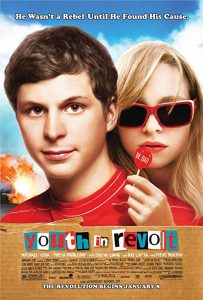
The movie I spent some time with last night was Youth in Revolt, based on a generally positive review from Fresh Air and my ongoing amusement with Michael Cera. It tells the highly episodic story of a sixteen year-old boy with a probably average and certainly miserable life, a downright horrible name (Nick Twisp), and a nagging virginity. After meeting the girl of his dreams in a northern California lake’s adjacent trailer park[2] and determining that she must surely take said virginity lest he die miserable and alone, he develops a split persona with an ironically wispy mustache and an endless supply of cigarillos that he names Francois Dillinger. With that character finally on screen at the end of the first act, the movie finally lurches out of its snail-paced romantic comedy first gear, rife with ubiquitous excessively cultured and vocabularied teens[3], and putts into black comedy at a stately second gear. This pacing issue, really, is its only serious problem. The laughs are sincere and sometimes side-splitting while they’re happening, but the flick is so very, very slow in between. Well, and there’s also the problem of Justin Long’s character, in that he seems to exist for no other purpose than to fulfill the deus ex marijuana role. Long story short? Probably not a movie worth seeing in the theater, but it was pretty funny if you’ve got an otherwise slow night and a DVD player somewhere in your future.

[1] Look, I… it happened so fast! I don’t know how to explain it.
[2] Although Sheeni manages to occasionally rise above that, it really is as intentionally trashy as it sounds.
[3] Likely in a (differently from the film’s main theme) rebellious response to their trashy or overly religious parents.

Ex Machina: Dirty Tricks

My understanding is that Dirty Tricks is the penultimate Ex Machina collection. Which leaves me all the more puzzled by how meaningless it was. Don’t get me wrong, none of the stories was in any way bad, nor did any of them leave me feeling less than entertained. All the same, when I think them over (unburied slaves ghost story, daredevil protester with a crush on the Great Machine, 2004 Republican national convention), I am left with a sense that there was no amount of plot progression or character growth. Sure, Mayor Hundred is planning for his political future, and sure, his old friend Kremlin is still working on a plot against Hundred in the hopes of forcing him to abandon politics and return to superheroism, but each of these plots is advanced so incrementally that I find it hard to credit the story can be validly concluded in only one more book.

I guess I’ll find out in May?