Red (2010)

Remember that time when they made that movie about a bunch of retired astronauts who went back into space one last time, for some reason? Red is like that, except about spies. The Double-Oh kind, I mean. On the bright side, it’s quite a bit funnier than I remember the astronaut movie being, as long as you don’t look too closely at the romantic subplot that Bruce Willis kicks off by kidnapping the hot mom from Weeds in order to head off (self-fulfilling) attempts upon her life. But of course it all works out, as movies do, without any long-term police involvement. Anyway, though, aside from that it’s a fun, breezy romp of exactly the type you’d expect from a spy movie based on a graphic novel of some kind. There’s a plot, but only enough to justify young spies trying and failing in spectacular ways to kill old spies; definitely nowhere near enough to comment upon. So, if you like that kind of thing, or just recognizable actors being reasonably funny? Dig it.

It’s a Funny Kind of Story

It’s really no wonder I see as many movies as I do, since I intend (with failures, sure, but the intent is always there) to see a movie on any given Wednesday afternoon, and then I still see other movies on the weekends or whenever. This Wednesday’s movie was It’s Kind of a Funny Story, an accurately-titled light drama about an overstretched New York City teen who asks to be committed to a mental hospital to get away from his suicidal thoughts, and only realizes after the fact what being committed actually means. And then he, y’know, learns about life and love and himself, and a lot of his fellow patients learn about these things on the way. If this sounds more than a little twee, well, it kind of was, but it had that type of self-aware tweeness that seems to say, look, this is basically a real story, and sometimes life can be a little twee, and, what are ya gonna do?

But the important thing is that it was often funny and extremely sweet, and sometimes I like movies that make me feel good. (I always like movies that make me laugh.) Oh, and another important thing is that it was populated in the main by very talented actors. Other than a few of the ancillary high school kids, pretty much everyone was really good. Good enough for me to take note of it, I mean, and one has to be a pretty strong outlier (in either the good or bad direction) for me to take note of one’s acting skill. So there’s that. But mainly, the funny and the sweet.

Neutron Solstice

I am still a little bit astounded by just how well the Deathlands series is paying off for me. Okay, sure, I’ve only read three of them so far and the series is still being published some 25 years later, but the truth of the matter is that the setting, formula, and characters are enough to keep me satisfied for a very, very long time. It turns out that post-apocalyptic gun porn with a hearty dash of science fiction and hints of a large backstory around the edges, being revealed piece by laborious piece, is pretty much my idea of comfort reading. And the irony of it is that my review of Neutron Solstice is essentially identical to my review of Red Holocaust, at least in every important way. The only differences are in the window dressing; instead of the bitter cold of Alaska, our heroes have teleported to the steamy swamps of Lousiana, and instead of Soviet invaders as the enemy, they must face the iron fist of a giant baron who is improbably not named Samedi.

But if you are looking for giant mutant alligators, voodoo zombies, maddening hints of the past from resident anachronism Doc Theophilus, or a decent chunk of backstory on one-eyed hunk Ryan Cawdor, you’ve come to the right place. Of course, you have no reason to be looking for most of those things, but that’s what I’m here for. If you’re like me and societal decay is your literary bread and butter, prepare to be astonished by just how much you’ll care about these characters, and especially by how affecting each scenario can become. Whoever this James Axler is[1], he’s actually a pretty damn good writer. Who knew?

[1] Pete knows, and I cannot help but dread the day when a new author shows up under the farm name, because what if the books drop back down to the quality of generic men’s adventure stories?

The Way of Kings

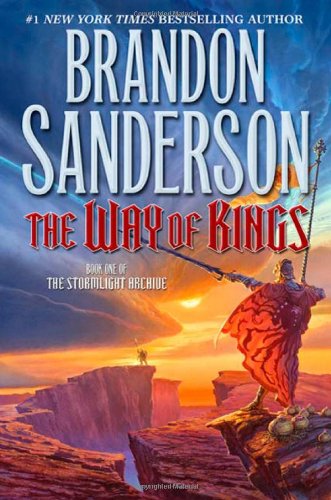
51WC999OnyLTruth be told, I finished The Way of Kings days ago, during the weekend. (Don’t worry, I’ve been reading only loose comics since, so it’s not like I’m getting backed up or anything.) I guess the reason there’s been no review is because it’s a very large book. Physically, too, but I mean it’s a very large story. I mean, it’s referenced on the cover as Book One of The Stormlight Archive, and it’s being written by the guy who stepped in because Robert Jordan was crushed under the weight of the Wheel of Time.[1] So you can see why this is tricky; I don’t think I’ve ever reviewed the first book of a doorstop fantasy series without having read other books in its series prior to any review. Still, since I keep thinking about the physicality of the book, it’s a good place to start, particularly during a month in which a lot of the chatter I see in my corner of the internet is about the migration to Kindles or other electronic book-reading devices.

Whether because Tor is also thinking about the e-book revolution a lot lately or simply because they’ve been sufficiently satisfied with Sanderson’s output over the past few years to want to splurge or maybe it’s something Sanderson wanted out of this book in the first place, but The Way of Kings is probably the prettiest modern book I’ve ever seen. The cover art is nice but not all that noteworthy; the inside is where it’s at. The inner covers have multiple different maps of the same continent, in startlingly fine color detail. The paper is heavier than I’m used to, not quite to the way I imagine vellum, but definitely of superior stock. There are any number of drawings and diagrams scattered throughout the story, each also of excellent quality. It’s the kind of book you’d expect to buy a special edition version of, years later, to get this many goodies. I know that has no real relevance to whether it has a good story, but it strongly informed my initial impressions, and even filtered through my distaste for non-physical books, it would be a pity to be looking at this on a screen. (Or even a paperback, almost certainly.)

So, was it a good book? I will say unreservedly yes, because a) I otherwise had nothing to complain about and b) my favorite part of any good-sized tale, the characterizations, was masterfully drawn. There are about four main characters and a handful of important secondaries, and another handful of very minor characters adding world flavor and possibly highlighting Important Facts that are not yet clear to me but will seem painfully obvious upon some future mythical reread. And except for those last few, I really do care a great deal about what’s going to happen to all of them. Of course, things will happen to them, as Sanderson doesn’t innovate the fantasy tropes: the world is falling under a long shadow for the first time in millennia, a shadow humanity has all but forgotten, and our heroes must figure out their own shit if they have a hope of doing anything about the worse shit coming. But Sanderson innovates like nobody’s business on sense of wonder, and he got it all over me. Still, that wouldn’t be enough to leave me excited[2] without how well he writes his characters and without the attention to foreshadowing and as yet unsolved mysteries and the promise of more that lie ahead.

I guess, after all is said and done, my excitement comes from the fact that this is the best kind of doorstop fantasy: the kind that leaves me wanting more and at the same time willing to pause and digest and discuss and (yes, someday) re-read. And while there are several series I’m in the middle of that leave me with some portion of those desires, this really is the first one since I finished Jordan’s The Shadow Rising and was officially caught up on Wheel of Time publications that has left me with all of them at once. That’s a heavy expectation to leave on a book, but I can’t really lie about it, right?

[1] I have a saidin-poisoning joke floating around in my head, but it would almost certainly be in bad taste. Well, worse taste.
[2] As opposed to merely entertained.
Devil

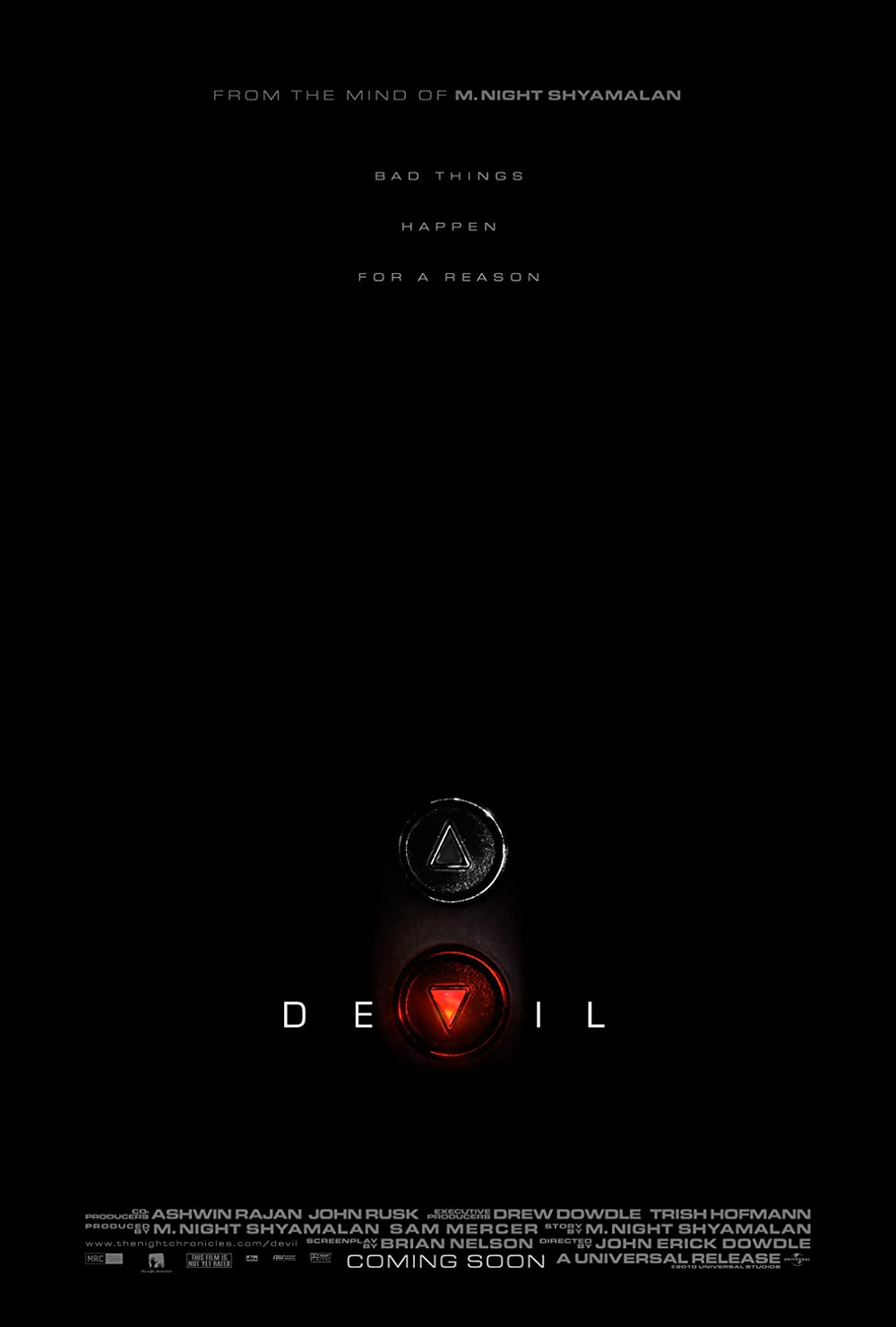
It turns out that there was another M. Night Shyamalan movie this year besides The [apparently horrible] Last Airbender. Devil had very little of his touch, though; only the story concept was his, with both script and direction handed out elsewhere. I honestly don’t have an opinion on whether that’s particularly good or bad, though I will say that it was less overwrought than, for example, The Happening. It was extremely religious, which is another of his hallmarks, though I suppose with a title like that it is to be expected here. The premise is simple and more than enough to determine if it will hold your interest: a group of people are on a malfunctioning elevator when suddenly bad things start to happen, including an eventual belief that one of the people trapped on the elevator is the devil, tormenting people for their sins even before they are dead.

On the one hand, I felt like a lot of what happened outside the elevator was fluff to pad out the movie and could have been cut, up to and including a last moment shock reveal that was neither shocking nor revelatory to me, despite that I had not figured out the “twist” ahead of time or anything like that. But then again, it’s an 80 minute movie, even padded. It was good enough for what it was, I guess, but I think I have to be disappointed by the fact that not nearly enough energy was spent on script and face time in the elevator itself, because, violent deviltry in an enclosed space, with no way to know who to trust? That sounds like an incredible premise to me, yet I don’t feel like it’s what I actually got.

Resident Evil: Afterlife

Upon realization of the upcoming release of a new Resident Evil sequel, I cleverly hosted a movie night to catch up on the previous three movies, which had a high degree of plot and character consistency across them. I’m glad I did so not only because at least two of the three movies are genuinely good, but also because the continuity has continued onward. Afterlife begins with Alice’s assault on another (or possibly the primary?) Umbrella stronghold, and then settles back into the business of the lot of the movies: finding friends and survivors (the only difference in a world with this few remaining humans being how long you’ve known a survivor) and especially finding a place where the zombies can’t get at you. I suppose it’s much the same as the Walking Dead series, except with the addition of the evil multinational conglomerate and a heightened sense of action.

Not as well-themed as Extinction nor as campy as Apocalypse, it was nevertheless an excellent sequel, with good character and action moments aplenty. Basically, if you like anything about this series, it is continuing to deliver the goods, and if you don’t, well, sometimes people and zombie entertainment don’t get along. It happens. I guess.

Ex Machina: Ring out the Old

So it turns out I was wrong about which was the penultimate volume of the Ex Machina series. But, since the series is now over in monthly publication form, I can definitively state that Ring out the Old is next-to-last. Superficially, it has the same structure as all the books: Mayor Hundred addresses a political issue (environmentalism!) while at the same time a piece of the puzzle of his past and the mysterious powers he’s been granted is revealed. The big difference is that Vaughan finally noticed his story was nearly over and picked up the pace on the latter portion. I can’t help but wonder whether the pacing would look right if I read the series all as a piece, but at the same time, the series has been released piecemeal (in two different formats) over the past few years, so there’s only so much credit I could give to that possibility even if it were factual. It’s not that it was a bad story, but since I’ve spent all this time wondering what was going on only to see it all finally revealed in a chunk at the end, mainly I’ll be glad it’s over. I guess I had a journey fail, here.

Oh, but the initial story in the book before all that I just mentioned, about Hundred’s biographers? That was just shameless self-indulgence.

Machete (2010)

I don’t even know where to begin. All I can tell you is that from the moment Machete started until the credits rolled (complete with promised sequels!), I had a grin on my face the size of Texas. At one point, I believe I actually whooped at the screen. There is just not enough hyperbole in the world to express how much I loved this movie, and I know I’m going overboard with the praise already, like by a lot, but I can’t stop myself. It is really comparable in plot and character development to what 2012 did with set design and special effects. In fact, if 2012 had not existed, I would call this the most over-the-top movie I’d ever seen, and I still think the fact that it goes in other directions will make anyone who loved that movie love this one without having to feel like it’s ripping anything off.

Of course, Machete is ripping something off, and that something is an entire decade of drive-in cinema, picking and choosing plot points, recurring themes, and larger than life characters at will to create the ultimate expression of 1970s badassery. Oh, and it’s ripping off limbs and heads by the cart-load, but that probably goes without saying. I don’t think there’s a single character that Danny Trejo (in the eponymous role) doesn’t fight or fuck his way through on his rampage through a slightly surreal version of Austin to take out Steven Seagal’s conniving drug lord; it’s not clear that Machete knows any other way to interact with the populace at large. Robert Rodriguez has surpassed Planet Terror in every way, and all with a movie he fleshed out from a fake trailer, apparently because modern politics reminded him of the idea? I am grateful to you, crazy Arizonan lawmakers!

I kind of wish I was watching it again, right now.

Marvel Zombies 2

The thing about the Marvel Zombies series, or at least about these first two books’ worth that I’ve read, is that they’re not all that good objectively. Despite the fact that they have interacted with one of the two mainstream Marvel continuities and are therefore entirely valid storylines, the main purpose behind them is still to be a little bit of a laugh. There are serious moments in Marvel Zombies 2, don’t get me wrong. Early on, when Peter Parker and Luke Cage are talking about why Pete still makes jokes, after 40 years in which they have devoured an entire galaxy’s worth of sentient life, he replies that if he doesn’t, all he’ll be able to think about are the decades of horrible atrocities he has just committed. Sure, they don’t really pick that up and run with it, but it’s heavy stuff for nominal superheroes to deal with.

But my point is that, after all is said and done, it’s still a lightly comedic look at a Marvel world where things went terribly wrong and now everyone is dead and our heroes still need to eat, and whatever will they do? You can be sure it will be violent, gory, and a little bit hilarious. And that there will be four more sequels, for some reason? If I find them used, I’ll check them out, but I just don’t have the necessary hunger for the subject matter that would require me to make them appear on my doorstep in a few days.

Drood: A Novel

The very best and very worst thing about Drood is how heavily invested it was in Charles Dickens. Because, and here’s the thing, I really dislike that guy! He probably wrote great stories full of interestingly-drawn characters, but the names are so twee and the plots so meandering (ah, payment by the word) that I’ve never been able to get past that to whatever it is underneath that people rave about. But this book, you see, in which Dickens and fellow author William Wilkie Collins concern themselves with a mysterious foreign priest and  murderer, has narrator Collins espousing the same Dickensward distaste I have, and for some of the same reasons. So it’s nice to start off a book with someone that’s on my side.

I mislike the idea of delving very far into the plot, as Simmons is good at doling that out at his own pace; it’s only the endings that seem to fall apart. And in this case, I can truly say I don’t have that complaint. The complaints I do have are largely character-based and hard to elaborate upon other than through those spoilers I’m avoiding. Suffice it to say that for a variety of possible and overlapping reasons, our narratorial window into the world is severely compromised, making it impossible to have any confidence in unraveling the central mystery of the novel, and even worse, making one doubt that Simmons actually has any complaints about Dickens himself.

Still and all, the twists and turns are entertaining and the narrator’s personality made up quite a bit to me for his compromised perspective, so if you can live without being sure what happened[1][2], it’s a pretty fun book. Also, if you care, this is explicitly the same world as his previous The Terror, right down to the fact that Dickens and Collins wrote a play on the very topic of that missing expedition. In real history, yo!

[1] And I know that some people cannot…
[2] If you’re sure that we are told what happened and I’m just holding on to alternatives unreasonably, I am prepared to have a discussion about why that would mark pretty shoddy writing and also to bring up a pair of scenes that cast vague, formless doubt on the whole enterprise.