Gravity

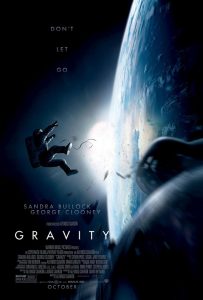
And then I finally saw a new movie, for the first time in I really don’t want to look up how many months. Gravity pits George Clooney (charm amped up to 12) and Sandra Bullock (charm amped down to 5 or so) against space in a nailbiter of an escape movie. See, there’s an exploded satellite that, post-explosion, has become a debris field, but not to worry, that won’t stop either Bullock’s specialist repairs on the Hubble nor Clooney’s “you didn’t have to be there because I’m so good at painting the picture” stories that everyone in Houston has heard dozens of times before. ….until it does. Debris fields can be a real bitch that way.

What follows is 60 minutes of sheer adrenaline broken up by 20 minutes of philosophical musings, gorgeous tracking shots of the earth and space and the tiny objects floating above the former from within the latter, and occasional bursts of tension-relieving humor. Do you want to see it? Probably, as long as you like solid acting and are not allergic to being tense for long periods of time. Do you want to see it on an IMAX screen in 3D? Yes, unless you have that motion-sickness problem some people get, and even then, still probably yes unless you can find it in IMAX 2D, because you’ll be a pretty sad panda if you see it on some middling five-story screen. I mean, it’s space. Space is supposed to be big! Y’know?

But seriously? It was good. And absurd once or twice in the best kind of way, where you are saying to yourself, “Come on! That’s not fair!”, but you are not thinking “Come on! That could never happen!” Also, in the interests of full disclosure, I grew up in the ’80s when the shuttle program was in full swing, and was raised by a man who built parts for it for basically his entire career. So I may be more than usually locked into the idea that space missions matter, among the non-scientist set. But that said, I’m pretty sure this was a really good movie on its own merits, and not just because space is cool. But that said, it was definitely as cool as it was[1] only because space is as cool as it is.

[1] “Cool” and “good” are not the same thing, obviously. But it’s always better when they intersect.

Doctor Sleep

Doctor_Sleep“Whatever happened to that kid from The Shining?” Well, it turns out that quite a bit. Danny Torrance kept his shine, picked up a genetic drinking problem, and kicked around through life doing a generally terrible job of things until he got mixed firmly into the plot of another book. Which I guess I mean a couple of ways. One is almost literally as written above, that he probably would have faded into miserable obscurity if a new story hadn’t happened[1]. And one is that, well, you could have easily told the core of this particular tale without him. He’s not precisely grafted onto it, and moreso because the Constant Author assures me it started with him, but it would only take a little unraveling to make it a brand new book with brand new characters.[3]

Anyway, because the collective of foes Doctor Sleep presents us with are so very cool and creepy, I’m not going to say any more about the plot than I have, but I owe a rundown of the book’s structural flaws, mainly because they are pretty big flaws. They did not interrupt the mood of the book one bit, and make no mistake, this is a book that, much like The Shining before it, is primarily concerned with mood. But from a plot perspective, they are really quite troubling. And…. being from a plot perspective, they are chock full of the spoilers I just promised not to provide, so continue at your peril! (The footnotes remain spoiler-free.)

Continue reading

The Wind-Up Bird Chronicle

41E4+fttDjLIn case you are wondering why I should read such a very Snow Falling on Cedars type of book, and nevermind that I haven’t read comics in ages or that there’s a new Stephen King book in the world? Book club.

So, The Wind-Up Bird Chronicle. There’s this Japanese guy, living in a house with a wife and a secret alley that wanders through the neighborhood and a missing cat and some fortune tellers and a Lolita neighbor, all of which are also Japanese[1]. And…. okay, I have no idea where to start or end this review, spoilers-wise, because very little of what actually happens is the point, and I’m going to spoil the hell out of the themes of the story, because that’s what I usually do, except this time if you take away the themes there’s actually nearly nothing to discover, so I may be doing it wrong. If you’re worried about that kind of thing or this particular book, you should skip the rest of this, only then you’d have no review at all. So here’s what I’ll do.

Before all the despoiling of the fecund thematic territory I am about to perpetrate, I will say that I did not particularly like the book, and mainly it was because of a probably cultural difference between myself and the author that leads me to strongly disagree with the points his book is making. (I am not so sure he himself is making them, but it’s hard to explain why. Hopefully I succeeded below, in the spoiler part you aren’t reading? Still, it seemed like I ought to say so, in case.) However, and this may strongly tie into the recent parenthetical distinction, the way it wrapped up was pretty satisfying, so at least I don’t resent the whole endeavor.

Anyway, though, themes. Well, theme. Toru Okada (the Japanese man I mentioned earlier), as he wanders through his world, growing more and more confused by the ever stranger events and people he comes into contact with, is presented with one unifying message from every single character, except possibly the cat: “there is no way to control fate, not yours, not mine, not anyone’s.” And I mean, the name of the book itself: there’s this bird that nobody can see, up in a tree somewhere, winding up the world every morning, and then the world goes off on its preordained path until it winds down again. And while that’s an interesting thought exercise, it makes for a pretty horrible world. Nobody can fight for happiness. Nobody can feel good about any accomplishment, nor feel regret about any shortcoming. It all just is, and that’s the end. My ability to maintain interest in characters for whom I don’t feel the slightest shred of empathy? Turns out to be vanishingly small.

The one good thing about all that is that I’m pretty sure the pivot on which the story swings is Toru’s decision whether to accept that message or not. If you are saying to yourself, “He can’t decide that or it undermines the entire premise!”, well, a) that’s what makes me feel a little better about things but also b) that’s why I’m not sure if I read the book correctly. Because, seriously, if I’m right, it’s 95% “everything is outside your control” and 1% “I disagree”, and that’s a weird proportion when you are arguing the converse. So I may really just be inserting what I wanted to happen instead.

(The remaining four percent is Japanese history lessons, ca. World War II.)

[1] I point this out repetitively because it will be important later. I pointed it out with one repetition instead of one per noun because that would have been as horrible to type as it was going to be to read.

Latitude Zero

517LqnCryCL._SY346_Here are the important lessons I have learned from reading two Deathlands books in a row[1]:

1) Yep, they are able to catch me by surprise still, and even better, do it by meeting my expectations on one hand while utterly subverting them on another.
2) It is a bad idea to read two of them in a row. It’s not that popcorn isn’t still delicious every time you get a tub of it, it’s that you fail to get the proper impact if you have it daily.
3) Man, life really is nasty, brutish, and short. These are the good guys, and they usually try their best to help the most people, but noble self-sacrifice? Playing long odds in the hopes of saving a few more? None of that. They help when they can, but if they decide they can’t, that help ain’t coming. On the bright side, they do a pretty good job of staying alive, and they’re almost never the aggressors. But heroes? Nope.

Also, though I didn’t learn this from the specific two-in-a-row circumstances, Latitude Zero taught me that this author and/or stable of authors is really quite good at recycling villains. And getting me to empathize with them, no matter how minimally. I know I keep praising this series, so I should make a point of explaining that it’s not that they’re objectively good. It’s that they’re a post-apocalyptic sci-fi series that so dramatically transcends the limitations of the men’s adventure shelf, and in so many literary and social ways, that they are objectively Not Bad. Which is wildly unusual if not unique in the annals of that shelf, and results in my getting to read a never-ending series that is dialed into my specific proclivities.

It’s like that time when the soap opera I randomly chose to watch from the beginning as my first ever soap opera turned out to have witches, talking dolls, and portals to hell opening up under peoples’ homes. Nobody could have predicted that something so perfectly aimed at me would ever exist! Much less that I would trip over it.

[1] Because I was camping in the desert and didn’t want to a) run out of books[2] nor b) destroy my delicate electronic devices[2] nor c) bring a book whose physical form I would be worried about[2].
[2] I did not. So that worked out pretty well!

Time Nomads

51o+C5jhCvL._SY346_The good news for me is, I read more than one book while camping in the desert a couple weeks ago, and Time Nomads was every bit as solid as any book I’ve read in the Deathlands series. Which, okay, I understand that these books are first and foremost pulpy romance novels for men who prefer that most of the mushy bits be replaced by guns and also the shootings of said guns into people. But they’re apocalytic sci-fi with female characters who have many qualities other than victim and a cast that is not safe from harm at any moment. Which is to say, in some ways they’re better than many books I’ve read that are of objectively higher quality.

The book starts out on its standard, with the merry band of not-quite do-gooders teleporting into a new hidden government installation somewhere in the nuke-ravaged America of the 22nd century. But then the author proves he’s not afraid to mess with his formula by sending one of his main characters on a botulism-fueled flashback to the days before they found all the hidden teleporter pads, robots with laser guns, cryogenic pods and and towns in need of rescuing that have made the series such a delight. And okay, I admit that “flashback” doesn’t sound like that much of a formula-buster, but that’s because I’m leaving out the drastic changes that occur as the book ends.

The changes may not take, and I won’t be offended if they don’t, but the fact that I can’t be sure? That’s what impresses me about this series. Well, and also the post-apocalyptic setting, but I think everyone already knew that part.

Skin Trade

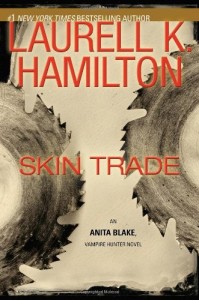
51nHng3hYnLSee, I even sort of have a couple of things to say about Skin Trade, but then I think to myself, I could not begin to guess what the title actually means[1]. It has no bearing on anything I read, none at all.
And then I think, fuck it, how can anyone else possibly still care anymore? Even the good ones are so terrible.

So. Terrible.

[1] Also, the saw blades on the cover? Equally random and meaningless. Perhaps title and cover are a metaphor for what lies within. There’s a kind of sadistic irony in the fact that it would be impossible to comprehend such a literally superficial metaphor without having read the book.

The World’s End

I made the mistake of watching a movie the day before I vanished from the internet for a week and a half, and I made the further mistake of not writing the damned review before said vanishment. So, um, sorry about that.

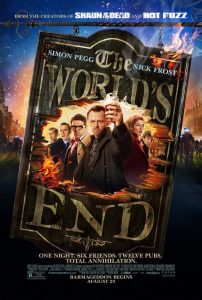
On the bright side, the movie I saw was The World’s End, a movie which you no doubt already knew you wanted to see because of its links to the brilliant Shaun of the Dead and the pretty okay Hot Fuzz. The formula is not precisely the same as before, I guess? Where the other two movies were parodies of the zombie and action genre, this is less parody and more mash-up. In the unlikely event that you aren’t spoiled for the mash-up by previews, I will leave out one of the genres, but the other is…. well, okay, hard to qualify. It’s not precisely coming of age, because although Simon Pegg plays an uncomfortably old-looking man-child, all of his friends have clearly grown up[1]. It’s not precisely whatever genre The Big Chill is, if only because the mood isn’t nearly as solemn as all that.

But anyway, whatever it is, it’s funny and well-acted and building towards something meaningful and fellowshippy, when suddenly…. but, y’know, that’s why you should go see it.

On an unrelated note, I am sad that I do not have a bar named The World’s End to go to. And not only because of books Neil Gaiman wrote once upon a time.

[1] If anything, that’s the point.

Ultimate X-Men: Reservation X

51JvJHig0aL._SY346_First, a quick scheduling note: I know it’s weird that there’s no book in between the last set of graphic novels and this one, but I’m about to be off the grid for a couple of weeks, and I both didn’t want to start a new book yet when I know I’ll be taking a couple with me and especially didn’t want to take any of these out into the wild, so, here we are. (Also, nobody at all was actually asking this question, but on the off chance one person was? This paragraph is dedicated to you, hero!)

So, anyway, Reservation X? Although it opens with a completely out of left field premise that in the aftermath of America’s eight-way civil war, the new President has a cure for the formula that was used to create so many mutants over the past few decades, it quickly becomes the first story since mutants became outlawed that actually feels kind of like it’s the X-Men again. See, Kitty Pryde (the de facto leader of the remnant of mutantkind who did not opt for the cure) is offered a chunk of desolate land where her people can form their own sovereign nation[1], and where they must find a way to live in a world that once again almost accepts them as, y’know, people while dealing with internal power struggles and external threats and resentments and also still The City, which you will mostly not remember is where all the new mutants in the SEAR reside and where Jean Grey is still hanging out.

What struck me most about the book, aside from my footnote just now, is how every moment of the story felt like it was building toward the same schism between Charles Xavier and Erik Lensherr that marked the birth of mutantkind the first time around. Hopefully that does not sound to you and will not be treated by the authors and editors as trite, because in my opinion it’s nice to see some kind of familiar order imposed on the Ultimate universe. They won me over on Miles Morales, and now the X-Men has mostly stopped being a muddled, sprawling hash of a storyline too. I dig it!

[1] Um, wow. How did it take until I was reviewing this book to realize that the Ultimate mutants have been the Jews since like 2009? (Plausibly longer.)

The Walking Dead: What Comes After

WalkingDead_Vol18_WhatComesAfterIt seems like the last several Walking Dead collections have left me feeling reluctant to continue with the series, yet I keep finding new reasons to go on. And there’s probably a lot of truth to that, though I still stand by my most recent prediction that extending beyond today’s storyline will be a huge mistake. Luckily, that has not happened yet, and so I can document my positive reactions and not feel like a chump.

So, you are undoubtedly asking yourself, What Comes After? Besides a painfully generic title, I mean. I guess my answer is, a cult of personality? Also, a renewal of my certainty that Carl Grimes is the toughest customer this side of The Internet’s Chuck Norris. But yeah, what I mean is, Negan is downright fascinating, for all that he’s a terrifying psychotic killer. Far more entertaining than the Governor ever was, and as long as he stays that way and nothing else really boring comes along, I’ll be fine seeing this storyline extend onward a ways. Could wrap up in one book? Could extend for two and not feel like it was being milked, if done properly. But after that? Yeah, I dunno.

But it does seem like 20 is a nice round number, you know?

The Boys: Herogasm

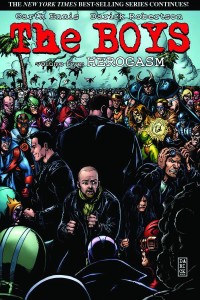
the_boys5In its way, Herogasm is pretty clever. See, it starts off with the concept that big superhero crossover events are all faked, and while the various teams are off “fighting off the alien menace” (or whatever it is this year), they’ve really taken a week or two off at an orgy resort, to recharge their batteries. And since the biggest conceit of the Boys series is how superheroes are basically all horrible people who make the world a consistently worse place, I can appreciate what Ennis is doing here.

Of course, then he and his artist take this premise as a challenge to draw and write the filthiest scenes they can come up with, and they keep throwing it at you nonstop, and at some point even my prurience threshold was overcome. I like to hope this was the point, but I imagine I’m fooling myself there.

But then (and here’s the clever bit), suddenly there’s all kinds of deep politics, both in the present-day and flashback portions of the story, bubbling up around the non-stop porn, and before you know it really big events have occurred and you were still trying to figure out if you were tired of the nipple parade and you almost missed it. I’m definitely not saying that Ennis was trying to slide some mocking social commentary over on his readers here; like I said, I’m not even sure he was trying to make the point that I should have been getting tired of it in the first place. But I am saying that it was an artful job of playing to his strengths.