The Invention of Lying

I know that October isn’t really the right time of year to watch comedies. I mean, it’s really a pretty straightforward process. October and February are for horror, November is for family movies and James Bond, December is for OMG-Drama, spring (and September? I’m not entirely sure where September fits) are for comedy, summer is for action blockbusters, and January is for movies that honestly shouldn’t ought to have been released. But, okay, Hollywood doesn’t always do the right thing, and also sometimes I am in the company of people who have an aversion to this or that type of movie. In this instance, despite there being a couple-few horror movies left for me to catch up on for the month, I ended up seeing The Invention of Lying.

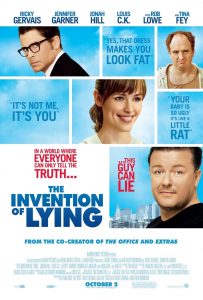
Imagine, if you can, a world in which humans never learned how to lie. I mean, not about anything. They don’t even have that polite society filter that keeps them from saying whatever crosses their minds. And Ricky Gervais is one of this world’s losers, near the bottom of the genetic lottery, and almost out of job prospects despite talent, because of nothing more than unfortunate luck. And in this moment of disaster, a neuron fires in a way that has never happened before, and he, y’know, invents lying. Next thing you know, he has achieved fiction and religion, not to mention a ton of cash, yet despite all his efforts, he cannot win what he wants most of all: the love of Jennifer Garner. The rest, well, romantic comedy, I guess? Will he learn a valuable lesson, will it come too late, etc.

And you know, it was funny, and it was sweet, just as you’d expect. It was even funny for a regular funny movie, so quite a bit moreso than the usual romantic comedy. (It may have been sweeter than usual too, but as I had been rendered tipsy earlier in the evening, I do not fully trust my opinion on that matter.) The one thing I didn’t like was the religious angle, because it seemed, well, a little cruel. I mean, in the movie it wasn’t at all, but there was still this underlying snicker, like even though Ricky Gervais isn’t a jerk, probably whoever invented religion the first time was. And I figure that as many good religious people as there are, it didn’t have to be that way at the start. My headspace on this point may be all jumbled, I admit. It’s not like I disagree with the underlying point at all, I just don’t think it needed to be mean. So, there’s that?
Zombieland

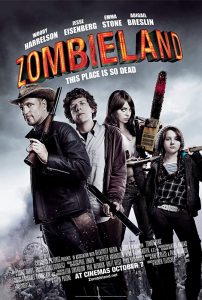
So, okay, Woody Harrelson versus the zombiepocalypse. There’s no chance I was not going to love this movie. Calibrate accordingly.
Well, nah, honestly I’ll be able to calibrate Zombieland pretty well my own self. Because it mostly was not one of the classic Romero zombie movie types where the zombies are a setting in which to cleverly satirize the American condition, I won’t be endlessly and high-falootin’ly describing the literary-cinematic influences and depth of the work, like I might be inclined to do in different circumstances. No, it was a pretty straightforward road trip movie, wherein our cast of characters must learn to trust each other and grow into a tight knit community by the end. Just like every road trip movie, is what I’m saying. Except for the part where road movies don’t usually have zombies, a hilarious running schtick about the rules to survive in Zombieland, or did I mention really a lot of zombies being fought by Woody Harrelson?

Seriously, what part of that premise isn’t pure gold?

Dragons of the Hourglass Mage

The final volume of another Dragonlance series has at last arrived, and I am forced to admit to a lack of objectivity about Dragons of the Hourglass Mage. Because, as the cover and unwieldy title alike imply, it is mostly about Raistlin Majere, and I don’t really get tired of that guy, at least not when written by Weis and Hickman.

Pretty much, the book details the lost month in the original Chronicles between when Raistlin left his companions to die in the Blood Sea of Istar[1] and when he reappeared at the series climax to tilt the balance against the Queen of Darkness[1], in order to further his own ambitions via a freer world. It may contradict some of the other main sequence canon, but never in very noticeable ways. Plus, since the character study continues to fulfill everything I’ve sought out of the series in the past twenty years, I don’t really care. Things in the story include a secret resistance in the heart of evil’s lair, an assassin kender, a plot against the gods of magic, and perennial Dragonlance favorite Lord Soth, the death knight. Unless you also really like the psychology of Raistlin Majere, though, it’s okay at best.

[1] Sometimes, when I have not typed the words out in a while, I forget just how standard-fantasy these books can get.

The Final Empire

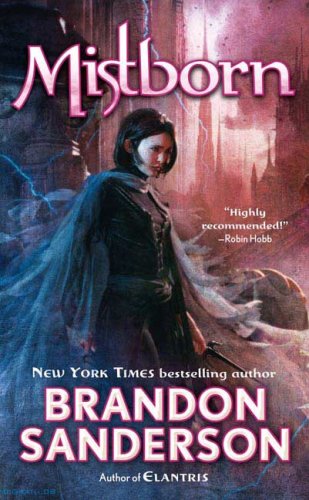
51E+7V-PDyLAt long, long last, I have found copies of some of Brandon Sanderson’s Mistborn trilogy. Sanderson, you may already be aware, is about to publish the first of the concluding volumes to Robert Jordan’s Wheel of Time series. Naturally, therefore, I’m interested in seeing how his previous writing style goes. And awesomely, I can report that Elantris was not a one-hit wonder.

The Final Empire tells the story of an indentured people that have been held down for a thousand years partially by the ruling noble class but mostly by the Lord Emperor, an immortal god-ascended man who once saved the world from a vague being known only as the Deepness, and by that man’s Inquisitors. It doesn’t help the enslaved skaa that the nobles are not only propped up by the regime, but that some of them also have magic powers derived from burning ingested metals and related alloys, such that they can see better or have more strength than normal people, or even influence emotions. Skaa women with whom the nobles dally are immediately killed to prevent the talents from entering that population, though of course it’s not a perfect system…

And then, there are those who have not the power to burn one metal, but the power to burn them all. These Mistborn are virtually unstoppable, except in combat with each other, or with the Lord Ruler’s Inquisitors. A skaa Mistborn would be the most dangerous creature the Final Empire has ever encountered. And though I bet you can guess what happens next, the story has twists and turns galore to keep you guessing at every moment. And after a full-blown stand-alone conclusion, there are still two more books worth of supposed awesome ahead of me!

Law Abiding Citizen

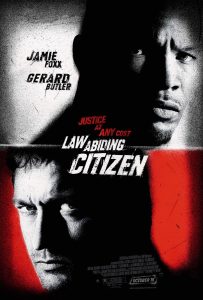
Law Abiding Citizen is, in addition to being a frequently good movie, kind of a comparative sociology experiment. So there’s this guy, and his family gets killed in a home invasion. Then later, DA Jamie Foxx cuts a deal with one of[1] the two invaders because he doesn’t think the case is strong enough to get both of them. Later still, the guy whose family got killed puts together the best revenge package imaginable.

Anyway, sociology, right? This is true in a few ways. Firstly, it marks a clear divide from what I’m going to call a generation ago, in the ’70s. Back in those days, when Charles Bronson’s wife and daughter were raped and/or murdered, he would never have even let the law get involved in the first place, and the audience would have been with him the whole time, no matter what he did. Of course, Chuck would never have gone after innocent people, so that’s an important possible distinction. Also, though, I learned something important about audience dynamics. It seemed to me that the moment when people finally turned against the guy, saying his revenge had gone too far, was when he killed the cute blonde chick. I know that the media has already demonstrated this sociological tidbit, but seeing it in live action and furthermore knowing the writers had planned to evoke the audience turn? Little bit weird to realize it this fully.

By and large, it’s a decent flick. Marred by some unfortunate (and worse, wholly out of place) sexism, but if you leave that scene out of it, you’ve got a pretty great combination revenge flick and tension thriller. If I knew how I’d feel about it without having actually experienced the plot, I’d watch it again.

[1] The worse one, though in fairness he probably could not pick who would make the deal?

Paranormal Activity

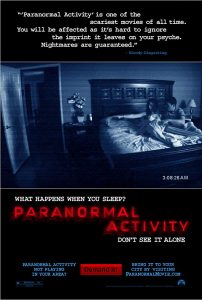
On Thursday, I had never heard of Paranormal Activity as a movie, even though it has apparently been out since 2007. On Saturday, I watched it, knowing nothing more than what I’m about to say here: spooky stuff is happening in a house, the residents set up cameras, and then bad stuff happens. Delving only slightly more, the girl has been haunted by something spooky for her whole life, and this is the latest iteration thereof.

I can’t exactly say it scared me, although there are circumstances under which it could have. For one thing, the audience would have needed to not be present. On the bright side, I traded potential fear for guaranteed amusement. There really is something awesome about listening to ripples of shock and fear spreading through 500 people at your back that brightens your day! Another fear-conducive circumstance would have required me to live in an alternate universe where The Blair Witch Project had never been made. And in some ways I would prefer that alternate universe, because this would have been far scarier than Blair Witch was when I saw that movie under the precise circumstance I describe. All that said, the movie really was pretty affecting, with slowly building tension that transformed into dread and quite a few “oh shit” moments.

I guess the best thing I can say for it is that, unlike the majority of movies I see these days, I forgot to mentally write my review as I was watching, because I really did want to see what unexplained and maybe-scary thing would happen next.

Ice Age: Dawn of the Dinosaurs

Rainy days plus dollar movies equals a pretty decent salvage of a date day, if you ask me. Although I guess I never saw the middle one, the original Ice Age was pretty good, so I was perfectly happy to accept the idea of checking out Ice Age 3 when it was presented to me. Dollar movies, for now, means no 3D, so I dunno about that part. But the movie itself was mixed. As a kid movie, it was perfectly fine, sometimes way to kiddy for me like you’d expect, other times with surprisingly naughty dialogue that had me laughing in shock as much as humor. But, y’know, adventure, heart-warmingness, dinosaurs, all the stuff you expect in a kid movie, even if it is served a bit lukewarm to not burn all those metaphorical kid tongues. I mean, it had Denis Leary, and even lukewarm Denis Leary will entertain me pretty well. I may even be a fan.

As an adult movie… I mean, you know it won’t work, right? So when they try, is that a good thing because they want to overcome their limitations, or is it a bad thing because they give you whatever brief moment of unfortunate hopefulness? I honestly can’t decide, either in this case or as a general purpose question for the genre. In this case, the adult theme they inserted was the way that friendships are able to suffer when some friends are married and starting families while other friends are still free-wheeling singles.[1] And I was a little bit interested in seeing where they went with the line of thought, especially since Denis Leary was the main representative of the free-wheeling class, and I thought it might spice up his otherwise kid-friendly performance at least a little. Instead of that actually happening, the sloth character was put into danger via an underground lost dinosaur world, and everyone ended up on a quest to save him, at the end of which they all just decided to stick together and be a big family unit instead of actually resolving any of the underlying fractures that initially raised the question. Which is fine in a kid movie, but I thought, if only for a few moments, that it might be more.

Oh, well. On the bright side, there was a canyon chase on pterodactyls, and a lot of lava. That shit is awesome even in 2D, no matter what else might be going on around it disguised as plot. So there’s that. That, and velociraptors.

[1] It occurs to me, belatedly, that not many free-wheeling singles are going to show up in the seat for this one, so the message might have been skewed more than a bit from the start. But okay.

The Walking Dead: What We Become

The new Walking Dead books keep catching me by surprise. Which is nice, really, I’m not complaining. There I’ll be, scanning my Amazon gold box for cheap stuff that I usually don’t want or need, and hey, another new one! Still, I think it may be a little while before this happens again, so I will bask in pleasedness over the event for a moment.

You can probably tell by now that I’m padding. I have a good reason. The book is great, although not much plot momentum occurs. But that’s okay, because I’ve felt throughout this ride that Kirkman really gets what a zombie story is about. Zombies themselves are mostly boring, and the struggles against them, while interesting enough on both the purely physical survival level and on the mental game-of-chess level in which an entire unthinking world of death is ranged against the few survivors, can only capture so much attention before repetition sets in. But the psychology, the eroding emotional state of people who are thrust into this impossible and deadly world? I just don’t get tired of that, no matter how long the story lasts and no matter how many different versions of it I am presented with.

So you’ll understand why What We Become was so compelling to me, even though there was no real movement on the hinted plan for eventual salvation. But at the same time, I can’t really say anything about the book that the title hasn’t already said. A year beyond the zombiepocalypse, a year filled with unrelenting horror interspersed with only the sparest patches of peace and contentment, and it is time for the characters to take stock of their place in the world, an emotional dipstick measuring the dregs of their humanity. But no matter how bad things may seem? They’re still alive, and in Kirkman’s world, that may be the only measure anyone is still capable of taking with any true accuracy.

Jennifer’s Body

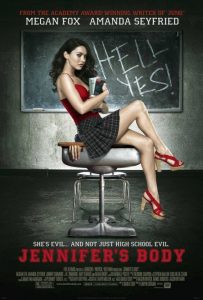
This was not the movie I expected. I saw previews in which the freakishly hot Popular Girl and the attractive but movie-mousy Best Friend have a power-based friendship that devolves when the hot chick is revealed to be a vampire, and I was pretty sure I’d be seeing a horror-slanted riff on the darkly comedic high school ground broken by Heathers. Coming out of the theater though, I can better relate it to the cinematic version of Buffy the Vampire Slayer that Joss Whedon disliked so much. There’s still a little black comedy, sure, but it’s pretty much an even split between an actual horror movie and an over-the-top zany comedy.

Jennifer’s Body follows the devolution of that primary relationship I mentioned after the aforementioned Jennifer turns out to be a demon who is gradually eating the boys in the senior class. Which is not really a good measure of… Well, words are kind of failing me here, which is unfortunate because it’s a surprisingly good flick. Mixed in with the hilarity and the occasional scares is a pretty decent metaphor for growing out of school relationships that are based more in history than reality and toward adulthood. Then again, the paired sex scene between the main characters in dueling scenes[1] made no sense to me at all, so I’m not trying to say it’s all oniony layers of impressive and thoughtful depth here.

But I can say that Megan Fox has the best set of dying words I have ever seen on screen.

[1] 2018 edit: I know what I mean here, but damned if I can figure out how to phrase it better. They each were having sex with other people, in different locations, in one intertwined scene in the movie, is what I mean to say.

Ultimate Spider-Man: Warriors

So, the most recent Ultimate Spider-Man, Warriors[1], has me thinking about Peter Parker’s foes. Most of the time, they’re dudes that were changed by science like he was, only with more sinister results. Most of them are bit characters, because there are always way more villains than heroes, and the heroes never permanently lose. (Mostly.) You’ve got the Green Goblin and Doctor Octopus, with whom he shares pretty much a familial bond.[2] But otherwise, most of what he faces is a generic stream of similar villains that he can quite easily quip to death, even without the spider powers. But then there’s the Kingpin.

Wilson Fisk is just a rich guy mob boss type. His henchmen are all just folk too; Elektra has no special mutant or science-run-amok powers that I can figure, and just about everyone else he works with isn’t big-time enough to have a recognizable name. He could be Spider-Man’s least interesting foe, and yet instead I think he may be the best of the bunch. He’s scary smart and he has the power that money brings, even though he’s been laying low due to legal difficulties for practically the entire run of the comic. I guess it’s a lot like Lex Luthor with Superman: the only person who can really compete with an unstoppable force is the one who can out-think it. And okay, Kingpin is a bald rich guy, so maybe there’s a little bit of larcened[3] idea in the character at that. But I don’t really care, because the more important of the two is original, and nowhere near an unstoppable force anyhow, which leaves Kingpin free to be even more of a puppet-master. Case in point: the book that I just finished reviewing, albeit in footnote one.

[1] The actual book? Of course it was fantastic. What do you expect me to say instead, at this point? In a way, there were way too many bit characters from previous continuity (and, okay, also from previous events in this series), but in another way, that managed to work and be really cool itself, even though that kind of thing usually pisses me off. Which is why I keep writing paeans to Brian Michael Bendis. Whatever he’s selling, I apparently keep buying it.
[2] I mean, Norman Osborn created him, and the paternal vibe has been there ever since. All too readily, Harry Osborn falls into the overlooked brother role, and Otto Octavius, self-created but still in Osborn’s employ when it all happens, kind of feels like part of the family to me too. The last part may be a stretch, I admit, but I’m impressed with how neatly Bendis shoehorned the other three characters into these roles, just as though they had always been written this way.
[3] Is that even a word? I bet not.