Ultimates: Reconstruction

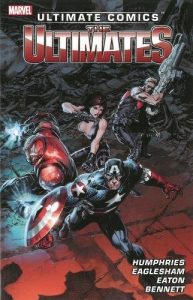
So there was this big Civil War that happened in the Ultimate universe. I mean, not between superheroes, they just did that in mainstream, and boy howdy have I no idea when I’ll get there to see it. No, this was straight up a bunch of warring American factions as the country fell apart. Also, Hydra. (They’re a (let’s say) terrorist organization on American soil, fighting against, or for… something, I guess? At least in the ’60s, it was just plain old world domination. I have no clue what new Hydra actually wants, though. I don’t even know if that’s bad writing (probably[1]) or a clue about something I may learn someday.)

Anyway, there was a civil war. Thus, the next step, Reconstruction. Which basically consists of Captain America, in his new position, moving from crisis to crisis as Hydra, California, and other collections of basically terrible people try to take advantage of the still fragile situation for their own various, nefarious purposes. Other boxes being ticked off: the West Coast Avengers Ultimates, and Vision. You may think, no no, they already did the Vision, right? Someone disagreed that it was done on enough of a 1:1 correlation, is all I can say in answer. Well, unless I want to get impolite and say that someone thought it hadn’t been done derivatively enough? But that would make it sound like I hated this book, and I didn’t. I’m just very aware of its limitations.

Good news: the really bad idea of a job that Cap took? I think they’ve reset it back to status quo, so I’m hoping that fixes the rest of the problems by the time I read Volume Oh Good, We’re Back to 2 Again.

[1] In that they may just exist so someone can check off the “Did we use Hydra yet?” tickbox, and that someone failed to consider what specific goals / desires new Hydra should have. This book gives them a goal, but it is a reaction to something that happened after they were formed, so their original goal? Completely unknown to me.
Fables: The Dark Ages

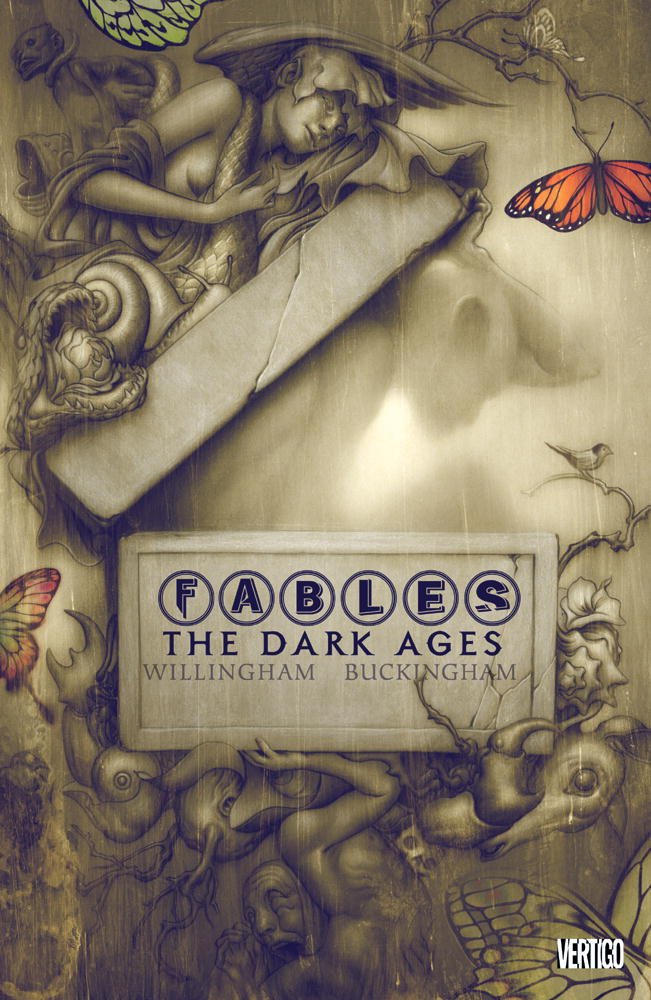
71y77SjvsBLDespite how far behind I am, I probably would not have read this yet, except I realized about three issues in that I had it backwards with the Jack of Fables I just finished, regarding publication order. So I went ahead and fixed that, as you’ve seen, but then: already three issues in, may as well read the rest. And so here we are, at the end of the twelfth volume in the Fables series, The Dark Ages.

Which, okay, that title doesn’t make much sense when you consider that they just won the war against the Adversary (whose name I should probably stop inching around, to be honest) and Fabletown is no longer in imminent danger, right? Sure, the Empire is still out there, mostly holding all the old lands through numbers and inertia, but it’s a headless snake now, and any heads that develop will at least be smaller and less dangerous. Right?

Let’s just say that any fears I may have expressed about the story’s ability to soldier on in the absence of its initiating premise have been laid to rest, and in rather dramatic and literal fashion at that.

Jack of Fables: Turning Pages

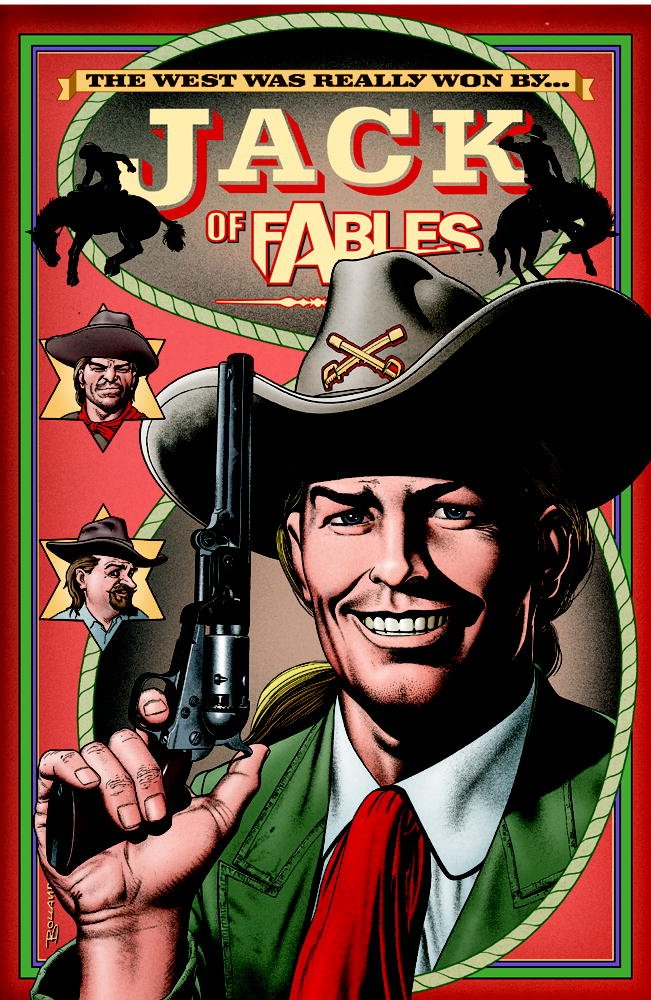
71BC8eESweLIt turns out that if your cyclical reading schedule for graphic novels comes into conflict with your desire to reread the great fantasy series of your lifetime, you can end up going a year and a half between one book and the next. Which explains why I had almost no idea what was going on in the fifth Jack of Fables book. I mean yes, he’s still the self-absorbed, money-, sex- and fame-obsessed character who climbed a beanstalk that one time. I haven’t forgotten everything. But as to his specific circumstances? Let’s just say it’s a good thing I have a long-running review blog.

Good news for me is that this was an incremental book. That is, the first half of the story was a conflict between Jack and Bigby Wolf in 1883, a follow-up I suppose to some previous historical Jack tales about his time in the Civil War[1]. So it was easy to follow, and then I only had to deal with three issues advancing the main plot, which was just enough time to a) get me caught up and ready for the next book, y’know, months from now when I read it, and b) make me fully aware that there’s some high-level familial machinations going on here that I probably need to be paying much closer attention to, to understand them.

There’s this guy Revise who I’ve mentioned before, who wants to make everyone forget all the Fables, because… I wonder if I’ve ever known why? And there’s this guy Bookburner who hates Revise, but seems to destroy Fables, and I guess that’s worse than draining them and the world of magic through forgetfulness, but all in all, I don’t understand why these people are opposed to each other. Except that there’s a lot of family drama, all of which involves other characters with literary tropes as names and powers, and frankly the literary-trope-as-plot works so much better in The Unwritten, which to be fair I had not yet read any of last time I read one of these. So that’s unfortunate.

It’s not like the book’s bad. I really like Jack[2] and I like the hot librarian sisters and the bizarrely Proustian miniature blue ox and quite a few other things that are going on, but the plot? Either I’m lost, or I don’t get it, or it’s kind of dumb.

[1] I sure don’t remember which book anymore, so no link for you.
[2] Well, no, but I really like to read about Jack.

The Lies of Locke Lamora revisited

91Lq5qpHKxL._SL1500_A really cool thing happened a couple of months ago, which was that a new Locke Lamora book was released. Since I rather liked the first one a lot[1], this was naturally exciting to me. But then, I realized that it had been five years since I last read one of these books, and, well, I didn’t exactly remember what had happened. Broad strokes yes (and mostly accurately, as it happens), but fine character and plot details, not so much.

I won’t drag this out, both because I’ve already been here before and because I have plenty of things I’d like to be reading right now. First: yes, I still like this book a very great deal. With a five year veil, everything I didn’t remember took on the sheen of awesomeness, amusement, sick horror, and exhilaration that I’m sure it had the first time through. The one thing I did pick up on that I certainly missed before was Locke’s overwhelming pride in the first third of the book. It really stands out in sharp relief when you know just how hard the left turn is about to be.

Anyway, really cool story, stands alone, well worth the read. And I’ve been told that you don’t actually have to reread these to prepare for the new book in the series. While I’m sure that’s true and while I regret that I haven’t read the new one yet myself, I regret it in the way I regret the other dozen or so books that I want to read right this instant. In no way do I regret the reread.

[1] And also the second, but all in due time.

The Boys: Self-Preservation Society

boys6My research indicates that, having finished Volume 6 of  Ennis’ The Boys series, I am halfway done. (Also, that all of them are published, so that’s nice.) This particular volume is pretty much just going through the motions, with no real plot development to speak of.

Which, okay, it’s not an especially fair claim, but I can’t help being disappointed in a book which, when all is said and done, provides no real movement. Sure, the author has ticked off his “I’d better parody the Avengers” checklist, including the spectacularly over-the-top inclusion of a Nazi super-soldier as their leader.[1] And yes, it’s nice to get origin stories on the three supporting members of our titular band of ne’er-do-wells. (Except for how I found the Frenchie’s origin to be actively annoying. But I could be biased.) But that’s just not enough.

It’s strange to realize, I guess, that the most interesting story and character development occurred among the bad guys this time, is all.

[1] Probably I’d be less irritated if it hadn’t felt exactly like a tickbox instead of an actual event. Also, if it hadn’t seemed so nakedly steeped in shock-value. Also, if there had been consequences.

Thor: The Dark World

THURS_003B_G_ENG-GB_70x100.inddFirst things first, to get it out of the way. Yeah, I really liked this movie. There were disappointingly obvious problems with Newtonian physics, and there was, as far as I can recall, no more than one plot turn I didn’t see coming. Nevertheless? Loved it. I mean, to start with, I’ll watch an entire 120 minutes’ worth of Darcy reaction quips and consider it money well spent.

But aside from hammer gags, cool explosions, and Kat Dennings, there are solid reasons to like Thor: The Dark World. Probably the precipitating plot, in which Christopher Eccleston is more or less wasted behind too much makeup as an inexplicably albino Dark Elf who wants to return the universe to eternal darkness and who nearly kicked Odin’s father’s ass several thousand years ago during his first attempt, is not one of them? I’m not saying I dislike comic book plots, because I don’t, but it’s impossible to deny that this one is towards the fringier end of the form.

The broad, vague answer is that I liked the acting. It doesn’t hurt that I’ve been immersed in 1960s Thor comics for the past few months, but it was cool to watch Odin interacting with his two sons. Far more than that, though, this movie gave me something I didn’t realize I’d been missing in the annals of Marveldom[1]. I finally have a solid, bone-deep belief that Thor and Loki really are brothers. That’s going to help me later, when I’m still reading 1960s Thor comics and Loki is still a cartoonishly annoying villain instead of nuanced and clever.

Also, Natalie Portman was in it, I guess? In retrospect, I should probably have more to say about someone who got so much screen time.

[1] Except maybe the Loki book I read years ago now, before I’d barely gotten started on my in-depth project here? Who can remember what happened in 2007, though?

The Handmaid’s Tale

51qGjF8UHJL._SY344_BO1,204,203,200_Another month, another book club book. This time out, a horribly dystopian near-future examination of some religious dudes stealing everything from women. You know, to save them from how cruel the world can be. I must say, despite taking a while to get to a point where it was believable, The Handmaid’s Tale seemed utterly plausible from then on. Due to plummeting birthrates and the aforementioned (aforeimplied?) enslavement of functionally all females in the nation, our mostly-nameless heroine viewpoint character heroine has been enrolled as a Handmaid; which is to say that, Genesis-style, she acts as a stand-in for the wife of one of the high muckety-mucks of the fictional future nation of Gilead, so they may be fruitful and multiply. Keeping in mind the disdain these people have for fertility clinics (or, indeed, science), well, my point is to say, yes. That is every bit as horrible as you’re imagining it to be.

The rest of the story, with its leisurely revelations of the world Atwood has built[1] and its insistence on hitting the reader with one terrible event after another, is a surprisingly difficult slog. Well, if you’re looking at the size of the book it is, anyway. If you’re considering the emotional toll of the things I’ve mentioned and taking me at my word that I’ve left out five or ten reveals for every one that I’ve spoiled so far, well, it’s easy to see why the emotional density of the book makes for a slow, miserable read.

The worst part is, it was extremely good and I wanted to know what would happen. If only it had read as badly as it made me feel and I could have quit a few chapters in!

[1] She revealed things far more leisurely than I just have! In my defense, I’ve still only scratched the tip of the iceberg.

Ultimate Wolverine: Legacies

51KsVWevvML._SY344_BO1,204,203,200_I am really incredibly bad at reading this year. Perhaps I’ll be slightly better at moving? I’ve been pretty good at burning, and I’ve maintained my general high qualities of working and drinking, so at least I can point at where the time went? (Except the drinking, which usually includes reading, so I don’t know how to reconcile that part.)

The reason you care about all this is that I’ve been annoyed to be so close to caught up with the Ultimate Marvel series only to have it slip through my grasp again. But one is better than none, which brings me to Ultimate Wolverine: Legacies. I know what you’re thinking. Didn’t Wolverine die? So, no, it’s cool, they haven’t started bringing people back to life. It’s more like, y’know, legacies. Which is to say, Logan’s son Jimmy Hudson (who I’ve possibly mentioned once or twice before while I’ve read recent mutant events) is on a quest to learn more about his biological father, instigated by an unexpected underlying signal in the holographic message Logan left for him.

Then, you know, *bam*, plot. Including more from Quicksilver, who we have not seen in too long considering what he was up to the last time we saw him. So it’s nice to know things are still happening with that guy. Unlike Jean Grey, who no longer makes any sense to me whatsoever. (She wasn’t in the book, I’m just complaining.)

Gravity

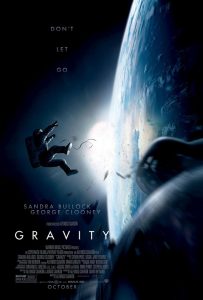
And then I finally saw a new movie, for the first time in I really don’t want to look up how many months. Gravity pits George Clooney (charm amped up to 12) and Sandra Bullock (charm amped down to 5 or so) against space in a nailbiter of an escape movie. See, there’s an exploded satellite that, post-explosion, has become a debris field, but not to worry, that won’t stop either Bullock’s specialist repairs on the Hubble nor Clooney’s “you didn’t have to be there because I’m so good at painting the picture” stories that everyone in Houston has heard dozens of times before. ….until it does. Debris fields can be a real bitch that way.

What follows is 60 minutes of sheer adrenaline broken up by 20 minutes of philosophical musings, gorgeous tracking shots of the earth and space and the tiny objects floating above the former from within the latter, and occasional bursts of tension-relieving humor. Do you want to see it? Probably, as long as you like solid acting and are not allergic to being tense for long periods of time. Do you want to see it on an IMAX screen in 3D? Yes, unless you have that motion-sickness problem some people get, and even then, still probably yes unless you can find it in IMAX 2D, because you’ll be a pretty sad panda if you see it on some middling five-story screen. I mean, it’s space. Space is supposed to be big! Y’know?

But seriously? It was good. And absurd once or twice in the best kind of way, where you are saying to yourself, “Come on! That’s not fair!”, but you are not thinking “Come on! That could never happen!” Also, in the interests of full disclosure, I grew up in the ’80s when the shuttle program was in full swing, and was raised by a man who built parts for it for basically his entire career. So I may be more than usually locked into the idea that space missions matter, among the non-scientist set. But that said, I’m pretty sure this was a really good movie on its own merits, and not just because space is cool. But that said, it was definitely as cool as it was[1] only because space is as cool as it is.

[1] “Cool” and “good” are not the same thing, obviously. But it’s always better when they intersect.

Doctor Sleep

Doctor_Sleep“Whatever happened to that kid from The Shining?” Well, it turns out that quite a bit. Danny Torrance kept his shine, picked up a genetic drinking problem, and kicked around through life doing a generally terrible job of things until he got mixed firmly into the plot of another book. Which I guess I mean a couple of ways. One is almost literally as written above, that he probably would have faded into miserable obscurity if a new story hadn’t happened[1]. And one is that, well, you could have easily told the core of this particular tale without him. He’s not precisely grafted onto it, and moreso because the Constant Author assures me it started with him, but it would only take a little unraveling to make it a brand new book with brand new characters.[3]

Anyway, because the collective of foes Doctor Sleep presents us with are so very cool and creepy, I’m not going to say any more about the plot than I have, but I owe a rundown of the book’s structural flaws, mainly because they are pretty big flaws. They did not interrupt the mood of the book one bit, and make no mistake, this is a book that, much like The Shining before it, is primarily concerned with mood. But from a plot perspective, they are really quite troubling. And…. being from a plot perspective, they are chock full of the spoilers I just promised not to provide, so continue at your peril! (The footnotes remain spoiler-free.)

Continue reading