Poseidon

Via the cleverly cunning plan of suggesting it, I have finally managed to catch up on the last of my summer blockbuster list; well, I mean the ones that have been released yet. I’m still short one or two current films, mind you (*cough* See No Evil), but certainly no blockbusters. Heck, I’m not sure if there even are anymore until Superman. So, yay for that.

Also yay for Poseidon. Okay, sure, it’s a remake. But at least there was a book behind both films, so I can pretend like it’s not a remake, a little bit. On top of that, it really was quite a bit better than the original. Obviously, 30 plus years of special effects advances were put to good use. But also, lots more adrenaline-pumping action. Now, is that automatically a good thing, replacing a character study film set in a disaster with a disaster film? Normally not, but the character study portion of the original fell flat due to subpar acting. In this case, the substantially reduced character study portion worked, because of a more skilled cast. (Or maybe direction? How should I know?)

Plot: Boat flips over due to technobabble (really? A rogue wave? Even if those exist: really?), ten mostly random people band together to escape, come hell or high water. Lots of character translated across, and some didn’t. Any place that I could see a translated character, the new version did a better job (or at least as good), so that was a nice change of pace. Except for Ernest Borgnine, who was still great, but as there was no adversarial character to compare with his original in this new cast, I can just leave him being awesome in the original by himself. And except for the kid, because one child actor is pretty well interchangeable with another.

In fact, the only unfortunate part of the movie was the obligatory child in danger, and will he somehow be rescued in time? It served a purpose in the plot beyond the lameness of its existence, I acknowledge that. But it was lazy writing to serve said purpose with this tired old saw. Sure, right, an eight year old is going to wander away from his mother after about 53 minutes’ worth of terror-laden escapes from certain dooooom, and for no apparent reason whatsoever. Really, if the rest of the movie hadn’t been quite so good, this would not bother me nearly as much.
Bloody Bones

As a result of a brief spate of overly long books, I went the short book route again, and might for the next little while. My immediate short book impulse these days is Anita Blake, because there are just so damned many of them and I can never find any Pratchett in the used bookstores. In that Bloody Bones mostly avoided the “How is our heroine’s love life these days?” thing that was starting to grate on me a bit, by virtue of taking the action out of St. Louis and over to beautiful, touristy Branson, I have to call the whole thing a rousing success.

I mean, okay, calling any of them a rousing success is perhaps overstating the case, but it’s nice to see some variation repairing the only real flaw in what’s been a nice bit of fluff over the past many months. This was an earlier edition than what I’m used to seeing, and the typos were mysteriously vanished. So I’m inclined to blame the new publisher a lot, now; if you insert new typos into future editions of a book that didn’t originally have them? That’s just sad. Most of the rest of what I have appear to be the not as good editions, but having solved the mystery, I probably won’t complain about it anymore. So there’s that. Plus, mystery-solving, look at me getting all kinshippy with the necromantic vampire-slayer chick.

So, what does this entry in the series have, relative to the others? Murders, as usual. Zombies, as usual. Vampires, as usual. Faeries, which is new. A different set of cops than usual, thanks to the jurisdictional change mentioned above. An apprentice vampire slayer, definitely new, but a welcome addition to the cast. More Anita-on-$Magical_Creature action than usual, but sure, that was always on the horizon from day one. Random vampire fetish games designed to squick our heroes, which was… well, kind of out of left field, but I suppose I need to be ready for that as the series progresses, so alright. Something approximating zombie sex, about which I will add little in order to not incriminate myself. (It failed to be nearly as hot as it should have been. Disillusioning!) Oh, and for once the mystery part was not completely interconnected from the get go, which change I like. The plots were starting to get a little too pat, despite how cleverly executed.

The Omen (2006)

Here’s what I dislike about movies like The Seventh Sign, about the biblical end of days and whatnot: the plot always seems to revolve around finding a way to prevent the apocalypse and the final confrontation between good and evil, just as though that is somehow not God’s plan to divvy us up once and for all. So you’re left with a choice between the bad guys winning (which tends to be unsatisfying if the good guys are at all sympathetic, but at least it rips away the sham that we have free will in a Christian God-created world) or with the good guys winning, breaking with prophetic inevitability and making the whole thing feel like one in an infinite number of meaningless hands of divine Texas Hold ‘Em. (Ye gods, the spam hits I’m about to start getting.)

Did I go see the remake of The Omen last night? However did you guess? It essentially compared with the original, to my eyes, and was therefore quite good. Playing Damien’s adoptive father (and quite complicit in the deception that allowed our budding Antichrist access to his future power), Liev Schreiber was a particularly bright spot in the acting lineup despite being unsympathetic for the majority of the film. Or maybe he was only serviceable, and I have a thing for brooding as character trait. In any case, the kid was reasonably creepy/intense, there was a fair amount of good disturbing imagery and a lot of excellent mood-setting propwork, though bits of that were hampered by Final Destinationish death scenes. (Not that there’s anything wrong with them, they just sort of didn’t fit the mood of the film once the comparison was in my head. Apparently, evil deaths work in mysterious and unlikely ways.) As far as the cheap jump-in-your-seat thrills? Well, there were several, and they were cheap, sure… but at the same time, there’s something supremely satisfying about sitting in a theater full of people who have just been moved to scream from surprise. (Heck, they even got me to twitch reasonably well, at one point.)

And I haven’t even mentioned the awesomeness of Nanny Evil.

Half-Life 2: Episode One

After all the time I spent in the aftermath of Half-Life 2, playing old versions of Half-Life and third-party mods and really enjoying the story, the mystery, and the gameplay all three (and including a replay of Half-Life 2 itself last month), finally some new stuff has appeared. Thusly did I dive into the descriptively named Episode One fairly late on launch day because of some weirdness with when they wanted to release the game to the public. So, whatev.

I wish I could say that was my biggest problem with the game, that delay. But it was not. My biggest problem was more of those damn sparkling pixels that so vexed me in Doom 3 (though white instead of red, this time, with occasional greens and yellows). I am left wondering if my computer is just badly misconfigured in some way or if ATI is an artifact of the past, as useful as so many potsherds brought as souvenirs to a Babylonian archaeology expedition. The sad part is, I only switched away from nVidia because of how they’d seemed to be behind for a few years and because Half-Life 2 was being designed with ATI specifically in mind. Also: I don’t remember this happening on my original play of HL2, yet I’m pretty sure it was present on the replay. Mysterious.

But still, that one really was my biggest problem with the game. All the actual play and storyline and mysteries? Cake. (I don’t really care for cake; it’s just an expression of approval in the generic sense. If I’d put ice cream or pie there, nobody would have known what I meant, is all.) After an intervention both surprising and foreboding, the game picks up almost immediately where the original left off, both in time and as a result necessarily in play style. The Combine has been shut down and crippled, but they’ll be back, and in the meantime City 17 is a deathtrap. Your two directives: escape to fight the battle another day, and also repopulate the world. From some of the looks Alyx was throwing Gordon’s way, I think that one might move to the top of the list before long, if only they can survive the… well, but that would be telling. Episode Two is supposed to be out toward year’s end, as I understand. I believe I am prepared for that occurrence.

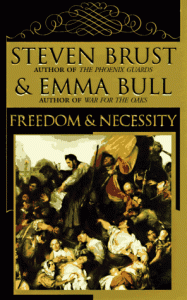
Freedom and Necessity

I think I may be getting bad at this. At least, lately I’ve been at a loss for descriptive words. In this case, my lack is for how to describe Freedom and Necessity, other than to say I liked it. I did, unquestionably, despite being of an insufficiently philosophic mind (or at the least insufficiently grounded in the basics of philosophic thought) to understand all of the historical nuances of the debates around Hegelian logic. …see, and this is exactly what I mean. Although Brust is very good at writing books that make me feel inadequate to fully appreciate them, that’s no excuse for me to make them sound like dry treatises with dense and well-disguised themes when I could as easily and far more approvingly describe them as rousing tales of adventure and skullduggery. So, y’know, bad. At this. (Also, I’m disregarding Emma Bull’s contribution to my enjoyment, but that is only because I’ve read nothing else by her and as a result can’t really put together in my head what that contribution was.)
So, I grabbed this book because of how Steven Brust is one of my buy on sight authors, these days. He is right to be, because of how everything I’ve read of his has a great authorial voice, humor that makes me laugh out loud[1], and plots that, though sometimes dense, always seem to hinge on exciting matters of life and death (and on occasion far more grave) that are guaranteed suck me in. As you might expect, this was just such a book.

Set in 1849-1850 England, this epistolary novel follows the loves and politics of a family that has just been struck by tragedy in the form of drowned James Cobham. Except that, two months later, he sends a letter to his cousin Richard informing that he is alive and without memory of his recent past. From there, the story quickly branches out to the addressing of that conundrum and a number of other family mysteries, the struggle between the proletariat and its oppressive masters, affairs of state, a magical conspiracy, blossoming love, and of course murder most foul. Allowing one of the characters eidetic memory combined with a penchant for writing letters long enough dam the Thames was perhaps overly transparent of the authors, but the unique and entertaining voices of all four main characters (one of whom cannot end a sentence to save her life) more than made up for that lone violation of my suspension of disbelief.

[1] I’ll admit here that I might seem to some people to laugh easily; to those people I would say that in fact I have a highly refined sense of humor, but choose to surround myself with people and things that activate it. So there.

The Da Vinci Code

The short answer is: someone made a near enough to duplicate as makes no difference film version of the Da Vinci Code novel. As a result, there is nearly nothing new to say from what I said a year ago.

Slightly longer answer: good realization of the sets and props described in the novel, with film improving the prose at most every step. Possibly better explanations of things, certainly not in a way that made me think any of the characters were stupider than they ought to be, much unlike the book. I can’t recall the book’s dialogue well enough to compare that bit. Somewhat actiony, extremely sacreligious if you are a lot of people, approximately as much information density as a 30 minute Discovery special on the topic. As movies go, it was really quite good. Also, Sir Ian was cool, like always. And the bad guy reveal was not nearly so clumsy as I thought it was in the book, or else maybe I was able to see the foreshadowing better. But I doubt it; I think the foreshadowing was actually presented better, instead. Advantage: Ron Howard!

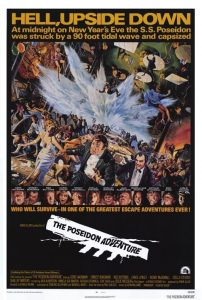
The Poseidon Adventure

I thought I ought to ground myself in history, so thanks to my good friends at Netflix, I snagged The Poseidon Adventure no more than a week after its remake’s release date, to watch prior to catching said remake. (Because I am nothing if not timely. Also: product endorsements deserve to be rewarded with free stuff. Just saying, good friends at Netflix.) The seventies were a different time is what I have learned. Sure, blah blah blah special effects cakes, but that’s not the thing. The thing is the acting. With the exception of Ernest Borgnine (who was frankly superb) and Roddy McDowall, every single male in the cast acted via angry loud voice. It was just bizarre to watch, especially in Gene Hackman, who I have certainly seen perform well enough in other (notably later) roles. Meanwhile, the women were mostly called upon to scream a lot. This is somewhat less surprising on the whole, but still pretty sad. As the main exception here was Ernest Borgnine’s wife, I am forced to assume that it was talent by osmosis.

As for the plot? Well, you know, boat flips over, people try to survive in upside-down boat. Is there more that you need to know? I will say that the set design did an almost non-existent job of conveying upside-downness, which robbed the movie of a good third of its purported impact. I expect that the remake will handle that part, at least. And maybe less shouting. But mostly better special effects traded in for someone not as good as Borgnine. Probably this is a bad thing; it certainly would be if the original had been a tour de force, but since it was not, I’ll take what I can get.

X-Men: The Last Stand

So a few years ago, they made an X-Men movie. Despite having played an X-Men video game for the NES in the 80s, I really knew nothing about them except that Nightcrawler was fun to play in that game and Wolverine was supposed to be pretty cool. Comics and me have never really gotten along to the extent that I would expect them to, considering how much I enjoy the movies and games and other trappings of the comic book industry, not to mention how much I enjoy, y’know, books and television. So, there I am, with no expectations. And the movie met or exceeded them. It was fine for what it was, but nothing crazy exciting or groundbreaking. Then they made another one, and man, it was really good. Meaningful character interactions, tough choices with tough consequences, that storytelling meme where the guy that you used to dislike turns out to be really stand-up and helpful when compared against the new opponent that hates all of the characters equally, so the established people have to put aside their petty squabbles and face the new thing together. That’s an idea that has rarely failed to wow me.

And now, the trilogy has been completed. X3 is kind of a weird movie to me. I mean, not the plot. The plot was fine, with its paired external struggles of mutants against government and mutants against mutants and internal struggles between certain sets of key characters, its allegorical hearkening back to the original film, and its pyrotechnics and combat by virtue of leaping through a lot of air at your opponents. So, that was all fine. (Okay, I’m lying about the leaping through the air thing. It didn’t take very many such leaps to start looking really dumb. But, whatever.)

No, X3 is weird to me in that it has so many successes and so many failures. On the one hand, you’ve got the subtle brilliance in the contrasting character development between Magneto and Wolverine, even including an ironic mention of it in conversation between them. But on the other, you’ve got reference to the comicbook love triangle between Rogue, Iceman and Kitty Pryde that goes absolutely nowhere despite ample screen time to make some kind of point. Mix that in with a choppy editing job early on, and I’m forced to conclude that although the spectacle of it was almost total greatness and although the story from all three movies was wrapped up cleanly by the conclusion of this one, it nevertheless falls well below the bar set by X2. Still, though, far better than the original. After all, unlike that (and unlike a lot of first entry comicbook movies, really), it had a plot with deeper complexity than good guys versus bad guys.

A Storm of Swords

And so, my third and final reread of the recent era, A Storm of Swords. As previously, I read this over a little too broad of a time- and bookspan to really dig deep into it, but over a lesser span than before, so I’ll see what I can do.

Certainly, as the name implies, it was a bloodier and more dire book than its predecessors. The scattered hints of doom have coalesced into a thing that, though still rarely seen, is now believably dire enough to plunge the entire world into shadow; if only there were enough people who knew it was coming to stop with all the other stuff and, y’know, fix it. For the most part, though, it felt like a plot-driven book with just a few good character studies again. I don’t mind that, really, as I am really enjoying the chock-full-of-politicky-goodness plot. But it’s light on theme, and the book reviewer in me has little to catch hold of. As it is, though, the people to watch for are Jaime Lannister, Brienne of Tarth, and Stannis Baratheon, and in that order. There’s a lot going on there. I could name plenty of other people I liked, but for character growth, there’s your fun. (Prediction: the next one is going to be Sansa’s book.)

I have a feeling that my review of my first time reading of A Feast for Crows is going to suffer from this timespan thing. Hrmm. I might have to cheat and read ahead as I go, much as I hate the idea of it. Unclear. Maybe I’ll take notes? Hard, when I always wait for a whole picture to start coalescing my thoughts. Problematic, this.

Dune

A thing that qualifies as unlikely: I’ve never read Dune before. Unlikely, yes, but all true. I expect I would have gotten around to it, but was reminded prematurely by this girl who inspired me to pick it up because it’s one of her favorites. In a more optimal world, having read it would in some way that I’m failing to imagine inspire her to become suddenly interested in me as date material. Because of a defect in my brain that allows me to conceive of that kind of world, I now have read the book, and therefore, I will talk about it.

In a trend that fits more well with the actual world, I’m left a little bit mystified by the whole experience. I pretty well understand what happened, and now want to go back and watch the movie and see if it makes more sense. Except for the part where I don’t actually understand what happened at all. The discrete events made perfect sense, yes, but I’m really unclear on what it means to have gotten to the end of the story. It feels like there’s this symbolism rumbling around below the surface that transforms it from entertaining sci-fi vengeance war into shining, brilliant example of the genre, and I’m just not seeing it. (Spoilers for a forty-year old book below the cut. Panic!)
Continue reading