Tag Archives: science fiction

Time Nomads

51o+C5jhCvL._SY346_The good news for me is, I read more than one book while camping in the desert a couple weeks ago, and Time Nomads was every bit as solid as any book I’ve read in the Deathlands series. Which, okay, I understand that these books are first and foremost pulpy romance novels for men who prefer that most of the mushy bits be replaced by guns and also the shootings of said guns into people. But they’re apocalytic sci-fi with female characters who have many qualities other than victim and a cast that is not safe from harm at any moment. Which is to say, in some ways they’re better than many books I’ve read that are of objectively higher quality.

The book starts out on its standard, with the merry band of not-quite do-gooders teleporting into a new hidden government installation somewhere in the nuke-ravaged America of the 22nd century. But then the author proves he’s not afraid to mess with his formula by sending one of his main characters on a botulism-fueled flashback to the days before they found all the hidden teleporter pads, robots with laser guns, cryogenic pods and and towns in need of rescuing that have made the series such a delight. And okay, I admit that “flashback” doesn’t sound like that much of a formula-buster, but that’s because I’m leaving out the drastic changes that occur as the book ends.

The changes may not take, and I won’t be offended if they don’t, but the fact that I can’t be sure? That’s what impresses me about this series. Well, and also the post-apocalyptic setting, but I think everyone already knew that part.

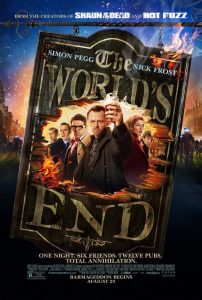
The World’s End

I made the mistake of watching a movie the day before I vanished from the internet for a week and a half, and I made the further mistake of not writing the damned review before said vanishment. So, um, sorry about that.

On the bright side, the movie I saw was The World’s End, a movie which you no doubt already knew you wanted to see because of its links to the brilliant Shaun of the Dead and the pretty okay Hot Fuzz. The formula is not precisely the same as before, I guess? Where the other two movies were parodies of the zombie and action genre, this is less parody and more mash-up. In the unlikely event that you aren’t spoiled for the mash-up by previews, I will leave out one of the genres, but the other is…. well, okay, hard to qualify. It’s not precisely coming of age, because although Simon Pegg plays an uncomfortably old-looking man-child, all of his friends have clearly grown up[1]. It’s not precisely whatever genre The Big Chill is, if only because the mood isn’t nearly as solemn as all that.

But anyway, whatever it is, it’s funny and well-acted and building towards something meaningful and fellowshippy, when suddenly…. but, y’know, that’s why you should go see it.

On an unrelated note, I am sad that I do not have a bar named The World’s End to go to. And not only because of books Neil Gaiman wrote once upon a time.

[1] If anything, that’s the point.

The Map of the Sky

9102OsNohAL._SL1500_You know that book The Map of Time that is so intimately tied up in my Kindle ownership? It turns out that it was the first book of a trilogy of standalone books. Who knew? The important thing to focus on here, besides that I also definitely liked The Map of the Sky, is that word “standalone”. Because while this book makes more sense if you’ve read the first one, that is not necessary and there is definitely not a cliffhanger at the end, or even any more hint of a third volume than the first one implied that this book was coming. So if you’re worried about reading it? Don’t, it will be fine.

Okay, now that that’s out of the way: You know how the first book in the Victorian trilogy riffed on the Time Machine? This one riffs on the War of the Worlds, albeit a lot more straightforwardly than that other time. And really, I think that should be all you need to know? Yes, it’s in the same tone and voice as the first book, like you’d expect, and since that worked for me just fine then, I’m happy with it here as well. And what it somewhat lacked in byzantine twists, it made up in my deepened emotional attachment to the characters (and their deepened emotional attachments, for good or ill, to each other).

Also, one part of the book, set in the 1830s instead of 1898, is possibly based on a Poe novel instead of War of the Worlds? I am saddened to be unfamiliar with it, if so, and especially saddened that I did not get to choose him as my American Literature senior focus, back when I was getting my lit degree. I tried, but one can only wait so many semesters before you just have to agree to get on with graduating instead. In any event, it reminded me a great deal more of a completely different narrative which I shan’t mention here, to avoid spoilers.

Star Trek Into Darkness

MV5BMTk2NzczOTgxNF5BMl5BanBnXkFtZTcwODQ5ODczOQ@@._V1__SX1537_SY723_I saw J.J. Abram’s Star Trek sequel on approximately opening night, which raises the entirely valid question of “why haven’t you reviewed it, that was weeks or months ago, and in the meantime it has been universally[1] panned by the internets, and also you could have saved me some trouble over here, so why are you wasting my time now?” Well, the long answer is that there was something that didn’t quite gel for me and I knew I would see it again because of having parents that I see movies with, but then scheduling failures made that never actually happen until yesterday, what with my active camping life and all. The short and far more relevant answer is because I (apparently) was waiting for all of that panning to occur, so that I could write a review in defense of Star Trek Into Darkness[2]. To that end: the remainder of the review contains spoilers. Since I really am pretty sure everyone has already seen it, and also since my cuts survive nowhere except here on the site anyway, I opt not to care so much.

See, what everyone seems to have disliked so much (aside from the standard summer blockbuster lazy shortcuts) is “why are you going back to the Khan well just because this is your second movie?” and “how are we supposed to believe the emotional connection between Kirk and Spock when you haven’t established it yet?” Which are entirely valid questions, but I think Abrams was coming in from the opposite direction. He doesn’t have three years of TV episodes and a decade of fans clamoring and fictioning and relationshipping and all of that to build from, he only has his previous movie, which got Kirk and Spock from visible dislike to something nearing respect.

The first thing that it’s important to remember, then, is that this is not a remake of the Wrath of Khan, certain climactic engine room sequences aside. It’s a remake of Space Seed, with the perfectly fair excuse that Khan and his ilk were found by someone else because Starfleet was crippled by that one Romulan mining ship last time, and isn’t spread out and exploring everywhere yet. So, yes, you can call Abrams cheap for picking a Star Trek villain so iconic they made a movie about him later, BUT, like I said, he doesn’t have the room to explore all these growing relationships comfortably, and I will not fault him for taking a shortcut on the bad guy so the audience understands the stakes immediately. (I also will not blame anyone else for faulting him that, though; it could have been done other ways, I reckon.)

Anyway, my second and much more relevant point is this. The scene I watched at the end of the engine room sequence was not an emotional payoff about friendship and loss that didn’t work on multiple levels, because it wasn’t a payoff scene at all. That was the moment in which Kirk and Spock became the friends we are meant to suppose they were always destined to become. Even knowing the Khan scream and the tribble were around the corner, both actors sold the sense of losing something they had just found, and it was more moving the second time around when it clicked into place than my first time had been.

Which, alas, brings me to the way the movie really did fail. Yes, there’s no fifteen years of accumulated backstory to rely upon, and yes, I was not seven years old when I was watching this particular film. All the same, Kirk’s “death” was terribly cheap. Why is McCoy randomly injecting dead tribbles with super-blood in the first place? Lamest, most random science ever. And as much as I respect the method of finding and exposing that moment of friendship on the screen, a sacrifice is still a sacrifice. I don’t want to watch a contrived third movie in which they race to find a cure for Kirk-on-ice, even more remaketastic than this one was, I admit that. And after just having praised the way the scene started, it’s pretty lame of me to turn around and fault the same scene from the other direction. I can’t say what I would have done differently, but man was it a clumsy band-aid on the problem. The moreso when I compare myself walking out of the theater at age seven, crying because how could Mr. Spock really be dead, and now today’s seven year-old has magic tribble blood?[3]

Upshot: it’s still not as good as it should have been, but I think it’s a lot better than I’m seeing it be given credit for. Upshot of the upshot: I really wish this cast would be put on television instead of making another movie in another few years or being put back on the shelf forever. Because the parts that work, they work really well, and the parts that don’t work are mostly Hollywood’s fault.

[1] Galactically?
[2] It really makes me twitch that IMDB expects that preposition to be capitalized even in the absence of a colon. I will not be defending the title part of the movie, thusly.
[3] I’m well aware that’s not what happened, but I’ve also talked to seven-year-olds lately, and it’s not nearly wrong enough for them to be well aware it’s not what happened.

Bioshock Infinite

I have been having a very hard time reacting to Bioshock Infinite. As a story, it was beautiful and compelling and I spent every moment from beginning to end wanting to know more. As a game, it was, well, rather a lot like Bioshock, with a few interesting differences. And a few unfortunate ones, it must be noted. The inability to have a save game and instead only be allowed to wait for when the game decides to save for you is… mostly not so bad, but when it was bad (I’d like to go to sleep now, not in 15 minutes; I’d like to be able to restore and do this fight a different way), it was pretty terrible. Still, as flaws go, they had a good reason for it and it was nowhere near a showstopper.

Unfortunately, I got about two lines into the next paragraph before I realized that I have to play this one too close to the vest to be worth a whole lot. But I can give you the premise in broad strokes, I suppose: Booker Dewitt, down and out private detective, has been sent to Columbia, a city in the sky, with one haunting directive: “Bring us the girl and wipe away the debt.” Well, okay, there are one or two more directives, but they wouldn’t mean anything much to you until you were playing anyway. I would quickly add that he discovers nothing is as it seems, but let’s be honest, he just magically appeared in a floating city in the clouds in 1912, I think you probably already knew that part. I think he probably already knew that part already! Okay, the rest is behind the cut. Continue reading

Oblivion (2013)

Since Oblivion is the kind of movie that it’s best going in knowing as little as possible[1], I will endeavor to keep this missive short and sweet. Remember when everything was basically fine on Earth, and aliens had not shown up to attack us and destroyed the moon and we had to retaliate with a bunch of nukes and therefore the planet wasn’t mostly a barren wasteland from which pretty much everyone still alive had emigrated to Titan? If so, you share at least a little in common with Tom Cruise, who despite the mandatory memory wipe has occasional flashes of memories that he knows aren’t really his, about the old days. When he isn’t having paradoxical contemplations about Earth-That-Was, Tom mostly flies around troubleshooting equipment (that is being used to collect what remains of the planet’s resources) or defending that equipment from the remaining aliens that still pop up to cause trouble now and then. When not on the job, he hangs out in a floating sky palace with his mission controller, Victoria.

Okay, that gets you through about the first five minutes of the film, and I am quite sure that’s all I want to tell you, except to say that you should see this one. It’s not a “run, don’t walk” kind of scenario, but if you like thoughtful science fiction, this is where you want to be. And Cruise, like Bruce Willis, has in my estimation been very reliable about picking the right sci-fi scripts. If you needed evidence outside my opinion about this one time, I mean.

[1] For example, don’t read footnote 2.[2]
[2] For real example, I wish I had been able to not know Morgan Freeman was a cast member, but every preview and the media blitz made it perfectly clear. Alas.

Northstar Rising

I went with a Deathlands book to ease myself into reading not-The-Wheel-of-Time, and I have to say, it was a solid choice. (The other initial possibility was Dresden Files.) See, while I had no problem returning from screen to paper, I had a huge problem reading a book that didn’t have Rand in it. Not him specifically, but I’m not kidding either; for pretty much the first half of Northstar Rising, everything about it felt subtly wrong, like I was reading a fake book that someone was trying to convince me was the real thing.

Eventually I settled in, and this one is every bit as good as the others, though I am starting to have minor problems with the series. For one thing, the titles? Chosen seemingly at random lately. I’ll admit that they went to Minnesota, which is in the north. But otherwise, they hung out with cryogenically frozen doctors (who are a touch on the stereotyped side, alas) and giant ant swarms and vikings and barrels of radioactive waste. You know, like you do when it’s the nuclear devastated wastelands of America a hundred years in the future.

Then again, I cannot really say what I’d have named it instead, there being no common theme to pull the various events of the book together. On the other hand, they broke formula a little, and that’s probably good news. Like I say, minor problems. Certainly nowhere near enough to make me put away the mind candy.

Halo 4

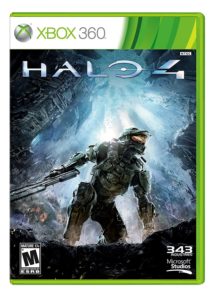
Remember that time when I played Halo 3 and called it a science fiction trilogy? So it turns out that a new studio got their hands on the property and made a new game, so, trilogy no more I suppose. To get the obvious parts out of the way, gameplay is identical to the previous games, so if you liked those, you should ought to like this too. I reckon that the same is true for multi-player, but I haven’t hit it up yet, so I cannot say for certain. But the important questions are: new studio? new plot entry in an already complete story? seriously, someone thought this was a good idea?

Except, in contravention of all known wisdom on the topic, this may be the best Halo of all of them. It’s like, yeah, the new story absolutely relies on everything that has gone before and would never work as a standalone tale, and what has gone before is a pretty cool story that had lots of highs and lows and dramatic tension and tragedies and triumphs, and I stand by all the good I’ve ever said about it. But Halo 4 relates two very personal, small-scale struggles, and it wrestles on multiple fronts with a question as old as the very genre of science fiction itself, what does it mean to be human?

There’s also an entirely serviceable sci-fi plot to hold up these philosophical delvings, about which I’m glad, because you have to have a working plot, and a working plot about the historical forebears of all the cool tech floating around in the galaxy is always of interest. But mostly this game was about the emotional resonance for me, and I have not had this much investment in a specific videogame outcome but a handful of times previously. (Aeris in Final Fantasy VII, the shocking climax of Assassin’s Creed: Brotherhood, and my fierce protectiveness of Tali in the Mass Effect games are all I can think of.) Honestly, there’s a specific line of dialogue that haunts me days later, and I don’t think any of the others have managed that. (Aspects of the Portal games haunt me too, but not in the same way.)

Mass Effect 2

Remember when Shepard, um… yeah, okay, neither do I. I know she did something to learn about the history of the Protheans and the present of the Reapers, and repelled an initial foray into “the destruction of life as we know it”, but that’s about all I remember. Because I played Mass Effect way too long ago. To give you an idea of how long ago, I didn’t finish playing Mass Effect 2[1] until after the majority of people I know who like video games had finished Mass Effect 3.

But I did. And it turns out that knowing why the Citadel was attacked and what that means to the next few years of “life as we know it” isn’t so relevant when compared to politics, especially if new players in the galaxy (called by people who are watching history The Collectors because of their habit of gathering up entire populations and leaving through a mass effect relay nobody else has ever returned from in recorded history) kill you before people get a chance to decide if they consider you a hero for sure or not. Although martyrdom is nice for the hero image, don’t get me wrong.

But it’s cool, because Shepard is back a couple of years later (you can’t keep a good hero down apparently, especially when she has the financial backing of her biggest political enemy behind her) to figure out what happened to her and what is about to happen to everyone else, with new allies at her side (and a selection of the best old allies, including Tali, without whom the galaxy basically seems not worth inhabiting). If you liked the first game, you’ll like this one. If you didn’t like the first game, it is either a) because you are a bad person or b) because you hated the inventory system. That has been fixed, and all that is left to worry about is the exploration of uninhabited planets, which is not bad per se as long as you don’t give yourself the mistaken impression that you should ever explore them in advance beyond your needs. Because there are way more planets rich in resources than you will ever need to probe.

And if there are unexplored planets that have plot relevance but are not announced except by looking for them? That is a fault of the designer, not the reviewer.

[1] Technically, I still haven’t finished, as there are monetary DLC that seem worthwhile. But it feels close enough for review work.

Red Equinox

You remember those Deathlands guys, with their gender equality and their gun fetishism and their occasional mutations and their ability to teleport around the shattered ruins of the United States trying to find that perfect settlement for forever but otherwise righting wrongs while they keep ending up in the wrong place? Well, in Red Equinox, they got a callback to the second book in the series, which you undoubtedly remember is the one where they teleported for the first time, and ended up in Alaska where they could run into some invading Russians at the land bridge.

How can such a callback exist, you ask? See, this guy got to report on first American contact in the hundred years since the nuclear war, and so he got promoted home to Moscow. And meanwhile, Ryan Cawdor and company got to learn that the American embassy in Moscow has the same teleportation capability as so many of the hidden redoubts scattered around the Deathlands. None of which sounds so terrible, because you just leave, you know? Moscow is like the most dangerous place for an American to be! …too bad they broke the door you need to close to trigger the teleport sequence, eh?