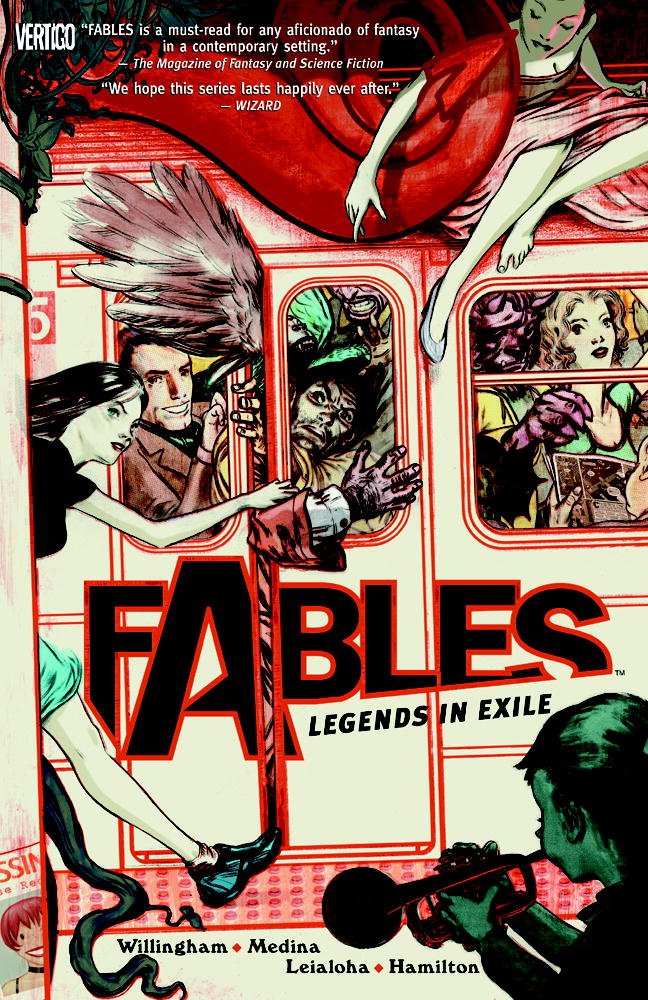
 Another new graphic novel series? I can assure you, it’s all true. For, y’know, extremely relative values of new that seem in fact to reflect things published years ago. My initiation into the format only occurred within the last couple of years[1], though, so running behind kind of goes with the territory. The Fables series got on my radar via Amazon recommendations, much as with Dorothy and for that matter Ex Machina. Of my recent new series, this is certainly the one I’m the most satisfied with.
The idea of storybook characters all jumbled together in New York, while obviously cool enough to take the risk on (since I did buy it), seemed potentially fraught with peril. Apparently, they all come from different worlds (which I will choose to call dimensions) that were one after another attacked by an Adversary (who is thusfar shrouded in mystery), and by the time they realized that there was true danger afoot, they had no remaining options but to flee from their worlds to this one, which the Adversary has no apparent interest in. Being the stuff of fables, they’re immortal, so while they all came from different storybook dimensions to start with, they’ve had several hundred years on earth as Legends in Exile to properly mingle and form interrelationships. The upshot of all that background being that the interactions were rich and often funny, with distaste, attraction, working relationships, and even unlikely friendships all laid bare. The book was equal parts Storybook Melrose Place and Fable Noir.
Which raises my other extreme like for the book. The mystery was, if moderately simple, plotted quite well and made good use of the setting. Bigby Wolf[2], the sheriff of Fabletown, is confronted with murder most foul when Jack[3] reports that his girlfriend Rose Red is missing and her apartment covered in blood. Once Deputy Mayor Snow White[4], the victim’s sister, insists on including herself in the investigation and the rich and powerful Bluebeard is fingered as a potential suspect, all the trappings of a Humphrey Bogart noir are in place, and the only thing left to do is lean back and enjoy the ride. There are a lot of possibilities for the series, since the available characters cast such a wide net. I figure, if I get more volumes in the noir vein, well and good, and if not, the creators have already proven they have the chops to do good things with the premise, at least.
[1] Well, except for Sandman, which I’m prepared to call a special case.
[2] That name still gives me the giggles, even now.
[3] of “and the Beanstalk” fame
[4] whose surpassing loveliness is storied… er, whose fabled… Dammit. The point is, she’s a looker with legs that just wouldn’t quit and a smoldering fire in her eyes that told me she’d seen enough of the world to know that it wasn’t as pretty as the stories said it would be.
 I cannot decide if my love for the Harry Dresden books comes from their being objectively awesome, or from them being in such sharp contrast to the Anita Blake books. I mean, sex happens, but it’s dealt with tastefully, with soft-focus lensing and quick cut-aways, and far more importantly, it is not the constant focus of Harry’s regular magic-wielding, mystery-solving lifestyle. Which leaves him some time to think about wielding magic and solving mysteries. Is the prose with which he wields his magic, the world-building in which he solves his mysteries, the characterizations that come into play when he interacts with the other, er, characters really any better than most books I read? I’m going to guess that probably not, and yet I could grab the next three that I currently own and read them all in a row without getting the least bit tired of it. Um, unless the plot suddenly changes into a situation where he’s banging the vampire chick Bianca like a drum and his cop friend starts hating him and he wallows in angst by taking up with a werewolf pack? Don’t be sexy, Harry! It’s not worth it!
 For the first time in a reasonably large number of years, I’ve missed a buy-on-release-date book. I mean, I’ve chosen to wait occasionally, but this one I didn’t even know about until months later.
  By right of expectation, this should be a graphic novel review. I’ve been pretty darn faithful about the alternating thing, and such. But then I went on vacation, in which there was a beach, and more importantly, an ocean. Also there were friends and children and laughing and a board game. And also, because I live inside myself so much and it’s worthwhile to reiterate the things that really affect me, on a bone-deep level, there was still an ocean. She had waves and a loud voice, and we had a friendly tussle in which she made sure to show me she could kill me at any moment without a thought, but that was only momentary and to demonstrate who was who; like I said, it was friendly. And just for me, flying in the face of all established knowledge on local weather patterns, she put a storm on the horizon.