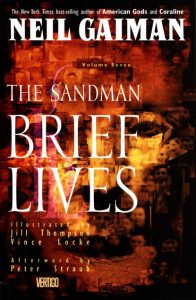
 I realized in the midst of all the graphic novels I’ve been reading, I had completely neglected my Sandman collecting. So I immediately ordered Brief Lives, and read it a much shorter than usual time afterward. (I mean, I buy stuff and then don’t touch it for a while, due to the stack.) And I’m so glad, because it’s probably my favorite one. I’m also glad because of how much more depth I’m picking up this time. Foreshadowing and all, sure, but there are just so many layers all over the place that I could probably re-read the series annually and not run out of things to love.
In Brief Lives, Delirium (which is to say, the personification of the human experience of delight, inevitably corrupted by time and perspective) decides upon a whim to go in search of her mysterious elder brother, frequently referred to in the series but never identified, who some centuries ago decided to abdicate his responsibilities to his family and to his role; after all, he claims, they’ll continue along this path whether I’m here to oversee things or not. The consequences of her decision are the driving force behind the now-inevitable climax of the series.
So, pivotal turning point, plus my favorite character in the cycle, from the moment I first laid eyes upon her. Some fictional characters just do it for me, I guess, in ways that are inexplicable to other people. Well, some of them are probably wholly explicable, but I fancy that the choices I can think of offhand aren’t. Laura Ingalls, when I was reading those books as a kid? A crazy, literally Endless girl that has the ability to render me insane almost in an instant, if she got it in her head that I had done something she didn’t like? (I mean, maybe I did, but maybe I didn’t. She’s crazy, remember.) Okay, I can’t think of anyone else offhand, so I guess it doesn’t happen that often. But still, these can’t be normal tastes. Despite all that, I remain convinced that Brief Lives, with its wide-angle focus on life and death and how much life is enough and which deaths are timely, plus the awesome plot part, is a high point in the Sandman series, if not the high point. But, as I’ve tried to imply, I might be biased.
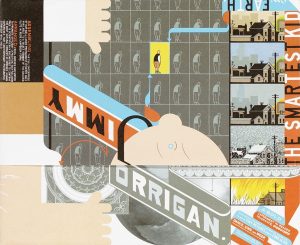 I think what keeps me from reviewing this graphic novel is the fear of being sucked back into the depression of it all over again. So I sit here staring at the blank screen that is in one incarnation or another over 24 hours old now. Which I’ll have you know isn’t all that uplifting itself, even by comparison. Therefore, I’m going to buckle down and power through it.