Tag Archives: graphic novel

Lucifer: Exodus

I wonder if I should ought to break out of my rhythm and read the Lucifer books more concurrently with each other than I have done. After this most recent four month gap, I’m starting to feel more and more like the narrative has grown too complex for me to not keep the series more firmly in mind as I read each new story. Exodus, just for example, took me fully two-thirds of the book to get much of a handle on. The exodus in question is ordered by Lucifer himself, who, having seen the way that the various immortal/ancient beings in Yahweh’s universe of his birth have variously conspired against their God and now seek to replace Him in His absence, decides to rid his own universe of such backstabbing treachery. I suppose there’s no small amount of irony in that goal. And so the main part of the book is a series of stories about various immortals in each universe and how they have responded to both the originating event and the subsequent edict.

What struck me as interesting is how this is the first book in the series that has shared a structural hook with the Sandman series that gave it birth. Although many Sandman books followed a main plotline in which the Lord of Dreams reached certain conclusions about the nature of his existence, many were only stage-dressing in which Gaiman got a chance to tell various unrelated short stories through the lens of bit players that briefly or tangentially touched upon the lives of one or more of the Endless. And Exodus, you see, was like that, mostly told through the prism of Lucifer’s trusted[1] lieutenants (Mazikeen the Lilim, Michael’s daughter Elaine Belloc, the cherub Gaudium, and others) on their quest to enforce the, you know, exodus of the immortals. Of course, there’s only one place to send them, and in His absence, it appears that Yahweh’s universe may be experiencing a shelf-life.

[1] Well. Reasonably well trusted, for all of the unlikelihood of that claim.

Ultimate X-Men: Sentinels

I have observed with some degree of interest how I have changed the way I interact with shorter types of external stimuli, such as movies and graphic novels. By no means is it that they have fewer themes, nor ones that are necessarily smaller in scope; just that with the limited amount of time and space for presentation, the themes are usually more compact and immediate, which means that I not only have to be prepared to pay closer attention finding them, but that they also can require more ability to read between the lines. Like, with a 20-50 hour game or a 300-1000 page book, I can just let my mind wander and see what bubbles to the surface as I go, but in the couple of hours I spend on these shorter media, sometimes not treating it like a treasure hunt for nougaty thematic goodness means I won’t have anything to say when I get here.

And then there are stories like Sentinels, which are simultaneously so muddled and so scattered that I have no idea what just happened, try though I might. There are two and a half plots in progress, at least two timelines to keep track of, an inexplicably large number of drive-by characters who show up for one scene or issue only to vanish forever, and far more needless overt sexualization than I’ve seen anywhere in the Ultimate line before now.[1] In what I’m going to assume is the plot that matters, a new group of X-Men has formed in the wake of the original group’s disbandment to focus on the “school” aspect of Charles Xavier’s school for mutants in upstate New York, that disbandment coming in the wake of the events of the previous book. And said new group fights off the return of the mutant-hunting robot Sentinels, while the people at the school go off in search of underground mole mutants and deal with the ever-present portentous foreshadowing about Jean Grey’s fated transformation into the Phoenix. I think if they’d used the same amount of space to tell either story individually, it wouldn’t have felt rushed and full of annoyingly fast cuts between scenes that weren’t related by plot, theme, irony, or even art. I can’t help but feel like, in response to my recent thoughts that a series-level climax is drawing near, they suddenly found themselves out of time to tell the stories they had left and were forced to rush.[2]

Still, I shouldn’t complain too much. The use of a new artist for each of the 2.5 storylines means that at least I wasn’t stuck with the horrible first guy during any of the needless sexualization scenes.

[1] I mean, I’m kind of a fan of needless sexualization, but not when it takes me out of what ought by rights to be a good story.
[2] If so, I have no sympathy, because they could have used the space taken up by the worthless Magician storyline to tell these ones right.

Ultimate Spider-Man: Ultimate Knights

I maybe already mentioned this, but in case you’re wondering: after I noticed that I was getting spoiled for my Spider-Man stories in Ultimate X-Men, I’ve started reading the Ultimate series in graphic novel release order, and I had a bit of catching up to do on Spidey. So, that’s why so many of these in a row. So that’s that. Luckily, the Ultimates and Fantastic Four cross over with the rest of the continuity less often, or this would have been a problem much sooner, and probably when I could have done less about it. As it is, though, hooray, all’s well now.

The upshot being, I just read Ultimate Knights. And… okay, even though I knew it would be another 5-star story, I also knew there was no possible way it could live up to the jaw-dropping splendor of the Clone Saga. I’m not going to sit here and tell you it did, either, because I meant that about no possible way. Yet, at the same time… Bendis took a book that should have been breathing space from one major revelation after another, things that will likely have repercussions for years down the line if the series continues (as I very much hope it will), and he made it about a collective effort, organized by Daredevil, to take down the Kingpin. And what I’m saying is, it worked as breathing space, an arc that under any other circumstance I would have considered a major turning point in its own right! But as fantastic as I have found these various rounds with the Kingpin to be, what I think I liked best about the book[1] is that it really was breathing space. It’s nice to see Peter Parker have a good day every so often, and this was one of those.

[1] Please don’t take this to be a spoiler about the outcome of that Kingpin confrontation; I wouldn’t do that. Separate thing here.

Death: The High Cost of Living

Between the length of the week with various holiday trips and all and the amount of time I’ve spent staring at my own writing while scouring the internet for repairs on this until recently dead site, it’s kind of hard to remember just how I felt about The High Cost of Living. There is a legend that Death must spend a day in every century as a mortal, I guess to better understand her job. And the book is entirely about that day, spent with a Manhattan kid whose ennui would do a French philosopher proud, Mad Hettie from the Sandman series, and a couple of bad guys who hope to capture all of Death’s power while she is mortal and vulnerable. It is fair to say, I think, that there’s not a single character in the story who actually understands what is happening, nor what his or her individual role is to play. Possibly Hettie, but as she’s quite mad, it’s difficult to tell. Certainly nobody else. It is left to the reader to unravel the various skeins of consequence. It’s a good little story, for all that it’s short and confusing. There are aspects I did not understand one bit, but I felt pretty comforted by what I did latch onto.

The last pages of the book are a brief sexual health pamphlet distributed by Death to keep us all from getting AIDS (among other STDs), as, after all, we’ve only got the one life and wouldn’t it be best to keep on living it, and to do so in reasonable comfort and health? You can certainly tell it’s twenty years old, but I like to imagine that it both helped some people and turned some people onto Gaiman’s world that might otherwise have never known to look for it.

Ultimate Spider-Man: Clone Saga

If I thought I could get away with it, the entirety of my review would be “Holy shit.” Because, in contravention of every reasonable expectation I could have had, Clone Saga did not merely maintain the high standards that I have, despite myself, come to expect from the Ultimate Spider-Man series; it surpassed them in every way. Everything else that it crosses my mind to say is, although probably accurate for me as a reader, actually too hyperbolic to put on a page. Suffice it to say, I wish I could do a targeted mindwipe of the book, so I could read it again for the first time, Right Now.

It is my understanding (in fact, there’s an entire introduction discussing it) that this revisits yet another long-celebrated moment in the original Spider-Man continuity. As such, I look forward to it, but I’m glad there will be so many differences, because if it was very similar beyond the essential clone concept, I would be doomed to disappointment. But, okay: in thumbnail, Spider-Man fights the Scorpion at the mall, only to discover that the man inside the suit is Peter Parker! In the aftermath of that stunning moment in the real Peter’s life, Mary Jane gets kidnapped by… but that would be telling; and Nick Fury declares war on Spider-Man, a move that could well be his biggest mistake. And honestly, I’m barely scratching the surface.

And, I know I’ve said this before, but, my God, Aunt May. Simply amazing.

Ultimate X-Men: Cable

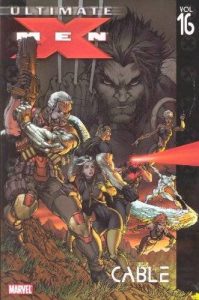
I have made mention several times over the past few months that the Marvel Ultimate series has an expiration date that, according to my bookshelf, I seem to be approaching. But it hasn’t felt like that in the depths of the storylines, right? Which is one of the reasons that Cable caught me by so much surprise that it has caused me to rethink the Ultimate X-Men series as a whole. More on that in a sec, but what made me start thinking about the Ultimatum again is how much finality and apocalypticism Kirkman brought to the table this time. There’s this guy Cable, see, and he has come from the future to kill Charles Xavier and thereby prevent said future from ever occurring, probably because it sucks? This is information I have not yet been specifically given, so. All the same, the situation felt like the first pebble of an avalanche, in a way that nothing previously has.

Which I guess ties into what I meant about rethinking the UXM series. Obviously I’ve been fine with the development of Spider-Man. The Ultimates are busy with one nation-threatening event after another, and the Fantastic Four skip jauntily from one sci-fi menace to the next, but neither group has built up much in the way of continuity. (The Ultimates would I think have built more, if only more had been written about them.) The X-Men, though… some I’ve liked, many I haven’t liked very much, but I never really looked at the series as a cohesive unit before, and I have to admit, for all the individual episodes I haven’t cared much about, the whole of it stands together really well. Somewhere along the way, no question, I started caring about these characters. If I’m right about this being the first signpost of things to come, I’m glad it happened here. Spider-Man’s story is too personal for world-shaking events, and the others are too scattered.

Hack/Slash: Reanimation Games

The thing about a cheesy 80s-slasher-movie-themed comic, albeit with modern sensibilities regarding every aspect of the actual content, is that there’s only so much praise you can sing. I can tell you about the skillful way that each volume weaves together seeds planted in previous issues into a new tapestry of angst, obsession and gore, all the while planting new seeds for future volumes. I can gesture emphatically at the art, which is always clear and articulate without wandering off into post-modern regions that elevate experimentation above functionality, and which also provides occasional cheesecake. But these descriptions are quite generic, however heartfelt the sentiment that underlies them, and when you peel them away, Hack/Slash is still a cheesy 80s-slasher-movie-themed comic. And for the general mass of graphic novel audience out there, you were already sold or turned off by that line of description, irrespective of the actual contents.

For the vanishingly small group of people who care, Reanimation Games is focused primarily on the culmination of Cassie Hack’s search for her father, who ironically has built his career around the study of the causes behind and uses of the very slashers that Cassie has hunted and destroyed ever since her mother first turned into one. Detours along the way include encounters with the scientist guy from the Re-Animator movie series and with the Suicide Girls[1], and the usual careful examination of the trials and triumphs of Cassie’s small circle of friends. I guess what surprises me with each new volume is not that I’m entertained; it’s nice, easy brain candy in exactly my flavor. No, what surprises me is that it’s good enough that I want people to see it as the small step above brain candy into genuine quality that it consistently achieves.

[1] If you don’t know, these are not a mysterious cult nor movie shout-out, but instead a generally tastefully gothy porn collective that you will not I think have very much trouble finding on the internet, if you were to put your mind to it. For some reason, Cassie has been considered sufficiently gothy-attractive for the comparison to be made, and for some reason, the creator decided that, hey, sounds like a good crossover to me! And here we are.

Ultimate Annuals Volume 2

I know this is supposed to be a review of the second (and I suspect final) volume in the Ultimate Annuals series. But it’s not so much a series as it is a collection of the oversized annual edition of each of the four major Ultimate serieses, and unlike last time, I’ve read most of these recently. Like, the X-Men story is I think the most recent thing I’ve read in that run, in which Nightcrawler goes from an unfortunately prejudiced dude who needs to have a good lightbulb moment to a disturbingly broken kidnapper who is probably on the verge of defection to evilness, over the next storyline or two. Or the Fantastic Four story in which Mole Man returns with a new plot to kidnap geniuses and harness them for his own uses. Okay, that one was pretty good, but I’ve already reached the end of the Ultimate FF run (save for the Ultimatum stuff), and it didn’t actually have the payoff it seemed like it should have had later on, so I am retroactively a little disappointed in it. Plus, the only story that isn’t collected in another book I’ve already read, in which Captain America and that Falcon guy from Ultimate Galactus head into the post-war American landscape[1] to fight an old Nazi menace? It kind of bored me. I think I blame this on it being the first Ultimates story I’ve seen that wasn’t written by Mark Millar. He’s good at those!

So, okay, yeah. Pretty disappointing book all in all, though I have given unfairly short shrift to the FF story. Except, y’know, Spider-Man. His story, which you may recall me choosing not to review when I read Deadpool earlier this week, is another clash between Peter Parker, Daredevil, and the Punisher. Except, right, I never read the original such clash because it was somehow left out of the three Ultimate Marvel Team-Up books in which comics-run it occurred. Luckily, someone eventually released a giant collection of that entire run in one book, making my three individual volumes obsolete. So, I read the three comics in question out of that, just to feel caught up. In short, across pages of annoyingly impressionistic artwork, we’re introduced to the Punisher, cop-turned-vigilante who hunts and kills dirty cops and dirtier criminals and spends most of his time in jail for said vigilantism, and Daredevil, blind lawyer with super-heightened alternate senses that allow him a better grasp of the world than any civilian and most superhumans. And Pete puts the Punisher back in jail while annoying the snot out of Daredevil for his happy-go-lucky attitude and his penchant for jumping into the middle of things first and asking questions later. (Which is I guess why Nick Fury is annoyed by him too. Also Blade.[2])

So, anyway, in this follow up meeting (Also including the Moon Knight (who I still have no kind of handle on), the Kingpin (still a magnificently realized bastard), and Kangaroo (uh…)), Daredevil still finds Spider-Man annoying and the Punisher still finds him detrimental. But none of that is really the point. The point is this: there’s been a long-term piece of plot involving the new[3] police captain, Jeanne de Wolfe, that I haven’t ever mentioned partially because it’s been largely in the background and partially because, well, any amount of detail places us squarely in spoiler city. But the thing is, as much time as I spend talking about how great the USM series is, right? This is just on a day-to-day basis. In the meantime, there are these deep undercurrents spanning something like half of the series to date that I’ve never even felt the need to mention. And of course there’s an inevitable huge payoff, that leads me to have to jump back into two paragraphs of review material just to explain how even an oversized single comic in this series is still so very cool. This is why I can’t stop gushing, no matter how hard I try to hold myself back. Because it’s just always this good.[4]

[1] Yeah, for serious, I really really need to do a quick reread of the four Ultimates titles that have been released so far, ’cause I barely have any idea what’s up in that quadrant of the Ultimate universe anymore, and I’m starting to reach the point where everything really does tie together. Maybe I’ll do one mega-review? Maybe not, depends on how it strikes me I guess.
[2] Yeah. The half-vampire guy. Seriously.
[3] The old captain was Gwen Stacy’s father, up until he was shot and killed by a guy in a Spider-Man costume. Good times!
[4] And the last page or two, in which Daredevil has a conversation with the Moon Knight guy? I’ve learned my lesson and mention it now, as I expect it to be the next major undercurrent.
Ultimate Spider-Man: Deadpool

I almost wish, if only for half a moment, that Bendis would write a bad, nay, even a merely mediocre run of Ultimate Spider-Man, just so I’d have something new to say. “It’s just so good! You’ll love it!” Whatever, man. I’m losing all credibility over here. But, okay, why do I love it this time? I have an answer to that. Now and again, one of the series will focus on a character with whom I’m unfamiliar, and the author will seem to be so proud of having worked that character into the Ultimate continuity that the book just coasts on recognition factor without really trying to be actually good in its own right. In fairness, that plan has worked on me when I did recognize whatever new character it was, but for the many times when I do not, the laziness outshines everything else.

Except this time, not so much. I’m not particularly familiar with Deadpool, and really all I know about him is that in the Wolverine movie earlier this year, he was maybe kind of indestructible? That character is largely dissimilar to this one, in any event. But, and here’s the part where I fulfill the inevitable gushiness quotient, Bendis went ahead and wrote a fine plot around the advent of Ultimate Deadpool. See, Spider-Man gets mixed up in a plot to murder the X-Men on broadcast television[1], and this guy Deadpool is the main hunter. But despite all kinds of mutant powers and explosions of exactly the types that a superhero comic needs to have to maintain credibility[2], most of the focus is on Peter and the delightfully unconfident Kitty Pryde, his recent paramour. Because, as has consistently been the case throughout the USM run, Peter Parker’s life is the important thing; super-villains and web fluid alike take the back seat. This is why it works. But also, Aunt May has a hot date, so I guess maybe it isn’t always about Pete after all. Then, for a change of pace, vampires! And more friendship trouble with Mary Jane! And the Kingpin! But I’ll glance at that last bit in my next review.

[1] Which is actually a callback to a previous UXM storyline, but I forget which one. It was alright, in any event.
[2] Unlike me, you see, is the thread tying this review together.

Ultimate Annuals Volume 1

The reasonably self-explanatory first volume of Ultimate Annuals collects the annuals from each of the main comics in the Marvel Ultimate line-up. An annual, if you’re not familiar, is a extra-large comic published outside the monthly run, sometimes used as the climax of or opening to a major storyline but just as often not very relevant to the immediate continuity. Though, Marvel being who they are, continuity is generally king. The downside to these books is two-fold, in that 1) most of said annuals have already been produced in their respective series, and 2) one of them has not, so I needed the book anyway. Far easier than finding and sorting an actual comic in the middle of my graphic novel shelf, and probably not that much more expensive, used. So, that happened.

However, reading so much material I’ve seen before, and some of it recently, did free me up to pay attention to other concerns, such as the artwork and each story’s place in the arc. So, there’s a Fantastic Four story in which the Inhumans are shoehorned so that they can be seen, and I guess that is my problem with a lot of what I read of the Ultimate Fantastic Four run in the first place. The lack of consistent writer over any period of time made it so that a lot of what I read failed to engage me on a new coolness level, instead of the baseline “I recognize that!” level. Plus, in this case, the art was just distractingly bad. (Not to my taste, if you prefer.) And then there’s an X-Men story that checked in on Rogue, Gambit, and Juggernaut, and it was a pretty good one that did shift things around some and matter later, but felt maybe a little rushed. And then there’s a Spider-Man story that I read in literally the most recent Spider-Man book, and while the story itself was sweet and funny and seems like it will matter for at least the next while, the art was distracting there too, not for being bad, but for being even marginally different after so much consistency throughout the USM run.

And finally, the Ultimates story that I had not read before. By now I was already paying attention to the art, but I think I would have anyway, because it was so distractingly familiar. Finally placed it, same guy that did the art for the Preacher series. His style definitely fits the Ultimates, so that was alright. The story was Nick Fury unravelling a few layers of his ongoing plans, which mostly involve improvements to superhuman defenses and the political fallout from that, but also touch on his ongoing suspicions about Henry Pym’s loyalties and his worldwide search for evidence as to the life or death of Bruce Banner. ‘Cause, for serious, the Ultimates books have always been less “super” and more “spy/political”, and I once more avow my almost certainty of re-reading that entire sequence before I get to the build-up to Ultimatum, probably sometime next year?

Takeaway lessons: 1) Rereading comics can be pretty okay. 2) I allow myself to re-use words with distracting frequency, if I decide they have become thematic rather than merely indicative of vocabularic deficiencies. 3) That Ultimates series just keeps on delivering, but is somewhat more dense compared to the other series, and thus needs more contemplation. 4) Amount, quality, or newness of material have no particular bearing on how long I’ll keep nattering about them, and it’s mostly down to my writing mood when I sit down.