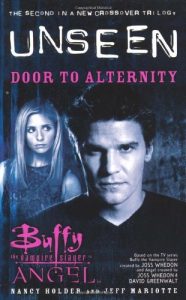
 If you’re in any way interesting, you don’t remember that I read the first book of a Buffy/Angel crossover trilogy in December (at least, not before I reminded you just now), because you’ve had other, better things on your mind. Like, say, tax season, or how the Iraqi election contributes to the stability of that region.
A few days ago, I finished reading the equally engrossing second book of the Unseen trilogy, Door to Alternity. (As before, there are inevitable spoilers through the first several seasons of Buffy, so stop now if you want to avoid them.) Much as The Burning had lots of fire, this book has lots of doors to alternities (which, sensibly, are alternate realities but without so many syllables). This third of the trilogy combines the thrilling danger of randomly appearing monsters swarming over Sunnydale, teens (disaffected and affected alike) disappearing into glowing portals all over LA, and a turf war between Mexican street gangs and the Russian Mafiya.[1] Against this thrillingly dangerous backdrop, the authors have included the kinds of Buffy tropes you’d expect of a Scooby gang frozen in emotional time for the summer: Xander and Anya sure do talk about and have lots of sex, Buffy, Riley, and Angel sure do spend a lot of angsty thought over their non-existent triangle, and Spike sure does want that chip out of his head.
It was approximately three months between when I read the first book and the second. By comparison, it was approximately two months between when the two books were released. I can’t say I know they were written two months apart as a result of that publication spacing, but I also can’t say I’d be surprised to learn that it was so.
[1] As you can see, only a couple of key changes have occurred in the greater Southern California area in the ten years since the events chronicled in Grand Theft Auto: San Andreas.
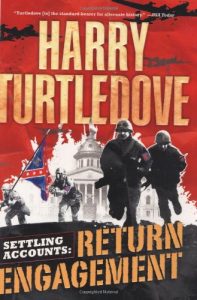 I think half the fun of alternate history writing comes from the winks and nudges that the author is able to give the informed reader about the parallels and outright differences between what got written and what really happened. Not that this is hard to achieve in a Turtledove novel; he’s the genre’s Grisham, writing alternate history for the masses, which means that he’s not really writing beyond the high school history level on most occasions. There are certainly things to spot even for more informed readers, but they’re rare. (Or else, I’m insufficiently informed; that’s likely.)