Tag Archives: graphic novel

Ultimate X-Men: Absolute Power

A tried and true way to annoy fans of a series is with a drug metaphor. There you’ll be watching [spoiler elided] perform magic, getting better season after season, even earning a girlfriend out of it, and then suddenly in the sixth season, it turns out that [spoiler elided] has an addiction to magic that must be stopped any any cost, lest lives be destroyed. Or in the Ultimate X-Men, say, there’s Colossus, this big steel guy, but it turns out he’s been doing drugs all along to be strong enough to support his impenetrable skin. And now all of his friends are addicted too, and the ones who aren’t had better step in and save the day! Oh, and also, it’s time to introduce another half-dozen Marvel characters that you won’t be able to care about unless you already know who they are, because heaven knows we certainly don’t have enough time to actually introduce them and find out if they make any sense or should be cared about, before they’re gone again.[1]

It’s too bad, too, because without the rush job, well… I mean, the drug thing still would have annoyed me. Ongoing series of every flavor really need to stop with that shit, because it is never done well. Ever. But, without the rush job and the drug-story allergy, the last couple of pages of climax, dramatic revelation, and cliffhanger would probably have been pretty cool. Instead of feeling excited about what comes next, though, I’m mostly glad that Absolute Power is the last Ultimate X-Men book I have to read.

[1] That right there is the biggest problem with the Ultimate line of comics, in a nutshell. If you’re going to pretend to be shedding forty years of continuity so that new readers can join the fun, then stop letting your stable of writers add in old characters unless they promise to tell me who they are and why I care. Or, better yet, make me care within the confines of the plot. I know that’s not that hard to do.

The Walking Dead: Fear the Hunters

I hope the Walking Dead series is nearing its conclusion. I hope this because I’m getting a little bit tired of trying to figure out who is who, as the characters get more haggard and similar and there’s no color palette to tell them apart with. I hope this because, as of Fear the Hunters, the majority of characters have finally made it into survival mode, and I no longer have that much concern about whether or not they’ll be okay, but only about in what manner they will succeed. Most of all, I hope it because I fear that Kirkman is running out of new stories to tell. The push-and-pull between survival at any cost and the dignity of retaining human goodness? Rick’s[1] band of traveling survivors versus unseen and unknown human horrors to match and surpass anything that zombies could possibly dish out? I have, as they say, both been there and done that. And the thing I really hope is that I don’t get to a point where the stories bore me. It hasn’t happened yet, but without some kind of fundamental shift (or else that conclusion), I can smell it on the wind.

[1] Although, here’s a twist. I don’t think the book addresses last names anymore, and I know I don’t recall the main character’s. Between the lines and in the silences, it is nice to know that the story still has progression, even if it’s starting to feel played out on the surface.

Ultimate Iron Man II

One of two things happened between my readings of Ultimate Iron Man and Ultimate Iron Man II. Either the writing got a lot better, or I relaxed about the continuity weirdness and accepted that this whole prequel thing could be true after all without breaking anything that has happened later in Tony Stark’s timeline. Regardless, the upshot is that I got to enjoy this book lots more, and yay for that! Despite being labeled and numbered as a new series, it picks up right where the last one left off; Tony is using his new experimental armor to fight against bad guys and his father is in jail, framed for the murder of a rival arms manufacturer. The story adds in a few new twists that work well as prequel fodder, including government agents who want Tony’s new “robot” and continued visits to the pre-Richards Baxter Building. But mostly it’s a straightforward murder mystery set at the highest levels of corporate espionage and global terrorism. The man inside the Iron Man suit may be far more powerful than I’m comfortable with, but his story is always funny and never boring, so I can cut a little slack on my complaints this time.

Card has still come nowhere near a connection point between this ongoing origin story and the Tony Stark that joined the Ultimates way back in the second issue of that comic, and I suppose now that the Ultimate series has ended and been rebranded, perhaps he never will. Despite my previous complaints, I have to be a little disappointed by that, as the characters were really starting to pop. At least I’ve got something like 40+ years of main sequence Marvel continuity to read, so I don’t have to feel too sad about it.

Ultimate Power

I have thought about mentioning for a few books now as it kept getting coming up (but then ultimately never did so) that things have changed within S.H.I.E.L.D., the organization that is mostly concerned with terrorism, superheroes and supervillains, and the management thereof. Good old Nick Fury, one-eyed ass-kicker extraordinaire, based on Samuel L. Jackson for the appropriate level of badassery right out the gate, has gone missing and is no longer in charge of the Ultimates or much of anything else. And people keep talking about how weird it is that he’s missing and wondering if he’ll ever come back. I had been expecting something along the lines of Ultimate Power to come along and explain this to me, and not only was I right, but it turns out I should have actually opened it earlier in my readthrough; who knew it came out in a hardback version first? (Must definitely re-order these books correctly, once I finally have the missing X-Men volumes back.)

Reed Richards of the Fantastic Four is working on a promise to change his friend the Thing back to human form, because being a giant rock creature is just not very pleasant for some people, even when they’re stronger than just about everyone and practically indestructible. As part of that project, he sends a handful of probes into several parallel dimensions[1] in search of scientists willing to assist him, against Nick Fury’s explicit orders. Naturally, moments later[2], angry superheros from one of these other dimensions[3] appear to arrest Reed, because his probe nearly destroyed their planet. Being a stand-up guy, he agrees to be arrested and tried; being a master tactician with Marine sensibilities, Fury immediately mounts a rescue operation including pretty much every good character in the Marvel universe. And then, you know, things explode or generally go down in strange ways.

The story was pretty okay if you can get past only being able to follow the two-thirds of it that involved Ultimate characters. But it had massive continuity problems. Because, all the people wondering where Nick Fury has gotten to, in other books? They were in this book to see. Also, there’s a completely inexplicable appearance by a character who, last I knew of, should not have been available for this particular event. But writers sometimes do things because they’ll look cool without worrying about whether it makes much sense. And this did look cool.

[1] Not unlike the N-Zone that he was running teleportation tests through when he accidentally created his group’s superpowers in the first place.
[2] Probably, it took longer? Comics as a medium can fail to properly express the passage of time.
[3] I took a little while to catch up here, as none of these characters was familiar. Apparently, they are meant to be a crossover from a different current Marvel series about the Supreme universe, in which all the heroes are ripped off from DC. It is not clear to me why this would be compelling, but there you go.

Fables: Arabian Nights (and Days)

By no means am I implying the book was not good, or even less entertaining than usual. But Arabian Nights (and Days) did something more to the Fable series than merely define the very model of a transition book; it actually made me think that Bill Willingham doesn’t have a solid road map for where his series is going, anymore. I mean, he spent time establishing Fabletown and its history, and then there have been important storylines in the fields of romance, politics, and the war against the Adversary. So it’s not like I really know enough at this juncture to say that the sudden influx of the Arabian fables (including Sinbad, the ubiquitous evil magician with a pointy beard, and all manner of harem girls) marks a directionless grasp at new plots. It could well be merely another foundational introduction to the people who will be important in the next phase of the story, now that part one has been so firmly established. The fact that the political scene was still as solid as ever and that the last couple of issues gave us a brief look into the Adversary’s side of the war leave me hopeful that this was nothing less than the transitional book it certainly was.
While I’m pondering what I’d like to see out of the series, anyway, can the next book have more Mowgli and his current quest please? (Or Cinderella, if I’m remembering correctly just who it is that I mean; she was pretty awesome.)

Ultimate Spider-Man and His Amazing Friends

It is with something very like relief that I report Ultimate Spider-Man and His Amazing Friends as merely good. Over the course of a few mostly light-hearted adventures, Peter and his classmates interact with the Human Torch and Iceman (plus several other X-Men from a very slightly different continuity to the one I’m reading about in Ultimate X-Men[1]) while dealing with such issues as a classmate’s newly activated mutant gene or the perennial high school parenting assignment that seems to only exist in fiction. You know, the one with the doll that the “parents” trade back and forth and keep details of, and sometimes the doll also reports on its own status via sophisticated electronics, and sometimes the doll is an egg that you would think is a chicken egg but turns out to be the egg of a cave-dwelling reptilian deity? Yeah, that one. And Peter also tangles for a full issue with the Shocker, a punchline of a villain that is by far Spider-Man’s most common foe, but who is always dealt with so quickly in the introduction of a real storyline that I had failed to realize it was constantly the same guy until reading the giant glossary at the end of Ultimate X4. So it’s been nice to notice him in the past few volumes and be amused, and nicer still to see him get a full plot to himself for once.

I am getting more used to the new art, but Immomen is kind of terrible at drawing chick hair. (Mainly Mary Jane’s irritates me, but she is by no means the only victim.) Still and all, my main point is the one I opened with. I really am glad that I can see this book as only good. Because it’s nice to get a chance to relax from Bendis’ non-stop action over the last several books, it’s nice to think to myself that I’m capable of noticing when the quality is below outstanding, and it is correlatedly nice to be confident that my previous reviews have probably been accurate after all.

[1] Honestly, the differences are not that important, but it’s odd to me that they wouldn’t have worked a little harder to avoid glitches, since the reboot is still so very young in relative terms. Inexplicable presence of Colossus, no mention of Charles Xavier’s very public murder, etc.

Ultimate X-Men: Apocalypse

If it wasn’t for the fact that I know the Ultimate Marvel universe has a sort of a time limit to it[1], I would be impressed by the new directions that have opened up as of the closing panels of the apparently appropriately named Apocalypse. The book closed up three separate Ultimate X-Men storylines in just five short issues. This has got to be some kind of record, I think.

First off, it closed down a Storm story that has thusfar been too anemic for me to mention, and in such an abrupt way that even if I had managed to care about it before, I would not now do so. (Thankfully, that was the bad part of the book; had the rest been even half as terrible, I would have had to work very hard to finish up.) After the lameness, though, the main event started, and it was a pretty decent main event, I must say. Remember a couple of books ago when that guy Cable came from a terrible future to stop it from ever happening? And so he hunted the streets of Los Angeles for Sarah Connor, until… okay, that’s not right at all. Anyway, he did what he did, and then over the next book, the differently-configured X-Men continued to work toward preventing that dark future. And now, finally, it all comes to a head! There are not so many revelations[2] as you might expect out of an eponymously apocalyptic event, but there are enough knock-down drag-out fights and casualties to make up for their lack. Plus, there’s also the conclusion of that third ongoing arc to deal with, which I will pretend not to explicitly reveal by saying only that it involves Jean Grey.

All of which goes back to what I was saying in the first place. If I did not know that there were only 1.5 books of Ultimate X-Men left, and then a giant question mark as to whether more will come afterwards, I would currently be very very excited by both the fact that so many old plotlines have been cleared away and especially by the manner in which it was done. It at least seems like there are really big things ahead for Marvel’s mutant populace.

[1] And, man, why is it consistently only the X-Men that make me think of this?
[2] haha

Ex Machina: Dirty Tricks

My understanding is that Dirty Tricks is the penultimate Ex Machina collection. Which leaves me all the more puzzled by how meaningless it was. Don’t get me wrong, none of the stories was in any way bad, nor did any of them leave me feeling less than entertained. All the same, when I think them over (unburied slaves ghost story, daredevil protester with a crush on the Great Machine, 2004 Republican national convention), I am left with a sense that there was no amount of plot progression or character growth. Sure, Mayor Hundred is planning for his political future, and sure, his old friend Kremlin is still working on a plot against Hundred in the hopes of forcing him to abandon politics and return to superheroism, but each of these plots is advanced so incrementally that I find it hard to credit the story can be validly concluded in only one more book.

I guess I’ll find out in May?

Ultimate Spider-Man: Death of a Goblin

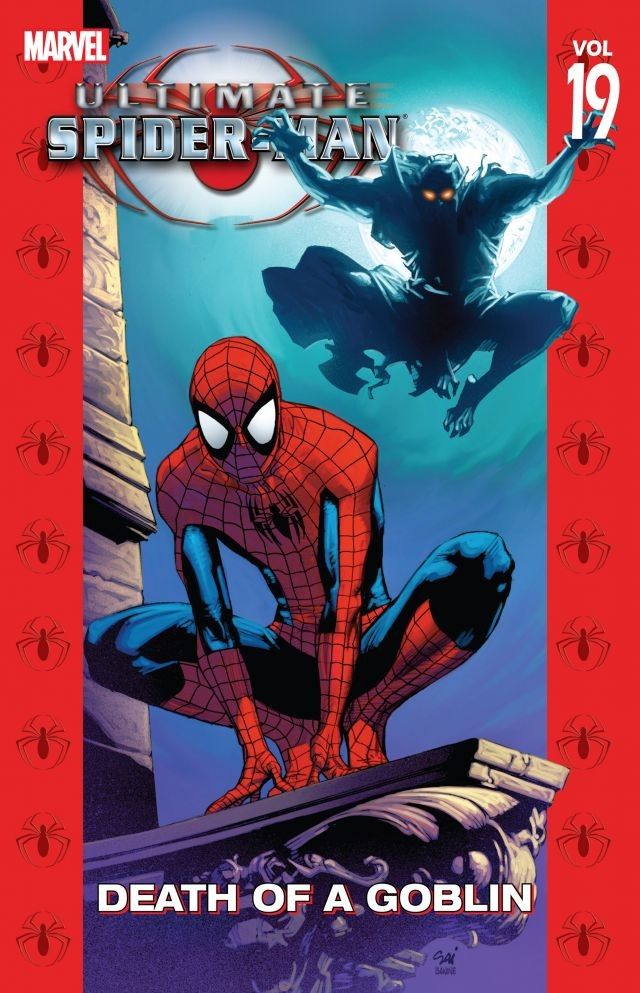
DIG008685_1Blah blah blah goodcakes. I know, I know. But since it continues to rate, I can hardly not continue to say it, right? As is by now usually the case this far into the series, it’s time for another familiar old villain to rear his head:  as the title indicates, Norman Osborn’s Green Goblin has broken out of S.H.I.E.L.D. custody to once more torment Peter Parker and friends. What continues to impress is how there’s always a new take; this time, it’s the mysterious absence of Nick Fury, Osborn’s devious scheme to discredit the missing Fury, and a dire hint about S.H.I.E.L.D.’s [in]ability to control the Oz formula that transforms Osborn into the Green Goblin and has also affected others of Peter’s friends over the past year. I definitely like how most new Ultimate titles I read these days tie that universe closer and closer together. Not unlike a spider’s web, you can hardly touch one strand without consequences being sensed in each of the others.

But enough about all this, I can hardly convince you of the goodness of the story by now if I haven’t already done so long since. Rather, I feel it necessary to comment on the change of artist for the first time in over 100 issues. Newcomer Stuart Immomen[1] definitely has a different style, and it will take me a little time to get used to it. I mean, I’ve seen his art in Ultimate Fantastic Four as well, and it’s not at all bad. It’s just that Bagley’s weight on the series is a lot stronger than any other artist/series combo in the Ultimate universe, and probably in most of Marvel’s history. That said, Immomen has a few quirks. For one thing (and I cannot get over the fact that I hold this opinion at all; apparently I’ve been reading a lot of comics over the past 2-3 years?), his lines are really heavy. Generally if I notice them as distinct from the figure they contain, that is too heavy for me. For another thing, he seems to work from a limited pool of facial expressions. At least, annoyed Peter Parker is the same as annoyed Reed Richards. Also, the eye on the Spider-Man mask has gotten vast. I mean, seriously frakking huge, like a full third of the mask’s surface area per side. However, none of the art is stylized or overly focused on experimentation; all of the people look like people. So I will get used to it, no worries. It’s just a lot of change to take in at once.

[1] I cannot help but think of him as a girl unless I’m really trying not to, because his name reminds me of Imoen from Baldur’s Gate and Baldur’s Gate II. This is not something you actually needed to know.

Ultimate Vision

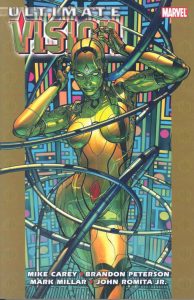
After the earth was saved at the end of the Ultimate Galactus trilogy[1], things pretty much went back to normal I guess. Except, some editor and Golden Age and/or Silver Age android fan decided that there ought to be a few more consequences. As a result, we have Ultimate Vision, in which the robot that came to earth to warn of Gah Lak Tus’ approach and document our doomed civilization rebuilds itself a female body with implausibly proportioned hips and tangles with the scientists of a criminal organization called A.I.M.[2] (whose presence I have not previously detected in the Ultimate continuity) over the disposal of a spare Gah Lak Tus drone that was damaged and left behind as the swarm retreated in defeat. And yeah, that’s pretty much the whole thing. It’s not that it was a bad story; it was actually pretty okay. It’s that it was tragically irrelevant to anything else going on.

[1] Spoiler alert
[2] Advanced Idea Mechanics, if you were curious