Tag Archives: fantasy

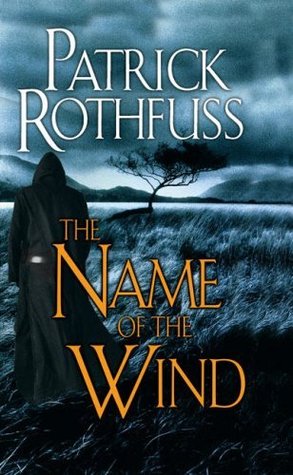
The Name of the Wind

186074Last year, I read an author’s first book about which I had only the best to say. I like this kind of thing, because I get to know about a good author early in the career, and I can keep up over the progression and have thoughtful, chin-stroking opinions and pass on the news to other people to repay all the times that people have done this for me. The thing is, though, it really doesn’t happen very often. So you can imagine my surprise when I’ve got another one, a mere year and a half later.

The Name of the Wind tells the first third of a story that borrows liberally from the tone of Scott Lynch’s books, the voice of Steven Brust’s Vlad Taltos, and the plot, among many others, of Harry Potter. How many of these are actual influences I cannot guess, of course, but there’s no question that whether influence or simple similarity, Patrick Rothfuss has created a character and a story that both are very much all his own. His world is a fairly standard fantasy landscape in trouble: the roads aren’t safe, war and the rumor of war are on everyone’s mind and tongue, and demons stalk the landscape. But stories and legends abound, very old and recent alike.

A chronicler of such stories is following rumors of one Kvothe[1] the Bloodless, Kvothe Kingkiller. He finds trouble on the road and yes, demons, but he also seems to have found what he is looking for in the guise of a small-town innkeeper. And to even his own surprise, Kvothe agrees to have his story told, if it be told exactly as he tells it, with neither embellishments nor redactions. Of course, who but Kvothe himself is to say how true the story really is, but as it involves magic, demons, dragons, and still more stories of the world underlying his own tale, it makes for a worthy read.

Well, okay, lots of terribly unworthy reads have those things too, but Rothfuss’ premiere work has, as I’ve already implied, an excellent voice telling it. This is the rare work in which the prose and plot are of equally high measure. It also has an entertaining mythology, an engagable and interesting take on magic, and, regardless of Kvothe’s veracity, a great deal of truth to it. The best of the book, though, is Kvothe himself. Unreliable narration has been a pretty sure guarantor of my enjoyment of a book for some time now, but The Name of the Wind is all the more interesting for alternating between Kvothe’s tale and the room in which he tells it, where we can see him through eyes other than his own. He contains in him the heroism he claims, the boundless sense of duty he may not even wholly be aware of, and unplumbed depths of bitter anger that appear whenever the world does not really conform to his liking. Despite how pleasantly entertaining he comes off in the story, an event during its telling that lasted for a mere page told me far more about him than anything he actually said. And this is exactly the kind of thing I love to read about. I suspect it may have to do with my hobbyist interest in psychology? In any event, my only warning and the only complaint I have about the book at all is my lack of clue about when the first sequel will be published.

[1] “Pronounced very nearly the same as Quothe”
The Wayfarer Redemption

Imagine you are a teenager, maybe just starting college. And you’ve been raised in the traditional American Christian mindset, the one that is so generic and ubiquitous that if you tried to imagine a painting of it, we’d have more or less the same painting in mind. But you’re at college now, away from your old life and on your own for really the first time. And your roommate is a Wiccan, and after you get over the exotic amusement, you start talking a lot, and damned if the Wiccan isn’t saying a lot of stuff you’re interested in. A few minutes later[1], bam, you have a full-blown conversion experience, you love Mother Gaia, you worship in the moonlight in the center of the quad, and you’re certainly naked when you do it. You hug trees, not to conform to a filthy hippy stereotype so much as because you genuinely feel connected to each and every one of them. This is for reals the best experience of your life, and it’s aggravating how people are rolling their eyes at you and trying to get you to chill out with all the “We are one” talk, and even your Wiccan roommate feels like you’ve gone overboard.

Okay. Got it?

That person, I think, is who wrote The Wayfarer Redemption. About a thousand years ago, humans got proselytized into cutting down all the trees and plowing the world into flat and perfect order, because the people who hang out in the trees with little horns on their heads and the ones who hang out in the mountains with wings are evil and in fact Forbidden and need to be kept away from humans, and cutting down all their trees is a good way to go about it. Except now there are frozen ghost dudes and a monster-guy named Gorgrael leading them, and there’s a prophecy that says a lot of people have to do a lot of things, like throwing off the shackles of their oppressive religion and teaming up with the Forbiddens, learning to love trees and talk to stags and embrace the Mother[2] and also find each other terribly attractive and fall in love on pretty much that basis alone. It’s fairly generic fantasy pulp that is mostly saved by the bad guys being somewhat cool. On the downside, the writing is iffy and feels like a first book, in that there’s way too much telling about peoples’ motivations instead of showing. Both plot and writing improved as the story progressed, though I’m not sure it got enough better to carry a trilogy.[3] I most likely would not have finished it, except it was recommended to me and I felt the obligation. Still, it was getting better instead of worse, so there’s every chance I’ll read the next one.

[1] Or maybe a few weeks? Things change fast in college, it could be either one.
[2] Sadly, not a euphemism.
[3] P.S. This is the first book of a trilogy.

Dead Like Me: Life after Death

One upon a time, there was a television show in which the always enjoyable Mandy Patinkin (as Rube) wrangled a group of grim reapers, those randomly selected dead who remain alive to harvest the souls of the living as part of the cycle of life and death. Think the personification of Death, if it were a worldwide non-profit business organization instead of one guy in a robe, or perhaps girl wearing an ankh and black casualwear. Anyhow, Mandy was the district manager for this group of people assigned to handle accidental deaths in the Pacific Northwest, and the series opens on one such death of a teenage girl and focuses on, in addition to the reaping, Georgia Lass’s slow process of moving on with her life after death, and on her family’s slow process of coming to terms with their dead daughter. It was a good, funny, occasionally moving show.

In the curse of time, it was canceled, as tends to happen. And then, unexpectedly, a direct-to-video movie was made. Life after Death covers a couple of plotlines, one following Rube’s replacement as the regional boss and one following George’s assignment to reap a teenage boy who happens to be her sister’s boyfriend. The second plotline was everything that I would look for from the show when it was on, funny and moving all wrapped up in one well-written package. The first one, on the other hand, was meaningless from start to finish. There was no good explanation for or resolution of Rube’s disappearance. The remaining side characters all ditched their past motivations, in ways that are slightly believable, but only if I fill in the gaps for myself; the script did not explain adequately. And the resolution felt episodic rather than like its own story; that is, the situation at the end of the story was exactly the same as it had been at the beginning. Which I assume was an effort to leave a space for Mandy to return if another movie is made, because his absence was a glaring hole. But it still made what was half of a good movie turn into half of a good episode and half of a terrible one. The idea of a film doesn’t offend me, but if it’s only going to be a long episode, they should bring the series back instead. And write it the better way it used to be written!

Harry Potter and the Half-Blood Prince

I’m genuinely unsure what to make of the 6th Harry Potter movie. It took its time and worked hard to include what was necessary, unlike some of the previous films. Lots of backstory was ditched, but it kept the important bits. And they did a great job with the character interactions. Every cylinder fired really well[1], honestly, except for the parts that dealt with the central storyline and mystery. The Half-Blood Prince’s identity scarcely registered as a mystery in the first place, despite so many revealed reasons as to why it might be troubling. Voldemort’s secret was mostly an afterthought, though I suppose it being the main focus of two more movies will make up for that. And the climatic scene felt, well, rushed.

But what I can’t decide is how it would have looked to a newcomer. Were the scenes unsatisfying because the script and the direction weren’t quite up to it? Or because I was able to choose the pacing in the book, and the movie simply didn’t live up to my preferences? You’ll have to ask someone who came at these from a different direction, I guess, because I’ve got nothing to go by here, except what I’ve already said. On the bright side, it was pretty good in itself, just not as satisfying as I had hoped. Alan Rickman, as usual, is the tops. Oh, and speaking of bright sides, I think I recommend an afternoon or evening viewing. It’s a very dark film, visually, and emerging into the bright of summer would be… disorienting, at best.

[1] Okay, Daniel Radcliffe is simply not keeping up with the emerging talent of his co-stars. Pity.

Luke Skywalker and the Shadows of Mindor

You would think, given a decisive lack of job, that I would have plenty of time to read, right? And I can’t in any real honesty say I haven’t had, but I somehow haven’t been reading much nevertheless. Less than usual, even, which is a bit puzzling. I guess all those lunches at work added up? Anyhow, what I have been reading is a perfectly serviceable Star Wars book. I wish I could say more for it, but it really very much reminds me of the early books chronicling the chaotic period after the fall of the Empire, before the people in charge had started taking firm plot-based reins on the progression of the extended universe. So, some of the books would be top notch, some would be godawful bad, and the majority would be like this: perfectly okay, good Star Wars feel, but ultimately forgettable.

Luke Skywalker and the Shadows of Mindor suffers the most, I think, for being so plot-based. After a 20 book series with an epic plot and a 9 book series with reasonably epic character progression to follow it, it’s just hard to go back 30 years and read a standalone book that has yet another take on the dark side of the Force and how different people perceive it, yet another wholly alien species that must be understood if the day is to be saved, yet another stack of TIE Fighters and stormtroopers. The characters were all on, and that means a lot. And there’s a reasonably good running gag behind the awkward title. But on the whole, it was entirely too missable for my tastes. I hope the next one I read, which delves the farthest yet into the future of that universe, is a substantial sight better.

Elantris

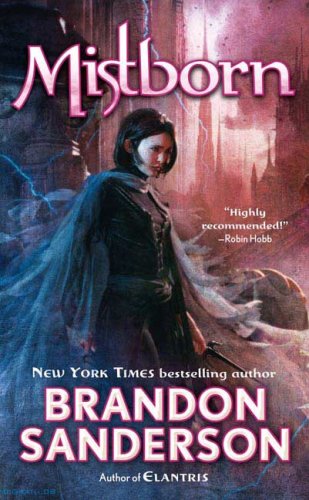
So, this is an old story by now, but I picked up Elantris to read after Brandon Sanderson was named as the author of the Wheel of Time’s concluding volumes. Well, and also after being told that people like his books pretty well. And hey, good news, this is a pretty damn good book. A strong female protagonist, a holy war, a symbol-based magic system, a pretty horrific curse, and a thoughtfully drawn adversary are only some of the upsides. Plus, rumor has it that his Mistborn trilogy is even better.

The book is pretty hard to describe, though. There’s this city, Elantris, and it used to be the envy of the world. People would randomly ascend to a higher state of being, move to Elantris, do their cool magic, and everyone in the country had a pretty great life because of the free foods being distributed from the ascended magic people, and yeah. Pretty much utopian communism at its finest. Sure, there are religious differences out in the rest of the world, with a holy warrior / proselytizing empire ranged against a fairly low-key, love-based religion that most of the world’s other countries embrace. This would probably spell a recipe for disaster, except for Elantris. And then, ten years ago, its ascended, magical residents are all inexplicably struck down: their bodies waste away, their magic has failed, their city is a rotten, crumbling ruin. And worst of all, people continue to randomly ascend, just as they always had, only now they “ascend” into pain, misery, and forced exile in that once proud city.

These facts combine to form the setting for a story about three characters: Prince Raoden of Arelon (Elantris’ country), brought down by the Elantrian curse in the book’s opening sentence; Princess Sarene of Teod, who would have married Raoden a week later under better circumstances as part of a politically-motivated alliance, and Hrathen of Fjondell, the priest who has most recently converted the country to the south of Arelon by fire and is determined to not make the same mistakes with Arelon and Teod, the last countries not to have fallen under his empire’s sway. Add several interesting supporting characters, many of whom have backstories too large for this one book, stir, and watch the results, about which I can say no more. That issue, a few elements of the plot or the characters lacking enough explanation to really make sense, was my only problem with it. But these didn’t get in the way of an excellent story, and, like I said, people say his current books are better. That’s a decent achievement already, as much as I did like this one.

Fables: The Mean Seasons

In the wake of the Battle of Fabletown, the winds of change are blowing. The exiled Fables finally have prisoners who might reveal information as to the disposition of their long-abandoned homelands, not least of which would be the identity of their Adversary. Despite the seeming upswing in fortune, though, it’s really more of an ill wind as blows nobody any good. Political discord, births, deaths, clandestine spywork, and ultimately the scattering and separation of our long-time heroes, all blows on this wind. No wonder the book was named The Mean Seasons!

Although the book seemed to be rushing along on those winds, blowing a year past in almost the blink of an eye, there were several points of interest along the way. Demonstrations of just how capable of a leader that Bigby Wolf and Snow White each have really been are scattered throughout; particularly, Bigby’s prowess as a manager and spymaster are laid bare. Meanwhile, Snow stumbles onto an unfortunate murder mystery, and there’s a completely gratuitous WWII story thrown in. By and large, it’s a good book that suffers only by letting the ongoing plot simmer instead of boil. I’m still looking very much forward to whatever comes next.

The Time of the Dark

It turns out, and probably unsurprisingly, that the landscape is littered with old fantasy series that never struck my fancy or I otherwise never got around to, and that’s nevermind the many current(ish) ones I’m interested in. So what brings an otherwise random element of that book-studded landscape[1] to my attention? I think more unsurprisingly than the last not very surprising thing I said, I started reading the Darwath trilogy on the advice of a pretty girl.

The Time of the Dark is very much the picture of a book that was written for me.[3] It has a couple of people who more or less stepped through a random portal in the universe to end up in a fantasy realm, much as I’ve wanted to do since I was in high school, and that realm is threatened by eldritch[2], floating Lovecraftian abominations that avoid the light of day, not unlike the premise of Pitch Black. And there’s even a proto- Chain of Dogs situation that informs the final third and climax of the book. Ultimately, the only bad thing I can really say about the book is that the me it was written for is probably ten or fifteen years less experienced, minimum, in the elements of fantasy and horror that it describes. But it’s quite easy to recognize all the holy wow moments I would have had if I’d read it at around the same time I was reading, say, Eddings.

In addition to the cool plot and setting tricks, there seems to be some veins of philosophy beneath the surface that I expect to show up a lot more strongly in the second and third books. And also, there are some mysteries yet to solve, even aside from the central one of whether humanity can be saved from the Dark Ones. (Oh, right, speaking of things that are designed to lure me in, civilization is on the brink of utter collapse. So, yeah.) Good stuff, and I am pleased to be reading more soon.

[1] I’m really loving this imagery, by the way. I mean, not my portrayal of it, just the idea that you’re walking around, and there are these piles and drifts of book every which way, scattered about like a nine-pins. Except for the problem of rain, that would be a pretty sweet world.
[2] You pretty much always have to say “eldritch” in these situations, you know?
[3] Aside from the ridiculous cover art, that is, which I feel obliged to mention since it’s the only literal picture in sight. In its defense, that is (inexplicably on first blush) a literal portrayal of a scene from early in the story.

Tales of the Vampires

Back when Buffy and Angel were over and nobody had yet realized that they could continue the show via comics, Joss Whedon and some of his close writer friends got together to write up some ancillary material and dump it into a few graphic novels. One such outcome is Tales of the Vampires, in which an agreeable connective story (about a vampire who is, um, telling some tales about vampire-kind to some young Watchers-in-training) surrounds a reasonably high number of micro-stories that vary between so-so and surprisingly clever. As you’d expect, the Whedon-penned connective story is the best, with Jane Espenson’s entries an easy second choice. The art, as usual for old-style Buffy comics, isn’t really to my taste, but it’s never really that bad either. Mostly, though, it reminds me I should really ought to catch up on the monthly Buffy shipments I’ve been getting.

Lucifer: The Divine Comedy

While waiting for the third movie to start, ridiculously late last night, I made kind of a cardinal mistake. If I believed for an instant there would be a fourth Horrorfest, despite the missed timing, horrible scheduling of the movies over the course of this weekend and the next week, and the single digit attendance numbers yesterday, I would make a point of being at the beginning or in the middle of a long book during that weekend. Because now I have to take that much extra time to write a thoughtful book review, too? We’re taking eight movies in three days, you know! (Though it remains to be seen if that’s true, with special thanks due once again to the Fest’s carefully planned-for-maximal-uselessness screening schedule.)

But since the book in question is the fourth volume of the Lucifer series, I do have to be thoughtful after all. Dammit. The Divine Comedy takes a lot of elements of the story so far and resolves them. I mean, with a vengeance. There are maybe three things that are different from before the start of the story. They’re major things, but there are only three things! Given such an aggressive trimming schedule, I look forward to what will happen next. I am pretty sure that God still has a problem with Lucifer, and the archangel Michael is about to embark on a pretty impressive story arc. But beyond that, I have almost no guesses.

A thing that interests me about Gaiman’s Sandman world that this is drawn from: no Jesus. I mean, he is referenced in the vernacular on a regular basis, but, strangely for a series as steeped in religion as Sandman is, and much moreso for the Heaven-and-Hell-centric Lucifer series, Jesus does not show up as a character in any way. I have to imagine it’s really related to DC comics being worried about horrible press, but I’d like to catch wind of an in-story explanation. His absence is downright conspicuous.