Tag Archives: superheroes

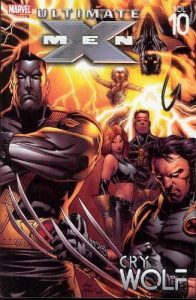
Ultimate X-Men: Cry Wolf

I am really ambivalent about my latest X-Men, Cry Wolf. On the one hand, it was a good story that hung together well and shifted around several of the character elements in new ways, such that I am looking forward to what comes next. Also, unlike the last time he showed up, Gambit got a proper introduction and seemed like a real person. Which is good, because he’s apparently a favorite, but I don’t really know of him from anywhere but these books.

But on the other hand, too many of the events seemed forced for the sake of hitting key plot points from the original run. It’s all good and well for there to be a triangle between Bobby Drake and Kitty Pryde and Rogue, but build it up a little bit, yeah? I’ll care more if it doesn’t seem to be performed by rote. I’m willing to reserve judgment on the Fenris Corporation, as I assume they’ll be relevant later and this wasn’t just a whirlwind but ultimately pointless mention.

(I’m not leaving out the actual plot on purpose, it’s just that it was a hanger for the character interactions and changes, and thus seems less important than the other stuff I talked about.)

Ultimate Spider-Man: Ultimate Six

So, a kind of a funny thing happened. I completely forgot to read this book. I had it in queue, and I guess it was in the back seat of my car or something, and I was so far behind on reviews anyway, and somehow I convinced myself I’d already read it. It could be that a new Walking Dead contributed to my misapprehension on this matter as well? I just realized, suddenly, that there was no review, and then while looking at the book with the intention of loaning it out to my friend Emily (who you will no doubt recall as the violently abused daughter in The Last House on the Left), it hit me that, hey, you did not at all read this. Both matters: rectified!

You would think, having finally caught up to the book I most recently finished, I would have it in me to do more than gush. There’s just something about Brian Michael Bendis writing Ultimate Spider-Man that leaves me incoherent with glee, apparently. I’d like to mind, but if that’s what it takes to get work this consistently amazing and this consistently able to top itself, then I’m not going to quibble overmuch. Ultimate Six re-envisions the first really big Spider-Man event of the original Marvel era, in which six of Spider-Man’s past foes team up to accomplish what none of them could individually: Spider-Man’s annihilation.

Of course, when I say “re-envisions”, what I mean is, “takes the kernel of an idea and demonstrates that, no matter how good Marvel really was in the ’60s, it has the ability to blow that out of the water in the modern era”. Four of Peter Parker’s previous foes, including the Green Goblin and the Sandman as a newly added fifth in a flashback sequence from a few months ago, are under S.H.I.E.L.D. imprisonment for illegal genetic modifications. The consequences of this unfortunate collection of villainy in one holding area are many and varied, ranging from the airing of Nick Fury’s significantly dirty laundry[1], to Peter’s identity being revealed to a significant portion of the Ultimate universe, to the likely psychological collapse of his once-friend Harry Osborn. And even these pale in comparison to what will happen if the Ultimates[2] cannot prevent the team of five (and their newest sixth recruit) from fulfilling their plan to strike at the very heart of the government.

[1] I like that I can trust this event will have future consequences to the continuity.
[2] For timeline purists, the Ultimate Six storyline (which was apparently independent of the Ultimate Spider-Man run, though I like that it was collected here) falls between Ultimates and Ultimates II.

Ultimate Marvel Team-Up, Volume 2

After being underwhelmed by the first Ultimate Marvel Team-Up, I was looking forward to getting through the remaining volumes quickly so that I could move on to some of the side storylines I’ve been seeing in the future that look pretty awesome, and the moreso because apparently there’s some kind of big Ultimate Universe event coming up, and I can’t be more than halfway through the accumulated catalog yet. To my surprise, though, the second volume of the series’ rather short run was thoroughly enjoyable.

The stories are all short and fluffily irrelevant to solid continuity in a way that the other runs and one-shot storylines are not. But they are far more strongly written than last time, including another visit from the X-Men[1] to explain human-mutant relations that clearly predates the UXM series’ start, and a ridiculously non-canonical visit with the Fantastic Four that was over the top hilarious. It also included the origin of Dr. Strange via a direct rip-off of the first Spider-Man/Strange crossover story back in the ’60s. The best moment, Logan/Peter notwithstanding, was the Lizard-Man origin issue. Curt Connor’s tragic scientific success is one of the best “villain” arcs I’ve seen out of Marvel in either universe, even if there’s an underlying message about the consequences of meddling with nature that I’m not so happy about.

The art varied between perfect, wonkily appropriate, and just plain wonky. Really, the only thing I was unhappy with was that three issues were outright skipped between the first and second book, resulting in my need to either scour comic stores for the missing issues directly, or to rebuy the Ultimate Marvel Team-Up run in a single volume. Both ideas are pretty solidly meh, at the moment. But I’m sure I’ll do one of them, eventually.

[1] Plus, yay, more Logan/Peter interaction. Still easily the best Ultimate crossover relationship, though the Nick Fury/Peter and /Professor X interactions are quite interesting. It’s just, Fury is so damn unlikeable most of the time.

Ultimate Fantastic Four: Silver Surfer

Being behind makes for subpar reviews. So, y’know. But I liked Silver Surfer more than I’ve liked the last few Fantastic Fours, even despite the fact that it was a fair bit more divergent from regular Marvel continuity than I’m used to the Ultimate universe being. Basically, Reed Richards is continuing to research the cosmic cube he was tricked into taking home a couple of books ago, and this time he accidentally summons a familiar-looking silver being riding a familiar-looking silver surfboard. And then the world kind of gets kidnapped. As usual, the FF are the most sci-fi series in Marvel, even when it doesn’t seem to match the rest of the continuity. Sometimes, that bothers me. This time, at least, it was a pretty damn cool story, albeit one with no apparent continuity impact. But I could be wrong about that, easily enough. If I find out otherwise, I’ll let you know!

Ultimate X-Men: The Tempest

I assume I liked the last Ultimate X-Men book, insofar as I’ve been liking them in general. Plus also, tragedy struck, and while I don’t automatically like that (depending on what happened), I definitely always like aftermath. And The Tempest is very much about aftermath, even though it’s in a quiet way, against the backdrop of a brand new villain and a mutant-assassin in his employ.

And, the book being short, that’s pretty much all that happened. I don’t want to elaborate on the aftermath, because, spoilers, and I can’t elaborate on the new villains, because I’m supposed to recognize them old school, and I did not get far enough to, I guess? But they made for a good story, and I can ask for little more than that! Except for being so deep into a series as to be pretty confusing, I could recommend the book unreservedly as an afternoon’s diversion.

So. That’s that, then!

Watchmen (2009)

So my normal Mondays involve some beer, some bar food, and some zombie slaughter. It is a pretty sweet deal, y’know? This Monday had its differences, though, in that I skipped the beer and food alike in favor of a brief, ultimately successful struggle to get the media company to honor the passes they had sent out for a sneak preview of Watchmen. (Okay, technically, we relied upon the kindness of strangers. But the important part is, everybody had a seat!)

So I watched it for something like two hours and forty-five minutes, and I’ve spent the subsequent day or so trying to figure out what I can possibly say about it, that I haven’t already said. The layouts and scenery shift constantly between starkly beautiful and grimily seedy with almost dizzying regularity, as a perfect counterpoint to the characters and their actions and motivations and essential, almost unstoppable humanity.[1] It’s a highly political and moral tale set at the height of communist paranoia in an alternate, superhero-laden 1985, and the thing is, I really don’t want to say any more than that because it’s worth coming to fresh.

But if you’re one of the people who didn’t come fresh, because you’ve already read Alan Moore’s original book from which this movie was drawn, I’ll say this much more: it is very probably the most faithful and effective adaptation of a literary work I have ever seen.[2] Got anything going on Friday or maybe Saturday? At least, anything you can’t cancel? Because, go see this.

[1] I might be gushing. But the story and the characters really are that good.
[2] And I was pretty happy with almost all of Peter Jackson’s choices on the Lord of the Rings movies.

Ultimate Marvel Team-Up, Volume 1

I may have mentioned at one point my sudden realization that a lot of things I have read during my what, year-long now Ultimate Marvel kick, had backward-looking references to some books that came out right at the beginning and I had initially failed to be aware of. But I’ve found these, and they are now in the rotation. Which brings us inexorably to Ultimate Marvel Team-Up, in which various characters from the Ultimate universe, you know, team up with each other.

Or, to be more accurate, Spider-Man meets other characters in an explicit crossover format that comes from the late ’60s or early ’70s or somewhen, because Brian Michael Bendis mostly likes Spider-Man and wanted to revive that format for the new generation. The only problem is, brief historical curiosity aside, the stories weren’t that interesting. The strength of Marvel, past as well as present, has always been its ongoing storylines with long-term consequences. Yes, there’s a lot of soap-operaish returns to life and failed relationships, but they are at least consequential from moment to moment, instead of seen once and irrelevant ever after. Necessarily, one-shot stories are going to come off pretty cold in a world where everything else matters, quite a bit.

All that said, the stories themselves were about a conflict between Peter and the first appearance of the Hulk in this timeline, during which stuff got trashed, Spider-Man proved his own relative strength and durability to the audience, and any kind of climax was left completely by the wayside; about a meeting between the also-inaugural appearance of Iron Man (complete with origin story) and our good Mr. Parker, who actually do team up to stop some… high-tech Communists, I guess? And, best of all, a meeting between Peter and Wolverine in which they try to fight off Sabretooth (he’s an evil mutant who is basically the same as Logan, only, y’know, eviller) before lots of civilians get hurt. Unsurprisingly to me, that last story was the most compelling. I assume it has something to do with what mutually-sympathetic, outsider characters Wolverine and Spider-Man are within their respective worlds. So, yay inevitable chemistry.

The art, which I only tend to notice when it is particularly egregious or unusual, or when the story is boring me, was in this instance equally boring. I wonder if I just think most of the art is fantastic and forget to say so, or if I’m really picky about handing out praise, or if I think most of the art is workmanlike and that only bothers me because I’ve focused on it in search of something to hold my attention when the story is so-so. Probably it’s the first one, but the correlation in my (possibly faulty?) memory between iffy art and iffy plot has been high over time.
Ultimate Spider-Man: Cats and Kings

The problem is, it feels like all of my Ultimate Spider-Man reviews are basically the same. That is the only problem, though. I’m pretty sure that if there were forty years’ worth of this series to read, I wouldn’t read anything else for a long, long time. As it is, I hold myself in check, so that I won’t run out for a while. (See also: the Dresden Files)

So, in Cats and Kings, Aunt May continues to be the best (rather than worst) supporting character in comics, J. Jonah Jameson[1] shows sudden depth of character, Mary Jane reveals new troubles that, in retrospect, have been there all along, and… oh, right! There’s also some crime-fighting! Including the return of Spidey’s first foe, the Kingpin, the reveal of a single-dimensional Elektra that has nothing much to do with the one I’ve reviewed lately[2], and new-to-me character Black Cat, who… okay, despite an apparent cribbing of a DC character you may or may not be familiar with, seems like she might be the best crossover between Peter’s life and Spider-Man’s since the Osborn family. It remains to be seen, though!

As usual, none of this comes close to capturing the essential funness of the series. Every volume is like reading the first day of sunlight in the spring in Seattle, or reading your kid’s first steps, or reading the first time you ever had sex with Scarlett Johansson.[3]

[1] He runs the newspaper, the Daily Bugle, where Peter Parker works. But you knew that?
[2] Which is pretty much a good thing. The Ultimate Daredevil and Elektra in their own books have no good way to cross-over with the rest of the Ultimate universe, unlike most of the rest of what I’ve read.
[3] Too much hype?

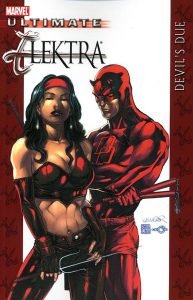
Ultimate Elektra: Devil’s Due

It has not been difficult for me to find graphic novels from the Ultimate Marvel series in my various used bookstores. I don’t have all of them by any means, but I’ve been able to pick up a lot just by keeping my eyes open. And then there’s the ambitiously numbered volume one of the Ultimate Elektra series, which seemed to have five or more copies available at every store I entered over the course of 2008. Which, despite the underlying snarkiness of that fact, is not to say that it was a bad book.

I imagine that if you knew nothing about the characters, even had not seen the Daredevil movie[1], then Devil’s Due might have told a pretty good story. See, there’s this ninja chick named Elektra, and she wants to protect her father from various lowlife thugs who are trying to destroy his business and / or manipulate him as part of a money-laundering scheme, presumedly because he owns a dry-cleanery. There’s also a blind lawyer who will probably be the Ultimate Daredevil someday, only he’s shown up in other Ultimate entries as himself instead of a shoddily-costumed law student; am I to assume this occurs before the rest of the Ultimate universe timeline? But I digress.

Anyhow, Daredevil, being the law and order type, wants Elektra to stop being such a deadly vigilante, she wants him to get off her back and stop being such a drag, and Manhattan crime boss Wilson Fisk, AKA the Kingpin, wants the lot of them to stop doing things that might result in his prosecution. The story has potential for nuanced shades of grey and moral quandaries; I think the biggest failure of the book lay in the knowledge that no character was ever going to budge from their initial position, which removed any hope of moral drama.

On a more nitpicky note, if Matt Murdock is going to dress all in dark clothes with a bandanna mask over his eyes, can they stop showing him in the red Daredevil uniform on the covers?

[1] You are incredibly lucky, by the way, for this one.

Ultimate Fantastic Four: God War

51OxcYYylpL._SY344_BO1,204,203,200_With Skrull and zombie troubles safely behind them, the Fantastic Four can finally turn their attention back to their research and romance and whatnot. Or they could if Manhattan wasn’t being threatened by still more interdimensional travelers, that is. Too many, as it happens; I think this must be what newspaper and NPR movie reviewers feel like when watching science fiction. There were a bunch of humanoids that had no apparent way of sharing a common species, although they might have been engineered instead, which would explain that part. And they had a lot of standard nouns for names[1], but I was only ever able to associate a couple of their forms to names, and only one or two more to character types.

The plot was clear enough, I guess. There’s some kind of war (perhaps a God War?) in progress in this other dimension, and all the unsortable Seed 19 people are on the run from a bad guy named Thanatos, who dies and resurrects regularly, for no clear reason beyond that it maybe fits his name. And they have a friend who they’re trying to save that’s apparently pivotal to the war, again for no clear reason. And Thanatos (plus the good guy, who lives in a giant, world-spanning tree[2]) has a long-standing prophecy about how Reed Richards will help him win, which doesn’t really seem like Mr. Fantastic’s style, but I cannot deny that by the end of the book, Reed was ominously constructing something that looks like it might have been the Cosmic Cube, an original series staple that gave people cosmic powers. That Cube was less inexplicable than anything here only because Stan Lee pretty clearly meant for cosmic powers and transistor powers and radiation powers to be cyphers that allowed his protagonists to do whatever they needed to do, via the scientific power of handwavium. I’m not convinced that Mike Carey has such an excuse here, which is probably what made the book so hard to swallow. Give me my underlying rationales, dammit!

[1] I honestly can’t remember any of them except Tesseract, now, or I’d give examples. But the book is in another room, so meh.
[2] I mean actually down inside the guts of it, or whatever trees have. Not up in the branches.