Tag Archives: science fiction

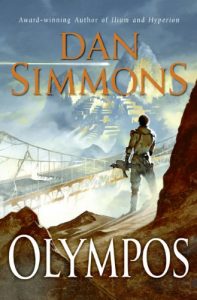
Olympos

Short Answer: Olympos, Dan Simmons follow-up to Ilium, was a really enjoyable read. I was interested in every character’s story from start to finish and glad to spend a little more time on the world. The bad news (there’s always bad news, isn’t there?) doesn’t outweigh any of this, but it did make for a substantial amount of disappointment.

There were only two things wrong, really, is the saddest part. First, some of the plot elements seemed rushed. I think all of my questions about what had happened to get from today to the future earth were answered, but some aspects, usually the negative ones, seemed tacked onto the story just because they were unanswered questions; after reading the first book, I know he has the ability to write more smoothly than that. So: jarring. Worse, though, none of the characters really changed in any important way. As far as enjoying a world, more to read is more to enjoy. But as far as character and plot development, I honestly would have been just as satisfied with the way Ilium ended, without ever needing to read another word. It is a damned shame that Olympos added almost no depth, after the brilliance of the original.

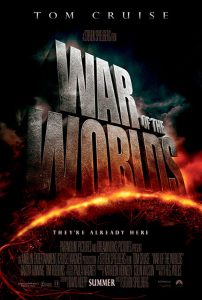
War of the Worlds

Spielberg has still got it. …well, sort of. If you want a special effects-laden summer extravaganza, of the type that Jerry Bruckheimer will try to sell you every year or so, Spielberg is definitely the top tier guy. From the moment Tom Cruise sees figurative storm clouds on the horizon until nearly the moment that the credits roll, well, critics use words like eye-popping, and I have to say that it applies. War of the Worlds is probably the prettiest film you’ll see all year. (Yes, Star Wars, but the fact is that it’s nothing Lucas hasn’t accomplished before, and yes, Serenity, but Whedon doesn’t have that kind of budget, and furthermore, his primary focus has never been on popping the eyes.)
If you can easily read between the lines, stop here, because I’ll end up spoiling the movie’s conclusion for you. Here’s the downside: The man has gotten maudlin and sentimental, and castrates the movie in the last non-narrated frames. Technically, I suppose I should blame the script-writer, but I’m not gonna, because Spielberg should know better than to have agreed to that part.

Child actor watch: I predict that Dakota Fanning has more Anna Paquin in her career-future than she has Haley Joel Osment, if you see what I mean.

Farcry

I’m probably not done yet or anything, but my spate of first-person shooters is at least slowing down a bit. Which is good, because there’s lots else I want to play, but since there’s already both a Doom 3 expansion released and a Half-Life 2 expansion scheduled for this summer, I’m sure I’m still stuck in these same woods for a bit longer.
Which made Farcry a welcome entry. No demons from hell that required a clumsy flashlight-or-weapon paradigm to fully unlock the fright potential, no transdimensional head-sized ticks waiting to leap out at you from the shadows… well, no, it really isn’t as good as the Half-Life series, so I shouldn’t deride. But it’s definitely the next best thing.

You play as Jack Carver, a Caribbean tour guide (or South Pacific? Well, somewhere with palm trees, sparkling blue yet crystal clear waters, and the occasional Japanese army skeleton or half-sunken battleship to break up the monotony…. so, yeah, probably the Pacific after all, then. Seems obvious, now that I’ve thought about it.) hired to take a beautiful young reporter on a tour of a nearby island chain. Only, before you even get there, someone decides you’ve trespassed a little too close, and blows up your boat. After that, the only thing left to do is penetrate the net of mercenaries, stop the mad scientist’s evil scheme, and save the girl. I mean, that was your best boat!

But, seriously, for the railroad scenario that all FPSes must be, this one does a pretty good job of making each next “choice” seem like the only reasonable one and even of sometimes providing multiple solution paths to each objective. But, shooting different things with different weapons, and each thing takes a different number of hits to kill it? *yawn* We’ve been here before, of course. What makes it work is the interesting storyline coupled with the deadly paradise motif. You genuinely want to pause now and then and take it all in, but more often than not, this is a bad idea. Plus, there’s a pretty good vehicle system, with everything from an inflatable raft with an outboard hooked on to a hang-glider.

I felt like it got a little too hard right at the end. I know, it’s supposed to and all, but this was essentially post-climax, which made it feel unfair. Both because I wanted to see how it turned out and because, well, I was ready to move on to the next thing. Which I will, but I only wish I knew how soon. My gametime is at a premium these days. Probably June, if all else fails.

Ilium

The problems with having no real standards are two-fold. 1) When you find something that’s really cool and worthwhile, people who let themselves be guided by such factors as quality or entertainingness will naturally suspect you of being up to your old tricks, and 2) you’ll find yourself being given to greater flights of hyperbole as a natural result of the first thing. Hyperbole is absolutely, positively, and I mean this 1000 percent, never effective. So, naturally, both of these are concerns of mine after having finished Dan Simmon’s Ilium.

Okay, the easy stuff. I came into it knowing it was about the Iliad, and basically not knowing any more than that. This is okay, because both the title and the first couple of paragraphs make the same point. A couple of more things that I didn’t know coming in are that it’s also about Shakespeare, and H.G. Wells, and Proust (and a little bit, I claim, about Arthur Conan Doyle), and sentient robots living in the shadow of Jupiter, and pampered people living in an idyllic golden age on Earth. It’s about knowledge, and whether knowledge has value, and whether knowledge has intrinsic value. Most of all, it is about what the very best in science fiction is always about, what it means to be human.

Ah, you ask, but is it any good? Well, obviously you’re not really asking that, because a) you don’t trust me to know anyway, b) I already basically said it’s good, and c) how can that mix of plot, character and theme not be good? I mean, really, did you even read the second paragraph at all? Seriously, though. It’s great. When I finished it, I would not have hated the author if it had been almost exactly the same[1] and been one book instead of the first of two. At the same time, if the second book were out yet, I would go buy it and be reading it now, in express violation of my policy of not reading / reviewing books consecutively. I kind of resent having to wait until early July, as Amazon implies.

Thinking it over, I can’t even say that I miss the lack of frozen zombies. Thinking it over a little bit further, there’s a case to be made that it has the potential for frozen zombies after all, and that makes me feel better about myself. At the least, I can’t say I needed them in volume one, and that’s still saying a lot.

Incidentally: Can someone who has read this book contact me external to the site? I have a question that falls outside the scope of the review, about faxing and whether there was an authorial misstep or hints for the second book. And, can everyone who hasn’t read this book go ahead and read it? The world will be a better place. I actually kind of want to read the Iliad again now. No, really.

[1] Because, being two books, there are elements of the narrative barely alluded to that are sure to come into full relief in the second book. If he’d covered everything, then a second book would be silly.

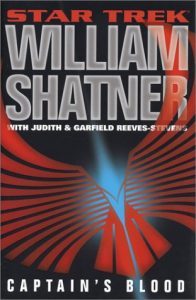
Captain’s Blood

Along with some equestrian obsession I don’t fully understand and a successful re-invention of himself as a kitsch icon, Bill Shatner (yes, that one) has been spending his time in collaboration with a couple of other writers going about the business of crafting Buck Rogers in the 25th Century stories, only with James Kirk instead of Buck Rogers. To be fair, this makes a lot more sense than if it were actually Buck Rogers, because there’s really no link there.
I can appreciate this desire, I think more than most. I know what it’s like to get inside the head of a character and then feel like I could tell more stories about the character after everyone else is done. The problem, of course, is that Kirk eventually died. Inevitably, the bringing him back to life and putting him back in play in the new Federation part of the story was complete tripe, because of the degree of self-indulgence required. (If another person had written exactly the same thing, would I be calling it self-indulgent tripe? Well, since I maintain that nobody else would have done, I’m giving myself a free pass.)

Here’s the thing, though. Once you get past the two books worth of that, there have been about four more since (and at least one more next year) that have been on the high end of the Star Trek novel spectrum. I know this is not a high mark to reach, but I’m already on record of reading treasure and trash with equal abandon, and this stuff is by no means the trashiest.

Which brings me to the latest book, the middle-of-a-trilogy Captain’s Blood. It has a lot in common with the first book of the trilogy, Captain’s Peril. Both wrap hints of an extra-galactic invasion force that are sure to pay off in the final entry around the meat of the plot, two murder mysteries. This one is more engrossing by virtue of the size: The murder in question is Spock, blown up in the midst of a unification speech furthering his efforts to bring the Romulans and Vulcans back together. Naturally, Kirk, his old-school pals who managed to still be alive into the 24th century with him, and his next generation chums gather together to investigate.

That covers the first couple of chapters, and, well, the twists and turns are well enough plotted out that I’d prefer not to dig deeper. Like I said, after you get past the self-indulgence bit, he (and his under-writers, I expect) writes some pretty good books. Plus, the next book with the extra-galactic invasion will probably be self-contained, just as these two have been, and that will save you really a lot of time over reading the 21 or so volume Star Wars extra-galactic invasion series. (I don’t even know if I’m serious there, so probably it’s not worth asking.)

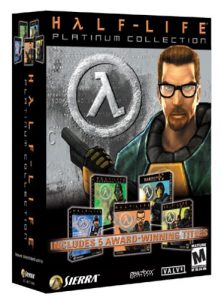
Half-Life: Opposing Force

51C9XNXNT7LWell, look at me, all with the string of finished games under my belt. I like to think the trend could even continue, although past experience indicates that these things run in cycles. Except the books, of course. I always, always read. Right now, my Half-Life kick is continuing with the first expansion, Opposing Force.

In it, you play as Corporal Adrian Shephard, a member of the military forces assigned to clean up the Black Mesa incident. There are a few familiar locations and at least two very memorable scenes to watch from the original, and the designers have cleaned up the moral ambiguity of playing as army guys bent on killing all survivors and especially on capturing Gordon Freeman, by setting Shephard’s arrival late in the incident. There are a lot more aliens running around, and the military have already started teaming up with scientists and security guards and whoever it takes to survive and escape.

Unfortunately for the player, you are opposed in this goal by special-ops black forces who view the army grunts to be as big of chumps as the army grunts viewed the scientists in the original game, and you are also opposed by the mysterious strange-voiced briefcase guy who has plans of his own (which, by the way Valve/Sierra/Steam/whoever I should be talking to about this, I hope will be explored more fully in Half-Life 3). And, as always, by the extra-dimensional Xen forces that are at the root of the problems in every game.

Can it be compared to the original? Strangely, yes. Whoever is on this design team is to be praised, because every storyline so far is nearly as deep as the original. The gameplay is nearly identical, and while yes, it’s a shorter game than either main sequence entry, I’m not going to fault an expansion for not lasting 30 hours. I am looking forward to the last Half-Life expansion, Blue Shift. Not as much as I would be if it was available on Steam for free with Half-Life 2, like the others have been. But I’ll find some highly legal way or other to get it. And before I’ve lost my momentary enchantment with the series, if at all possible.

Half-Life

I haven’t really addressed the issue of what happens when I re-experience something. I watched the Star Wars movies over Christmas weekend, for example, with nary a review in sight. I’m not sure if this is good or bad, and probably I’ll deal with it on a case by case basis. My gut instinct says that while movies are too easy to review at any moment, games and books require an investment of time and energy that makes it worth revisiting them. This doesn’t mean I’ll follow that rule, of course. But I might.
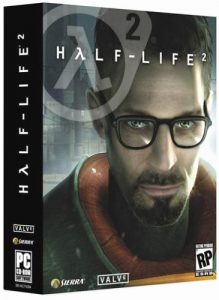
The thing is, I got so thoroughly sucked in to playing Half-Life 2 that I was more interested in re-playing the original Half-Life than Doom 3. (All the random red sparkle pixels in Doom 3 aren’t helping any, but I’ll get back to it, never fear. It was just starting to get good and terrifying.)

For a game that came out seven or so years ago, Half-Life retains incredible replayability. I went all the way through the game without cheating or skipping anything, up until the very last fight. I only cheated there because I was ready to move on and had beaten it once before for real. The graphics are very descriptive for being so clunky by today’s standards, and the storyline is enthralling. Gordon Freeman, our everyman hero with a PhD in physics who works at a top secret government research facility, is caught in the results of an experiment gone awry. In his struggle to reach the surface with his hide intact, he comes to symbolize to the workers in the complex their own shining hope to survive the disaster themselves (and unlike in most games, you genuinely feel bad when most of them do not), and he comes to symbolize a threat equal to the one he wants to escape, to those forces which oppose him.

Well, I don’t want to spoil it or anything, but the fact is that nearly everyone in the world has played this game already, and I’ll spoil it when I review the next game in the sequence anyway, as it would be unavoidable there. So, yeah, it’s the military clean-up crew and the dimension-shifting alien forces. Sure, they hate each other more than they hate Gordon, but he runs a close second. What is a physicist to do? Well, clearly, he is to kill anyone that tries to kill him first, and eventually stop the alien invasion once and for all, coming to symbolize the dreams for freedom of an entire generation of humans and Xen alien slaves who… but I’m getting ahead of myself. For that, you need the sequel.

And I’m serious there. You *need* the sequel. This is shaping up to be one of the best video-game storylines available, if they can even maintain the same meager slide in story quality for the forthcoming Half-Life 3 that occurred between 1 and 2. If they improve again, well, watch out!

Half-Life 2

I know it looks like I’ve been neglecting my duties here. Instead, I just randomly finished three different things in the same 18 hour stretch. I’m not really clear on how that kind of thing happens, and yet here I am.

This time out, Half-Life 2, the story of Gordon Freeman, the rogue physicist who can’t seem to catch a break. After going through the rift accidentally opened by his fellow scientists at the Black Mesa research facility to put a stop to the creatures coming through, Gordon wakes up years later to find that his efforts didn’t result in as safe a world as he’d expected.

Then, crowbar at his side, he finds himself swept along by events once again, this time not just in an attempt to survive but due to the efforts of a resistance movement that has long viewed him as the savior of humanity. As many dark turns as were taken in the original Half-Life, this story nevertheless has a more somber feel to it. The stakes are higher, the betrayals are more deeply felt (if less surprising), and the character interactions are more fully realized. All this despite the main character never uttering a word of dialogue.

As for the gameplay: Lots of loading screens. It breaks up the game, which didn’t bother me. I can easily imagining it bothering other people, but I typically enjoyed the pause to relax and reflect. Spectacular gameplay. Well, fine, anyhow. I think that the FPS control and interaction scheme has been finalized for quite a while. No real improvements, but it’s worked very well, and continues to here.

The graphics are breathtaking. I’m on record as having said that they were a solid increment above the Final Fantasy movie, and here I mean the in-game play, not the cutscenes (of which there are none). I’ve since considered that I may have overstated that. The character movements in Final Fantasy were more realistically human, but still images and especially facial expressions don’t really hold a candle to the ones in this game. The rest of the world is essentially photorealistic. If FPSes weren’t quite to twitchy, it would be very easy to entirely forget you were playing a game.

I look forward to Half-Life 3, although not to the years-long wait for it. I expect I look forward to whatever expansions that get thrown out too. However, I do wish the game wasn’t so tightly copy-controlled that you have to be online to play the game. I didn’t pay money for it, as it came free with my video card. That smokescreen aside, I feel very uncomfortable not owning a physical copy of a game I’ve paid for. Not even the CD so much (although that too), but the idea that if I unplug my ethernet cable, I suddenly no longer have the game. For one thing, companies do go out of business from time to time. Mostly, I mistrust the precedent. Today, I can’t control my own purchases, tomorrow, eyeless crabs are latching onto people’s heads while an unelected military organization enforces the whims of our unseen alien overlords.