Tag Archives: graphic novel

Ultimatum: March on Ultimatum

Even though there’s still one book left that predates the events about which I am now reading, it has yet to be released in trade paperback size to match all the rest of what I have, so apparently I’ll have to actually find out what’s up with this whole Ultimatum thing, now. Except, technically not quite yet, because despite the branding, March on Ultimatum is really just a handful of new annuals featuring mostly the usual suspects doing mostly the usual things. Still, there is a little big of a finger waggle pointing out that this whole Ultimatum thing is just over the horizon now, which since I’ve known that for months of my time as I’ve been reading along means it must have been excruciating waiting on these titles to release a month at a time, and all of them going on about the inevitable doom for a year or so.

The first pair of stories is the most relevant: the X-Men travel back in time[1] to prevent Reed Richards from doing something that has ruined[2] their future. Although this honestly doesn’t seem to have much to do with the Ultimatum, they at least mention it as an inevitable event in the near future from which these other problems sprang forth. But it’s okay, because I enjoyed the story on its own merits as well as for the characterizations of Ben Grimm and future-Sue Storm. Then there’s a Black Panther story which seems to exist only to retcon my racial concerns from The Ultimates 3. It I suppose accomplishes that, but at the expense of taking a pretty cool character and rendering him meaningless in the Ultimate universe, at which point, how about just not using him instead? Also, there’s a Hulk story that for some reason includes one of the Squadron Supreme character from Ultimate Power and (for that matter) that for some reason includes the Hulk; the less said about it, the better. (I exaggerate, in that it was mildly amusing. But mainly it was spectacularly unnecessary.)

The best of the bunch[3] was the Spider-Man story, which had no apparent tie to anything else at all and was just another large-sized Spider-Man story. It’s just, as usual, Bendis shows a world full of meaningful progress and understandable consequences while everyone around him is scrabbling wildly for plotlines from miserable futures or annoying side-dimensions or the drips and drabs of 45 years of bloated Marvel continuity. For example, the police? They have noticed that Spider-Man usually accomplishes things and are glad of his help. Will that ever happen in mainstream Marvel continuity? Not as of issue 91, I can state with great current authority. (And, okay, this third annual postdates a higher issue number in Bendis’ run, so I’m not being perfectly fair here. But I still don’t expect anything to suddenly change.) Bost mostly it’s a relationship story punctuated by the arrival of Mysterio[4], who plays such a small (and unresolved!) role that I fully expect him to matter quite a bit in the next full Spider-Man graphic novel, predictably named Ultimatum.

[1] Is it just me, or are future timelines just littered with X-Men possessing time machines? Time travel is never a mutant power, and one dark future is never described the same way as the next. Nevertheless, back they keep coming. Persecution complex, much?
[2] And while I’m on the topic of things that are just me: is it, or does Reed Richards destroy every alternate universe / dimension / timeline he gets his grubby paws on? That guy is just a colossal dick. (Though the younger Ultimate version is at least endearing about his galactic failures.)
[3] Prepare to feign shock in 5… 4… 3…
[4] In mainstream continuity, he’s a special effects wizard turned supervillain; here, it is way too soon to tell who he might be or what he wants. But I expect him to not be a mere villain retread, not this late in the game.
Ultimate Spider-Man: War of the Symbiotes

The most recent (and in a way, the final?) Ultimate Spider-Man book is based on a video game. That could be a death sentence in a lot of hands, but Brian Michael Bendis has, through years of solid effort, earned my trust. More troublingly, though, it’s based on a video game that came out in 2006, which by even the least generous of publishing schedules means that its events would be months or years out of real-time date from when these scripts were being adapted. So it was kind of strange to see, at a time when every other comic in the Ultimate universe was getting ready for the big Ultimatum conclusion to everything, the Spider-Man story jump back in time by a month or two for a pretty meaningful story-insertion (or, if you feel bitter about it, a big retcon).

War of the Symbiotes tells of what has been happening with Eddie Brock, trapped inside the Venom suit, or possibly it trapped inside him.[1] The problem of course is that I wasn’t all that interested in Venom the last time I saw him, and he’s only gotten iffier since. But in my experience thusfar, a mediocre Bendis Spider-Man story still makes for a pretty good ride on average, and certainly this one got better as it went along. The end result (courtesy of an additional, unrelated retcon) is a pretty big deal, like I said. I cannot decide if I approve or not; it depends on how it gets used down the line. But I have a feeling I’m not going to find out until after the whole big Ultimatum thing, which I am beginning to realize I will have a hard time taking with perfect seriousness; it’s been looming over my knowledge of the series for entirely too long. But I guess we’ll see!

[1] Even in video games, Bendis is pretty good about providing that minimal amount of depth / uncertainty, about just who the parasite is supposed to be.

Lucifer: The Wolf Beneath the Tree

I have realized that I am more impressed by the Lucifer series the further into it I get. Although it does not have the ambitious scope of Gaiman’s Sandman series that was its genesis, the scope it has is ambitious indeed, and the depth is all but equivalent. Or maybe it just depends on what you mean by scope. Where Sandman traipsed all over the field, from myth to human nature to family, all interleaved, Lucifer keeps its focus pretty narrow. But considering that the focus is on the end of the world with heavy dollops of religious controversy for flavor, you can’t exactly argue that scope is a problem here either.

The Wolf Beneath the Tree is the culmination of months of planning. Lucifer has paid his debts and cleaned his house, and has no particular plans beyond sitting on his metaphorical back porch and watching the sun set on God’s creation. But of course things never work out that simply, do they? Not when there’s a Norse wolf-god out to destroy all of existence and Destiny is either meddling in events or fated to do so, depending mostly on whether you believe in free will. (Lucifer, unsurprisingly, does.) I could be wrong, but I feel like the series has reached the point of no return, events spiraling out of control, explosive climax and all that. It’s gonna be hard to convince myself not to just go ahead and finish up now.

Also, the first story about Lilith and her countless offspring and especially about the earliest part of Mazikeen’s backstory? I would like more of that, please!

The Ultimates 3: Who Killed the Scarlet Witch?

I’m torn on this book, unlike the rest of the internet. (They seem to despise it, and I think it is only fair to calibrate expectations in that way.) But first things first: Who Killed the Scarlet Witch? is simultaneously the straight-forward murder mystery that its title implies and also a means of setting the stage for the upcoming Ultimatum that, so far as I know, I am only two books away from. I can’t think of a good way to add more to my plot summary that wouldn’t be extensively spoilerish, so I’ll move on to the controversy.

On the one hand, I really did enjoy the actual storyline. Both the pacing of the mystery’s unraveling and its ultimate denouement were satisfactory to me. And honestly I think even that, my enjoyment thusfar of the build toward this crossover event thingy they’ve decided they had to do, is a bit controversial. But so be it, some days I am an easy audience. Still, there’s that other hand, wherein a lot of the details went wrong. Like, wasn’t Juggernaut dead the last time I saw him? And was it absolutely necessary to drop in a Ka-Zar[1] cameo this many years into the Ultimate run, and this close to its end? And, seriously, the use of the Black Panther seemed racially insensitive at best. And none of those missteps was necessary to create the plot that I was happy with! So frustrating.

[1] He’s a Tarzan rip-off from the mid ’60s. Not bad as characters go, just untimely.

The Ultimates Omnibus

Note: I did not actually read The Ultimates Omnibus as my title and link might otherwise indicate; I just re-read the four volumes of The Ultimates and The Ultimates 2 that I have mentioned previously, but this seemed like the easiest way to get away with treating it as one project, so soon after I had read them individually. And in short, I want to say that I was right to go back and reread them, as seeing the Ultimates in their proper context over the evolution of that universe would have made a lot more sense than seeing everything at once right when I started, and then going back in time to see them interact with the rest of the series in progress as I variously caught up to “current”.

As for the books themselves, though? Still good, and they certainly do stand alone, if you wanted to ditch the rest of the universe to just read these. They’re by far the most adult books, both in theme and in prose. And certainly in plotting, where they occasionally seem to go above and beyond the adult theme cut-off just to show they can. But since almost every other main character in the Ultimate universe is mid-late teen in age, it makes sense for the one adult group to make a point of doing adult things. Anyway, it rarely seems to actually pander, which I guess is close enough for me. Also, the art is always good, though it strikes me funny that both the Wasp and the Scarlet Witch have violet eyes. The odds just seem implausible, is all I’m saying. So, like I’ve doubtless said in previous reviews that I don’t feel like digging up: if you like adult-oriented[1] globe-spanning events with real emotional and physical consequences, this is the place to get them. (Because Wolverine can’t be the star of every X-Men comic, and really, who else is there besides him and these guys to count as adult?)

[1] For the most part, non-pornographic.

Death: The Time of Your Life

There may be more Death-based graphic novels; the existence of an Absolute mega-edition like was created for Sandman and some other DC titles suggests so, but I’ve only ever seen two. And as of today, I’ve read the second one, so I guess I’ll just have to see what else pops up or else not worry about it. Which is not unlike how the pale gothy girl wearing the ankh expects me to live my life, I think; after all, it’s what I’ve got.

I kind of wish, though, that I either read Sandman more often than I have or else that I had eidetic memory, or that I had been obsessed with the series the way I was with the Wheel of Time during the ’90s, or really anything that would lead me to have good recall about the characters of Foxglove and… Jesus, I’ve forgotten her girlfriend’s name in the time it took me to start this review after finishing the book earlier today. That’s just sad, though unfortunately illustrative of my point. Because, you see, The Time of Your Life is mostly about the two of them and their son Alvie who has a suspicious anagram in his name, and also of course about the pale gothy girl with the ankh, who you may better know as Death.

It was a sad and sweet but probably more sad story about relationships and fame and sacrifice and of course death, and I liked it on its own merits, but I didn’t really like it on the merits of being a story about Death. She felt shoehorned in to provide a… well, deus ex machina can hardly apply if the being providing it is pretty well at a higher level of existence than gods are. But all the same, her only real point in the story was that she worked as a lever to break the logjam between waify singer/songwriter Foxglove and that girlfriend whose name I can’t remember, so that they can proceed with their lives (or not) one way or another, instead of continuing to circle around and around the same static relationship they were stuck in on page one. And even worse, Death provided this lever by way of an action so implausible that she even commented in the dialog that it’s the kind of thing she never does, right before doing it anyway, for no apparent reason. That could be a hint that she has taken more interest in the two characters than I apparently managed (her name is Hazel, if you are itching to know), but I couldn’t bring myself to take that hint. Instead, it was just an inexplicable oddity in, like I said, what could have been a pretty interesting story about a few side characters without ever including her.

Although, I admit it does seem like some member of the Endless should have probably been involved for it to really fit in the universe, familiar characters or not. It’s just, it’s plausible that if a character is going to behave inexplicably, Gaiman already wrote one who has that exact modus operandi. Y’know?

[1] It’s weird, or serendipitous, or merely coincidental, but I’m positive not ironic in any sense, that I’m listening to Who Killed Amanda Palmer? on vinyl as I write this. See, I bought it a few weeks ago while browsing a local record store for a few pickups, and finally unwrapped it right before I started on this. I had been going to write it anyway, just over Jon Stewart from last night instead, but the whim struck me, and there you go. And after I’d gotten about a sentence deep into the review, a line from the third track played out: “Nobody deserves to die, but you were awful adamant that if I didn’t love you, then you had just one alternative.” And the thing is, I feel like there might be a way to tease out a very close parallel between that line and the book, but only with spoilers, and anyway, it really would be coincidental, almost certainly nothing more. Even though I’m pretty sure Amanda Palmer wrote the introduction to that giant updated Death collection I mentioned, and Neil Gaiman wrote the copy on the back of Amanda Palmer’s album, and they’re engaged, and all of that. Sometimes, despite everything, it really is just a coincidence.
[2] How weird is it that there are two unreferenced footnotes in this entry?

Batman: The Killing Joke

I wish DC would rip off the Marvel Ultimate universe idea and perform their own reboot for new readers. Alternately, I wish that someone would tell me this has already occurred, and what I should be looking for. I know that the constantly renewing TV shows serve approximately the same purpose, but still, something in the original format would be nice to have around. This is certainly one reason why I have found Marvel so much more accommodating than DC since I decided that superhero comics were pretty sweet after all. (The much broader availability of original run comics as data files was the larger reason, despite how much more Ultimate universe I’ve actually read.)

The upshot of this lack is that there are all kinds of DC storylines that I’ve heard people talk about but never gotten around to, while I’m coasting along quite nicely on the other side of the fence. But I did recall that one of the biggest deal stories I hadn’t read was Alan Moore’s The Killing Joke, about the relationship between Batman and the Joker. Much to my surprise, it is a story that has consequences I’ve actually seen play out in one of those TV series I mentioned earlier, the short-lived Birds of Prey. So, in addition to my actual reaction to the story, there was that bonus feeling of getting to catch on to an underpinning moment that has defined the DC universe. I dig that kind of stuff, in exactly the unfortunately punning sense that makes me sometimes wish I had gotten my degree in archaeology.

But as to the story itself? First of all, it’s very short, only about the size of a standard annual comic. No run of issues here like you’d expect to find in an “important” story. It’s also very simple: Batman has decided that it’s time to really talk to the Joker, who is unique among the Batman’s adversaries in that nobody has any idea who he is; he is simply an enigma sowing chaos in the world. All Bruce Wayne does know is that they hate each other, and sooner or later one of them will die as a result of it, and being that he is a fundamentally good man despite his anger issues, he wants to try to solve it. Whereas the Joker… in his own words, he wants “[t]o prove a point.” To prove that he’s not really sowing chaos, or at least that any chaos sown is just a side effect. He wants to prove that his reaction to the world is not only normal, but inevitable. And the ensuing clash between these two conversations is dire, bloody, repercussive, and entirely horrible. And it sums up, in only about forty pages, the entire history and future of the relationship between the two characters.

Every voice was perfectly realized, every expression and motion had economy to it. Except for the unfortunate refrigeration of Barbara Gordon, there is really nothing about the story that is not concisely perfect. It should ought to be read by anyone that enjoys either lead character. And also? The joke was pretty good.

Ultimate Origins

I kind of feel like Ultimate Origins was a risk. Okay, the continuity had only existed for about nine years at that point, plus I think they already knew that they were headed towards an ending of sorts. But still, taking even a mere nine years of continuity and then going back and finding a way to tie it all together in meaningful and unexpected ways, without accidentally being ridiculous? It’s a fine line to walk.

But what am I talking about? It turns out that the Ultimate universe, about which I talk from time to time, has some important and unrevealed information from the World War II era that spawned the original super soldier project and ultimately Captain America, and also from the generation that precedes modern times / the current crop of superheroes and mutants. Information that has strong relevance to mutantkind and its imminent war on humanity. Information of particular interest to one Peter Parker on the topic of his dead parents, if only he knew it.

All the same, I’m pretty sure that, if it hadn’t been written by Brian Michael Bendis, it would have been ridiculous after all. So yay for the author they chose!

Hack/Slash: In Revenge and in Love

I’m reading five (or six? but probably five) graphic novel series right now, not counting the Ultimate Marvel stuff. As of my completion of the sixth Hack/Slash volume, I am caught up with three of them. Plausibly, that means it’s time to start a new one, next time I get to an empty gap in my rotation. Which will be kind of weird, what with my not having started a new series in a really long while now. (Then again, I’m also supposed to reread the four volumes of the Ultimates as I’ve been threatening to do for probably six months now, and yet, nothing on that front. Also, I’ve caught up enough that I think it’s time to slow down on my Marvel Ultimate reread and intersperse something else in one of those two slots.[1])

None of that matters, though. What matters is that Cassie Hack is experiencing a crisis of faith. In herself, in her role in the universe, in her fate. After the dramatic events of the previous book, she’s decided to put away her baseball bat, build that white picket fence, and settle down with her long-time stripper crush, Georgia Peaches. The list of people who are unhappy with this plan is extensive, and includes enemies from another dimension, an evil rock icon, police around the country who have been led to believe by a psychic that Cassie is responsible for most of the murders that were committed by the slashers she has put down, and perhaps most dangerously of all, her neglected companion Vlad who seems to have no place in her new plans. Life is hard for a gothy, slightly emo, and confused teen slayer of supernatural evildoers.

I think my two favorite bits were a) the one-shot with the possibly autistic Encyclopedia Brown chick, investigating the soon-to-be-important new bad guy, Samhain, and b) really any scene with the skinless alien dog-thing; it is quickly becoming my second-favorite character! Due to hilarity, you see.

[1] I honestly don’t know why you have to hear about this stuff.

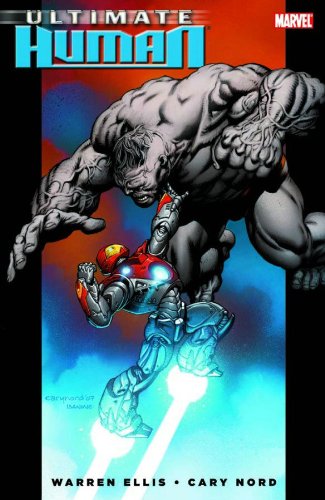
Ultimate Hulk vs. Iron Man: Ultimate Human

51uXRhTRrhLThe majority of one-shots in the Ultimate universe have not been all that good. Of course, the majority of them have been about Daredevil and/or Elektra, and while those stories may be good spread out over years, I have yet to see the short term version do them justice, even though both characters work just fine as guest stars to Spider-Man. Ultimate Human, however, is an exception to that one-shot rule. Card’s Tony Stark retcon has finally taken hold, and the world’s smartest man seems like the best person for Bruce Banner to turn to in finally beating this Hulk thing once and for all. Over the course of four issues, the two men finally change the Ultimate version of Bruce Banner from caricature into a genuine character, while clashing with each other mentally and physically. And because one foe is never enough, a giant-brained person that you may remember as the Leader is waiting in the wings.

Oh, and incidentally? With an entire issue given to origin and backstory, the Ultimate Leader is exactly the kind of character reintroduction that the Ultimate universe does so poorly in general and should have been doing this way all along. I wish people who are not named Brian Michael Bendis could do a better job of accomplishing this on characters that I haven’t already seen elsewhere.