Tag Archives: fantasy

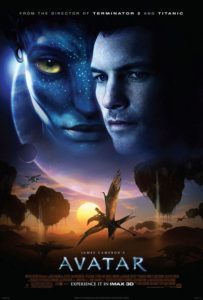
Avatar (2009)

Avatar has been an interesting phenomenon to me. Because I watch the previews of it, and it of course looks really pretty, plus I know James Cameron makes good sci-fi[1]. But then again, I watch previews of it and it makes me think it will be Dances with Wolves in space.[3] And I didn’t hate that movie the first time, but it grows more awful with each subsequent viewing, and eventually it has retroactively become the moment at which Kevin Costner stopped being a respectable human being actor.

So, after all of that spinning around in my head for a month, I expected it to be pretty, yes, but still mostly terrible. I didn’t see it in the IMAX that the tagline suggests, though it was in 3D. I suppose I’ll get to that before too terribly long, though. Because, IMAX or not, expectations or not, Dances with Wolves and all? It was still really good. (And, yes, very pretty.) And if the message was perhaps bludgeoned in, it is not a message with which I have no sympathy. I guess I should ought to find a hardcore conservative and find out just how much they hated it. But really, even if you are allergic to hippie granola, I think the prettiness of the film will get you past most of the relevantly crunchy scenes.

What impressed me most, though, was the uncanny valley effect. Or, rather, it’s lack. Far short of the giant blue Na’vi people looking just subtly wrong enough to hurt my eye, the time rapidly came when it was the actual actors who started to look slightly wrong, and every scene back among humans had me itching to get back to the part of the movie I cared about. Which, okay, the whole point of Dances with Wolves is to throw off the trappings of the Western World, so it makes sense this movie would want me to be there. But when he can manage it even on a physical CGI level? Kudos, Mr. Cameron. I daresay you deserved the full theater and applause you got on even this third weekend of theatrical release.

[1] Seriously, that’s kind of his Thing, blips on the radar like Titanic[2] notwithstanding.
[2] Hey, now there’s a piece of irony.
[3] And then I watch South Park, and they point out that in fact it will be Dances with Smurfs, and Giovanni Ribisi will be an unobtanium-hungry Gargamel, but really that’s still Dances with Wolves.

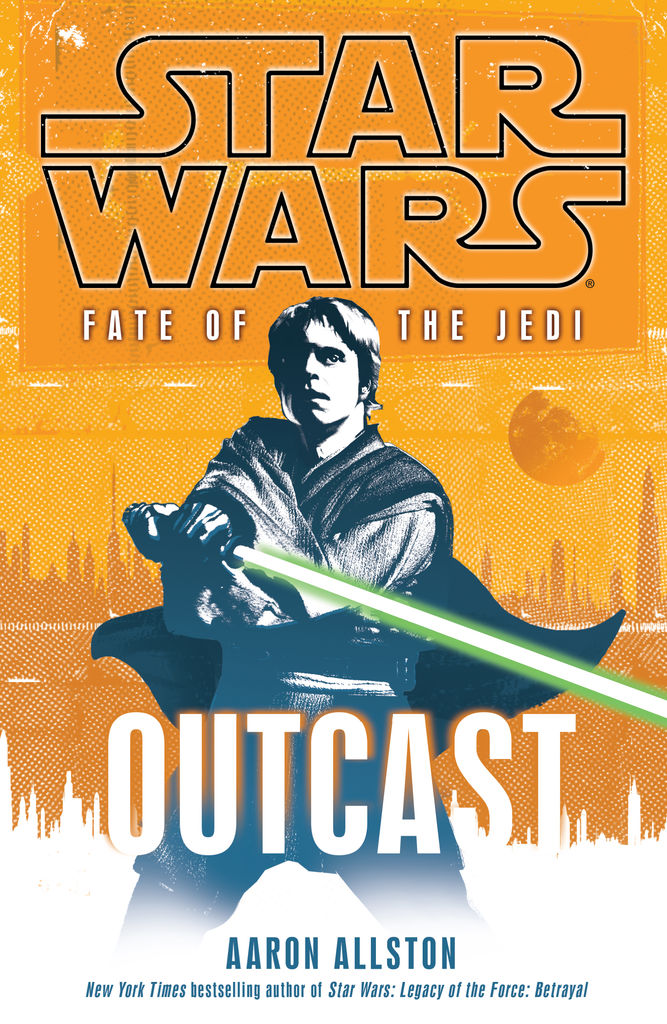
Outcast

Outcast_coverThere’s a new Star Wars series again, set 40 years after the events of the movies, decades past the final fall of the Empire, well past the invasion of an extra-galactic alien armada not affected by the Force, just a few years past a second galactic civil war caused by another Sith lord from the Skywalker line. And this most recent event shows that people are basically the same all over; public sentiment has turned sharply against the Jedi Order in the wake of Jacen Solo’s fall, mostly because political figures are of the opinion that Luke Skywalker should have seen it coming and prevented it.

The truth of that statement, despite its simultaneous unfairness, points Luke and his son Ben on a quest through the galaxy in search of the various Force-sensitive but non-Jedi societies Jacen visited in the years before his fall, to see if they can find any clues. After establishing this premise and hinting at mental illnesses that may be starting to afflict some of the Jedi, Outcast proceeds to… well, to stall out. The first leg of Luke’s investigation is entertaining, as are Han and Leia’s adventures trying to keep a planet from being blown up. (By earthquakes, not Death Stars.) But the pacing back and forth between these stories and the Jedi illness plotline is awkward, and by the end of the book, I felt like it maybe should have been compressed into just a hundred pages with plenty of room for more. Worse, the Han and Leia plotline actually had no apparent bearing on anything else, even though I’m well aware that a seemingly minor event involving their granddaughter will be relevant later on. The knowing and the entertainment just weren’t quite enough to make up for the structural weirdness and the slowness of the pace.

Possibly as part of a straight through read of the nine book series, the pacing would not have struck me oddly, but in the book standing alone: no good. Luckily, I did enjoy the discrete events, so I have no worries about liking the next book, whenever I get around to reading it. (Probably not terribly long from now, as it would be nice to be caught up again.) I guess the majority of my disappointment comes from the fact that Aaron Allston is a known good quantity in the Star Wars Expanded Universe, and to see plotting or pacing problems from him, much less both, confuses me more than just any randomly off-kilter Star Wars book would. It’s not like they don’t exist in the wild.

Death: The High Cost of Living

Between the length of the week with various holiday trips and all and the amount of time I’ve spent staring at my own writing while scouring the internet for repairs on this until recently dead site, it’s kind of hard to remember just how I felt about The High Cost of Living. There is a legend that Death must spend a day in every century as a mortal, I guess to better understand her job. And the book is entirely about that day, spent with a Manhattan kid whose ennui would do a French philosopher proud, Mad Hettie from the Sandman series, and a couple of bad guys who hope to capture all of Death’s power while she is mortal and vulnerable. It is fair to say, I think, that there’s not a single character in the story who actually understands what is happening, nor what his or her individual role is to play. Possibly Hettie, but as she’s quite mad, it’s difficult to tell. Certainly nobody else. It is left to the reader to unravel the various skeins of consequence. It’s a good little story, for all that it’s short and confusing. There are aspects I did not understand one bit, but I felt pretty comforted by what I did latch onto.

The last pages of the book are a brief sexual health pamphlet distributed by Death to keep us all from getting AIDS (among other STDs), as, after all, we’ve only got the one life and wouldn’t it be best to keep on living it, and to do so in reasonable comfort and health? You can certainly tell it’s twenty years old, but I like to imagine that it both helped some people and turned some people onto Gaiman’s world that might otherwise have never known to look for it.

Guards! Guards!

This is the point at which, if I understand conventional wisdom, the Discworld novels start to become “good”. Also, more incidentally, this is probably the first Discworld book I ever read, far back in the depths of junior high. (All I remembered is the “mllion to one shot” gag, so, it was basically like reading it all over again.) And most incidentally of all, I’m pretty sure it’s the farthest I had read into the series, so everything from here on will be entirely new, cultural zeitgeist notwithstanding. Anyway, that “good” thing, though: as much as I have enjoyed the last several books on their own merits, Guards! Guards! definitely has some barely definable adult quality that the previous books have not had, though some have grasped at it.

In addition to first introducing Ankh-Morpork’s city night watch and its world-weary, heroic-in-spite-of-himself Captain Samuel Vimes, a group character study that could have carried a book with no plot whatsoever, the novel also for the first time superficially grazes the inner political workings of the city at the dark, ulcerated heart of the Disc. It asks and perhaps answers the essential question of whether democracy or monarchy ought best be left to run amok through the lives of a citizenry that barely comprehends either and tends to cheer whichever of the two it has seen least recently. Also, and here is the only point at which it diverges from any standard reality to which you may be accustomed, there is a dragon.

The Hero of Ages

Sometimes I know exactly what to say about these things. Other times, and they feel increasingly common (though perhaps that’s my imagination instead? I hope so), I’m a little bit stuck. Is it that the middle of the night makes me too tired for inspiration? Is it that inspiration itself is rarer on some days than others? Is it simply that the book is too easily spoiled if I give very much depth to a plot review, and so I’m going to have to actually stare at the themes for a little while instead, and should maybe ought to quit whining about it and move along? Well, okay, that’s pretty clearly it, but in my defense it is the middle of the night too.

The Hero of Ages concludes Brandon Sanderson’s Mistborn trilogy in grand apocalyptic style. Another year has passed since the events at the Well of Ascension, and circumstances are more dire than ever. In truth, I read a lot of books that describe the end of a world, usually but not exclusively Earth. Sometimes, there are comets. I’m just saying, I know from apocalypse, and out of all such books I’ve read, this is the one that best demonstrated the hopelessness and wanton destruction of a world going through its last throes. I had to slow down now and again just to keep from letting myself get washed away by the currents of despair. But what’s cool is, the book is kind of about that: the capacity for trust in the face of destruction, faith in the face of despair. Also, it’s still about cool powers of jumping around and stabbing every enemy in sight, and sometimes seeing the future, so it’s not like that part of the series has taken a backseat as it progressed; if anything, the magic system has only grown in complexity.

Although the circumstances were not optimal, I’m glad I got a chance to see this author thrust into the limelight, and I’m looking forward to whatever he writes next. (Okay, technically, it’s already written. But I will totally read it, honest! Just not sure how soon.)

Fables: Homelands

As the Fables world grows to include more and more key characters, some are falling into the background to make way for the rise of previously bit characters. And certainly the tone is changing away from the noir feeling of the early volumes as the stories start to grapple not just with events involving the fable characters, but with their overarching histories and futures. Or maybe it’s just that recent political upheaval is what has pushed Bigby Wolf and Snow White off the main stage, and the tone change is down to their absence as well. I figure it might be both, but I’ll have no way to really know until the Wolf is back and the noir returns, or doesn’t.

Homelands focuses on two characters over another handful of quickly passing years. In the opening, Jack Horner, and the Beanstalk, etc.[1] hatches another scheme for riches and fame, with better than usual success. It may be my independent knowledge, but it very much felt like Willingham saw that Jack was his for-fun character and didn’t really fit the flow of the main Fables story, and this was an explicit way to put him in position for the spin-off series, Jack of Fables, which I will begin reading relatively soon in the sequence, I think. And then in the main part of the storyline, Boy Blue infiltrates the fallen Homelands on a daring quest to rescue his love, save his best friend’s life, and with a little bit of luck, unmask and assassinate the Adversary himself! If that sounds pretty cool and exciting, well, sure enough, Fables keeps on delivering. And if you expect it to keep on delivering in ways the characters (and sometimes readers) cannot hope to foresee, well, that just means you’ve been paying attention.

[1] They’re all the same Jack, you see.

The Well of Ascension

I was already reading this book when the Robert Jordan book came out, which explains both why I have skipped my allotment of graphic novels and why I read two books in a row by the same author. At least it isn’t the same series? Anyhow, The Well of Ascension chronicles the continuing adventures of… well, I guess I never talked about the characters in the first Mistborn book, did I? So, anyway, there’s this skaa thieving crew and our heroine, Vin, and they achieved a pretty big victory at the end of book one. And now, as book two opens, they and their noble allies must face new dangers in the form of invading armies, untraceable spies in their inner circle, and a growing certainty that the world is still in the same grave danger that the Hero of Ages was supposed to have defeated a thousand years before.

Sanderson has done a pretty good job of maintaining sense of wonder, by delving more deeply both into mistborn abilities and into the history of the Hero of Ages and the Final Empire. As in the previous book, each chapter starts with an excerpt of writings from a thousand years prior when this chain of events first began. Unlike last time, however, the writings are more or less in order of the story they are telling; it was all I could do not to ignore the book and jump ahead to read the entire ancient record at once, and then come back. All of which to say: see? totally sense of wonder. The mood of the book is by turns ratcheting tension, romantic angst, a little bit of creeping dread, and occasional doses of intense action, all of which build toward a pretty explosive last hundred pages. I was out at dinner Tuesday night and just itched to read the last 20 pages instead of interacting with my companions. I didn’t, but probably only because Skwid was there to answer my minor spoiler and relieve the tension just enough to hold out until I got home.

Dragons of the Hourglass Mage

The final volume of another Dragonlance series has at last arrived, and I am forced to admit to a lack of objectivity about Dragons of the Hourglass Mage. Because, as the cover and unwieldy title alike imply, it is mostly about Raistlin Majere, and I don’t really get tired of that guy, at least not when written by Weis and Hickman.

Pretty much, the book details the lost month in the original Chronicles between when Raistlin left his companions to die in the Blood Sea of Istar[1] and when he reappeared at the series climax to tilt the balance against the Queen of Darkness[1], in order to further his own ambitions via a freer world. It may contradict some of the other main sequence canon, but never in very noticeable ways. Plus, since the character study continues to fulfill everything I’ve sought out of the series in the past twenty years, I don’t really care. Things in the story include a secret resistance in the heart of evil’s lair, an assassin kender, a plot against the gods of magic, and perennial Dragonlance favorite Lord Soth, the death knight. Unless you also really like the psychology of Raistlin Majere, though, it’s okay at best.

[1] Sometimes, when I have not typed the words out in a while, I forget just how standard-fantasy these books can get.

The Final Empire

51E+7V-PDyLAt long, long last, I have found copies of some of Brandon Sanderson’s Mistborn trilogy. Sanderson, you may already be aware, is about to publish the first of the concluding volumes to Robert Jordan’s Wheel of Time series. Naturally, therefore, I’m interested in seeing how his previous writing style goes. And awesomely, I can report that Elantris was not a one-hit wonder.

The Final Empire tells the story of an indentured people that have been held down for a thousand years partially by the ruling noble class but mostly by the Lord Emperor, an immortal god-ascended man who once saved the world from a vague being known only as the Deepness, and by that man’s Inquisitors. It doesn’t help the enslaved skaa that the nobles are not only propped up by the regime, but that some of them also have magic powers derived from burning ingested metals and related alloys, such that they can see better or have more strength than normal people, or even influence emotions. Skaa women with whom the nobles dally are immediately killed to prevent the talents from entering that population, though of course it’s not a perfect system…

And then, there are those who have not the power to burn one metal, but the power to burn them all. These Mistborn are virtually unstoppable, except in combat with each other, or with the Lord Ruler’s Inquisitors. A skaa Mistborn would be the most dangerous creature the Final Empire has ever encountered. And though I bet you can guess what happens next, the story has twists and turns galore to keep you guessing at every moment. And after a full-blown stand-alone conclusion, there are still two more books worth of supposed awesome ahead of me!

9

MV5BMTY2ODE1MTgxMV5BMl5BanBnXkFtZTcwNTM1NTM2Mg@@._V1__SX1859_SY847_I had my time-killing afternoon movie for yesterday narrowed down to three options, when suddenly someone at the end of the table said, “Hey, do you wanna go see 9?” And other than a slightly more expensive ticket price, I had no compelling reason why not; after all, it’s a flick I’ve wanted to see, even if Tim Burton is kind of getting played out by virtue of basically every single one of them being about loneliness. I can deal with that in my music, but it starts to get old on the screen, eventually.

In the dawning years of World War II, war-attuned scientists have created self-replicating machines “for the defense of the nation”. And then… well, you know what happens next, don’t you? As sure as zombies commute on trains[1], the machines rise up against their masters. And as humanity declines, one scientist, perhaps seeing the way the wind is blowing, engages in a knit-punk experiment to create nine tiny homunculi in the slim hopes of carrying on life on the planet. So, that’s where the movie begins; as for the actual plot, it can best be summed up as “adventure and interpersonal[2] conflict ensue”.

It was a decent albeit flawed movie. I look at it like this: if you want to see a movie with incredible animation, as good as any I’ve ever seen, you should check this out. If you want to see actiony dramatics, you’re good. If you want to see the best use of Over the Rainbow as score, this is the place to be. If you want to see a thoughtful movie that makes coherent sense as a whole, well, you might should ought to look somewhere else. Also, if you are at all allergic to the really crunchy granola[3], you’ll have some problems.

[1] Dude, it rhymes. You expect more depth from zombies?
[2] Grpuavpnyyl, vagencrefbany, but that would be a spoiler. P.S. http://rot13.com
[3] Hippies, yo. Hippies. You know what I’m saying.