Tag Archives: fantasy

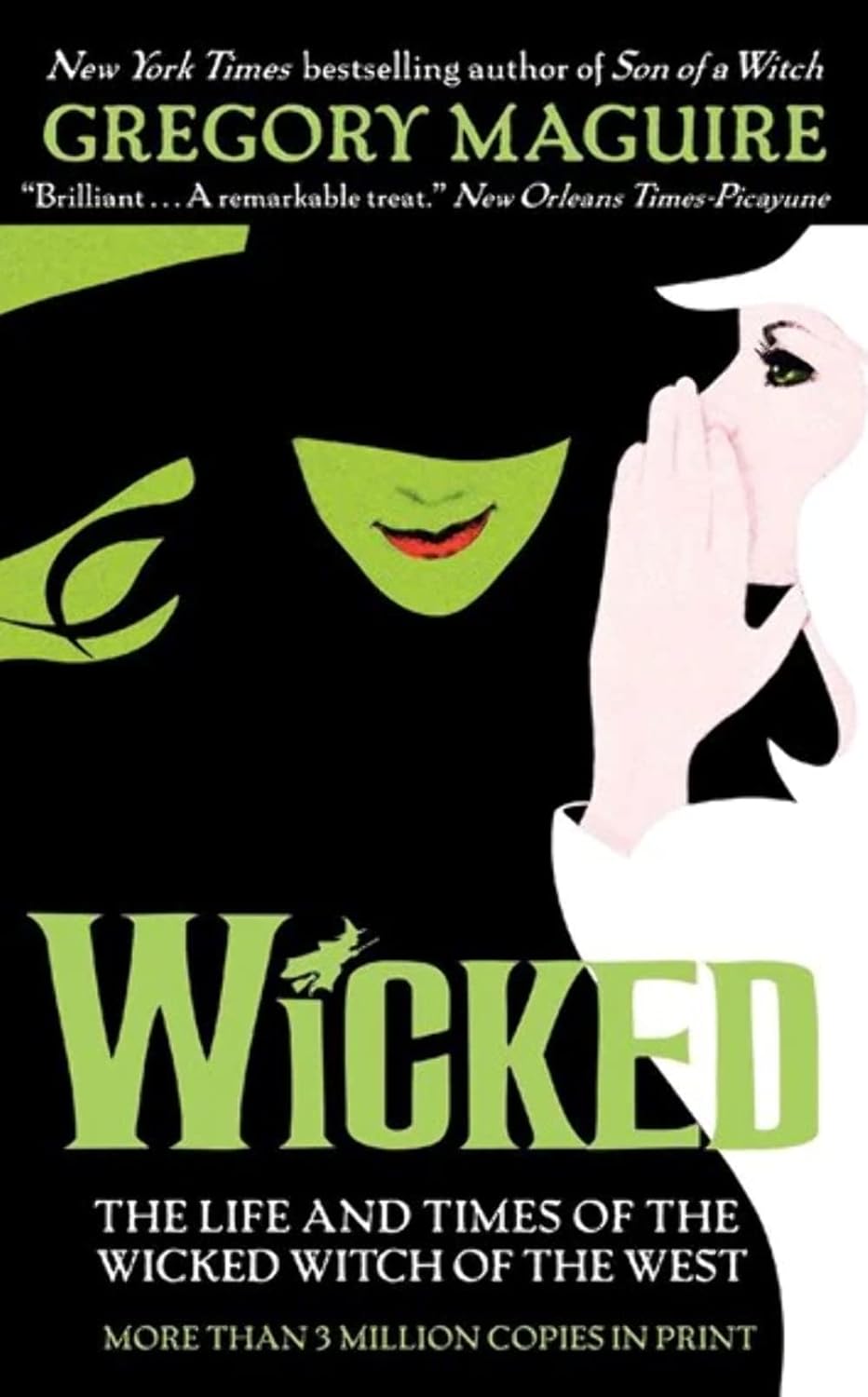
Wicked: The Life and Times of the Wicked Witch of the West

A couple-few years ago, I saw the musical performance of Wicked in Dallas. It was a little heavy-handed with its pro-PETA message, but entertaining for all of that, plus at the time we were under a tornado warning (no shit) and the power actually went out briefly mid-show. The chick who was playing Elphaba? Good lungs, as she was able to joke at the audience until the power came back up, and everyone could hear her. So you see.

Sometime not long afterwards, I picked up a copy of the book that inspired all that, also named Wicked. Then, as is often the case, some years later I have read it, and my reaction is extremely mixed. On the one hand, I’m a little surprised to have liked it, even though I couldn’t say why. I mean, I liked its derivative work well enough, right? But still, I went into it expecting not so much, but with enough interest to understand why all the fuss. Instead, I got a pretty neatly put together series of five stories that probably could have been about five different people, even though they are not. The styles differ wildly (my favorite was the second part, at school, which reminded me constantly of Jane Austen) and the portrayals of our main character differ as well, due mostly to extensive passage of time between each section. I wouldn’t want to see it in a lot of books, but I kind of approve of Maguire’s choice to disregard continuity, perhaps in an attempt to give his audience more insight into the central point he is making about passing judgment without very many facts?

Which, right, I suppose I shouldn’t ought to assume everyone knows about the book. It is, basically, the other side of the story of the Wizard of Oz, in which our wicked Witch, Elphaba, went to college with Glinda, joined political resistance against a tyrannical usurper who styled himself the Wizard of Oz, and was eventually brought low by one Dorothy who frankly had no idea what was going on around her and was everyone’s pawn at every turn. And like I say, it’s a pretty entertaining story, with a lot of interesting character voices and structural choices. So why am I ambivalent? Because, at some point in the story, after her political agitations but before the arrival of her destined nemesis, Elphaba starts to reflect upon her legacy and quickly to fixate upon it, which gives Maguire an excuse to start dealing with everything through the prism of Literature, and Theme, and Essay Questions. And if there’s one thing I cannot stand, it is the 20th Century tendency toward intentional art. People should ought to create what they want to see, not what they believe other people will consider important. And that’s the worst part: this book is something I wanted to see. It just lost its way, somewhere along that yellow brick road.

Fables: Wolves

The very fact that I’m still reading Fables says[1] I’m predisposed to like it. Which makes it hard to reach any particular objectivity, eight volumes in. Still, the title helps indicate for anyone who may also be reading the series that they will probably enjoy this particular one. Because, really, Wolves? There’s no better way to hint that we’re back to what I at least consider the central part of the story: Bigby Wolf, Snow White, and the fruit of their relationship.

I no longer have a clear idea of where the plot may be going, but I’m less concerned about it than I was last time. Or maybe that’s because I got more Mowgli and Cinderella, just as I had requested! Certainly the part where the characters, good, evil, power-hungry, or indifferent, are universally well-drawn[2] and entertaining helps things, though.

[1] I know what you’ll be thinking as of my next book review, but there are special circumstances in that one case.
[2] Ha ha. But, yeah, both ways.

Omen

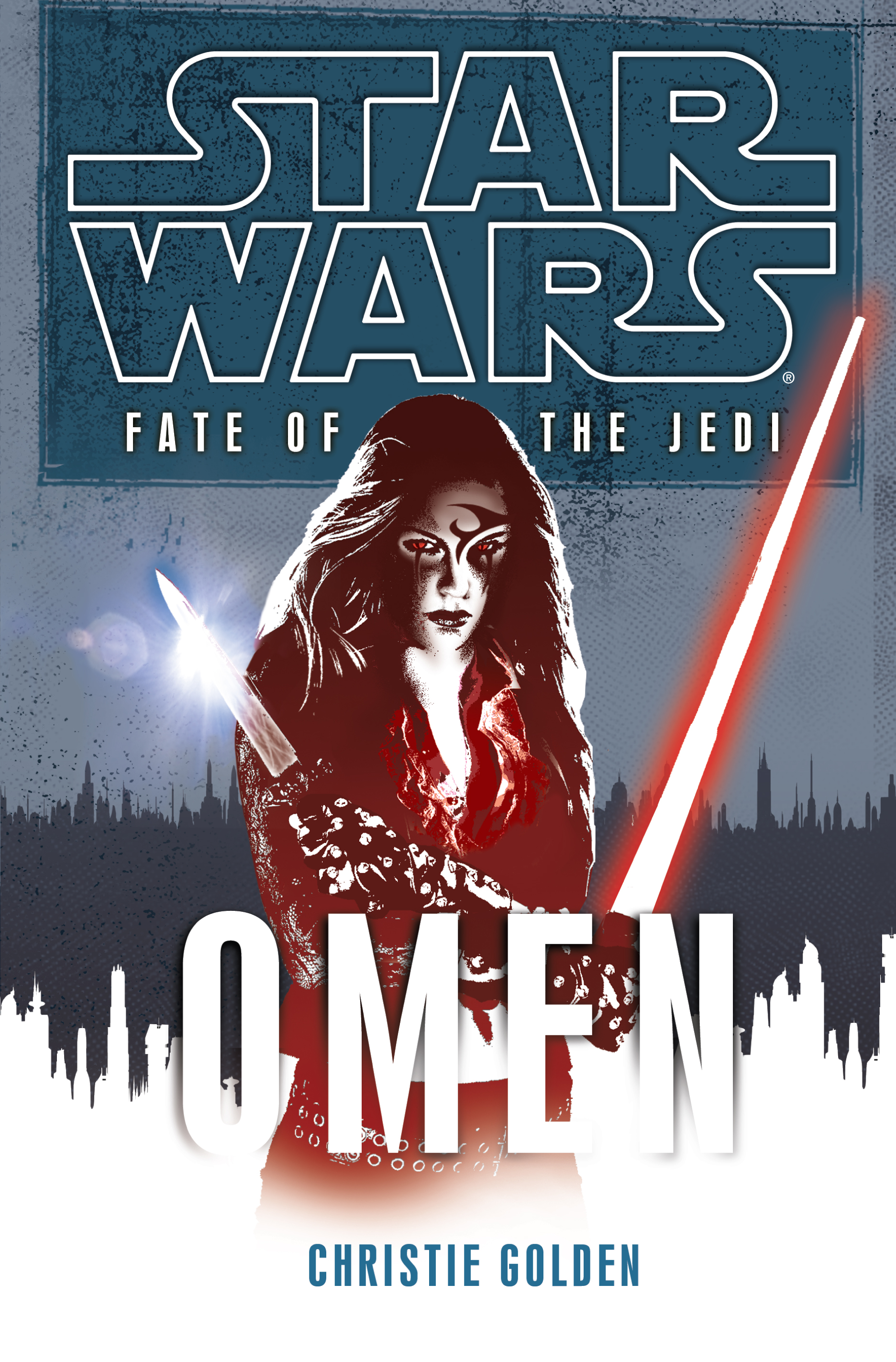
Omen_front_bgIf I had not read Outcast first, or[1] if it had been a different book, I would have liked Omen a lot better. Because, Omen was almost exactly the same book, it was just written a little more tightly. Two plot elements were identical, in fact. Luke Skywalker and his son are wandering the galaxy in search of non-Jedi Force-sensitives to learn from them and find a way to guarantee that he’ll know the next time one of the Jedi is slipping toward the Dark Side. And meanwhile, more and more Jedi are experiencing the Capgras delusion, wherein they are convinced that everyone they know has been replaced by perfect impostors. I’m saying, the prose was different but large swathes of the plot have literally not moved.

The only thing that is really new is that the extraneous third plot from the previous book has been replaced by dire rumblings of a new Sith ascendancy troubling the galaxy. Like, old school Sith from thousands of years ago, before even the Old Republic; a last remnant that has been cut off all this time, back from when they were a species more than a lifestyle. So that part was pretty cool, as was the prose I mentioned, really, and all in all it’s like I said at the start. I’d have liked this book a lot better if most of the events of it had not been duplicated from the inferior first book of the series.

Dear stable of Star Wars writers: it is okay to write fewer, more tightly plotted books to tell a story. Despite the fact that people will pay for nine books when only a three book series is needed, you should write three books anyway and consider the lost money a write-off on your soul. It will be worth it! …to your soul, I mean. Also, to me.

[1] More rationally, since this is a series.

Clash of the Titans (2010)

I’ll say first what most everybody else is saying first, which is that the Clash of the Titans remake is actually more of a reimagining, in which there are a lot of visual elements that match the original film, but its plot and characters are really its own, with as little overlap as can reasonably be imagined considering the sheer number of visual milestones that are reached as the film progresses. Or, in shorter monkey speak: looks about the same, feels very different. And at the beginning, I was preparing in my head to put together a reasonably clever riff on how the movie was making a sincerely bold and certainly rare stand against the gods in our society. It would have inevitably been flavored with Battlestar Galactica, of course; you can’t mention Greek gods in a modern setting for a few years yet without that being an automatic comparison. But, y’know, good company and all. I even think I might have been able to conceal for a few sentences the reveal that I was talking about Greek religion in modern times rather than Judeo-Christian religion. It would have merited at least a chuckle.

The problem, you see, is that I can’t really do that because despite scripted grumblings over 75 percent of its length, the movie actually didn’t have the courage of its convictions; when push came to shove, it completely stopped being a diatribe against man’s reliance upon his gods and a paean to man’s ability to care well for himself, even with the gods ranged against him, and far more so if they would just leave us all alone. And that is the disappointment of the movie. If it had been content to be sound and fury, I would have been content to enjoy it on its own merits. But to, all sly references aside, start that diatribe which I think we all know validly works as a modern metaphor once you disregard that the gods being impotently raged against are Greek, and then right at the turning point of the movie when things are the darkest to unnecessarily cave in and undermine what had apparently been your entire message? It doesn’t make the movie any less loud, or pretty, or by-the-numbers humorous, but it makes it a lot less satisfying than mere popcorn would have been.

Warbreaker

It is hard to start a review when you are afraid of saying too much. It is harder still when you are both afraid of saying too much and also have very little idea about what to say. I can say that I’m glad I came to Warbreaker almost completely cold[1], and that this is exactly why I’m afraid of saying too much. I can say that Sanderson has created a third completely new magic system, and that it is really hard to explain even though it was not all that hard to understand. It has to do with an amalgam of color and life-force transference, anyway.

But what I can mainly say is that the story is fantastic. So many different viewpoint characters, each with wholly realized and differing viewpoints[2], failing to communicate the way that Jordan’s characters do but for completely understandable reasons and with real and immediate consequences that aren’t four books of mounting irritation from now. (To be clear, Warbreaker is standalone.) And they exist in a world rife with religious and political conflict that has no easy answers. Best of all, every important character out of at least six is in the midst of a crisis of identity whose solutions are poised to cut to the heart of generations of barely constrained turmoil. Also, there is a talking sword that I am prepared to say is the best talking sword character I’ve ever witnessed in the genre. In short: if you think Brandon Sanderson has been doing a good job with his career to date, this book is guaranteed not to suddenly make you change your mind.

[1] There is an unfortunate spoiler in one of the reviews on the back cover, all the more insidious because it’s not obviously a spoiler until you’re mostly through the book and realize that it hasn’t been revealed anywhere else.
[2] Which sounds redundant, but I dispute that it is.

Death: The Time of Your Life

There may be more Death-based graphic novels; the existence of an Absolute mega-edition like was created for Sandman and some other DC titles suggests so, but I’ve only ever seen two. And as of today, I’ve read the second one, so I guess I’ll just have to see what else pops up or else not worry about it. Which is not unlike how the pale gothy girl wearing the ankh expects me to live my life, I think; after all, it’s what I’ve got.

I kind of wish, though, that I either read Sandman more often than I have or else that I had eidetic memory, or that I had been obsessed with the series the way I was with the Wheel of Time during the ’90s, or really anything that would lead me to have good recall about the characters of Foxglove and… Jesus, I’ve forgotten her girlfriend’s name in the time it took me to start this review after finishing the book earlier today. That’s just sad, though unfortunately illustrative of my point. Because, you see, The Time of Your Life is mostly about the two of them and their son Alvie who has a suspicious anagram in his name, and also of course about the pale gothy girl with the ankh, who you may better know as Death.

It was a sad and sweet but probably more sad story about relationships and fame and sacrifice and of course death, and I liked it on its own merits, but I didn’t really like it on the merits of being a story about Death. She felt shoehorned in to provide a… well, deus ex machina can hardly apply if the being providing it is pretty well at a higher level of existence than gods are. But all the same, her only real point in the story was that she worked as a lever to break the logjam between waify singer/songwriter Foxglove and that girlfriend whose name I can’t remember, so that they can proceed with their lives (or not) one way or another, instead of continuing to circle around and around the same static relationship they were stuck in on page one. And even worse, Death provided this lever by way of an action so implausible that she even commented in the dialog that it’s the kind of thing she never does, right before doing it anyway, for no apparent reason. That could be a hint that she has taken more interest in the two characters than I apparently managed (her name is Hazel, if you are itching to know), but I couldn’t bring myself to take that hint. Instead, it was just an inexplicable oddity in, like I said, what could have been a pretty interesting story about a few side characters without ever including her.

Although, I admit it does seem like some member of the Endless should have probably been involved for it to really fit in the universe, familiar characters or not. It’s just, it’s plausible that if a character is going to behave inexplicably, Gaiman already wrote one who has that exact modus operandi. Y’know?

[1] It’s weird, or serendipitous, or merely coincidental, but I’m positive not ironic in any sense, that I’m listening to Who Killed Amanda Palmer? on vinyl as I write this. See, I bought it a few weeks ago while browsing a local record store for a few pickups, and finally unwrapped it right before I started on this. I had been going to write it anyway, just over Jon Stewart from last night instead, but the whim struck me, and there you go. And after I’d gotten about a sentence deep into the review, a line from the third track played out: “Nobody deserves to die, but you were awful adamant that if I didn’t love you, then you had just one alternative.” And the thing is, I feel like there might be a way to tease out a very close parallel between that line and the book, but only with spoilers, and anyway, it really would be coincidental, almost certainly nothing more. Even though I’m pretty sure Amanda Palmer wrote the introduction to that giant updated Death collection I mentioned, and Neil Gaiman wrote the copy on the back of Amanda Palmer’s album, and they’re engaged, and all of that. Sometimes, despite everything, it really is just a coincidence.
[2] How weird is it that there are two unreferenced footnotes in this entry?
Alice in Wonderland (2010)

Unless you live at the bottom of a very deep hole, you will no doubt have heard that Tim Burton is remaking Alice in Wonderland. Well, was remaking, I should say, as it came out last weekend. And I am here to tell you that it is a gorgeous movie. As usual, modern 3D is good even when it’s not particularly serving any purpose, and IMAX always looks and sounds about as good as you can imagine, but I’m not just talking about that, of course. Burton has a stylized signature art style that suffuses every movie he has made since at least Edward Scissorhands. It is slightly dark, in an almost proto-goth kind of way, even though he has sometimes made it darker than others. It is cartoonish without being cartoony. Basically, every world he creates looks like a fairy tale world; in this case, Wonderland already being a fairy tale world in its own right, Burton has pushed it through a glass darkly. Which, of course, is appropriate.

In addition to being so very pretty[1], the casting was consistently spot on. I mean, obviously the focus will be on Johnny Depp as the Mad Hatter, and I kind of thought he alternated between acceptable and annoying. But everyone else was pretty great. Crispin Glover as a gawkily tall bad guy, Alan Rickman as the snide caterpillar, Anne Hathaway as the ethereal White Queen, and then lots more. Perhaps best of all was Alice herself, though; in addition to managing to have girlish innocence despite now being 19 and looking really nice despite unreasonable ongoing damage to her wardrobe, she was a delight throughout the framing story (in which she is blindsided with a marriage proposal from some British lord or other), portraying the uncertainty, the yearning against the bonds the society was placing upon her, and so on. It would not have been Alice in Wonderland by any means, but I think I could have watched an entire movie built from that framing story.

Which is a pity, because the main story? Also was not quite Alice in Wonderland. The March Hare was as mad as… er, he was entirely crazy. And the Cheshire Cat was approximately perfect, plus all the casting I’ve already mentioned above. But the story… after complaining about Depp annoying me, I feel bad to say this, but the story was entirely too sane. It was linear, and standard, and about nothing much more than a hero needing to decide to be heroic. Which in itself is a movie I’ve watched many times before and will watch many times again, but placing characters from Lewis Carroll’s works into a movie does not make the movie suddenly about Wonderland. So I think I was ultimately more disappointed than it deserved, due to the misrepresentation, yes, but also because of how everything that was not the script[2] was so very well done.

[1] I should note that bloodhounds hit the uncanny valley of dogs for me; they looked perfect, but moved all wrong. Still, it’s nice that the technology keeps getting better.
[2] Well, except the dogs. And about 30% of Depp’s performance.

The Walls of Air

At an unreasonably slow rate, I have gotten to the second book of the Darwath trilogy, The Walls of Air. And as a chapter in that series, it was pretty good! Characters and relationships developed, plot advanced, the world and its history gained a little more clarity. All the things you would want out of an ongoing story. It’s just that, as a book alone, it had issues. (This right here is where my penchant for staying away from reading groups of books all in a row meets with occasional failure.)

Our romantically entangled heroes split into two groups, with wizards Ingold and Rudy off to seek the assistance[1] of the wizard school at Quo, whose residents may have the knowledge and/or power to fight the Dark, while city guard and former grad student[2] Gil and widowed Queen Minalde stay behind with the last vestiges of the kingdom of Darwath at the ancient Keep of Renweth, renowned for being able to keep the Dark Ones out. Rudy’s arc is both the slowest and the most necessary, as by the end of the book, it actually seems like he might have grown into a useful element in the story, instead of being only an observer to Ingold’s awesomeness. Gil’s arc deals with the acquisition of knowledge, which she does with the same single-minded determination she throws into her guard duties. Minalde’s arc is about growing into leadership and Ingold’s arc is about learning to rely on people who are not himself. Like every middle book of every trilogy, things seem far worse by the end than they did at the beginning, but glimmers of new hope are still out there.

The problem I had, I think, was the pacing. I feel like there were maybe 100 pages of text devoted to plot, and not that much more devoted to character development. Rudy grew a lot, as I said, and Minalde grew a little, but Ingold’s changes were incremental at best (a problem with someone who starts off so strong) and Gil didn’t particularly change at all. Then again, she hardly needed to. My point, I guess, is that when the plot status is hardly different at the end of the book than where it started, and only one character has undergone major changes? It feels like things could probably have been tightened up. Still, I should say that this was something I thought about but rarely during the course of the book; it’s only that I have so little to say while reflecting on it now, and I think that this pacing issue is the reason.

[1] Should I back up a step and mention that society is collapsing because underground-dwelling, shape-changing, light-averse beings known as Dark Ones have burst forth from beneath major cities to mostly slaughter humankind? Consider it mentioned!
[2] Should I also mention that Rudy and Gil[3] are from California, brought by Ingold when he was saving the royal heir during the first modern attack by the Dark, last book? I guess I already have, in a way.
[3] Jill? Gill? I wish I had any idea how that’s meant to be pronounced!

Fables: Arabian Nights (and Days)

By no means am I implying the book was not good, or even less entertaining than usual. But Arabian Nights (and Days) did something more to the Fable series than merely define the very model of a transition book; it actually made me think that Bill Willingham doesn’t have a solid road map for where his series is going, anymore. I mean, he spent time establishing Fabletown and its history, and then there have been important storylines in the fields of romance, politics, and the war against the Adversary. So it’s not like I really know enough at this juncture to say that the sudden influx of the Arabian fables (including Sinbad, the ubiquitous evil magician with a pointy beard, and all manner of harem girls) marks a directionless grasp at new plots. It could well be merely another foundational introduction to the people who will be important in the next phase of the story, now that part one has been so firmly established. The fact that the political scene was still as solid as ever and that the last couple of issues gave us a brief look into the Adversary’s side of the war leave me hopeful that this was nothing less than the transitional book it certainly was.

While I’m pondering what I’d like to see out of the series, anyway, can the next book have more Mowgli and his current quest please? (Or Cinderella, if I’m remembering correctly just who it is that I mean; she was pretty awesome.)

Iorich

What I think I like best about the Vlad Taltos novels is the voice, just as it has been what I liked best about the Paarfi novels that comprise most of the rest of Steven Brust’s Dragaeren world. Although, mind you, I’ve read other books by him where the voice was not the primary feature, so it’s not like voice is his only skill. (In these, it is pretty clearly a stronger skill than plotting just lately, but even then, I wonder how much of that is really the author, and how much of that is Vlad’s voice coming through more strongly than ever, with his own interest in the plot (read: events occurring in his life) taking a backseat to his interest in how those events are affecting his physical/mental/emotional wellbeing. Our Vlad is definitely… but I get at least a little ahead of myself.)

Iorich documents the furthest step forward in his life to date. Still on the run from Jhereg assassins[1], Vlad’s life seems to consist of, well, not very much, though as usual he implies there are chapters to it we have not yet been told about. This latest interlude of not very much is rudely interrupted when his friend Aliera is accused of practicing Elder sorcery, which she does all the time as a matter of common knowledge even though there is a good reason for it to be so heavily illegal. As most of his friends that would otherwise take care of such a problem are constrained by matters of honor, Vlad immediately sets himself to the task of untangling the odd political situation that has resulted in this common event suddenly being taken seriously for the first time. Which would be basically fine, except for those Jhereg assassins that in case I didn’t mention it intend to not so much kill him as destroy his soul. No question, it’s a bit of a sticky situation.

Here’s what I liked about the book, though. I was down on the plot a few moments ago, but reading over that muddled mess in the previous paragraph that I am pretty sure I have nevertheless described succinctly, it’s a plot that interests me. In practice, it’s a little slower than it should be, but the central questions are really compelling, and Brust dumps all manner of politics[2] into the mix along the way, even including an eventual explanation of what’s been going on. But what really grabbed me was Vlad’s ongoing metamorphosis as a character. He has long been my definitive example of an unreliable narrator, and that’s still true. But I have the sense that he has a much clearer picture of who he is than he has had in previous of his stories. (For one thing, there are at least a couple of mocking references to his own unreliability as a narrator, which I’m confident he was not aware of in, for example, Jhereg or Teckla.[3]) Like I said before, his lack of reliability comes more from what he chooses to care about, these days. And that metamorphosis of character is… well, it’s not what Vlad cares about, that’s not true. But it’s what Brust cares about, and Vlad’s voice is showing it more and more with each book since Phoenix, whether Vlad intends for it to or not. There will come a time, before this series is over, when the man will be an actual human being. He’s not there yet, but I and my psychology degree look forward to it with almost childlike glee.

[1] Look, this is like the 12th or so book in a series. You should ought to read that series, if you haven’t, but if you haven’t, nothing much of this brief summary will make sense. Just trust me that Vlad’s voice is worth your time.
[2] Not just politicking, which is a usual ingredient of a Vlad novel, whether at the personal, professional, national, or even ontological level. But in this case, actual politics. It has been observed that Brust was reading Adam Smith’s The Wealth of Nations during the period in which this book and the next one were/are being written. There’s not a direct line to that fact, at least in this book, but it’s reasonable to assume his political self could have been pushed to the front as a result of it.
[3] If you think it is odd to so frankly discuss a literary character’s self-awareness, well, you’re not wrong about that. But it exists all the same, and without breaking any fourth wall. That’s a pretty neat trick in itself.