Tag Archives: superheroes

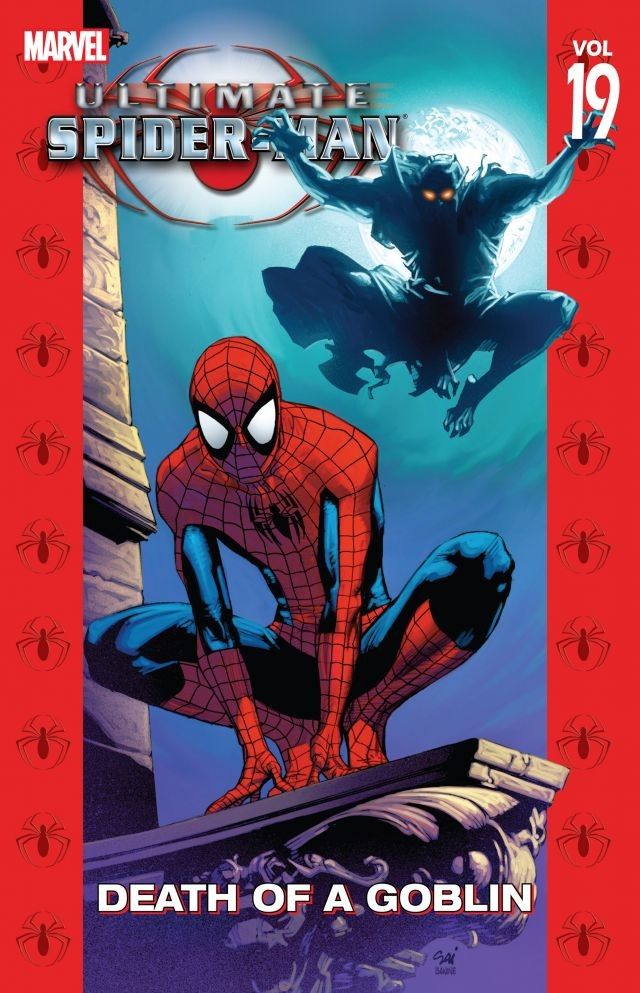
Ultimate Spider-Man: Death of a Goblin

DIG008685_1Blah blah blah goodcakes. I know, I know. But since it continues to rate, I can hardly not continue to say it, right? As is by now usually the case this far into the series, it’s time for another familiar old villain to rear his head:  as the title indicates, Norman Osborn’s Green Goblin has broken out of S.H.I.E.L.D. custody to once more torment Peter Parker and friends. What continues to impress is how there’s always a new take; this time, it’s the mysterious absence of Nick Fury, Osborn’s devious scheme to discredit the missing Fury, and a dire hint about S.H.I.E.L.D.’s [in]ability to control the Oz formula that transforms Osborn into the Green Goblin and has also affected others of Peter’s friends over the past year. I definitely like how most new Ultimate titles I read these days tie that universe closer and closer together. Not unlike a spider’s web, you can hardly touch one strand without consequences being sensed in each of the others.

But enough about all this, I can hardly convince you of the goodness of the story by now if I haven’t already done so long since. Rather, I feel it necessary to comment on the change of artist for the first time in over 100 issues. Newcomer Stuart Immomen[1] definitely has a different style, and it will take me a little time to get used to it. I mean, I’ve seen his art in Ultimate Fantastic Four as well, and it’s not at all bad. It’s just that Bagley’s weight on the series is a lot stronger than any other artist/series combo in the Ultimate universe, and probably in most of Marvel’s history. That said, Immomen has a few quirks. For one thing (and I cannot get over the fact that I hold this opinion at all; apparently I’ve been reading a lot of comics over the past 2-3 years?), his lines are really heavy. Generally if I notice them as distinct from the figure they contain, that is too heavy for me. For another thing, he seems to work from a limited pool of facial expressions. At least, annoyed Peter Parker is the same as annoyed Reed Richards. Also, the eye on the Spider-Man mask has gotten vast. I mean, seriously frakking huge, like a full third of the mask’s surface area per side. However, none of the art is stylized or overly focused on experimentation; all of the people look like people. So I will get used to it, no worries. It’s just a lot of change to take in at once.

[1] I cannot help but think of him as a girl unless I’m really trying not to, because his name reminds me of Imoen from Baldur’s Gate and Baldur’s Gate II. This is not something you actually needed to know.
Ultimate Vision

After the earth was saved at the end of the Ultimate Galactus trilogy[1], things pretty much went back to normal I guess. Except, some editor and Golden Age and/or Silver Age android fan decided that there ought to be a few more consequences. As a result, we have Ultimate Vision, in which the robot that came to earth to warn of Gah Lak Tus’ approach and document our doomed civilization rebuilds itself a female body with implausibly proportioned hips and tangles with the scientists of a criminal organization called A.I.M.[2] (whose presence I have not previously detected in the Ultimate continuity) over the disposal of a spare Gah Lak Tus drone that was damaged and left behind as the swarm retreated in defeat. And yeah, that’s pretty much the whole thing. It’s not that it was a bad story; it was actually pretty okay. It’s that it was tragically irrelevant to anything else going on.
[1] Spoiler alert
[2] Advanced Idea Mechanics, if you were curious

Ultimate X-Men: Sentinels

I have observed with some degree of interest how I have changed the way I interact with shorter types of external stimuli, such as movies and graphic novels. By no means is it that they have fewer themes, nor ones that are necessarily smaller in scope; just that with the limited amount of time and space for presentation, the themes are usually more compact and immediate, which means that I not only have to be prepared to pay closer attention finding them, but that they also can require more ability to read between the lines. Like, with a 20-50 hour game or a 300-1000 page book, I can just let my mind wander and see what bubbles to the surface as I go, but in the couple of hours I spend on these shorter media, sometimes not treating it like a treasure hunt for nougaty thematic goodness means I won’t have anything to say when I get here.

And then there are stories like Sentinels, which are simultaneously so muddled and so scattered that I have no idea what just happened, try though I might. There are two and a half plots in progress, at least two timelines to keep track of, an inexplicably large number of drive-by characters who show up for one scene or issue only to vanish forever, and far more needless overt sexualization than I’ve seen anywhere in the Ultimate line before now.[1] In what I’m going to assume is the plot that matters, a new group of X-Men has formed in the wake of the original group’s disbandment to focus on the “school” aspect of Charles Xavier’s school for mutants in upstate New York, that disbandment coming in the wake of the events of the previous book. And said new group fights off the return of the mutant-hunting robot Sentinels, while the people at the school go off in search of underground mole mutants and deal with the ever-present portentous foreshadowing about Jean Grey’s fated transformation into the Phoenix. I think if they’d used the same amount of space to tell either story individually, it wouldn’t have felt rushed and full of annoyingly fast cuts between scenes that weren’t related by plot, theme, irony, or even art. I can’t help but feel like, in response to my recent thoughts that a series-level climax is drawing near, they suddenly found themselves out of time to tell the stories they had left and were forced to rush.[2]

Still, I shouldn’t complain too much. The use of a new artist for each of the 2.5 storylines means that at least I wasn’t stuck with the horrible first guy during any of the needless sexualization scenes.

[1] I mean, I’m kind of a fan of needless sexualization, but not when it takes me out of what ought by rights to be a good story.
[2] If so, I have no sympathy, because they could have used the space taken up by the worthless Magician storyline to tell these ones right.

Ultimate Spider-Man: Ultimate Knights

I maybe already mentioned this, but in case you’re wondering: after I noticed that I was getting spoiled for my Spider-Man stories in Ultimate X-Men, I’ve started reading the Ultimate series in graphic novel release order, and I had a bit of catching up to do on Spidey. So, that’s why so many of these in a row. So that’s that. Luckily, the Ultimates and Fantastic Four cross over with the rest of the continuity less often, or this would have been a problem much sooner, and probably when I could have done less about it. As it is, though, hooray, all’s well now.

The upshot being, I just read Ultimate Knights. And… okay, even though I knew it would be another 5-star story, I also knew there was no possible way it could live up to the jaw-dropping splendor of the Clone Saga. I’m not going to sit here and tell you it did, either, because I meant that about no possible way. Yet, at the same time… Bendis took a book that should have been breathing space from one major revelation after another, things that will likely have repercussions for years down the line if the series continues (as I very much hope it will), and he made it about a collective effort, organized by Daredevil, to take down the Kingpin. And what I’m saying is, it worked as breathing space, an arc that under any other circumstance I would have considered a major turning point in its own right! But as fantastic as I have found these various rounds with the Kingpin to be, what I think I liked best about the book[1] is that it really was breathing space. It’s nice to see Peter Parker have a good day every so often, and this was one of those.

[1] Please don’t take this to be a spoiler about the outcome of that Kingpin confrontation; I wouldn’t do that. Separate thing here.

Ultimate X-Men: Cable

I have made mention several times over the past few months that the Marvel Ultimate series has an expiration date that, according to my bookshelf, I seem to be approaching. But it hasn’t felt like that in the depths of the storylines, right? Which is one of the reasons that Cable caught me by so much surprise that it has caused me to rethink the Ultimate X-Men series as a whole. More on that in a sec, but what made me start thinking about the Ultimatum again is how much finality and apocalypticism Kirkman brought to the table this time. There’s this guy Cable, see, and he has come from the future to kill Charles Xavier and thereby prevent said future from ever occurring, probably because it sucks? This is information I have not yet been specifically given, so. All the same, the situation felt like the first pebble of an avalanche, in a way that nothing previously has.
Which I guess ties into what I meant about rethinking the UXM series. Obviously I’ve been fine with the development of Spider-Man. The Ultimates are busy with one nation-threatening event after another, and the Fantastic Four skip jauntily from one sci-fi menace to the next, but neither group has built up much in the way of continuity. (The Ultimates would I think have built more, if only more had been written about them.) The X-Men, though… some I’ve liked, many I haven’t liked very much, but I never really looked at the series as a cohesive unit before, and I have to admit, for all the individual episodes I haven’t cared much about, the whole of it stands together really well. Somewhere along the way, no question, I started caring about these characters. If I’m right about this being the first signpost of things to come, I’m glad it happened here. Spider-Man’s story is too personal for world-shaking events, and the others are too scattered.

Ultimate Spider-Man: Warriors

So, the most recent Ultimate Spider-Man, Warriors[1], has me thinking about Peter Parker’s foes. Most of the time, they’re dudes that were changed by science like he was, only with more sinister results. Most of them are bit characters, because there are always way more villains than heroes, and the heroes never permanently lose. (Mostly.) You’ve got the Green Goblin and Doctor Octopus, with whom he shares pretty much a familial bond.[2] But otherwise, most of what he faces is a generic stream of similar villains that he can quite easily quip to death, even without the spider powers. But then there’s the Kingpin.

Wilson Fisk is just a rich guy mob boss type. His henchmen are all just folk too; Elektra has no special mutant or science-run-amok powers that I can figure, and just about everyone else he works with isn’t big-time enough to have a recognizable name. He could be Spider-Man’s least interesting foe, and yet instead I think he may be the best of the bunch. He’s scary smart and he has the power that money brings, even though he’s been laying low due to legal difficulties for practically the entire run of the comic. I guess it’s a lot like Lex Luthor with Superman: the only person who can really compete with an unstoppable force is the one who can out-think it. And okay, Kingpin is a bald rich guy, so maybe there’s a little bit of larcened[3] idea in the character at that. But I don’t really care, because the more important of the two is original, and nowhere near an unstoppable force anyhow, which leaves Kingpin free to be even more of a puppet-master. Case in point: the book that I just finished reviewing, albeit in footnote one.

[1] The actual book? Of course it was fantastic. What do you expect me to say instead, at this point? In a way, there were way too many bit characters from previous continuity (and, okay, also from previous events in this series), but in another way, that managed to work and be really cool itself, even though that kind of thing usually pisses me off. Which is why I keep writing paeans to Brian Michael Bendis. Whatever he’s selling, I apparently keep buying it.
[2] I mean, Norman Osborn created him, and the paternal vibe has been there ever since. All too readily, Harry Osborn falls into the overlooked brother role, and Otto Octavius, self-created but still in Osborn’s employ when it all happens, kind of feels like part of the family to me too. The last part may be a stretch, I admit, but I’m impressed with how neatly Bendis shoehorned the other three characters into these roles, just as though they had always been written this way.
[3] Is that even a word? I bet not.

Ultimate X-Men: Phoenix?

Robert Kirkman, who you may recall me lauding from the Walking Dead series, begins his run as the writer for Ultimate X-Men with Phoenix?, in which the X-Men take some time off. No, seriously. The first half of the book is pretty much a date night. I mean, it’s literally named that. So, anyway, most of what happens is character development rather than plot advancement, but I’m okay with that. The central question of the book, as you may be able to guess by combining the title with some small amount of X-Men knowledge, is “Is Jean Grey the Phoenix?” And it’s a pretty interesting question even if you are familiar, because the Ultimate Phoenix has always been different from standard continuity, at least from what I know of the latter. Other questions for the book include: “Which character is homophobic?”, “What’s all the weirdness with Wolverine lately?”, “Who is this new Magician guy and did Kirkman create him out of whole cloth to seem awesome?”[1] and, if you are like me and reading these books in the wrong order, “Why are there Ultimate Spider-Man spoilers, dammit?”

An additional question, if you are familiar with Kirkman, would be “Why is the dialogue so stilted and basically terrible?” Thankfully, that question is obviated by reality as of his second issue, which means I don’t have to claim this book is terrible. Which is nice, since I had only recently started to really like the series.

[1] I hope the answer is “No”, because the character is kind of annoying, however intentionally.

Ultimate Extinction

Concluding the Ultimate Galactus trilogy, Ultimate Extinction finally brings us the arrival of the traveling destructive force known as Gah Lak Tus, its Heralds, and quite possibly the end of humankind in the galaxy. As previously, the main hallmark of the book is that new characters[1] are produced only to be minimally utilized. To their credit, most of the characters that appeared in the earlier volumes return for this one, but that causes even more of a mish-mash feeling than the “Ultimate Universe is pulling together” feeling they were undoubtedly attempting to evoke. All in all, Ultimate Galactus was a decent story that was hampered by being told too fast for the amount of story that wanted to be told.
[1] That is, new Ultimate characters that I might have heard of if I had read deeper into the original continuity.

Ultimate Spider-Man: Hobgoblin

Not only am I running out of ways to say that the Ultimate Spider-Man series is fantastic, I’m kind of running out of ways to say I’m running out of those ways. I’m not sure I’m even objective on the topic anymore; it may have turned bad and I simply failed to notice in a whirlwind of fannish obsession. To nobody’s surprise, anyhow, I really liked Hobgoblin. Harry Osborn, son of the Green Goblin, is not having the best few months. His father has turned into a beast that regularly stalks him and killed his mother, and Harry most recently witnessed his father’s apparent (or actual?) death at the hands of the Ultimates and his very good friend Peter Parker. As usual, though, Harry’s return to school and mental state is only a small part of the book’s story. The tragedies that have dogged the Parker household during the same months that treated Harry so badly are finally pushing Peter to the breaking point.

I know things have to turn around soon, since the Ultimate universe apparently has an expiration date that I might be broaching by late this year. But honestly, I’m not sure how at this point. Pete is a pretty moody boy lately, and with good reasons. And the more tightly the inhabitants of that universe are tied together, the more interesting the stories get. Nick Fury’s small role in this book practically guarantees that whatever comes next for Peter Parker, it will not be the sudden positive turn that he really deserves.

Ultimate Secret

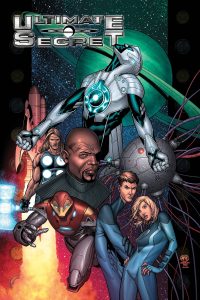
Ultimate Secret continues the Ultimate Galactus trilogy in much the same fashion as the opening volume. That is, it tells a reasonably good story whose main flaw is feeling entirely too short. I mean, most of the Ultimate books have felt like discrete storylines in the lives of our heroes. The Galactus books, on the other hand, have felt very much like part of an (extremely incomplete) ongoing story. It is not particularly a flaw, except that it makes it hard to feel much excitement for the review; it’s as though I’m reviewing thirds of a book, instead of three books.

Another way it matches the first volume is that it uses the Galactus story to talk about other characters entirely that had not yet been drafted into the Ultimate universe.[1] In this case, the fight is against the alien Kree who are sabotaging mankind’s space program, in the hopes that when Gah Lak Tus arrives, the planet will have no survivors. The story was decent, it just wasn’t what I was looking for. Again. I’m really relieved this is only a trilogy, as I’m not sure I could take much more pushing back the payoff.

Except for the lack of character continuity, what this has most reminded me of is the old G.I. Joe event weeks when they’d present a five-part series in which Cobra and G.I. Joe were crossing the world in search of parts for a doomsday machine, and inevitably Cobra would manage to get all the parts, fire up the machine, and then lose anyway. The continuity meant that each episode had a series payoff feel, unlike these books, but there’s still definitely a race across the world in search of clues feel. (Does anyone but me remember those episodes fondly? I mean, clearly there’s a movie studio that hopes so.)

[1] Captain Marvel? Really?