Tag Archives: fantasy

Moving Pictures

I have no point here but to warn you that it’s coming sometime pretty soon, but I very nearly read the next Anita Blake book here instead of Discworld. (In both cases, I only found out Tiassa was about to be released after I had / would have already started. Oops.) The plan fell apart when I realized I no longer owned “the next Anita Blake book”. I’ve corrected that now, but it came as quite a shock! So, y’know, pretty soon.

So, anyway, what I did instead was read Moving Pictures, in which Terry Pratchett uses the comedic voice that… okay, the truth is, I have either read zero or at most one book later in the series than this one, so I don’t know whether his voice gets funnier or not. I only know that it’s as funny as I have ever seen it to be, and that level of funny is entirely pleasing to me. So, there’s my caveat; let me try this again. Ahem. …in which Terry Pratchett uses the comedic voice that he has perfected over the last several books of the series to tell a story whose point, well, I really didn’t get.

Essentially, through the employment of an extremely subtle metaphorical representation of early Hollywood[1], he… well, he seems to be saying that it is dangerous for people to get wrapped up in fantasies while the real world is happening around them, since heroes will not actually appear to sweep them off their feet and/or save the day. Except, he’s writing escapist literature which gives people the same fantasies, only with words instead of frames of film. And as if that isn’t enough to undercut the entire thesis of the book, things go really off the rails once the Lovecraftian monstrosities take the stage.[2]

So I guess my point is… am I crazy? Does the book have this entirely unrelated meaning that I failed to comprehend? Am I right and it’s both inherently and internally contradictory? Either way, it was funny and had new characters I’ll probably never get to see again but will at least be excited if I do, so that’s not too bad. And everyone still says the best run of the series is ahead of me, which is even better news.

[1] Get this: he removes one of the Ls and replaces it with a space, only the space, the space isn’t in the same spot as the missing L was. Genius!
[2] On the one hand, there’s only one way I can see to interpret this complaint, which makes not actually spoiling it seem like a cowardly act. But I could be wrong, and I’ve already spoiled plenty enough already, old book that everyone except me has read or not.
The Wise Man’s Fear

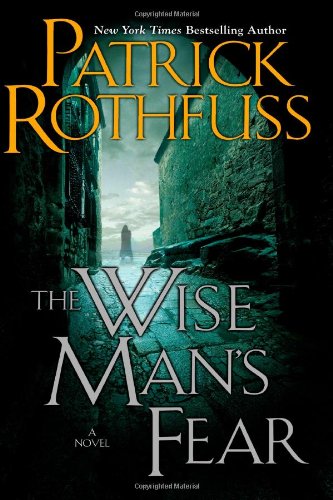
51tfhkACppLAfter what has perhaps been an unreasonably long time, the first of two sequels to The Name of the Wind came out earlier this month. It’s neither the longest I’ve waited for a sequel nor the most excited I’ve been for one to come out, but for a second book in a series and/or a second book ever, it is both of these things. And then, over the several weeks I took reading it, not to mention the several internet-famous people who had advanced reading copies, really a lot of people have gushed extensively about how good of a book it is, even better than the original.

All of which has conspired to make me nervous about my review of The Wise Man’s Fear. As expected, it continues the infamous Kvothe’s recounting of his life story to the biographer who had come in search of him, a story that contains magic, growing fame, bandits, faeries, revenge, chases, escapes, and quite possibly true love. And the thing is, on the one hand, I thought it was a fantastic story, with all kinds of internal and external twists, interesting and reasonable character development, and a storyline that, while just slightly uneven, is all the more believable for that; I was never bored, but neither was I ever rolling my eyes at the sense of it being a story rather than a man’s life. Kvothe himself has grown just slightly unlikeable, a sense I never got from the first book. But I don’t mind, because the bravery of the choice has paid off, and Kvothe-as-narrator seems slightly more reliable for showing his worse moments to us.

For all of that, there’s the other hand, where I didn’t find it to be a better book than the original, nor did I find Rothfuss’ prose to be as revelatory. Since I find both to be every bit as good as before, that seems like plenty enough praise in itself, and more than I’m used to, at least among the rarefied air of very good initial attempts. All the same, when I compare this review to the several others I’ve seen, I feel like I’m selling the book way too short. Maybe everyone else is like me, and the fact that a second volume is as good as a great first one is so unusual that it feels like it’s even better just by not having the expected drop-off in quality.

Jack of Fables: Jack of Hearts

The brilliance of splitting the Fables series by giving Jack Horner his own spin-off is that the mainstream series is free to switch to an all serious, all continuity focus while giving fans of lighter fare a place to go for that. I like both, don’t get me wrong, but all the same, I like them better separately than together, because now I know what to expect from each storyline, instead of guessing whether the next book will matter to the plot or not. (This theory probably falls apart entirely for people who read the individual comics instead of the collections, but I’ve got to say that I’m really glad the graphic novel format exists; as much as I’ve enjoyed my Marvel readings over the last years[1], the modern trend toward extended storylines fits my pleasure a lot better than changing focus every issue or three. Whether the graphic novel format led to or from extended storylines is a question for historians.[2]

The downside of reviewing a book in which you already know that the plot will be played for light comedy (nevermind how brutal or violent individual moments might be) is that probably nothing will really change, and there’s not a whole lot you can say about it except for spoiling the plot. So, to the minimal extent that I’m willing to do that, Jack of Hearts follows immediately from the events of the previous story, where Jack takes the time to tell his fellow escapees the possibly true story of how he became Jack Frost and the heads off to the warmer climes of Las Vegas, in pursuit of the two things it has in the most abundance, love and money.

On the bright side, though, the potentially very interesting story of Mr. Revise, the guy from the last book who has been capturing fables in order to remove them from pubic memory? It is not only not over, but figures to be the main arc of the Jack of Fables series, much as the war against the Adversary is the main arc of Fables. I really look forward to seeing where all it goes, though I trust Jack will stay for the most part light and comedic. Otherwise, it’s just a new series entirely, which defeats the purpose. Well, the one I laid out for it, anyway. Oh, and unrelated to almost anything else I’ve said about the book, I really hope to see more of Alice in future volumes.

[1] I’m in 1974, except that I went back to catch up on Daredevil, where I’m trapped in 1968.
[2] So, Fresh Air has a rock historian, right? I wonder how long until a show on NPR has a comic historian, and I also wonder why it cannot be me.[3]
[3] So, okay, there are a lot of really good reasons why. But still, what a cool job. If it existed, I mean.

The Steerswoman

The thing is, I finished this book days ago, and by that, I mean too many days ago. I’ve had tons of entertainments and about two-thirds of the next book since then, and I’m more sad at myself for failing to come to here than I’d normally be just for running behind. And that is because I liked it a lot better than the quality of this review will reflect. Still, this is the reality I’ve got, so I’ll do what I can.

The Steerswoman is the first book in a series about, y’know, steerswomen. (Mostly, though there are a few steersmen.) And the steerswomen are dedicated to knowledge. Gathering it, using it, disseminating it freely. And… but that right there is the thing. I started the book following Rowan’s adventures without any idea how the world worked, what the blue gemstones she was researching meant, or even why the wizards and the steerswomen are so strongly at odds. Truth be told, I still don’t know the answers to all of those questions. But watching the layers of the worldbuilding onion slowly peel back was every bit as entertaining as the unfolding of the actual plot. So I am forced to stop here, and add only that it’s a good book in a fantastic world that I want to excavate more thoroughly.

Best of all, I managed to not tell the story of why I finally started reading the series, which means I get to use it in a future review!

Harry Potter and the Deathly Hallows: Part 1

At this late date, it is essentially a given that a Harry Potter movie will be financially successful, capture some number of iconic moments, and have pacing problems inherent in adapting a multi-hundred-page book to a substantially-fewer-minute movie. Upshot: except in case of unforeseeable production errors, you already know everything you need to know to decide whether or not to go see part one of the series’ climax. Which leaves me with the unfortunate task of coming up with something to add to a closed topic.

Well, first I have the task of saying that there is no inexplicable failure right at the end, and that after a breakneck-paced opening in which we establish that evil is ascendant in the wizarding world, nobody is safe, and our heroes don’t have much in the way of a solid plan for how to do anything about it, the film settles into an excellent character study of Harry, Hermione, and Ron on the cusp of adulthood, finally set free from Hogwart’s apron springs, with the weight of the world on their shoulders. In a very real way, every scene of every previous movie has been leading to the last two thirds of this one, where we get to see what has been forged. And I have to say that the same segments of the book didn’t really give me that sense of completion to the series; which is not to say that the movie is better than the book, but that it’s nice to be able to contrast them and find strengths in each.

So, okay, I had a little to add to the topic after all, and that’s cool, because those three actors and the various directors who have led them through this past decade of films deserve a lot of credit. But still, on the whole you really already knew what you wanted to do about the latest Potter extravaganza long before I popped open my laptop to give you my opinion, and since you deserve my opinion on something, it’s this: I came out of the movie extremely disappointed. Disappointed, that is, that at least the sixth and probably the fifth movie deserved a similar amount of extra time to flesh out those stories as well, with these actors.

Too late to do anything about it now, I guess, but it’s at least nice to see they would almost certainly have been excellent.

Abyss

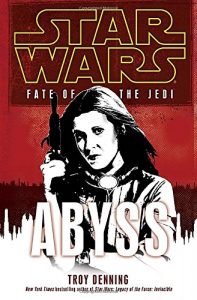
As with previous ongoing Star Wars series, Abyss marks a point in the storyline where it gets a lot harder to say anything much useful while also avoiding large spoilers for previous books. But I’m interested enough in seeing where they’re going with it to lay out at least a bare-bones sketch, all the same. First, things I’ve probably already told you anyway: the Fate of the Jedi series takes place some forty years after Luke and Leia and Han saved the galaxy from the Emperor. They have since saved it from the rest of the Empire that wasn’t really done yet despite their boss’s demise, from extra-galactic invaders, and most recently from a newly risen Sith Lord with uncomfortable family ties. Now, the Jedi are trying to save it from themselves, since many of them are suffering psychotic delusions, while navigating a political minefield that has already resulted in Luke Skywalker stepping down as Grand Master of the Jedi Order to go on a pilgrimage and figure out why good people do bad things, more or less.

Okay? So, the series at large has been Luke and his son hopping from one group of non-Jedi Force-sensitives to the next to gather this information, while everyone else plays at political shenanigans back home. The political shenanigans have been interesting, but in this book (as, I suspect, ultimately will be the case in the series as a whole) they’ve been largely irrelevant stage-dressing, since they don’t really touch on the Force, which is what we’re honestly here about, right? That part is where I’m getting to be interested, for two reasons. The first is one I’m likely to be let down by in the long run, but they seem to be making a close examination of Lucas'[1] underlying cosmology for the entirety of his creation, and I hope to see interesting conclusions drawn. The second, though, is a thing I haven’t mentioned previously (I don’t think), that there seems to be an old-fashioned Jedi-Sith confrontation on the way. Not the master-and-apprentice always-two Sith Lords of the last good long while, no, I mean the actual Force-sensitive species of them that wanted to take over the galaxy way back before there was an Old Republic. Which admittedly doesn’t sound that different on the surface, but old things coming back has always seemed pretty cool to me, and I do not expect to be disappointed as far as seeing where that goes. So, y’know, possible cool stuff in the outing, and interesting philosophical turns and the omnipresent swashbuckling and aforementioned political shenanigans in the meantime are more than tasty enough mind-candy to keep me coming back for more.

[1] I mean, obviously he has never given it even a tiny fraction of this much thought, but I guess at some degree of abstraction he still has veto power.

Fables: Sons of Empire

I think the main oddity of having started the Jack of Fables series is that it breaks up the flow of the “big event / build-up to next big event” in the main Fables sequence. Thankfully, it didn’t make me like Sons of Empire any less, but it does explain my unwarranted confusion over the slow pacing. Having gotten past that, the story was superlative for one of the down-cycle stories. In and around the Empire’s plans of vengeance against Fabletown, family vacations, and thumbnail character sketches of the bit players, the book is mostly about paternal relationships, and mostly about bad ones at that. Still, the woes of fathers and sons would only be so interesting of a theme, however well presented, if it were not for the fact that I’m sure these particular relationships — between Gepetto and Pinocchio, and between the North Wind and Bigby Wolf — will be of vital importance to the rest of the story.

Well, or to the next phase of the story, depending on whether or not Fables is an open-ended or an arced tale. I honestly have no idea which is the case, so.

Prince of Persia: The Sands of Time

I am thinking that today may be a good day to watch movies. Not sure yet if that’s how the rest of my day will proceed, but I can state definitively that it has begun that way, with the Prince of Persia movie that came out back in May. Which I think was the only movie I’ve actually missed all summer? Yay for being caught up! Possibly because it was based on a video game or possibly because I never heard anyone really talking about it, I am surprised to report that it was pretty good.

In the pro-column: a good soundtrack and really a lot of excellent action sequences that captured the spirit of both the specific game it was based on as well as the whole series, while cleverly jettisoning the majority of that game’s plot, which was good enough for a platformer game, but, well. Instead, our titular prince must unravel a plot to overthrow the throne of Persia when he is framed for the murder of his father the king, with only a princess who hates him and a sporadically magic dagger for allies. Y’know, pretty much the same plot as any action-adventure movie, when you get right down to it, but on the bright side, those are usually good.

In the con-column: way, way too many “sly” references to current events, including a search for weapons of mass destruction and railing against high taxes. This is why Star Wars is the better movie, y’know. Nobody was complaining about taxes in Star Wars. That and the desert may be the only substantive differences, though.

Eric

If all the Discworld books had been like Eric, well, okay, probably most people that I know would still have read them. They are, after all, competently written comedic fantasy. But they wouldn’t talk about them nearly as much as they do, at the least. I mean, as a representation of the kinds of things that tend to happen in Discworld, it is a top notch book. The problem is that, even as short a distance into the series as I am, I’ve come to expect a fair amount more incisive literary and social depth, and never mind the amount I expect from all the buzz that surrounds later books in the series. By contrast to that experience/buzz, this book was a merely[1] funny series of vignettes strung together as a parody of Faust with a horny thirteen-year old in the eponymous role and resident failure (as a wizard, too, but I more meant it with a capital F) Rincewind as the wish-granting demon. If that doesn’t make a lot of sense, well, that’s what the plot is for, yeah?

The sad thing is, I’m totally not joking about it being funny or a really good sample of the kind of thing that happens every day on the Disc. If there’s a moral to my story, it’s this: expectations are a fickle bitch. And as for great expectations, well, they were written by Dickens, which I think tells you everything you need to know.

[1] he says, as though that’s not a reasonably tough accomplishment on its own

Jack of Fables: The (Nearly) Great Escape

A few volumes ago, I made reference to my knowledge (garnered through the publishing industry) that Jack Horner, the same Jack who climbs beanstalks and kills giants, would be getting his own spin-off comic series soon. That was true, of course, and I’ve finally reached the point in publication order where his book interrupts the straight-through Fables series. (Which, by the way, is wow, long series. And I think it has no end in sight? So that’s a thing.) The Jack of Fables series picks up exactly where his story in the main continuity left off: with Jack once again on the wrong side of Fable law and in pursuit of a new way to re-create his wealth, fame, and generally easy lifestyle that he so richly deserves. Just ask him!

As the title of this first volume implies, he is almost immediately derailed in these intentions by his capture into a home for the dissolution of fables. Being the type who is not generally fond of being forgotten, he immediately sets about getting out. From there, adventure, chaos, and some amount of comedy ensue. The exact amount depends mostly upon just how much you are either willing to accept Jack’s conceit that he really is the most important person anyone he meets will ever meet, or upon how much you’re willing to accept the authors’ backhanded irony within Jack’s conceit. I’m split about halfway down the middle, laughing with him and at him in equal measure. If you find him intolerably boorish (which is fair!) and annoying conceited (which is even moreso), then you’ll probably hate not just the book but the whole series. In which case, I hope the eventual crossover is not much different than when Jack was just one of the characters in the series and will require no other knowledge to follow along with. That would be unfair.