Chainfire

51PDA40MJGLSo, yeah, the new Goodkind? (Okay, thoroughly not new; in fact, there’s going to be an actual new one in a matter of weeks, but it’s still currently “the” new one for now, so there’s that minimal claim to factuality, plus it was new to me, of course.) To absolutely nobody’s surprise, it really wasn’t all that good. I mean, look at the last one.

But here’s the thing. As bad as that was, at least it was competently constructed. Chainfire is a little bit better in some ways, but so much worse in others that I don’t even know how I got through it, though I do know why it took so long. See, on the good hand, the plot is more interesting than it has been in a few books and a substantial bit more relevant to the progression of the series. So, yay. Things are finally coming to a head between Richard’s empire and the evils of enforced liberalism from the previously hidden continent, which include the complete collapse of capitalism, rampant unhappiness, extensive rapine and murder, and all the kinds of things that you would expect if anyone believes that compassion is ever more important than self-interest. (Gosh, I have a hard time praising this thing.) But, whatever, when you stop looking at the thinly veiled metaphor sideways, my point is that things are coming to a head. The problem is, Richard’s wife has disappeared. And not by half-measures; instead, nobody in the world but Richard seems to recall that she was ever a part of his life or even existed. What’s more, an amorphous unstoppable killing machine of a demon has been unleashed onto his trail, and prophecies say that if he isn’t in the right place at the right time, the world as they all know it is doomed. So, yeah, not the best time for your wife to be missing from the timeline and all of your energy bent onto solving her problems instead of the other stuff going on. (It does kind of remind me of the Perrin/Faile thing more than a little bit, and I am impressed that the Wheel of Time plagiarism charges could possibly resurface. But that’s for my own horrified amusement, and not really otherwise relevant to this review.)

So, yeah, the plot elements and progression left me on the whole interested in the book, as I said. The real problem with the thing, far more dire than anything I’ve mentioned above, is that it was a 250 page story crammed into a poorly edited (copy- or otherwise) 600 page book. The first half is almost nothing but repetitions of arguments on the nature of reality, duty, right and wrong, between people that could not possibly be willing to talk to each other like this in anyone’s real life. Sure, to crowds of faceless nobodies like in the last book, okay, but these are almost all between friends and relatives. Such a beating. By the time the plot finally picked up the pace, started having more events than lectures and reminding me why I have occasionally enjoyed this series, it was only through sheer discipline (and my anticipatory enjoyment of a then-upcoming Jewel concert) that I had not already sporked my eyes free of their sockets to stop the pain.

Just… wow. If you correctly guessed that I’ll be reading the next book once I spot it used somewhere and wish to save me from myself between now and then using lethal force, I will both understand and almost certainly thank you with my dying breath. Bring breasts, though. They seem like they’d make that kind of thing easier on me, is all.
Dead and Breakfast

Imagine, if you will, that David Carradine owned a tidy little small town inn and further that he had a little magic box that turned people into zombies. Add in six young people driving across Texas who need a place to sleep for the night, musical narration, an authentic hootenanny, and a hall of records keeperwho takes her job seriously indeed (okay, that part doesn’t make a lick of sense, but trust me, it works), and you have Dead and Breakfast. Predictable and sometimes given to taking the easiest plot path possible (but both in a good way), very funny and with better music than you’d think, plus a really hot yet cool chick with a chainsaw, I have to call it the best zombie flick I’ve seen all month. This despite a completely inexplicably murdered French chef in the first act, which should have derailed the plot entirely, but instead serves as one of the movie’s little charms.

Lord of War

Although (regrettably) not in 3-D, I did catch a couple more movies on the same weekend as the last couple. (A week ago, or two? Already, my memory fails me. I suppose it’s an argument for creating these reviews on a stricter timetable, but I’m more concerned over the fact of it than its effect on the accuracy of these pages. Selfish bugger, me. Well, at times.) In any case, the first of these was something I was interested in from last year but never got around to, Lord of War.

So, it was pretty good. Nicolas Cage was serviceable as ever, and for that matter not quite as soulful and world-weary as usual; it’s nice to see people break out of their shells a little. But the previews were very misleading. It is made to look like a black comedy about the international arms black market, when in fact nearly all of the comedy is right there in the preview. Instead, it’s a pretty straight-up fictional biopic about an arms dealer, exactly the kind of thing I’d tend to avoid if left to my own devices. What it had going for it that matched my tastes was the topic being enough outside my experience to not seem like watching a movie about something I could just do instead, much like mob movies in that regard. So, hooray for lucky finds. That said, outside of the arms thing, it was frightfully generic, so if you do know a lot about that segment of society, a) that’s really kind of cool, and why would you be reading this review, but b) it really won’t have much to offer you, I am thinking.

Creature from the Black Lagoon

And herein lies the beauty of the double feature. Two movies in a row. The thing is, I really, really enjoy the cinematic experience. It’s like a double-header to baseball fanatics. (Although I’m not one, I certainly like those too.) Unless baseball people think that double-headers are somehow impure? Well, if they do: whatev. It’s just, there I’ll be, watching the credits go by, when suddenly I don’t have to leave and go home, because, another movie! It’s possible I’ve explained this sufficiently, though.
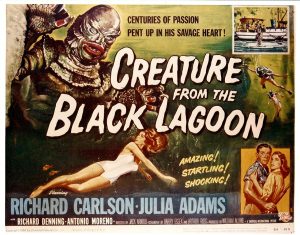
Creature from the Black Lagoon is about this, well, this creature, right? It lives along the Amazon, at a place that the natives call the Black Lagoon, for reasons that are not entirely clear to me. Black and white film makes some things non-obvious, water color among them. But I don’t remember any of the characters discussing anything being all that black. Anyhow, this so-called creature is kind of an amphibious fishman, who is among other things a perfect segue for the whole evolution discussion. It is amusing to me that the film so casually asserts that God created everything via evolution, yet it is so hard fifty years later to find people willing to take a look at that compromise position.

Besides evolution, though, this movie was about a lot of things. Underwater photography, for one. If you removed the underwater shots that served no other purpose than as a tech demo? Movie over in under an hour. It’s like Star Trek: the Motion Picture without the 45 minutes of “look at the cool new Enterprise model”. For another… well, it wasn’t about this, but it was certainly a permeating undercurrent to the whole thing. Natives? Completely irrelevant. The important thing is to work that paleontology and retrieve the creature-skeleton (and later, of course, the live specimen instead) in order to prove that it existed and make us all rich and/or famous. I mean, until the white people are in danger. Then it’s time to stop this tomfoolery and save ourselves. I know it was a different time, but I really am amazed/amused that nobody on the writing staff seemed to notice how blatantly dismissive of the natives they were being. Oh, and the paleontology? Maybe they were this careless back then, but I doubt it. The techniques were completely laughable, and I am very much an amateur on this topic.

But what it was really about was the relationship between the creature and the girl. The completely hot, thank you for going swimming and I wish you weren’t in your 80s right now girl, I’d like to add. She was thoroughly yum, and even moreso in her explorer shorts than in the bathing suit, if you can believe it. Which would be beside the point, really, except for the part where the creature is a stand-in for every teenage boy in America. Two goals: 1) get the girl, and then take her back to your aquatic underground lair where you’ll, well, okay, you don’t exactly know what it is you want to do, but boy do you ever want to do it, and 2) kill anyone that gets in the way of goal one, because that testosterone is on the upsurge just now, if you know what I mean.

I guess my point is, once the underwater scenes got old, it was the inferior of the two films due to being not quite as deep of theme. But then again, a good slice of cheesecake goes a long way. Also: multiple gratuitous spear gun shots, off the screen and right into your face! Yay, 3-D.

It Came from Outer Space

Just nearly a week ago, I made a run down to Austin to catch a, well, a science fiction double feature. No, really. And in 3-D! It had been a while since I’d watched red-blue 3-D, as opposed to the stuff they have at IMAX these days with the cross-stitched goggle lenses. It reminds me of nothing so much as those dioramas that you’ll get at some natural history museums, with all kinds of animals and rocks in the foreground, and a painted background. But mostly, it was eye-poppingly 3-D, which was pretty cool. I speculate that it works a lot better in black and white than it does in color, although I’d need something recent to compare with know for sure.
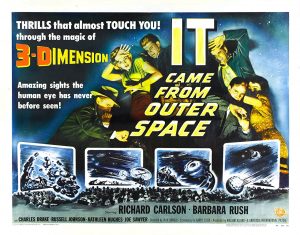
My point is, good or bad, I’ve already gotten my money’s worth out of these movies. I bet this is how it was in the early days of 3-D at the real-life cinema, too. Conveniently, It Came from Outer Space is a pretty good film in its own right. Everyone will talk about Cold War paranoia, and maybe there’s something to it, but I think that’s entirely too narrow of a reading. The fact is, the outsider has always terrified us as a species, and it probably always will. Sure, we’re thinking of Muslim extremists these days instead of Russian commies, but it’s all the same thing, and it will be in another fifty years too. Although, perhaps with literal aliens.

So, there’s this meteor, right? Well, no, it’s really a spaceship, but try convincing anyone else in town of that when you’re just an amateur astronomer that hasn’t a lick of credibility. Then, before you know it, some Vorlon-looking aliens have started kidnapping people and then posing as them and buying up all kinds of metals and electronic parts. And now that you finally have enough evidence to convince the sheriff, oops, they’ve got your girlfriend. Now that otherwise highly useful posse he is itching to use, it’ll just get your girlfriend killed. (And quite possibly the Professor, for that matter, whose name turns out to be George.) But it’s okay, because they only want to go home and don’t mean us any harm, it’s just they’re scared that we’ll lash out and kill them for the crime of being different. …or is it all a trick, and they mean to wipe us off the face of the galaxy?

On the one hand, I get a little bit annoyed at sci-fi film after film in the ’50s and ’60s telling me that humans are paranoid freaks who’ll destroy anything they don’t understand or fear that they can’t control. Even though they’ve developed space travel, surely there must be some aliens out there who are paranoid freaks in their own rights rather than benevolent overlords who just want to teach us a lesson and then be on their way. But on the other hand, the scene where the sheriff crushes the (obviously fake, not even minimally frightening) spider under his foot in demonstration of what he’d do to those aliens just for the sin of alienness? It touches me, man, deep in my soul. So, y’know, maybe no aliens for me.

Poseidon

Via the cleverly cunning plan of suggesting it, I have finally managed to catch up on the last of my summer blockbuster list; well, I mean the ones that have been released yet. I’m still short one or two current films, mind you (*cough* See No Evil), but certainly no blockbusters. Heck, I’m not sure if there even are anymore until Superman. So, yay for that.

Also yay for Poseidon. Okay, sure, it’s a remake. But at least there was a book behind both films, so I can pretend like it’s not a remake, a little bit. On top of that, it really was quite a bit better than the original. Obviously, 30 plus years of special effects advances were put to good use. But also, lots more adrenaline-pumping action. Now, is that automatically a good thing, replacing a character study film set in a disaster with a disaster film? Normally not, but the character study portion of the original fell flat due to subpar acting. In this case, the substantially reduced character study portion worked, because of a more skilled cast. (Or maybe direction? How should I know?)

Plot: Boat flips over due to technobabble (really? A rogue wave? Even if those exist: really?), ten mostly random people band together to escape, come hell or high water. Lots of character translated across, and some didn’t. Any place that I could see a translated character, the new version did a better job (or at least as good), so that was a nice change of pace. Except for Ernest Borgnine, who was still great, but as there was no adversarial character to compare with his original in this new cast, I can just leave him being awesome in the original by himself. And except for the kid, because one child actor is pretty well interchangeable with another.

In fact, the only unfortunate part of the movie was the obligatory child in danger, and will he somehow be rescued in time? It served a purpose in the plot beyond the lameness of its existence, I acknowledge that. But it was lazy writing to serve said purpose with this tired old saw. Sure, right, an eight year old is going to wander away from his mother after about 53 minutes’ worth of terror-laden escapes from certain dooooom, and for no apparent reason whatsoever. Really, if the rest of the movie hadn’t been quite so good, this would not bother me nearly as much.

Bloody Bones

As a result of a brief spate of overly long books, I went the short book route again, and might for the next little while. My immediate short book impulse these days is Anita Blake, because there are just so damned many of them and I can never find any Pratchett in the used bookstores. In that Bloody Bones mostly avoided the “How is our heroine’s love life these days?” thing that was starting to grate on me a bit, by virtue of taking the action out of St. Louis and over to beautiful, touristy Branson, I have to call the whole thing a rousing success.

I mean, okay, calling any of them a rousing success is perhaps overstating the case, but it’s nice to see some variation repairing the only real flaw in what’s been a nice bit of fluff over the past many months. This was an earlier edition than what I’m used to seeing, and the typos were mysteriously vanished. So I’m inclined to blame the new publisher a lot, now; if you insert new typos into future editions of a book that didn’t originally have them? That’s just sad. Most of the rest of what I have appear to be the not as good editions, but having solved the mystery, I probably won’t complain about it anymore. So there’s that. Plus, mystery-solving, look at me getting all kinshippy with the necromantic vampire-slayer chick.

So, what does this entry in the series have, relative to the others? Murders, as usual. Zombies, as usual. Vampires, as usual. Faeries, which is new. A different set of cops than usual, thanks to the jurisdictional change mentioned above. An apprentice vampire slayer, definitely new, but a welcome addition to the cast. More Anita-on-$Magical_Creature action than usual, but sure, that was always on the horizon from day one. Random vampire fetish games designed to squick our heroes, which was… well, kind of out of left field, but I suppose I need to be ready for that as the series progresses, so alright. Something approximating zombie sex, about which I will add little in order to not incriminate myself. (It failed to be nearly as hot as it should have been. Disillusioning!) Oh, and for once the mystery part was not completely interconnected from the get go, which change I like. The plots were starting to get a little too pat, despite how cleverly executed.

The Omen (2006)

Here’s what I dislike about movies like The Seventh Sign, about the biblical end of days and whatnot: the plot always seems to revolve around finding a way to prevent the apocalypse and the final confrontation between good and evil, just as though that is somehow not God’s plan to divvy us up once and for all. So you’re left with a choice between the bad guys winning (which tends to be unsatisfying if the good guys are at all sympathetic, but at least it rips away the sham that we have free will in a Christian God-created world) or with the good guys winning, breaking with prophetic inevitability and making the whole thing feel like one in an infinite number of meaningless hands of divine Texas Hold ‘Em. (Ye gods, the spam hits I’m about to start getting.)

Did I go see the remake of The Omen last night? However did you guess? It essentially compared with the original, to my eyes, and was therefore quite good. Playing Damien’s adoptive father (and quite complicit in the deception that allowed our budding Antichrist access to his future power), Liev Schreiber was a particularly bright spot in the acting lineup despite being unsympathetic for the majority of the film. Or maybe he was only serviceable, and I have a thing for brooding as character trait. In any case, the kid was reasonably creepy/intense, there was a fair amount of good disturbing imagery and a lot of excellent mood-setting propwork, though bits of that were hampered by Final Destinationish death scenes. (Not that there’s anything wrong with them, they just sort of didn’t fit the mood of the film once the comparison was in my head. Apparently, evil deaths work in mysterious and unlikely ways.) As far as the cheap jump-in-your-seat thrills? Well, there were several, and they were cheap, sure… but at the same time, there’s something supremely satisfying about sitting in a theater full of people who have just been moved to scream from surprise. (Heck, they even got me to twitch reasonably well, at one point.)

And I haven’t even mentioned the awesomeness of Nanny Evil.

Half-Life 2: Episode One

After all the time I spent in the aftermath of Half-Life 2, playing old versions of Half-Life and third-party mods and really enjoying the story, the mystery, and the gameplay all three (and including a replay of Half-Life 2 itself last month), finally some new stuff has appeared. Thusly did I dive into the descriptively named Episode One fairly late on launch day because of some weirdness with when they wanted to release the game to the public. So, whatev.

I wish I could say that was my biggest problem with the game, that delay. But it was not. My biggest problem was more of those damn sparkling pixels that so vexed me in Doom 3 (though white instead of red, this time, with occasional greens and yellows). I am left wondering if my computer is just badly misconfigured in some way or if ATI is an artifact of the past, as useful as so many potsherds brought as souvenirs to a Babylonian archaeology expedition. The sad part is, I only switched away from nVidia because of how they’d seemed to be behind for a few years and because Half-Life 2 was being designed with ATI specifically in mind. Also: I don’t remember this happening on my original play of HL2, yet I’m pretty sure it was present on the replay. Mysterious.

But still, that one really was my biggest problem with the game. All the actual play and storyline and mysteries? Cake. (I don’t really care for cake; it’s just an expression of approval in the generic sense. If I’d put ice cream or pie there, nobody would have known what I meant, is all.) After an intervention both surprising and foreboding, the game picks up almost immediately where the original left off, both in time and as a result necessarily in play style. The Combine has been shut down and crippled, but they’ll be back, and in the meantime City 17 is a deathtrap. Your two directives: escape to fight the battle another day, and also repopulate the world. From some of the looks Alyx was throwing Gordon’s way, I think that one might move to the top of the list before long, if only they can survive the… well, but that would be telling. Episode Two is supposed to be out toward year’s end, as I understand. I believe I am prepared for that occurrence.

Freedom and Necessity

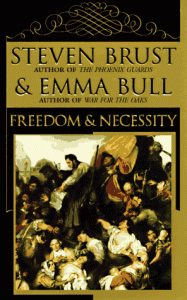
I think I may be getting bad at this. At least, lately I’ve been at a loss for descriptive words. In this case, my lack is for how to describe Freedom and Necessity, other than to say I liked it. I did, unquestionably, despite being of an insufficiently philosophic mind (or at the least insufficiently grounded in the basics of philosophic thought) to understand all of the historical nuances of the debates around Hegelian logic. …see, and this is exactly what I mean. Although Brust is very good at writing books that make me feel inadequate to fully appreciate them, that’s no excuse for me to make them sound like dry treatises with dense and well-disguised themes when I could as easily and far more approvingly describe them as rousing tales of adventure and skullduggery. So, y’know, bad. At this. (Also, I’m disregarding Emma Bull’s contribution to my enjoyment, but that is only because I’ve read nothing else by her and as a result can’t really put together in my head what that contribution was.)

So, I grabbed this book because of how Steven Brust is one of my buy on sight authors, these days. He is right to be, because of how everything I’ve read of his has a great authorial voice, humor that makes me laugh out loud[1], and plots that, though sometimes dense, always seem to hinge on exciting matters of life and death (and on occasion far more grave) that are guaranteed suck me in. As you might expect, this was just such a book.

Set in 1849-1850 England, this epistolary novel follows the loves and politics of a family that has just been struck by tragedy in the form of drowned James Cobham. Except that, two months later, he sends a letter to his cousin Richard informing that he is alive and without memory of his recent past. From there, the story quickly branches out to the addressing of that conundrum and a number of other family mysteries, the struggle between the proletariat and its oppressive masters, affairs of state, a magical conspiracy, blossoming love, and of course murder most foul. Allowing one of the characters eidetic memory combined with a penchant for writing letters long enough dam the Thames was perhaps overly transparent of the authors, but the unique and entertaining voices of all four main characters (one of whom cannot end a sentence to save her life) more than made up for that lone violation of my suspension of disbelief.

[1] I’ll admit here that I might seem to some people to laugh easily; to those people I would say that in fact I have a highly refined sense of humor, but choose to surround myself with people and things that activate it. So there.