Tag Archives: graphic novel

The Walking Dead: Too Far Gone

Either Kirkman is getting transparent in his old age or I am getting good at seeing through him in mine, but the latest volume of The Walking Dead makes to answer the question I claimed was being raised in the surprisingly recent volume, Life Among Them. That question being (to recap), can Rick and his band make the transition from a life on the run to a life of planned safety, after so very long in the valley of the shadow of brain-eaters? I won’t, of course, tell you the answer, but I have to share the anticipation I felt from the title page, wherein the name of the book was revealed to be Too Far Gone.

Rick’s struggle (really, everyone’s, but as ever he serves as stand-in for the whole group and for the reader alike) to retain his humanity in the face of an increasingly inhuman world is all very interesting, but I feel compelled to talk about the new TV show rather than extensive spoilers I’d otherwise be forced to resort to. It’s good, and it quickly deviates to some degree from the written account, which is honestly preferable for this kind of story, more about characters than story arc. I guess I exaggerated a little, as I mostly want to talk about the effects of the show. I’m very pleased it’s on the recently successful AMC, where a lot of people are catching onto both a dramatic zombie story at a time when the genre has been overplayed to the point of parody and to graphic novels at a time when the surplus of superhero movies, however well made, are making people forget how much more the medium has to offer. I have anecdotal barstool evidence to back this up, too! …er, the part where people are taking the zombies and the graphic novels seriously, is what I mean to say.

So that’s cool, yeah?
Ultimate Spider-Man: Chameleons

It is Really Hard to wait for new graphic novels to be released on their own schedule, you know? Or it could be that with the decades of digital Marvel comics I have access to and the decade (singular) of Ultimate Comics I’ve read over the last few years, I’m just extremely spoiled right now. All the same, it’s more exciting now when a good one arrives on my doorstep, and I guess that’s a fair trade-off, right? Case in point, the newest Ultimate Spider-Man.

Chameleons introduces another take on an old villain, of course, as you can imagine from the title. Well, really, it’s more like what I can imagine from the title, since you don’t read this many comics from the ’60s (and now I’m almost halfway through the ’70s, so, wow), but yes, there was a master of disguise called the Chameleon, back in the day. But next to such “sub”-plots as the government’s ongoing war against mutants, the Watcher’s choice for savior of mankind[1], and the return of J. Jonah Jameson, mere supervillainy doesn’t hardly rate. And since the Chameleon story was the only one that had me gasp in disbelief, it’s not like I’m saying it’s just because it wasn’t very good.

I guess my point is that next spring the Ultimate Comics line is set to explode, with maybe five different new titles, but for now Bendis still has the most control over the path of the overall story, and while that means Spider-Man is sometimes a bit player in his own title, it also means that the overall story is in the most capable hands, and I really like what’s being done with it.

[1] I can’t be shocked by the [re]appearance of Rick Jones, but I sure can be disappointed. This must be what it feels like to a be a Trek fan who hates Wesley Crusher.

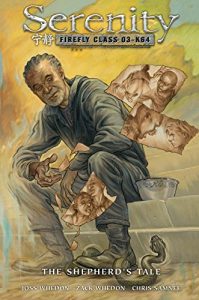
Serenity: The Shepherd’s Tale

51OPFX5nmALA third[1] graphic novel in the Serenity universe has just recently been released, and I love me my Firefly more than enough to snap it up and into the rotation right quickly. If you are familiar with the universe, the title alone will be all the spoiling you could hope for, and if you are not, this would be a hard (but not insurmountable) place to start. Still, just in case, The Shepherd’s Tale chronicles the history of Shepherd Derrial Book, focusing especially on his life before taking up a berth as a passenger (and eventually as crew) of the Firefly-class transport ship Serenity, a history that up until now has been as shrouded in mystery as anything that happened in that story. There were, to me, a couple of pieces that don’t quite add up, but not enough to object to what was a very well-presented, long term character arc in the fewest number of pages possible. Then again, the nitpicking (and the small sense of letdown from which it stems) could be more about another in an almost certainly finite number of doors closing on one of my favorite stories.

[1] As has been my perhaps unfortunate wont, I read the first two as they were released in comic form. So, uh, oops, no review for you.

Lucifer: Morningstar

As has been the case for a while, I blame myself for my disappointment in the Lucifer series. The irony of that statement being, I still consider it completely fantastic. But at the same time, it has become more and more apparent to me that I’d have gotten more out of it from a straight readthrough than the piecemeal affair that has served me so well with most every other series I’m reading, graphic novel or otherwise. So, my disappointment is rooted in the fact that I’m positive I’m missing some subtleties, and noticing callbacks to other subtleties in earlier volumes that I had felt comfortable with then, but now wonder if I was missing things all along or have perhaps forgotten small, important details. (Not unlike Sandman, Lucifer is full of details that are both small and important.)

Be that as it may, the series’ penultimate volume, Morningstar, does about what you’d expect out of a long literary work: it provides the climax. And when your players are the Devil, the archangel Michael, the massed hordes of hell, and let’s not forget God himself, you are looking at the mother of all climaxes. It is fair to say that this book includes literal Armageddon, as the universe winds down and the biggest questions on everyone’s minds (readers and characters alike) are 1) will we all survive this, or it it really over? and 2) what about dear old Lucifer? Will he save us, die in the attempt, ignore us entirely, or snicker up his sleeve as we are burned in the metaphorical flames of the coming apocalypse?

As it has been for a while, the most interesting question to me is how all of these literary takes on the struggle between God and the Devil, fate and free will, order and chaos, they are always based in Judaism without Christianity. I’m not sure exactly what about the revelation interests me, but it is heavily on my mind whenever I’m waist-deep in this kind of story. My current theory, which probably changes once per new such book I read, is that the author fears (rightly or wrongly) that books with Jesus in them wouldn’t sell as well, because while we as a mass of Western Civilization consumers have no problem with Lucifer being ascendant over God at some point in the story[1], there’s something about Jesus that would feel more inviolable than when it is God, non-sensical though that is when the slightest shred of light is played upon it. Like, it’s some kind of collective gut reaction. …or it could just be that Jesus is simply less literary of a figure than the others, who after all have thousands of years more weight and additional stories behind them than he does. I really have no idea. It’s just something I think about, because he’s really the giant elephant conspicuous by his very absence from the room, when a new retelling of this story gets trotted out.

[1] Whether that is a long-term or short-term accomplishment is beside the point.

Angel: A Hole in the World

You know how I’ve been reading a lot of comics, and they are comics from the Marvel runs in the ’60s (and now ’70s) via computer files, on my computer? You may not know that I am additionally reading lots of comics of the physical variety, from the recent continuations of the Buffy the Vampire Slayer and Angel television series. This would not be a point of much relevance, except that my subscriptions[1] have been rather limited, which I have discovered lately after catching up on about a year’s worth of said comics and seeing all their advertisements for side stories that somehow did not appear on my doorstep.

The result of that failure is A Hole in the World, a short run chronicling a particularly heart-wrenching pair of episodes late in the series’ run in which an elder god named Illyria rises to prominence. And since I’ve seen the episodes in question, this was pretty much just a reminder of them rather than anything new. And what I was reminded of, primarily, is just how good that show really was. Pathos, humor, and consequences, all wrapped together in a delicious, plot-filled bow. Plus awesome snippets of dialogue, one of which I will quote despite that it probably won’t make much sense: “This goes all the way through to the other side. […] There’s a hole in the world. Feels like we ought to have known.”

[1] Because, and let’s be clear, if I had to go into a comic book store on a weekly or monthly basis for this to occur, there is a zero percent chance that I’d have been reading these. Though I suppose I could have gotten them in graphic novel collections, as this particular review demonstrates.

Ultimate Avengers: Crime and Punishment

I’m well over two-thirds of the way through the next book, mostly because I can’t be bothered to stop reading it long enough to actually review Crime and Punishment, the latest release in Marvel’s Ultimate Comics line. Although this certainly reflects far more on the book I have in front of me, I’m not able to claim, as I would like, that it has nothing to do with this one. Basically, it was not dissimilar to the previous Avengers book, but with fewer things I found awesome and more things I found subtly off. Which is to say, still more extraneous characters (apparently just for the sake of being new) and a focus that has shifted completely from the Ultimates in favor of recently-demoted Nick Fury’s blacker-than-black ops governmental hit squad. It’s not that I think a world full of genetically enhanced super-villains doesn’t need a secret government hit squad so much as that I think that’s a little more realism than I want from my superheroes comics. And then mix that in with the appearance of the Ultimate Ghost Rider, and I have a whole host of new complaints that are, admittedly, more fairly entrenched in my readthrough of the original Marvel line (where I have now gotten to October of 1973), and these complaints are purely personal taste, so take them as you will. But dammit, superheroes and the supernatural just don’t mix, five years of the CW’s Thursday (now Friday) night line-up notwithstanding.

Seriously, I just read a storyline where Spider-Man had to fight against a space werewolf. I like Spider-Man, you know, kind of a lot. And I like space werewolves! I just don’t really like them together. It’s like lemon pepper in spaghetti sauce: you’ll regret it. So now, when I’m watching these Avengers guys in combat against a skeletal biker sent by the devil to kill powerful people, it reminds me that it took about ten years for regular Marvel to start pulling this crap too, and I get a little bit despair-filled. Still, it is what it is, and it’s not like I intend to stop anytime soon. Oh, also, if you like the Punisher, he’s still kicking around and gets most of the best parts of this particular story. So that’s alright.

Dr. Horrible and Other Horrible Stories

Remember that time when you watched Dr. Horrible’s Sing-Along Blog, and it was funny and poignant even though Felicia Day’s character ended up being wasted? And then nothing else ever happened, since it was a writer’s strike project for fun that didn’t really go anywhere, despite solid DVD sales? And you wished the story could continue? Well, albeit in prequel format, that very thing has occurred! Although perhaps a little pricey for the speed of the read, it was consistently interesting and funny both, and I hope to see more of the same sooner rather than later. The best of a good lot followed the Evil League of Evil’s rampage through the city, while the superheroes were all off on a forest retreat, getting back to nature or something.

If none of the premises in the previous paragraph are valid, I have the show on DVD and will happily watch it with you at any time. You’ll be glad you did!

Ex Machina: Ring out the Old

So it turns out I was wrong about which was the penultimate volume of the Ex Machina series. But, since the series is now over in monthly publication form, I can definitively state that Ring out the Old is next-to-last. Superficially, it has the same structure as all the books: Mayor Hundred addresses a political issue (environmentalism!) while at the same time a piece of the puzzle of his past and the mysterious powers he’s been granted is revealed. The big difference is that Vaughan finally noticed his story was nearly over and picked up the pace on the latter portion. I can’t help but wonder whether the pacing would look right if I read the series all as a piece, but at the same time, the series has been released piecemeal (in two different formats) over the past few years, so there’s only so much credit I could give to that possibility even if it were factual. It’s not that it was a bad story, but since I’ve spent all this time wondering what was going on only to see it all finally revealed in a chunk at the end, mainly I’ll be glad it’s over. I guess I had a journey fail, here.

Oh, but the initial story in the book before all that I just mentioned, about Hundred’s biographers? That was just shameless self-indulgence.

Marvel Zombies 2

The thing about the Marvel Zombies series, or at least about these first two books’ worth that I’ve read, is that they’re not all that good objectively. Despite the fact that they have interacted with one of the two mainstream Marvel continuities and are therefore entirely valid storylines, the main purpose behind them is still to be a little bit of a laugh. There are serious moments in Marvel Zombies 2, don’t get me wrong. Early on, when Peter Parker and Luke Cage are talking about why Pete still makes jokes, after 40 years in which they have devoured an entire galaxy’s worth of sentient life, he replies that if he doesn’t, all he’ll be able to think about are the decades of horrible atrocities he has just committed. Sure, they don’t really pick that up and run with it, but it’s heavy stuff for nominal superheroes to deal with.

But my point is that, after all is said and done, it’s still a lightly comedic look at a Marvel world where things went terribly wrong and now everyone is dead and our heroes still need to eat, and whatever will they do? You can be sure it will be violent, gory, and a little bit hilarious. And that there will be four more sequels, for some reason? If I find them used, I’ll check them out, but I just don’t have the necessary hunger for the subject matter that would require me to make them appear on my doorstep in a few days.

The Walking Dead: Life Among Them

Unexpected event: reading two books in a row by Robert Kirkman. And both with zombies, at that, despite the fact that he apparently writes lots of non-zombie scripts as well? (I have some small evidence of this, at least.) So the main difference is that I started off kind of angry about this book; the first few moments contained a bait-and-switch that made me pretty confident the series will in fact never end and not-at-all confident about my willingness to be dragged along for the next 72 issues. But then, over the course of the rest of the book, Kirkman reminded me why I’m still on this ride in the first place, which is that he really is good at the psychology of the zombie apocalypse, not to mention good at tension.

Life Among Them raises a new question that has not been asked before in the series: is it possible to go back to the old life? And although watching various familiar characters trying to adapt to the hope and possible fact of new safety, among people who claim to have held it for some time, is interesting enough on its own merits, I was most taken with my own reactions so similar to the characters. Constantly looking for something out of place, latching onto to anything strange, and unwilling to let my own guard down. If that’s how I feel about it, it must be only the very tip of how tense they feel. And by the end of the book, other new questions are being raised, questions that leave me squirming uncomfortably and yet still completely sold on at least one more volume, just to see where he goes next. Considering I started off angry, that’s a pretty neat trick.