Cerulean Sins

I have now developed a formula for writing an Anita Blake, Vampire Hunter novel. First, come up with a supernatural crime. Next, come up with a supernatural political conflict. These may be but are not required to be intertwined. Next, write an opening chapter in which something related to Anita’s job as a zombie animator occurs. Be sure to include enough detail to seem interesting at the time, but not enough that it will be possible to remember what happened 400 pages later, because you’re certainly not going to reference the scene again for at least that long, and you want the sudden reintroduction of that dangling plothook to come as a total surprise when you get around to it. Okay, now that that’s out of the way, time to introduce the crime or politics in whatever order you prefer. As this is a latter-day Anita Blake story, you’ll also want to use these first hundred or so pages to include sexual activity; it may be angsty, but need not be as long as some sex somewhere within the story is. Now, in alternating intensity, the politics will overwhelm the crime and then the crime will overwhelm the politics, pushing Anita closer and closer to her mental, emotional, and often physical limits so that she’s tightly enough wound to snap in a satisfying way by the climax (heh) of the story. Also, be sure to reference how little sleep she is getting a few times. Bonus points if she takes comfort from her stuffed penguin. (Not like that! What’s wrong with you?!)

This is going pretty well. Be sure to have a couple of more sex scenes in this section. After all, it’s a mystical compulsion and now it’s possible to keep the fans from thinking she’s slutty, even if Anita does. (In fact, having her feel that way makes her all the more endearing; after all, it’s not her fault, right?) Time to wrap things up with a display of power and / or ingenuity from our heroine as well as a dramatic reveal that the information in the first chapter (remember that?) was intricately tied up with the supernatural crimes (and maybe with the political part as well, if you’re feeling especially bold). Close with a short taking-stock chapter in which Anita will reflect on how pretty much every major character in the book is miserable, but she hopes that they will improve with time. The end!

You would think, after the excrementality of Narcissus in Chains, that I would not have started another one of these so soon. (Or at all, you say? Ha. I have no choice in these matters. No choice!) And I probably would not have, but when I have just finished a book and am about to be on a plane, I find that I choose ease of use above other deciding factors. Thusly, Cerulean Sins. Which, thankfully, was far better than its predecessor. Sure, there are verbal tics that annoy me, but I’ve resigned myself to that. Sure, Anita keeps ratcheting up the bad-ass factor, but it’s that kind of series, so, fine, whatever. The important parts are that the sex stuff has ebbed back down to levels that are not actually reasonable but feel like they are by comparison and that the plot elements were paced appropriately and were interwoven well. Also, apparently our author is taking a longer view of the series now, because that mysterious dropped first chapter element stayed mostly dropped by the end of the book. Not in a way that indicates bad writing, even, just a lot moreso than I would have expected or which has ever occurred previously in the series.
Hard Candy

mv5bmtc0mzgznti3n15bml5banbnxkftztcwndk3mdizmq-_v1_sy1000_sx675_al_Ah, Netflix. How I have forsaken thee! Well, mostly how I have watched TV on thee instead of movies, but definitely there was forsaking that occurred as well. It’s cool, though, we made up. Which, come to think of it, is probably not the best metaphor with which to open this review. So forget the Netflix stuff entirely except if you care about where I got the movie from, and pretend like I started with the next paragraph instead.
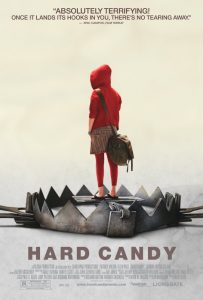
So anyway, I watched a movie last night. Except, that’s not where it started. Around this time last year (except imdb tells me it was more like two years ago), I saw a preview for a movie. I’m not convinced it ever got wide theatrical release, and I am quite sure I never found a place it was showing. If I remembered where I saw the preview, that might help, I guess. But I only remember the preview itself and my reaction to it, instead. Basically, it was a series of scenes implying a cat-and-mouse game between an adult photographer and a teenaged girl, but with the added spice that it was difficult to say who was the cat and who the mouse. Which, of course, made it ironically clear that the sexual predator guy was going to end up the mouse. But this is a good thing, because I think it would have been impossible to want to watch it, without that assurance. Instead, I was filled with intriguement. So, I waited and watched and eventually slipped it into my Netflix queue, the payoff of which occurred last night.

The movie went largely as predicted, which was not any kind of problem at all. Of course the ending stayed shrouded in mystery, but knowing all the stuff up to then wasn’t the point. Because the acting was really good and the situation was compellingly disturbing from the first moment until nearly the last. I know it’s not a particularly controversial position to take here, but I really had no idea just how visceral my negative reaction to the predator guy was going to be. Going in, I had the thought that maybe I was going to end up feeling sorry for him being trapped in Hayley’s web (Hayley being the Hard Candy in question), but that never happened. Sure, some of her actions were horrific or at least uncomfortable, but not once did I feel like his targetting was unfair.[1] Which (I’ll assume) says something else positive about the acting quality.

It’s hard to say I liked it, because it was so unpleasant to behold. But it was really very good, and it’s easy to say I was impressed by it. I don’t think I’d watch it again if I could help it, though. Those movies that really root around in the darkness of the human psyche (8MM and Schindler’s List spring to mind) tend to provide everything on the first viewing, as starkly as possible, as if to say, “See this? Don’t do this! Ever!”

(Footnote contains spoilers, sort of.)

Continue reading

The Hills Have Eyes II

Horror movie sequels are never necessary. You have to understand that before anything else. They are never, ever based on anything other than sheer whim. (Well, maybe except for Halloween II, which is why it’s one of the best sequels out there.) So when a review tries to explain that some sequel is unnecessary, this simply shows that they have no understanding of the genre and should be ignored. Did yet another remake of a horror movie from the 70s need a sequel, then? Of course not. Neither did the original movie need a sequel. Most likely, this one was better than that one, so that’s already kind of good news, right?

Anyway, The Hills Have Eyes II is just such a movie. Apparently, the military came in after the events of the first movie to clean out the eponymous hills, under the theories that we wanted some privacy over there and anyway there’s a carrot shortage being linked to the region. Except, of course, that eyes in hills are far cleverer than military dudes and ladies, so the first wave of scientists and techs and army guys get wiped out, just in time for a misfit band of National Guardspeople to arrive and initially miss all the classic signs of an old-fashioned Charlie-Foxtrot. About three deaths later, we are able to start identifying our cardboard characters. There’s Hero-Guy, bravely accompanied by Hero-Girl. There’s Slightly Insane Guy (Hispanic Edition), who can be counted upon to keep doing the wrong thing over and over again. There’s Black Guy, who is awesome in every way and by rights should share the Hero Guy title, except he’s black and in a horror movie, and will instead die dramatically and/or nobly. And because it’s a mutant movie, there’s Victim Chick. Normally she would just be a faceless casualty, but in this kind of movie, she has to serve double duty by being actively and unpleasantly victimized by the mutant guys, who are not able to get girls through match.com like normal people.

Still, it was a pretty good sequel. For one thing, no stupid message getting in the way of the carnage. Also, the climactic scene included badassery rarely seen from a horror movie chick who is not played by Sigourney Weaver. Mostly there’s nothing to recommend it, though. I mean, it was a grotesque horror movie and I liked it, but unless you thought there was a chance you’d like it when you first heard it existed, you probably will not. (In the unlikely event that you did think there was a chance, well, nothing I can see to talk you out of it. It was pretty good, like I said.)

Hot Fuzz

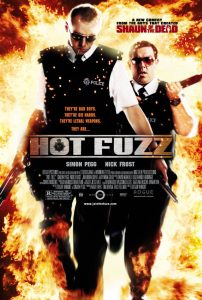
mv5bmjewmzy2ntgxm15bml5banbnxkftztcwmtg3mdm0mq-_v1_sy999_cr00672999_al_Here’s what I liked about Shaun of the Dead. It was made by people who completely understood the zombie movie genre. They were talented writers, which was also a necessary component, but what made it great was the deep knowledge and respect behind the talent. So when the time came for them to make a semi-parodic action movie, it was unsurprising that I’d want to see it too. A little surprising how long I waited, but these things happen.

Hot Fuzz is exactly what I expected it to be, but then it’s even more than that, too. It’s a parody of action movies, yes. But the characters within the movie, one and all, act and react as though it’s a serious movie with rational underpinnings. So that’s already a good point by itself; most parody movies are simply silly. This is an okay thing, but being serious and still very funny at the same time? The achievement is impressiver, is what I’m trying to say here. Award-winning supercop Shaun (he probably had a different name in Hot Fuzz?) is forcibly transferred to a tiny country village with almost no crime because the London police force just looks bad, next to him. The problem is, nowhere this perfect really exists; and Shaun being the cop he is, sure enough he and his new partner start to uncover the horrible secret behind the postcard perfection. And once uncovered, any good cop is simply obligated to enforce the law, no matter how much violence ensues.

And that, right there, is the secret of the film’s success. Every action movie since Die Hard has had one primary goal in mind. Push the limits. Give audiences more and louder: explosions, car chases, gun fights, blood. More! Cram in as much as possible! But make it believable. There are limits past which people will roll their eyes and make fun. Except, this being a parody, there are no such limits. So it was possible to go over the top, and then laugh derisively and go over the top of that, because it’s a parody and the people will forgive it. This is the movie Jerry Bruckheimer wishes he were allowed to make. Just wait and see if he doesn’t take it as the green light anyhow, and next summer we see the new actioniest movie of all time. I called it here.

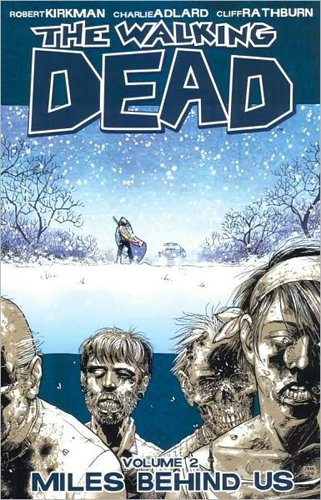
The Walking Dead: Miles Behind Us

51jw7ILYCsLI was right. It was totally worth going back and reading this again.

As Miles Behind Us opens, police officer and post-apocalyptic hero Rick Grimes is forced to lead his companions out of their camp on the outskirts of Atlanta and onto the open road; tragedy has recently proven that they are not safe without defensible walls. What follows is several vignettes of their search for some place of safety in an increasingly hostile world. Because, inevitably, the zombies are rapidly being supplanted as the most dangerous thing on the horizon. After all, humanity has yet to die out.

Thematically, the story is focused on reaction. Every decision the survivors make is a reactive one, and with at most one exception each of these decisions ends badly. On the personal level, every character is finally reacting to the new circumstances. Some people are becoming very hard, very fast. Some are getting lost in despair. Some are grasping blindly for love. Some are waist-deep in denial, without even a clue that they’ll eventually drown. And some, even in a world so changed as to be unrecognizable by any reasonable standard, still have secrets too terrible to be released.

On the whole, good book. The art was less good than I remembered (due apparently to a change in artist, so fair enough); the lines are not as clean anymore, which kind of works from a world-gone-bad perspective, but I still kind of prefer to have an easy time telling people apart and following the action. The people, especially, were my biggest problem. Only upon the reread did I really know who everyone was for sure. Mostly though, regardless of the art and despite the goodness otherwise, it was obviously a transition book. We know that some of these people will live to see a brighter day (or at least, we assume we do), but this wasn’t about watching them struggle to succeed so much as about watching all of the terrible things that will happen until they get back on the right track. Necessary, but ultimately (I predict) forgettable in the grand arc of the tale.

Pirates of the Caribbean: At World’s End

A thing that annoys me is when some movie is advertising itself as the big movie you should see this summer because it’s original and otherwise you’d have no choice but to watch a sequel in this, the “summer of sequels”. Well, guess what, you indie-pretension-wielding jerk? They’re all the summer of sequels. For good or ill, that’s the way it is now, because that’s what people want to see. And what makes it even worse is that you right there on your high and mighty holier-than-thou unique pony? You’ll have a sequel in two years, tops, if there’s money to be had by making one. So shut your piehole and either be a good movie or don’t, but don’t sound like a prat while you’re doing it. You’re not morally superior to any movie out there, and don’t forget it.
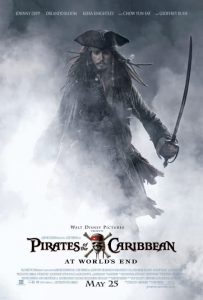
Speaking of uncharted seas full of deceit and treachery where it’s impossible to know who you can trust until you’re long since committed and even when you can they’re still more interested in your money than in anything about you as a person, I saw the third Pirates movie, At World’s End. And it was good. Obviously, there were swordfights and naval battles and combinations of the two (and in settings that were clearly designed to say “Top this, if you dare!”) But the true greatness of it was the diverse plots and betrayals. Every character worth mentioning had an agenda, and every agenda was partially compatible and partially incompatible with every other one, such that any two characters together would have common cause enough to double-cross (or triple-cross) any given third. It’s not that it wasn’t confusing, it’s that it was like a roller coaster going in seventeen directions at once. It’s far more interesting to just relax and see what happens next than to figure out what’s around any particular corner ahead of time.

My only complaint is that Johnny Depp seemed like he didn’t have much to do. The movie was obviously not about Jack Sparrow anymore, and that character needs to have center stage, or else he starts to look as ridiculous as he would if you met him walking down the street in your neighborhood. Luckily, I don’t see that being an issue again if there’s one more sequel. (There might be one more sequel. There probably won’t be more additional ones than that.)

Not a review of The Walking Dead: Miles Behind Us

One thing that I do before I review a sequel to, well, much of anything, is go back and read my review (or reviews) of the previous entries in that series. Having just done so prior to my review of the second Walking Dead graphic novel, I have come to the unprecedented realization that I need to read it again before I say anything substantive. Now admittedly I went to an awesome days-long party since finishing it wherein I drank like a… well, I drank a lot. But I’m pretty sure I remember what happened in the book. I just wasn’t reading it in the correct frame of mind, and I want to look at it through different eyes before I replay my thoughts.

Currently, they are: wholly entertaining, but nothing special. And that just doesn’t fit with my review of the first book. So now I’ll get a second opinion.

Fantasy Gone Wrong

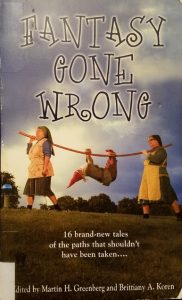
Yay, Christmas presents! I received a short story collection whose common theme is the reversal of expectations in fantasy settings. Just to toss out an example, in one case a unicorn bonds itself to a prostitute, with substantial negative impact to her livelihood. Some of the stories work a lot better than others, though only a couple ended up being pretty bad. I’m not going to go into it story by story, and I’ve pretty much covered the book as a whole with that first sentence, so this is destined to be a short review. I will point out my favorites, though: The Hero of Killorglin, about fairies and their companion animals; The Murder of Mr. Wolf, fairy tale noir; Crumbs, about the generation succeeding Hansel and Gretel, and Goblin Lullaby, with an alternate perspective on PC adventuring. And for balance, don’t read Finder’s Keepers, as it was both rambling and (by the end) trite.

Black Hole

I keep wanting to say that I’ve found evidence that the modern graphic novel is not for me, but there’s clear evidence that it is, in the right format. Sci-fi or horror or allegorical fantasy, and I’m basically in there. Plus, of course, the superhero genre, which, y’know: tradition! But at the same time, I’ve read a few lately that seem to be just telling a regular modern fiction story (except with pictures) and I keep failing to wrap my head around them. Unlike Jimmy Corrigan, I can at least say that Black Hole wasn’t a complete slog. But at the same time, it feels like there are strands and aspects I failed to grasp despite my best efforts.

It’s the ’70s, and it’a high school. So everyone is focused on being popular or not, taking drugs, and having sex. The problem being, there’s this STD called simply “the Bug”. It has a 100% transmission rate, and if you get it your body changes somehow. It might be concealable, or it might be completely deforming, or maybe somewhere in between. And we follow the lives of a girl and a guy over the course of several months or a year as they interact with a) the diseased, b) the drugs and alcohol to prevent having to deal with any of it, and c) eventually, perhaps with the disease itself. And from time to time, d) with each other.

As a straight-up story, it’s pretty good. Bleak as all get out, but effectively told. High school interactions are completely magnified by the Bug issue, with outcasts being relegated to a tent city in the woods where nobody has to see them, rather than just one corner of the lunch room. There’s a bit of horror, both the stark version where one mistake can ruin your life (so, okay, that’s magnified high school stuff too, maybe, to an extent) and the more literary version where murder is unleashed into the diseased populace. But it’s the metaphorical layer I can’t get my head around. AIDS fits, albeit imperfectly. The fact that the story was begun in the ’80s despite a 2005 publication date on the collection makes it feel more timely, which helps. But why are some people able to go unnoticed while others are branded? Why isn’t it deadly in itself? Why does nobody outside of the high school population seem to be infected? It’s not about pregnancy, since guys are affected as easily as girls. It’s not about the act of having sex, because clean people have no problems at all, as long as they stay away from the diseased. Like I said, I just can’t nail it down. And it’s all the odder because outside of the disease part, a nearly identical story could have been told with the same plot. So it’s mostly there (I believe) solely to be a metaphor for something. And here I am, with just no idea what’s up. Lame!

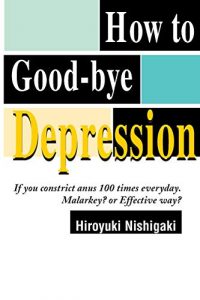
How to Good-Bye Depression: If You Constrict Anus 100 Times Everyday. Malarkey? or Effective Way?

Thing number one, which is important: I am not making this book up.

See, there’s this self-help book, in which the Japanese author recommends exercise, positive thinking, getting in touch with your body’s energy, diet changes and fasting to cure depression, cancer, family and personal problems of all stripes, to achieve success in life, to look and feel younger, and to be able to instantly apprehend all that can be known about objects and people using the power of your brain. Which, okay, is not that different from many other self-help books and/or new age treatises. The difference between those books and this one is they they were not written in Japanese and then seemingly passed through Babelfish[1] a couple of times. Nor do the first quarter of these other books consist of a mishmash of disordered Usenet postings from the turn of the millennium, before it sank beneath the waves of the internet never to be seen again.

Most importantly though, these other books do not recommend that you “constrict anus 100 times every day and then dent navel 100 times every day after constricting anus 100 times every day, following the lifestyle of long-lived British.” They do not explain that after fasting for three weeks, you will rid yourself of “a big bucketful of old, black excrement” which will weigh 4-5 kilograms. They do not exhort you to concentrate your third attention and send out your immaterial fiber at objects patiently for an hour a day for 3-5 years or possibly 10. They do not spontaneously speculate about the ways in which Al Gore and George W. Bush probably follow most of this advice and are able to * * twice or three times in succession without pulling out, as a result. (Okay, I may have taken ordering liberties with that last part; but it’s not an unfair assessment.)

Here’s my point. I don’t know if constricting anus 100 times every day is an effective way to good-bye depression or not. But reading this book? It really seems to do the trick. Sure, there’s a slow part in the middle, but mostly, more laugh density than most intentionally comedic books I read. Also, assuming you hadn’t heard of this book before, be honest with yourself. You’ve constricted your anus at least once while reading this, haven’t you? (Be honest with yourself. Not with me. I don’t want to know details, here. Come on, people! Keep me out of your anus!)

[1] Historical note from 2020: Babelfish no longer exists. I’d recommend translate.google.com as a good alternative.