Captivity

Look, okay, I know. Nevertheless, I took in a movie over the weekend, and it was before I’d finished reading. So you’ll simply have to wait a little bit longer. Ha ha. ‘Cause you know what’s fun, is pretending that every single person on the internet hasn’t already beat me to this review, much more so in that it’ll be another while longer before I actually do it. But enough of this obsession, because, movie!

Way way back during Horrorfest (which is repeating this year!), I saw a preview for Captivity, during which Jack Bauer’s daughter gets kidnapped for the sin of loosely portraying Paris Hilton. During the course of the preview, it was trivial to figure out nearly the entire plot of the film, including the twist. I was duly amused, but pretty much moved on. In the meanwhile, there was a billboard campaign in Los Angeles that spawned a pretty strong response from Delirium fan-favorite Joss Whedon.

The complaint, by and large, was about the misogyny of the movie. Because she gets kidnapped, held against her will, and pretty gruesomely tortured, all while being presented with interview clips of her fashion model life revealing her to be shallow and a little bit mean and, by implication, deserving of her treatment. And all of these things happen, it’s true. So I can see why he said so. But… well, spoilers now, on the minimalistic chance that anyone other than me will actually watch the movie. Continue reading

World’s End

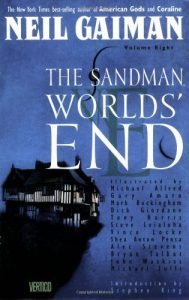
1563891719-01-_sx450_sy635_sclzzzzzzz_It was Harry Potter weekend, and I sat at work waiting and waiting and waiting for notification that my package had arrived, so I could leave work and grab it and have some reading time back at work with which to while away the long weekend hours. The fly in my chardonnay was that UPS handed off their delivery duties to the USPS, at which point delivery info didn’t appear on the tracking page until this morning. Although I now know it arrived at 2:52, at the time I had nothing but shattered hopes. The upshot of all of which is that I started reading the eighth Sandman volume, World’s End. And then got stalled by actually having to work, and was unable to finish it before I got home and took delivery of my book.

Here’s the thing, though. It’s Sandman, right? And even though it’s one of the alternating books that explores mythos and shards of character personality instead of the main plotline, it’s nevertheless right at the climax of the series. It’s possible I could have set down an earlier volume unfinished and come back to it, and I’m sure I could have set down any other re-read and probably a lot of new reads to start my precious Harry Potter conclusion. But not this.

The story is simple, is in fact nearing a millennium in age. Travelers forced together by circumstance tell tales to each other to pass the time on the road to Canterb-, er, no. To pass the time in the inn called World’s End, where they have each taken shelter from an unseasonable storm. And if you suspect that each of these stories will reference someone that has been important to the overall Sandman cycle thusfar, well, try not to be too surprised by your perspicacity in this instance.

Knowing what I know about how the overall story ends, I was at first struck by the irony of the storm as catalyst. Because, to me, this was the calm before the real storm that has been building for, well, the entire series. But it’s been obviously building for the last four volumes. And yet, I reached the end and surprised myself with the realization that the storm within the story was generated by the outcome of the metaphorical storm of plot I’d been envisioning. The next time I read these, I’m going to be looking for the iconic moments from each of them. Just as the dinner under the stars at quest’s end was the moment to watch for in the previous volume, the procession at the climax of World’s End nearly literally took my breath away. I took about 20 minutes to recollect myself before finally cracking Harry Potter, at least. And that’s on a reread.

V for Vendetta

I really liked that movie, V for Vendetta. It had Hugo Weaving and moving stories of humanity and some explosions and an important political allegory. Therefore, why not read the graphic novel upon which it is based? I’ve been doing a lot of that anyway, and it is one of the classics of the modern age, and anyway, they can’t all be serialized. Plus, adding to my knowledge of the overall field is cool, because then I get to giggle over things like the reference to Preacher in the last Y I read a few weeks ago.

To those various ends, I did read it. Which, maybe pretty obvious already, I guess. Anyhow, it was good. In the not-so-distant future, England has survived a holocaust that has left most of the rest of the world reeling. And to survive the aftermath and ensure that England prevails, a totalitarian regime has emerged. Was it inevitable, or even necessary? That’s a matter of argument, but in any event some of the actions it took in those early days clearly were unnecessary, and there’s one man who is ready for the regime to crumble and restore the power to where it belongs, in the hands of the governed. He has no name, but he has got a codename, V, and a Guy Fawkes mask, and some pretty sharp knives. And an impressive knowledge of explosives and the inner workings of the evil empire. And he’s got a pupil, Evey Hammond. Mostly, though, he’s got a vendetta. Because some of those unnecessary actions were performed on him.

There were differences of course. Mostly in the order of the story, but also via a few characters changed, added, or left out. For the most part, I ended up preferring the movie, which is probably a matter of blasphemy to some people somewhere. But the pacing was better, the message was just a little bit less scattered, and there were a couple of aspects that wouldn’t have affected me as deeply with still images. I did miss the written-out character of the party bigwig’s wife who loses all of her social support with the death of her husband and has to find a way to live in the world he helped to create. On the other hand, the Leader was mostly unimpressive in the book, which I didn’t like at all. It’s hard for me to credit that people will give up all of their freedom in the name of fear alone. Charisma has to play a part too, in my largely uninformed reading of history.

Lastly, there’s a message in the book that may have been in the movie as well, but I never saw it if so: that governments are inherently negative, and people should live in order without any guidance from leaders at all. Well, okay, I take that back. Should is a pretty strong word, and I think I agree with that as written. But unlike V, I don’t believe that people will do so, and that some amount of governance is therefore imperative. But I’m with him on how that line should be drawn much closer to the individual than it currently is, and especially than it has been at certain points in our history and probably will be again at certain points in our future.

Saints Row

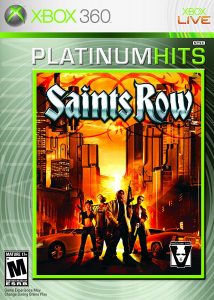
I finished another video game, yay! And got something like 650 gamer points in the bargain, also yay! Now I should maybe get around to finding out why my wireless adapter no longer works so I can resume being online. Or I suppose I could always move the cable modem into the TV room and go ethernet, now that my desktop has been broken for six months with no signs of me caring enough to fix it. It’s possible none of that is really relevant, except insofar as I’m pretty much console or nothing these days. Anyway, the coolness here is that I played Saints Row to the end of the plot, and did almost every single part of the non-plot as well.

As far as the game itself, it’s pretty easy to explain. Big sandbox game where you can drive or run around and explore the world and listen to all the people talking and radio stations playing and interact with things in various surprising and unsurprising ways. Plus an attached plot about a gang war that your character is involved in, in which the leaders of your gang keep placing more and more trust in you as you prove yourself cool by performing their missions, wearing their colors, and otherwise interacting with the city in such a way that your face becomes more and more known by the general populace. And a pretty deep cast of actors whose voices you might recognize. Which is to say, it’s nearly exactly the same as Grand Theft Auto: San Andreas, at least on the surface. (Now, there’s a game I never finished. Alas.)

Below the surface, there are a lot of changes that make this one easier to swallow. No impossible to maneuver airplane and helicopter controls. (Well, mostly the airplanes were the hard bit.) Instead of having to wander around hoping to stumble upon the side missions, they are mostly in plain sight on the map, waiting for you to take them on at your leisure. But there are still a few collection items to discover as well, for people who like looking under every rock. And there are definitely other minor tweaks and differences around that are harder to explain in a blurb, like the cell phone. The long and short of it is that Saints Row felt like a polished, optimized version of the GTA games. As long as GTA 4 due out in a couple of months has taken note of even a portion of these refinements while managing to hold onto the spare, evocative storytelling of GTA 3 (not so much Vice City or San Andreas, though they had their own charms), it is going to be the game to beat this year.

Mind you, the storyline for Saints Row here was pretty cool. I did, after all, complete 95% of everything available in the game.

Harry Potter and the Order of the Phoenix

You may or may not be aware that the final Harry Potter book is going to be published at any moment now, and that spoilers are nearly as prevalent as theories, recaps, final reworkings of relationship fanfics, and all-around general buzz. Potterdämmerung, they’re calling it. The fact that you are reading this right now puts you, on average, much more firmly in the “may” column, of course. I anticipate that the faint twinges that are accompanying me putting my thoughts together on the Order of the Phoenix movie are spare precursors beside what it’ll be like to have to review the actual new book.

And that’s before even taking into account that I really liked the movie. Sure, I had lowered expectations after the many shortcomings of the previous film. And sure, this book was even longer than the last one to try to shoehorn into the same amount of space. But either the adapter was much better or the book lent itself much better to compression, because this one worked as well as any of the previous volumes, possibly exceeding the high watermark of Prisoner of Azkaban. Luna Lovegood was note perfect, and Dolores Umbridge was nearly as unpleasant as I had imagined her. And the plot, though streamlined, hit upon all of the important themes and events. Harry suffered all of his turbulent anger, angst, and teenage lust and then emerged from it into his first shaky steps toward leadership. The wizarding community at large dealt with its fear and denial and backlash at the messengers over Voldemort’s return. Voldemort started gathering his forces. And all in full technicolor glory!

Okay, it’s next to impossible to both describe what I liked about the movie and avoid spoilers, apparently. But it really did work. I know that stuff was left out (and I acknowledge that I haven’t read the book since its release), but there was nothing much that really stuck out as a tragedy to lose. Except maybe they could have spent an extra ten minutes or so in the climactic battle allowing the kids to show their stuff a little more and to show off the Department of Mysteries in more of its glory. And possibly either not included Kreacher the house elf, or else given him more to do. But I have a suspicion he was present so that he can do something more relevant in the next movie that I’ve currently forgotten about, which would make that part basically okay, in the grand scheme of things.

Transformers

When I saw the first teaser trailers for Transformers, I was excited. Then, some time passed, and I saw the real trailer for the movie a few times, and suddenly things changed. Instead of being excited, I was concerned. Sure, it had big robots and a couple of high school kids observing said robots. More, it had explosions. But it seemed to lack any kind of soul. So I adjusted my expectations down a ways and decided it would all be okay. Except, the movie comes out and suddenly everyone is singing its praises all over again. Which kind of defeats the purpose of lowered expectations.

However, there is good news. It is, in fact, a really cool movie that I will be seeing at least one more time in the theater, and even more times than that would not surprise me. It has giant robots and explosions, sure, which was already enough to get me there the first time. It also has a good cartoonish blend of drama and comedy that hearkens back to the original show from lo these twenty years gone. Which, okay. If that sounds potentially dumb, it’s because parts of the movie definitely are dumb. But they’re dumb in a good-humored, summer action movie kind of way, and I have no problem with that at all.

Because what it also has is movie magic. The first time that truck rolls up to Sam the human protagonist and starts gravely explaining about the plot token that they’ve come to keep from the Decepticons, and it was the voice of Peter Cullen right out of my childhood? The absurd hilarity of the first spoken-by-robot line of the film? When Bumblebee meets Sam and pulls out a few stops to get chosen as his car? That stuff might not work for people who didn’t grow up on the show as I did, but the box office numbers seem to indicate there’s some pretty solid coolness here outside of the nostalgia set.

For people who like plot summaries: The giant robots split into two factions and had a homeworld-destroying war over the Allspark, a cube that provides life to machines. After the world destruction, it was lost in space. The war has continued throughout the galaxy as the factions search for it; naturally, it lands on earth. As do the Autobots and Decepticons, now that they have a good idea of where it is. Then, mirth, mayhem, and plot ensue!

And, yeah, that looks summer movie dumb, too. I’m not doing a very good job of explaining the difference, but there definitely is one to my eye. Maybe it’s nostalgia after all? Screw it, though. The important part is, it’s awesome. Did I mention the giant fighting robots and the explosions? I do know I forgot to mention that there’s an incredibly hot chick who furthermore likes to work on car engines, feeding into my Kaylee complex. Yay, that!

Y: The Last Man – One Small Step

The thing about nothing but graphic novels between now and next Saturday is that I’ll probably get through quite a few of them. Which means I’ll have a lot to do here. That’s not a bad thing, of course. Though sometimes I worry when I get all prolific like this that I’m just saying the same things over and over again. Probably not in this case, though, since the other stuff today was an action movie and a pretentiously dense allusion disguised as a book[1].

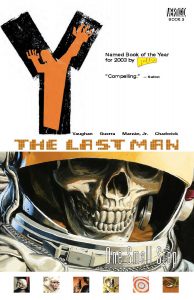
As for Yorick, his life goes on in the third volume of his epic tale of love and loss.[2] Being the most popular man on earth has drawbacks, though. Sure, you’re big with the ladies, but you get all that pesky negative attention too. So it is unsurprising that in One Small Step, rumor of surviving men in orbit around the earth brings a little bit of spring to his step. Nor is it surprising that his constant guardian, Agent 355, is less than pleased by the same sets of events. More men is a scientifically sound investment in the future, yes, but not at the expense of risking the one she has safely in hand to Russian spies or a platoon of Israeli soldiers. Yup, Yorick is pretty popular indeed.

Good story. Tied up a lot of loose ends. Maybe too many, because I have no idea where the story is going next. Sure, his sister is still somewhere out in the world waiting to gum up the works, and sure, they’re under the same basic set of plans from day one. Find out what happened and how Yorick and his monkey survived; find his girlfriend in Australia; save humanity from extinction. But the immediate plot is wide open now. Like I said, no more loose ends. At least for a little while. And the art has maintained quality. It’s simple, but very clear and fun to look at.

Plus, there was a nice two-issue story at the end, in very Sandmanesque style, about a troupe of traveling actors. Hardly any relevance to the main story arc, but it’s nice to get an idea of what the rest of the world is like, not just the world swirling around our hero. Because, after all, anywhere he goes? Things aren’t normal and everyday, pretty much by definition.

[1] That is not meant to denigrate, mind you.
[2] Okay, that was completely to amuse myself. And yet, it is technically a true description!

The Wizard

Gene Wolfe is an author whose work tends to exist right at the outer limit of what I can wrap my mind around. I swim through his novels, working to keep my head above water the whole time, and the nature of that effort leaves me with a limited perspective of the story’s surface from moment to moment. Not only that, but I’m aware of unplumbed depths of added meaning in a vague, unformed way; I guess I’m aware of it only to the extent that I can tell there’s a whole lot more happening that I’m not aware of. Possibly this all sounds unpleasant, and maybe it would be except for three things. The parts of the story I can grasp (a sizable amount of plot, bits and pieces of characterization, shadows of literary influences, and the faintest impressions of theme) have always been very entertaining; the prose is good enough to make mention of; and the parts of the story I can’t grasp exercise my reading brain. I’ll read the Book of the New Sun sometime again, and I’ll have benefited by that. Also, the Malazan series. (Which I’m sufficiently behind on now that I’ll probably need to start over. Oh, well.) Umberto Eco does this to me as well, but without quite as much enjoyability on the front end. I guess my point is that being challenged is cool.

However, it makes for difficult reviewing, because I don’t like to toss plot elements willy-nilly, and at the same time I have little else to reference right now. When I read The Knight last year, I indicated this same difficulty. Reading The Wizard was akin to leaving the public pool and taking a dip in the ocean. Which is ironic when you consider that water imagery was rife in the former volume. …and fire imagery as well. Whereas this one was much more about earth and air. So, hey, look at that! I figured something out right here in the middle of typing. Which would be cooler if I could attach some direct relevance to the revelation. But it definitely proves my point about the mind-exercise. Anyway, I’m going to see about minimizing the self-satisfaction and getting back to the review, now. I trust this will be taken kindly by all six of my readers.

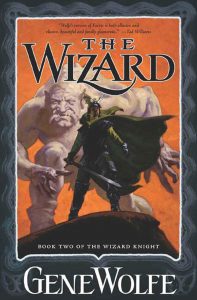
Sir Able’s continuing adventures in Mythgarthr and its surrounding realities have expanded from faeries, knights, and dragons to include giants, angels, unicorns, Arthuriana, and the Norse pantheon. As difficult to integrate into my understanding of the world as these were, the (at first glance) simple plot was harder still. The first half of the book is the story not of Able, but of his companion squires and knights. The emerging lesson of the section seems to be that we are not what people call us; we are what we are, whether people call us such or not. But people will tend to call us what we are. For example, Able is a knight because he determined to be so and lived his life that way, not because anyone dubbed him or acknowledged him. Despite that from his first appearance in the book he refuses to use any powers , Able is called a wizard now by all who spend time with him because his inner reality shines through. These examples together with a spoiler from later in the book make me pretty confident that this sometimes struggle and sometimes congruence between what is and what is perceived is another important theme of the story. But again, just because I can see it doesn’t really mean that I’ve yet been able to plumb its depths and understand the buried point to it. Which, amusingly, is kind of a mirror of the theme right there.

I said it at the beginning, and I’ll say it again. Hard books are cool. Which is not an excuse for the incomprehensible mess of the previous paragraph, but it is an explanation of sorts. (Seriously. I’ve edited a lot, and well, to get it to what you see now. The original would have made you weep with frustration.) So, yeah, they’re cool, but they’re also hard. Thus, by executive decree, it’s going to be all graphic novels from now until Harry Potter.
Live Free or Die Hard

MV5BNDQxMDE1OTg4NV5BMl5BanBnXkFtZTcwMTMzOTQzMw@@._V1__SX1537_SY747_Hard to believe, but true: once upon a time, the modern action blockbuster didn’t exist. Armageddon? Deep Impact? The Rock? Time was, those movies didn’t get made. Sure, Star Wars and Indiana Jones were contributing factors, but they were more about the summer blockbuster. As far as the action version, you have to go back to Christmas of 1988. There’s this wise-cracking cop in an office building full of terrorists, and stuff that blows up, and Beethoven’s Ninth playing. And sure, that’s yawn-worthy now, but the writing and the acting for Die Hard still stand up, despite decades of mostly pale imitators. (Also, it’s the first time I was aware of surround sound in theaters.) And then it had a couple of sequels. Which were fine and all, with the explosions and the wisecracking, but they never really stood out to me in the same way.

Now, however… here’s the best way I can explain Live Free or Die Hard. The people who wrote it and filmed it were people who also think Die Hard was the definitive action movie, and they wanted to make a sequel worthy of the name. Sure, the action is over the top. It’s supposed to be, it’s an action blockbuster. But it’s not over the top in such a way that you find yourself wondering how we’re supposed to believe anyone could ever do that stuff. (Like, say, Rambo sequels.) There’s definitely one sequence that is over the top; I rolled my eyes pretty hard. But John McClane is never superhuman. He’s tough, and he’s luckier than his fair share, but mostly he’s just taking his only option and running with it instead of giving up, and that guy? That guy is pretty much what heroes are.

Also, the plot is more of a sequel to the original than either of the other sequels. I know that the third one was specifically about a guy who wanted revenge for Alan Rickman’s untimely demise. Even still, the fourth one is a much better sequel, plot-wise as well as thematically. Now that everyone in the country who isn’t me has seen the Transformers more times than you can shake a pointed stick at, I say go see Die Hard 4. Unless you didn’t like the original for some reason? That would be weird, but you won’t like this one either, in that unlikely case. Otherwise, you should be golden.

And I’ll go contritely see the Transformers. Because at this point, I’m kind of an embarrassment over here.

Disturbia

MV5BMTMyNTIxOTQ3M15BMl5BanBnXkFtZTcwMjU2NzAzMw@@._V1__SX1217_SY911_So, Rear Window, right? One of those classic Hitchcock horror movies that scared people who lived in the black-and-white world, because it was entirely too plausible for their tastes, unlike such fare as Them! or It Came from Outer Space. Which, okay, possibly these people have a point, I guess. But also because the writing and direction were so wonderfully tense, about which the people definitely had a point.

Back in the spring, along came imitator Disturbia. Troubled teen Shia LaBeouf (soon to be famous for his role in Transformers, natch) is under house arrest. See, his dad died, right?, so he’s been having a bad year, and then his Spanish teacher, well, provoked him. Probably unintentionally, but we’ll never really know since his motivations are not explored. That’s okay, though. It’s a pretty minor plot point, except for the part where it sets up the rest of the film. Because now Shia has an ankle bracelet that keeps him confined to his property. This is a bummer, because his XBox account got canceled by his mom, a hot girl just moved in next door, neighborhood kids are tormenting him and then running away, and also because the guy in a house behind him seems to fit the information being provided in the media as a serial killer from Austin who, if it’s the same guy, has already kidnapped at least one person locally. All in all, it’s not the best summer to be trapped at home.

On the bright side, at least the girl came over to visit. But really, that just results in her (along with Shia’s mom and his best friend) getting entangled in the paranoia surrounding the neighbor. And that’s what makes the movie work. Whether he did or didn’t serial-kill all those girls is barely the point. It’s all that voyeuristic paranoia and how it affects people and what they decide to do about it. Because, up until the point where you take a sledgehammer to the interior walls and a shovel to the basement and back yard, he’s still Schrödinger’s serial killer, and it’s probably not cool to send people to tail him while other people break into his car and steal his garage door code. (Or, for that matter, take a sledgehammer/shovel to his property.) So, that’s good moralistic tension to drive a movie with. And then on top of that, I think it has a win over Rear Window, in that the hero of that movie was wheelchair-bound. Shia, on the other hand, is only bound by the law. In a very real sense, his imprisonment is by choice; he can cross that invisible line at any moment and take things into his own hands. But only if he’s willing to face the consequences of that action. That’s just a lot better piece of character tension than ‘if only I could get down these stairs; but I can’t!’

Simply by virtue of being a worthy successor to Rear Window in the tension-ratcheting department, it would be worth a Netflix (or, like me, dollar movie visit); what with the aspect that managed to top Hitchcock, watching this one at some point is pretty much mandatory. So, y’know. Tick-tock.