Exile

51cG8I-R2WLSo, yeah, Star Wars books. Whenever I go to Amazon to dig up my book link, I inevitably see a few reviews that other people have written on whatever the particular book is. And as far as Exile and the previous books in the Legacy of the Force go, the reviews seem one and all to lament that there’s not enough action in the series. And from a certain perspective that’s true. Lightsabers have been wielded aplenty, but the space battles have been rare at best, and if one is reading for the looming civil war between Corellia and her allies against the Galactic Alliance, I can see where that would be disappointing. Although you’d think that the fact that the stalemate has broken and the escalations have begun would be enough to satisfy people.

Anyhow, that’s not important. What is important is that I’m pretty sure these people have pretty solidly missed what the series is actually about, and this civil war isn’t it. What it is is a full-on Greek tragedy, pitting parents against children, brothers against sisters, and so on. It’s a very deliberate tale because you have to set up every aspect of the tragedy just so. The civil war? That’s just a pretext-slash-backdrop for the important events. Of course, now that I’ve defended the series for a paragraph or two, I have to admit that the plot dragged a fair bit more than in previous books. That is, big events occurred in the story; the civil war has reached its decision point past which peace is no longer an option, and the two principle characters have passed their own critical decision points as well. But the small events were a lot less epic-feeling than they have been in the previous books, and it’s hard not to be disappointed by that, no matter how pleased I am with the overall story progress.

Good Luck Chuck

This is how romantic comedies work, and feel free to insert different generic nouns in any particular spot, though by rights they should be used consistently. 1) Boy meets girl. 2) Boy loses girl. 3a) If the circumstances under which the boy lost the girl were at all plausible, boy wins girl back through a completely implausible sequence of actions that would have a boy who was not in a romantic comedy jailed or possibly killed in self-defense. 3b) Else, if the circumstances under which the boy lost the girl were completely implausible, the boy and/or girl return to their senses, upon which boy wins girls back. 4) Happily ever after.

In case you’re wondering, Good Luck Chuck falls under 3b. And by rights, this would be enough information to comprise a good review, because romantic comedies are not known for their innovations. However, there are two additional points worth addressing. Except for Chuck’s troll of a best friend, who is appalling for 80% or more of his screen time, the movie is mostly pretty damn funny, above and beyond reasonable genre expectations. And then there’s Jessica Alba. Maybe I’m on crack and she’s one of those classically hot people that everyone can agree on, but to me she’s more pretty in that girl-next-door kind of way, if admittedly at the top of that particular heap. And since cute trending toward pretty matches my personal tastes a lot more than hot, my point is that she works for me physically. But that kind of thing happens all the time, and would not be noteworthy except that her character (who looks just like her!) is a charmingly clumsy penguin enthusiast and trainer at the local Sea world knockoff, who makes trips to the Antarctic in pursuit of her chosen field. The words “tailor-made” spring to mind, is all I’m saying.

Well, and I suppose if you’re the kind of person who wants to know what a movie is actually about, it’s like this. As a pre-teen, Chuck pissed off a goth girl during a game of spin the bottle, so she cursed him to never achieve love, despite that love would find everyone who he was involved with. And sure enough, as an adult, every time he has sex with a girl and then they break up, she marries her next boyfriend. (To demonstrate this effect to the audience, he has sex with a lot of girls. We in the industry call this a plausible excuse for on-screen breasts.) Then he meets Cam, falls in love with her, and tries to find a way to keep from triggering the curse. I maintain that 3b should have been sufficient information, though.

Y: The Last Man – Ring of Truth

Y_the_Last_Man_-_Ring_of_TruthThe last graphic novel I read concluded a series. By contrast, Ring of Truth marks another chapter in the ongoing adventures of Yorick Brown, the earth’s last man, with no end in sight. Both kinds of stories have their place; it’s kind of hard to imagine the modern age in which the story of Superman, for example, had run from 1939 to 1946 and then ended. The negative side of ongoing serial stories is that they can get caught in a kind of hamster wheel where the same problem is being dealt with forever, absent any apparent advancement toward the goal. And there’s no denying that, despite my interest in the changing characters, Yorick’s advancement across America toward the San Francisco labs of his geneticist companion, Dr. Allison Mann, has certainly had Zeno-like qualities.

And so we reach the upside of volume 5 of the series: the author acknowledges that it’s time to start clearing up some of the mysteries that have been floating around since the day that most everything male expired. And while on that topic, that it’s also time to resolve several of the ongoing conflicts. By the end of the book, I still don’t feel like I know for sure just what’s caused everything and how to fix it, and that’s good; the story would be over if Vaughan ripped out the central mystery and conflict. But Yorick’s quest has definitely reached a turning point (just as his character arc did in Safeword), and I’m excited to see what the next chapter has to offer.

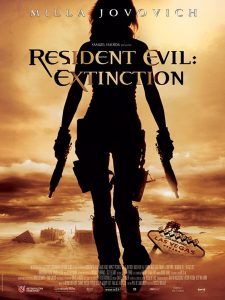
Resident Evil: Extinction

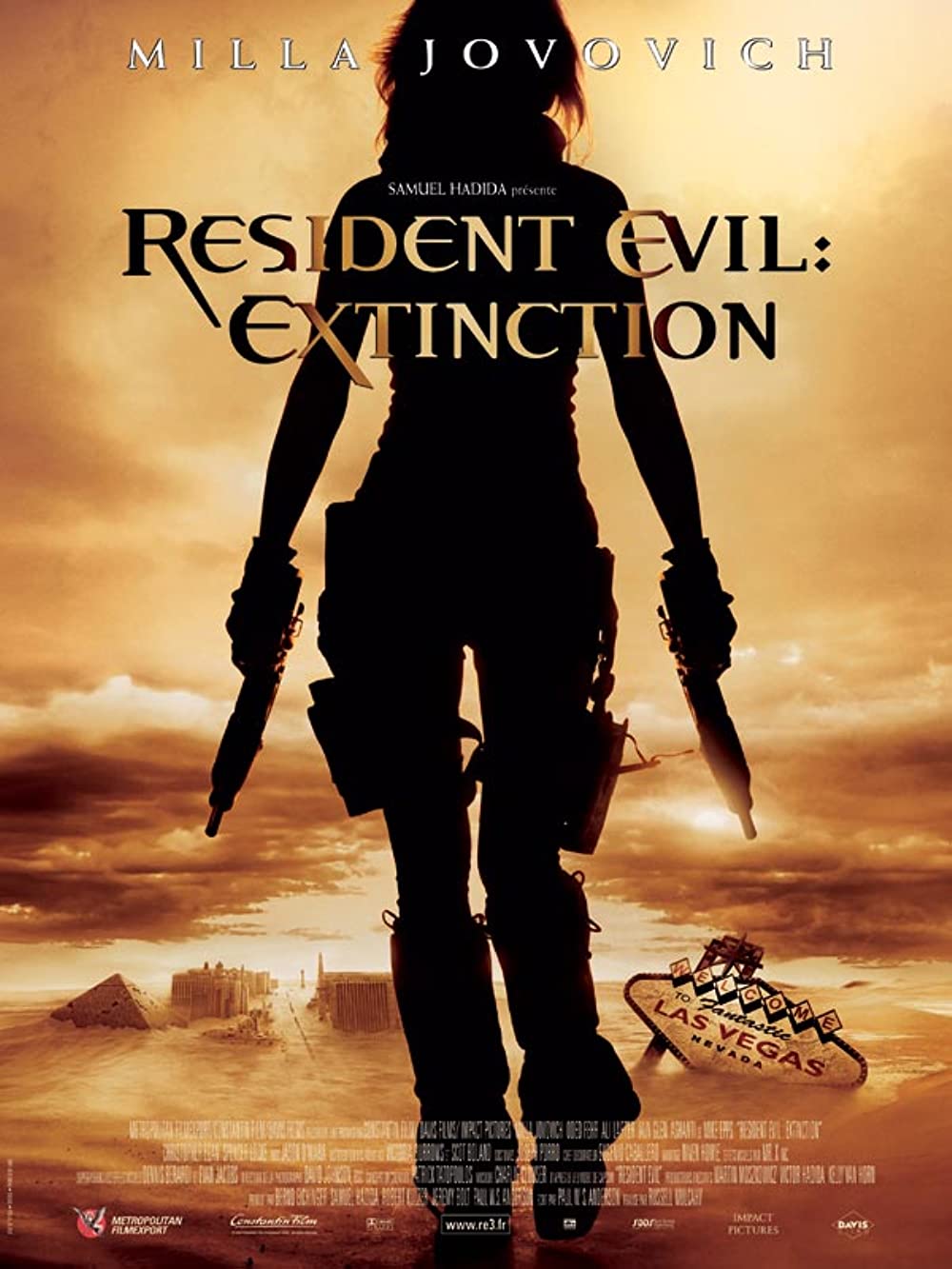
Resident Evil is one of those movies that has zombies in it. Resident Evil: Extinction, being a sequel, also has zombies in it. Therefore, I can be expected to like it. (In some things, I am pretty predictable. For what it’s worth, though, Redneck Zombies was not very good.) Despite that, I think that this movie was not only a decent action-horror piece, but that it furthermore surpassed that apparent goal. Not enough to say it’s great and everyone should see it, but how many movies surpass even modest quality goals that they set for themselves?

So, Milla Jovovich is once more wandering, sporadically nudely, through a zombie-infested nightmare unleashed by the multi-national Umbrella Corporation. Except it’s been a few years since this all started, and said nightmare is now a globe-spanning concern. Also, I guess it affected the weather or something, because the majority of the planet has dried up into desert. Although, let’s be honest, the real reason for this is what Mad Max taught us decades ago: deserts and apocalypses go together like Milla Jovovich and being naked. Faced with the twin horrors of zombification and global warming, the human race has pretty well called it quits, aside from roving bands of heavily armed warriors out on the roads, if you know what I mean. And there’s Milla, trying to work out how to proceed, discovering some new talents, and finding out that Umbrella isn’t quite done with her yet. As fans of the series are already aware, this is the kind of thing that (naked or not) she really doesn’t take lying down.

As a result, you have reasonably decent special effects, more action than you can shake a pointed stick at, everything you’ve come to expect out of a zombie movie[1], and the best girl-fighting scenes this side of Summer Glau. Like I said, when taken across the scope of all 2007 cinema, these are fairly modest aspirations to meet. So that’s cool that they do so, and you end up with what you wanted: a good action-horror flick. Now, stay with me, because you’ll find this next part hard to believe, but I maintain that’s it’s true.

This volume of the Resident Evil series also has a meaningful theme. See, Alice[2] is stuck in a holding pattern. She’s free of Umbrella, sure, but the world keeps getting worse and being free isn’t really all that great when you’ve got a dying planet as your only “on the outside” option. The majority of the movie is her quest to break out of that holding pattern and find a way to make things different than they are. Which sounds all fine, but I could just be reading it in, right? Except, I’m not, because every Umbrella scene has brought us full circle back to the original events of the outbreak. Same spooky mansion. Same giant underground complex. Same AI attempting to orchestrate events. Everything Umbrella stands for in this movie and every action Alice takes in response to the external stimulus of her doomed earth are the visual representations of the spiritual struggle happening in Alice’s psyche: until she faces the past in an almost literal fashion, she’s not going to be able to break the chains of the present and get a move on towards a future in which maybe humanity won’t be extinct after all.

See? Not only theme, but below-the-surface theme. Despite having moved well beyond the game franchise’s rails (or, more likely, because of this), these movies remain the best video game adaptations on the market, and by a fair margin. Also, and I may have forgotten to mention this, but sometimes Milla Jovovich takes her clothes off.

[1] That one guy who gets bitten but doesn’t tell anyone so that he can end up turning at the least opportune moment, the annoying people who are more dangerous to their fellow humans than the zombie plague, etc.
[2] This is the name the movie uses to refer to naked Milla Jovovich. Well, also clothed Milla Jovovich.

Blaze

For the first time in a reasonably large number of years, I’ve missed a buy-on-release-date book. I mean, I’ve chosen to wait occasionally, but this one I didn’t even know about until months later. Richard Bachman isn’t a prolific author, but of the people who write in the spare modern style brought to us by Hemingway, he’s one of the only ones that I’m willing to read at all, much less as soon as I can get my hands on the book in question.

First written in 1973 but only recently edited and published, Blaze tells the story of brain-damaged career criminal Clayton Blaisdell’s plan to kidnap the infant heir of a New England shipping magnate. So, you know, caper story with a pretty unusual twist, which is all fine and well if I was particularly into caper stories. For the most part, the caper itself was workmanlike, entertaining without being particularly special. What really worked was the character study of our unlikely hero, Blaze. For all that he’s the criminal of the piece and in the midst of some huge mistakes, he’s an extremely sympathetic character. Sure, he had a horrible childhood and missed every good break that came his way through no fault of his own, but it’s not that I was pouring out whiny liberal sympathy for him. He’s genuinely plucky and upbeat, downright likable, while his antagonists mostly range from neutral to distasteful. I wanted to see the good things that had passed him by before start happening now, even if they would be coming from the wrong side of the books this time.

Speaking from a fan’s standpoint, it’s interesting to see a sprinkle of elements that would be spread throughout King’s[1] later works: names and places used differently in the long run, but recognizable here as half formed elements of what they would become. Still, this isn’t a persuasive factor, just interesting. The book ranks solidly in the middle of King’s oeuvre. Still, that ends up as “guaranteed to enjoy”, for me.

[1] It would appear that the jig is up, even for those who don’t mouse-over.

Girls Volume 4: Extinction

Girls Volume 4 Extinction Luna BrothersI’m kind of stuck here, trying to make up my mind how I feel about the conclusion of the Girls series, other than accomplished at having completed it. I liked the interpersonal relationship changes. All the flaws and annoyances and dislikes were finally sorted out, after watching everyone remain static for the first three books. I mean, not everyone grew up or got better, but that’s to be expected. It was just nice to see the characters finally change at all, for good or ill. Trauma is supposed to do that, and this very clearly was traumatic. Being trapped away from the world, stalked by sex-starved alien clones, unable to trust anyone around you due to the gender inequity of the situation? I know it sounds awesome, but I’m convinced that some thousand-yard stares are going to result.

Also, there were a few instances of rewards and comeuppance I’d been waiting for, and those mostly worked out as I hoped too. So it sounds good so far, right? Except, there was this central mystery about how it all worked, and why the girls were there in the first place, and what the ultimate outcome would be. I am unable to even throw out my big question until after the spoiler cut, but I have to say that I came out unsatisfied, if only by a small amount on the balance scales. Except, that’s all there is to say. So, to sum up: The art was really nice, except for the people, where it remained mediocre. The character driven drama built slowly, but exploded into awesome over this book and the previous one. And the sci-fi mystery was almost where I wanted it to be, and then suddenly not. Nevertheless, it’s short, and I recommend it on the strength of how weird it is and that character drama part.

Continue reading

Sourcery

It’s been a while, here. Not for lack of reviewing, but my consumption has dropped dramatically, and I have no idea why. Don’t expect it to last. (For one thing, there’s another Horrorfest in November.) There’s no good excuse for the lack of movies, though, and the lack of books is part of the topic at hand, so onward!

After months of failure at finding it used, I gave in to the Amazon gold box and picked up the fifth Terry Pratchett book, Sourcery.[2] Upon cracking it, however, I took forever to read it. I’ve been pondering this for a while, and the best explanation I can come up with is that, well, it wasn’t all that good. I mean, it was frequently giggle-worthy, but I didn’t feel like I was reading a funny book. It wanted very much to be epic, but kept getting tripped up by trying to be funny, or derailed by the introduction of each new non-wizardly character, almost none of whom impressed me over the long term and none of whom seemed to actually accomplish, well, anything. They were funny sometimes, sure, but if they had never appeared again after Rincewind left them, the plot would have been hardly different at all.[1]

All that kvetched, I have gained a solid appreciation for Rincewind himself that was missing before. There was a theme all through here, about being true to yourself and about how badly things will go when you don’t. And it was a good theme, of which Rincewind was the ultimate realization. In addition to which, the more he was onpage, the more epic the plot seemed to be. Like I say: I never really got him before, as anything more than a silly little man who is terrible at magic. But that has all changed, and for much the better. I’m a bit sad that, now I finally appreciate him, he probably won’t be in the next several books.

Still and all, I liked Mort a lot better. But I’m glad that Discworld’s scope is expanding, as that promises to make up for a lot.

[1] Not entirely true, but close enough for the amount of pages they were given to get there.
[2] Interesting note: Before I grabbed the book for the first time, I had no idea what it would be about. Thusly, I had a failure of pronunciation. This is Sourcery as in “source of magic”, not as in “sourpuss sorcerer”. And now you know!

The Invasion

I believe that I am once again caught up on my horror movie quota. I mean, The Invasion is in actuality a sci-fi suspense thriller, but once you go longer than two words in a label, people lose interest, and so here we are in the land of miscategorized video shelves. (Except that since people no longer go to video stores, we’re in the land of miscategorized Netflix category links. Except they probably go ahead and categorize movies correctly, being who they are. But I digress.)

Space spores land on earth and jump into someone’s blood stream, re-writing his DNA in such a way that he loses many of the characteristics that we commonly consider human and is driven to reproduce the spores and introduce them into everyone else on the planet, the end result being that strong emotions will be eradicated, and along with them war and atrocities. But also passion, of course; what they’ve got is an infectious version of the Pax. It’s very much a remake of Invasion of the Body Snatchers, lacking only pods and Kevin McCarthy. (Though they did snag a female lookalike to restage his climactic scene from the original film.) Throwing a monkeywrench into the sporified plan is psychiatrist Nicole Kidman, who leads a small group in a quest to save her son, escape from the people who are no longer who they are, and maybe find a way to cure the rising tide of non-humanity. I could make jokes about how practically everyone in the cast is required to either act wooden and unemotional, or else act like they are acting wooden and unemotional for the purposes of fooling the former group. But the jokes pretty well make themselves, so I will not.

It was a perfectly serviceable thriller, making up in car crashes what it lacked in explosions. It was very nearly an excellent example of that perennial science fiction question, “What makes us human?”; it presented humans with all their flaws and their strengths, and it presented an alternative that was disturbingly non-human while at the same time debateably an improvement on the mold. But before I could start to actively consider the question, they cheated and removed it from the table. Coming so close to doing something that right has left me feeling disproportionately disappointed relative to the quality of the rest of the movie. A specific explanation resides below the spoiler cut, for the willing.

Continue reading

The Kindly Ones

1563892057.01._SX450_SY635_SCLZZZZZZZ_I spent about a week reading a book that should have taken me maybe two days, and all because I was trying to avoid its end. It’s just, I’ve read Sandman before, and I knew how The Kindly Ones was going to come out. But despite the fact that the reveal at the climax of World’s End had already sealed said outcome, and despite the fact that probably books don’t change themselves around to tell different stories while I’m not reading them, I’ve spent all week hoping that maybe I’d get to the end and it would be different after all. There’s no need to keep you in suspense: for this time, at least, it was not.

The Kindly Ones is structurally and all but literally a Greek tragedy, and between that reveal I mentioned in the previous volume and recognition of the structure, the outcome will be as inevitable to anyone reading it for the first time as it was to me on this, my first reread. It’s a skillfully constructed piece of fiction, liberally flavored with themes of loyalty and duty throughout. And, of course, revenge. All Greek tragedies are about revenge, though. About revenge and about causing, through one’s own actions, exactly that which one was trying to prevent. Loyalty and duty and revenge and directed irony. And unrequited love. And all manner of other things that also go right to the heart of what it means to be human. I guess what I’m saying is that it impresses me that either 1) we are so strongly affected by the literature of our millennia-gone forebears or 2) that the people who were creating some of the earliest literature of which we have record already understood the things that affect people the most. Or 3) that my flaw as a reading enthusiast is being all Western-centric without even realizing how narrow my view is. But let’s assume it’s not that one and move on.

I respect the book for what it accomplishes. I hate it for how it turns out. But the entire series is about the act of dreaming and the nature of dreams and the ways that they can make people better than they ever were (and sure, the ways they can reveal people as worse than we could ever imagine, too; we’re still talking about human people, after all). And so I love the book too, because it lets me believe that, like a recurring nightmare, the next time I experience it still might come out differently than it did this time. Really, how many books have that kind of power?

Halloween (2007)

[Note: I’m not concerned about spoiling the 1978 movie, because, come on. but I’ve found it impossible to discuss the remake without going in depth, so below the cut, expect heavy spoilers.]

How do you remake a practically perfect horror movie? You don’t change things around to suit yourself, and you make sure to have some kind of hook that explores something that’s never been explored before. If those sound contradictory, well, I maintain that they are not or at least don’t have to be. For a completely random example, Rob Zombie’s Halloween remake: it has to include a scary kid who killed his whole family; then was placed under the care of a psychologist for 15 or so years, who became obsessed with him; then broke out of the sanitarium to find his baby sister, who has no idea that their relationship exists. While hunting her, he has to be confronted by sex-crazed teens over and over again, so that he will kill them in re-enactment of the murder of his older sister. The scary kid, his doctor, and his sister have to come together in a deadly climactic confrontation. Maybe it’s formulaic, but it’s a pretty good formula, and one that John Carpenter all but invented.

Continue reading