Tag Archives: fantasy

Red Seas under Red Skies revisited

sl_redseasuBefore I consider further my feelings upon my reread of Red Seas under Red Skies, first, an excerpt from my original review, in May of 2008: “[T]he third book […] is due out in January. I am now sad.” So, yeah, that estimate was off by nearly five years. Whee! (True story: I have indeed remained sad over that period of time.)

The downside of such a long gap is that my overflowing excitement for the series has definitely died back a little. It’s hard to unreservedly recommend a series, or maintain a high level of excitement, after a surprise six year absence. The upside of the delay is that I “had” to read the books again, and they really are so good. By and large, I stand by my assessment after all. These really are the most fun pair of books I’ve read. They may fall apart soon after (I really hope not and will find out by sometime in Februaryish), they may not be the strongest on the literary scale or the political scale or the sweeping history of humanity scale, but they are hilarious and heart-breaking and absolutely clever as can be, and I’m glad a third one came out, five years late or not.

As for the specific book? I am struck more and more by the religion. A secret 13th god, watching over thieves and pirates, who most people consider to be a heresy? Okay, that’s not the part I’m struck by, that’s just cool. What I’m struck by is how religious Locke is. Sure, he loses his path sometimes, and he questions, but he’s sincere in his beliefs and in his unwillingness to trample anyone else’s in pursuit of his goals. He’s an absolutely good man, which is an odd thing to say of a thief and murderer. Part of it is that it’s a dark world, and basically everyone is a thief and murderer (legitimized, perhaps, but nonetheless) or else a victim. Makes it a lot easier to judge a man by the content of his character without getting all wrapped up in his pesky actions. Another part of it is that the Bondsmagi of Karthain are just so horrible of a shadow across, well, everyone, that it would be pretty much impossible to look bad by comparison.

The next thing, being massively spoilery, is behind the cut. But it’s just speculation chatter, so if you haven’t read the book, there’s nothing else down there to miss. Also: you should read the book. …after you read the first book, of course.

Continue reading

Fables: The Dark Ages

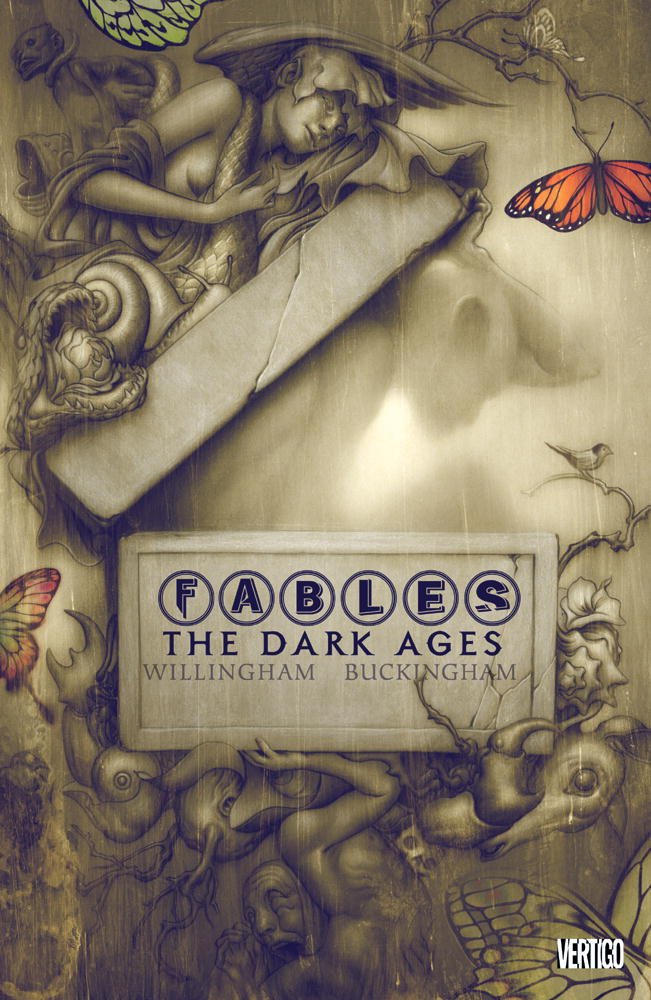
71y77SjvsBLDespite how far behind I am, I probably would not have read this yet, except I realized about three issues in that I had it backwards with the Jack of Fables I just finished, regarding publication order. So I went ahead and fixed that, as you’ve seen, but then: already three issues in, may as well read the rest. And so here we are, at the end of the twelfth volume in the Fables series, The Dark Ages.

Which, okay, that title doesn’t make much sense when you consider that they just won the war against the Adversary (whose name I should probably stop inching around, to be honest) and Fabletown is no longer in imminent danger, right? Sure, the Empire is still out there, mostly holding all the old lands through numbers and inertia, but it’s a headless snake now, and any heads that develop will at least be smaller and less dangerous. Right?

Let’s just say that any fears I may have expressed about the story’s ability to soldier on in the absence of its initiating premise have been laid to rest, and in rather dramatic and literal fashion at that.

Jack of Fables: Turning Pages

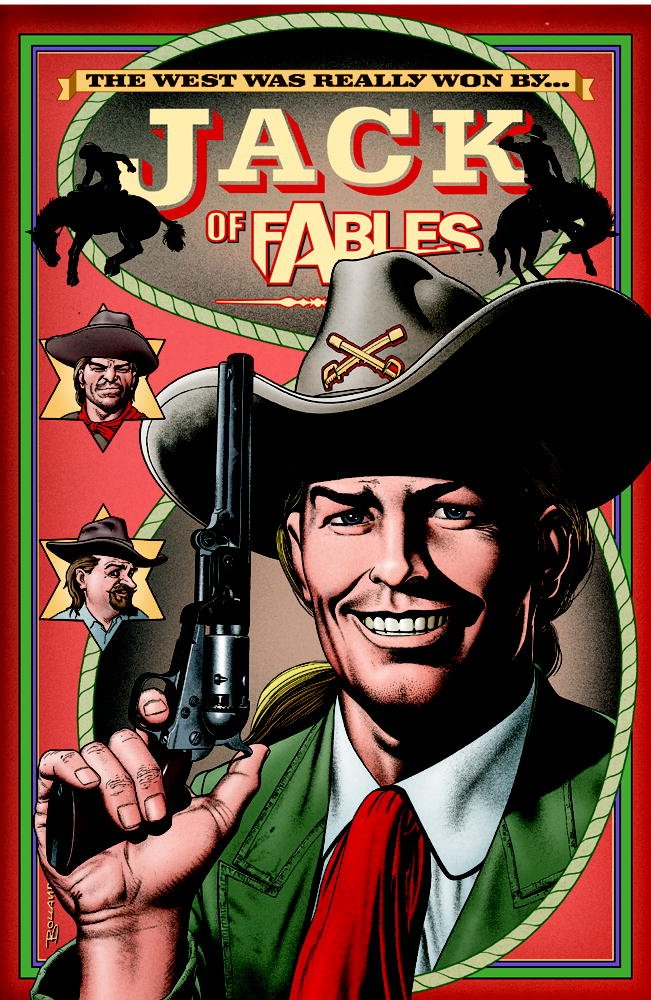
71BC8eESweLIt turns out that if your cyclical reading schedule for graphic novels comes into conflict with your desire to reread the great fantasy series of your lifetime, you can end up going a year and a half between one book and the next. Which explains why I had almost no idea what was going on in the fifth Jack of Fables book. I mean yes, he’s still the self-absorbed, money-, sex- and fame-obsessed character who climbed a beanstalk that one time. I haven’t forgotten everything. But as to his specific circumstances? Let’s just say it’s a good thing I have a long-running review blog.

Good news for me is that this was an incremental book. That is, the first half of the story was a conflict between Jack and Bigby Wolf in 1883, a follow-up I suppose to some previous historical Jack tales about his time in the Civil War[1]. So it was easy to follow, and then I only had to deal with three issues advancing the main plot, which was just enough time to a) get me caught up and ready for the next book, y’know, months from now when I read it, and b) make me fully aware that there’s some high-level familial machinations going on here that I probably need to be paying much closer attention to, to understand them.

There’s this guy Revise who I’ve mentioned before, who wants to make everyone forget all the Fables, because… I wonder if I’ve ever known why? And there’s this guy Bookburner who hates Revise, but seems to destroy Fables, and I guess that’s worse than draining them and the world of magic through forgetfulness, but all in all, I don’t understand why these people are opposed to each other. Except that there’s a lot of family drama, all of which involves other characters with literary tropes as names and powers, and frankly the literary-trope-as-plot works so much better in The Unwritten, which to be fair I had not yet read any of last time I read one of these. So that’s unfortunate.

It’s not like the book’s bad. I really like Jack[2] and I like the hot librarian sisters and the bizarrely Proustian miniature blue ox and quite a few other things that are going on, but the plot? Either I’m lost, or I don’t get it, or it’s kind of dumb.

[1] I sure don’t remember which book anymore, so no link for you.
[2] Well, no, but I really like to read about Jack.

The Lies of Locke Lamora revisited

91Lq5qpHKxL._SL1500_A really cool thing happened a couple of months ago, which was that a new Locke Lamora book was released. Since I rather liked the first one a lot[1], this was naturally exciting to me. But then, I realized that it had been five years since I last read one of these books, and, well, I didn’t exactly remember what had happened. Broad strokes yes (and mostly accurately, as it happens), but fine character and plot details, not so much.

I won’t drag this out, both because I’ve already been here before and because I have plenty of things I’d like to be reading right now. First: yes, I still like this book a very great deal. With a five year veil, everything I didn’t remember took on the sheen of awesomeness, amusement, sick horror, and exhilaration that I’m sure it had the first time through. The one thing I did pick up on that I certainly missed before was Locke’s overwhelming pride in the first third of the book. It really stands out in sharp relief when you know just how hard the left turn is about to be.

Anyway, really cool story, stands alone, well worth the read. And I’ve been told that you don’t actually have to reread these to prepare for the new book in the series. While I’m sure that’s true and while I regret that I haven’t read the new one yet myself, I regret it in the way I regret the other dozen or so books that I want to read right this instant. In no way do I regret the reread.

[1] And also the second, but all in due time.

The Unwritten: Dead Man’s Knock

51NFb36LVHLI am surprised and not a little annoyed to report that I completely failed to write a review. (Well, technically two, but one of them is on purpose[1].) I can’t even figure out how it happened. I know I read the third book in the Unwritten series, and I know I thought I had reviewed it, but when I went looking down the recent list, it’s definitely not there. So, um, oops? I’ll do my best, some week-and-change later.

My best ain’t gonna be a lot, unfortunately. I cannot even put together what the title, Dead Man’s Knock, is meant to indicate. (I mean, maybe I still wouldn’t have known if I were fresh?) I do know that this one was a little lighter on the deep literary thoughts and a little heavier on kicking Tommy Taylor’s story, not to mention the war being waged against him by the weird cognoscenti cabal that views him as such an unexplained threat, into high gear. Which is okay. I like the concepts swirling around, but without some excitement and menace, Carey’s latest opus would probably feel self-involved.

Also, there was an entire issue laid out as Choose Your Own Adventure, and you cannot tell me that’s not really awesome. You could try, but you would not succeed.

[1] Don’t worry, I’ll get there.

Hansel & Gretel: Witch Hunters

It is nice to have an occasional horror film that doesn’t try to pretend to be anything other than what it is. No high-minded art, no unforeseeable twists, no goddamn filming a Texan[1] story in Louisiana. In short, a movie that tells you everything you need to know right in the title and doesn’t skimp on a single drop and/or chunk of the gore.

For example, Hansel & Gretel: Witch Hunters. I mean, you know the fairy tale, right? And you know the genre of the movie? (Well, you maybe did not, but I have told you it, so now you do.) So, you now know everything about this movie. Let me prove it, by putting questions in your mouth.

1) “Are Hansel and Gretel a pair of siblings who make their living hunting and killing witches to save the people of medieval Europe from…. witches?” Wow, that kind of got away from you. Try being a little more planned and less off-the-cuff next time. However, to answer your question: yes! Yes they are and yes they do.

2) “Do they kill these witches in disgusting and effective ways that make you think they could never have been able to come up with such tools in real-life witch-infested medieval Europe, and do they crack wise with modern sensibilities in every line of dialogue along the way?” …I appreciate your taking my advice to heart, and also I’m growing impressed by your ability to glean fine points of detail from a movie title. Which is to say, again, yep, they sure do!

3) “No thanks, I’m good, that pretty well answers all of my questions.” I expected as much. So, um… huh. Didn’t really think about how awkwardly this would end the review. Maybe you could come up with more questions even so? Help a brother out here?

4) “Nope.” Well. Damn. This is because of that ‘kind of got away from you’ thing earlier, isn’t it?

5) “Yep.” …yeah. Fair enough.

[1] First person to mention Ed Gein gets chainsawed in the face.

The Hobbit: An Unexpected Journey

It occurs to me that, if I am to go to the bother of seeing a midnight movie premiere, I ought to at least have the common decency to get my review up before release-day proper has begun. I would try to defend myself by pointing out the incredible lack of sleep I was dealing with, but if I’m being honest, well-rested Chris would probably not have written his review of Peter Jackson’s The Hobbit, Part One of Many yet either.

So, let’s see. Was it good? It was, but at the same time… here’s the thing. One of the great strengths of the Lord of the Rings trilogy in cinematic form was that it pared Tolkien down to manageable levels. Because not everyone wants to watch dwarves dance around a kitchen making fun of their host to song and dance collectively written on the spot, is why. And so I want to grouse and complain that some degree of editing should have occurred, yet I really cannot do so in good conscience, because it’s fair to say that there are 13 potentially identical characters out of the 15 that are central to the plot, and Jackson has avoided that trap pretty neatly. And I doubt he could have without paying careful attention to every beat that Tolkien provided. Plus, the small hints of what was going on that Bilbo could not see (that will certainly provide a great deal of meat in future movies) were absolutely worth adding. So, in summation, this trilogy will be way too long and way too Tolkieny, but Jackson has made a compelling case for why he did it this way, and I cannot ask for more. (If I had not enjoyed myself, I could, but, yeah. Good movie. With internal-to-this-entry character growth in multiple places, even! But the rock fight was kind of dumb.)

I would be remiss, at this point, to not mention that this is a kid-movie. It’s less obviously so than many, but, y’know, kid-book, kid-movie. That is how the formula works. So don’t be surprised by your memory that it is a classic instead of a kid-book. I mean, it’s both, but you’ll only accidentally forget the one. ….and then there’s the technology.

So, the 3D? Quite good. The IMAX? Always dandy. 48 frames per second, which is the shiny new tech introduced by this movie? I believe that it was successful. The image was hyper-real, and I have no idea if this is what people want in the theater, but there’s no question now that it can be done. The biggest problem was with speed; several action shots seemed to be on a slight fast-forward, like when you turn too fast and the world lurches just a little bit. Which is to say, I’m pretty sure The Hobbit will be looked upon as a really clumsy implementation of 48fps in a few years, but for ground-breaking, you really could not request a better representative. (However, if that’s just how it will always work, then I kind of expect the experiment to fail.)

Jack of Fables: Americana

81lL7PMB-7LSo, this is cool. I’ve figured out what’s actually going on in Jack of Fables, way after the fact. (Probably way after anyone else who has read these books, for that matter.) Remember when he got captured by a bad guy named Revise who has been gathering up Fables and keeping them in a camp while making people forget that they ever had any stories, in the hopes of turning the whole world Mundane?

It turns out that Jack’s ongoing quest to garner increased fame, power, and wealth is actually beside the point, despite what he would constantly have you believe in his position as occasional narrator. Now that the war is over, this Revise guy is probably the most important thing happening in the entire Fables universe, and Jack just happens to be caught up in the swirl. I cannot decide if he would be offended by that or think it just and right that he’d be at the center of the action. (He would never admit he isn’t the center of the action, either way.)

Anyway, though, Americana: besides the other things that are obviously happening along the way as per above, Jack is now looking for a way into the American Fable country where he can find Cibola, the lost city of gold, and get, you know, rich. I’m glad that Revise’s three hot librarians[1] keep managing to keep tabs on Jack, though, because they are stuffy and hilarious, and I think he would be insufferable if left to his own devices.

[1] No, seriously. It’s not just comic art rendering everyone hot. There’s a t-shirt and everything! Also, in case you care, the three hot librarians are sisters.[2]
[2] Okay, I admit that knowledge to be gratuitous.

The Wind through the Keyhole: A Dark Tower Novel

Long ago, near the very beginning of Shards of Delirium, I made note of Stephen King’s retirement. I cannot think what made me believe, at the time, that it really might be true. I know intellectually that he will die someday, but since I barely believe that, what could have possibly made me believe the books would stop beforehand? Of course, I’ve written some significant number of King-based reviews since that time, in theory without making any further reference to this oddity. But this time, my Constant Author has taken things a step farther and added another entry to his already completed Dark Tower cycle, putting big lie to the long-existing small lie.

The Wind through the Keyhole picks up very near the center of the series and, of necessity[1], adds nothing to the progression of the events already chronicled. That right there will be enough to give a certain class of reader fits of disinterest, and while I don’t agree, I do understand. An argument could be made that it provides some deeper insight into Roland’s character and his history, but you will not find that argument here. What came varied, in my opinion, between obvious and facile. (Unless I am wrong and it is the indication I sought in vain in footnote one. I could accept that and would then retract both indictments.)

Here’s what the book does: it provides a mythology for Mid-World, which lack I had never precisely felt before. After all, Mid-World is already its own kind of mythology, and it had already contained its own stories,  some barely hinted at, some told in extensive detail. But stories are not the same as myths, and King has not written much in the way of mythology. It seems to me that perhaps this should change.

[1] In fact, there are spoilery reasons why I was keeping a careful lookout for this not to be true. But alas, no evidence presented itself to me.

The Unwritten: Inside Man

To start with, yes, I will be reading more of The Unwritten. It is about literature on every level: in plot, in theme, in voice, and I’m sure more ways that I haven’t thought of yet, and by gum, I don’t have this degree in English Literature for nothing. It’s really smart, really convoluted, and I expect to know more things at the end than I knew at the beginning, about the psychology of readers and reading as much as about the creation and function of stories.

As for Inside Man, aside from being obviously good enough to win me over, I can say a few things I suppose. In addition to following Tommy Taylor into prison (for a crime he didn’t commit!, no less) and into Nazi Germany, it explores the psychological impact of stories. On children and adults. On the stories themselves. On (at, okay, a more metaphysical level) the very earth upon which they occur. And then, after reading five issues’ worth of storyline that seems like it was made specifically to accommodate my personal interests, it’s capped off with a cautionary allegory set in Carey’s parody of the Hundred Acre Woods. So it may be fair to say that the closer your (non-horror, non-cult-classic) tastes match mine, the more you will like this series.

But man, there sure is a lot of foreign language in it, enough that I end up not trying to translate it. (This complaint is probably properly directed at me, not the book.)