The Deaths of Ian Stone

MV5BMTQxMjU3ODgxMl5BMl5BanBnXkFtZTYwNjIwMDM4._V1__SX1217_SY911_Have I mentioned that this weekend is HorrorFest? I’m thinking I maybe have, but there’s probably no way to be sure! Anyway, this is another weekend with way too little sleep and the necessity to whirlwind through my reviewing schedule to even have a chance of keeping up. Mind you, I’m not complaining. It feels like this weekend was created just to make me happy. Downside: It’s the second weekend of two, and the theater was basically empty all last night. Ten or fifteen attendees per film? As much as I don’t like crowds of people, that makes me sad. With rare exceptions, movie crowds don’t trigger any of my social anxiety at all, and I love the energy of a full crowd of fans at a premiere. My promise to myself, therefore, is to go the first weekend, next year. (I don’t actually know that there will be one next year, but I assume there will.)

I’ve been rather looking forward to the night’s second movie, The Deaths of Ian Stone, for several weeks now. It seemed very cool from a description which is not that different from the one I’m about to provide, and came very close to living up to my expectations. The Ian Stone in question is a regular bloke with a regular life, which includes as highlights a cute blonde that he likes to flirt with or possibly date and a lot of oddly familiar stony-eyed people who spend their time staring at him. The problem is, the staring people eventually try to kill him. The bigger problem is, they succeed. And then he snaps out of a kind of doze at 5:02, in different surroundings, nay entirely different life circumstances. And it starts all over again, with a brand new set memories and the occasional leakage from some previous life that he has no evidence ever really happened. He’s got to find a way to break out of the cycle, because dying a lot is probably pretty unfun. Except, any time he starts to realize what’s going on, his mysterious stalkers are right there on hand to kill him all over again. And, of course, is there any way to be sure any of it is really happening at all?

Yay, spooky paranormal mystery to unravel! The only negative I have to report is that, like so many mysteries out there, the solution’s pursuit is far more entertaining than the solution itself. But it’s hard to hold that too heavily against them, when it’s the norm. Also, for any Dexter fans (and you should be), the girl who plays Lila is in this movie. I don’t guess I have a particular point to that statement other than to praise Dexter. But the actress is really hot, if that matters to you.

Unearthed (2007)

MV5BMTczODI3NjQzNF5BMl5BanBnXkFtZTcwMTE5OTc0MQ@@._V1__SX1217_SY911_Have you ever wondered what would happen if Alien had never been filmed, and the concept sat on a shelf for 30 years, only to be released today as a Sci-Fi Channel original motion picture, set in an isolated corner of New Mexico rather than in space? And instead of being a bit-player warrant officer, Ripley is a sheriff with a dark secret, hovering on the verge of alcoholism? And instead of being trapped on a ship together, they’re trapped by a closed road and insufficient gas to get to the next town in the other direction? And instead of… well, no, that’s pretty much all of the actual differences. The characters aren’t all identical, I mean, but the four main ones are, which is plenty enough.

My point is, if you’ve ever wondered that, you should really see Unearthed. In the style of Alien, it chronicles the discovery of an alien life form that probably killed all of the Anasazi, has been rediscovered on an archaeological dig, and will now kill all of everyone else if possible. Unless Sheriff Ripley and her doomed companions can find a way to stop it, I mean. …okay, “doomed” sounds like kind of a spoiler there, I guess? I was using literary license; in reality, basically anybody might survive. (Well, not the black guy. You’ve seen a horror movie ever, right?)

Y: The Last Man – Girl on Girl

51DmVpA+bwLThings I have noticed about Y: The Last Man today, while noting that some of the things may be specific to the volume I’ve read, Girl on Girl, and not necessarily to the entire series:

1) The stars are aligning in an always entertaining but still highly improbable manner to get Yorick all the way to Australia, half way around the world and despite a variety of more logical destinations. Perchance to be reunited with his long-missing fiancée, Beth?
2) Men are not a necessary ingredient to make pirates entertaining. Yar!
3) In a world without men, lesbians really do show up a lot more often. Mmmm, lesbian pirates.
4) You know all those action movies where the bodyguard dude is keeping some material witness or annoying-voiced diva singer safe, and they start to fall in love? I guess it’s reasonable for that to happen in reverse too.
5) I suppose that’s all? It was a surprisingly short book.
6) Oh, and dream sequences are still always awesome. See also the Sopranos and that one episode of Buffy at the end of the fourth season.

Preacher: All Hell’s A-Coming

51ATQIvJSvLFor a transition book, All Hell’s A-Coming was surprisingly satisfying. On the one side, Jesse Custer, his girlfriend Tulip, and Cassidy the Irish vampire have finally started to sort out the truths behind their various ongoing interrelationships, in advance of Jesse’s final push to complete his vindictive quest in pursuit of God. And on the other side, Herr Starr, Allfather of the Grail society, is making his own final push to sort out that organization and take control of Jesse Custer once and for all. It promises to be a three-way (at least) clash for the ages. But, you know, mostly that describes the yet unread final volume. Like I said, this one is all about the transition.

In addition to Jesse’s search for answers as to his supposed friend’s true nature, the eighth entry in the Preacher series provides closure for several side characters and a little bit more history, this time of Tulip’s journey from birth to the failed assassin we first met in Gone to Texas as well as one of her early adventures with Jesse and their longtime friend Amy. All good to read and ranging from funny to emotionally horrible to ultra-violent, but with almost no movement towards the final resolution of the series. I’m kind of concerned that most things won’t really be wrapped up in the one book remaining; there hardly seems to be enough space. But, like Salvation, I can definitely say I liked this one a lot, overarching storyline be damned.

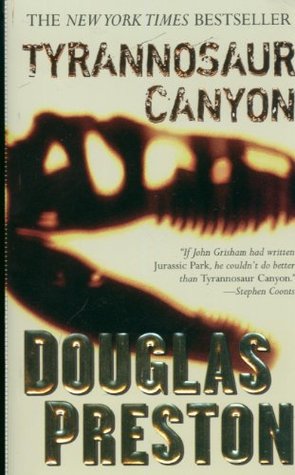
Tyrannosaur Canyon

136641Sometimes, the best way to judge a book is by its cover. I know people say not to and that it’s a bad thing, and I’m willing to grant that in the metaphorical cases of the phrase, that might have universal merit. It probably doesn’t, because some peoples’ covers are pretty much exactly as advertised. But it might. For actual books, however, that advice is completely insane. Sure, feel free to use other measuring sticks as well, but some good old-fashioned cover-judging is how you end up with books like Tyrannosaur Canyon. Right there on the cover, you have a tyrannosaur-head fossil, as well as a blurb that is being voiced in your head by the “In a World…” movie preview guy, explaining all about the mysterious missing moon rock, the fossil prospector, the evil paleontologist, and all the rest of the characters rounding out this airport thriller that promises (still on the cover, mind you) to be at least twice as good as anything by Michael Crichton.

As for how good it actually was? Well, honestly, probably not as good as Jurassic Park, what with JP having actual dinosaurs and all versus plain-jane fossils and kidnappings and manhunts through canyons and government black ops conspiracies. I mean, all of that stuff is cool, and makes for an exciting read. But it’s no chased by dinosaurs and unix hacking, now is it? Definitely better than The Da Vinci Code, in that the prose is substantially more thoughtful and not nearly as overwrought, and not incidentally because of Tyrannosaur Canyon‘s lack of monastic self-flagellation. (Not to be confused with its lack of monks, as that would be counterfactual. Don’t believe me? Just check the cover.)

Saw IV

I made an interesting discovery last night. In addition to being appropriately grotesque, being good fodder for morality discussions, and including the occasional jump-in-your-seat scares and/or nudity, the Saw movie series also has an intricately convoluted plot[1] that rewards multiple viewings of each movie as well as of the series as a whole. The four films have covered between six and eight months of in-series time, now, and each successive entry relies heavily on knowledge of the previous episodes to be able to best follow the new twists and turns. This is probably the smartest horror franchise of all time. (Which, okay, is about a hundred years now. But still.)
Saw IV has what they all have: a few people in individual short-term traps with the choice to force themselves to live via pain and sacrifice or die easily, as well as an ongoing storyline in which Jigsaw is trying to impart an important lesson upon one or more main characters. Everything you think you understand about what’s happening will be wrong, until it all falls together in the final frames. Which is another piece of intelligence about the series. Knowing that there’s a twist coming doesn’t make any difference in the ability to anticipate it correctly, and not particularly because of hidden information. Almost everything you need to know is present on the screen, and Jigsaw essentially never lies or even attempts to mislead. I guess some truths, we’re just conditioned not to hear.

To the extent that anyone will be willing to listen to me recommend a horror movie, I have this to say. It’s extremely violent in disturbing and disgusting ways. But if you can stand that (it makes me squirm, a lot) or at least peek between your fingers occasionally during the bad parts, I think you’ll be pleasantly surprised by how much and in how many ways each of these movies will make you think.

[1] Mike: you know how the time travel movies come along, and the reviewers complain about how confused they are, and it’s ridiculous? If a reviewer said that any of these but the first one was hard to follow, I would be willing to cut them a fair bit of slack. (In fact, albeit mostly due to mixing up two of the characters that looked too much alike, I needed Pete’s help to be sure I knew what had happened in this one. But I also found that I had missed a lot of detail in the first three movies as well, during said research.)

Captain’s Glory

296484I got around to the end of the most recent Shatner trilogy finally. I guess I read the last one two and a half years ago? Long enough that another one has already come out, but as usual, I can wait for used with no stress. Anyway, I was pretty high on it and the last several before it. Unfortunately, Captain’s Glory is not so good. I mean, it has good dramatic Trekky scenes in which ships face off, Starfleet personnel gamble with fate at high stakes, and so forth. And the prose has no problems[1]. But the ex machina not only had too much nonsensical deus, there wasn’t even a boring epilogue in which the author clarifies what we would have been able to piece together ourselves in a better book. Now I have to downgrade it self-indulgent tripe all over again.

The plot was alright, though, prior to that bit at the end. Due to an invasion that’s been hinted at for books now, the Federation (and most other Alpha Quadrant denizens, if not further afield) is losing warp capability. What with sublight being a little slow on the galactic scale, this would be bad. So now there’s a race against both time and gradually failing technology to forestall invaders that, as of page one, only a handful of people even believe exist. See? Except for the last thirty or so pages, that would have been pretty cool. Instead (spoiler alert), James T. Kirk’s history-making semen is once again called upon to save humanity. Yay?

[1] I know that sounds like backhanded praise, but come on. The prose was never going to amaze anyone; it’s a Star Trek book.

The Walking Dead: The Best Defense

I’m kind of torn on the fifth Walking Dead graphic novel. On the one hand, The Best Defense returns to a plot-oriented focus, just as I predicted it would. And, even better, a cliffhanger ending all but precludes a volume 6 return to form in which all plot progression is halted in favor of character exploration. (Mind you, having both in the same volume would be pretty great, but except for our hero and his wife, that mostly hasn’t been happening.) But on the other hand, the plot that Kirkman has oriented on is kind of tired. I’ve liked how much dissension has come from within, contravening standard expectations; in so many apocalyptic stories, the characters are all united, and any outside groups are evil and/or crazy, hellbent on taking everything that these good people have built, if not destroying it outright instead. In any event, that destructive and moderately trite external influence is finally here.

This is the downside of the zombie setting. Sure, you have all those zombies, but so many of the stories that you can tell against that backdrop have already been told. The best you can hope for is to tell it better, and with the current volume of writing available, that is getting harder and harder to accomplish. I’d hate to think I’m outgrowing this format? But if I had sat down to wonder what was missing from the Walking Dead mythos, this would have been the first plot twist that leapt to mind.

As far as the art, it at least is as good as ever. I am forced to complain about the lack of color, though. With all of the physically and emotionally wringing events they’ve been forced through, the characters’ faces are getting too busy. Where color would reveal exactly the difference between each scratch, scar, or wrinkle, black-on-white just results in character features that are more and more craggy, harder and harder to read accurately. And the art is simply too good to allow it to be reduced by something so trivial.

Sacrifice

51AwFtja8bLIn a fit of irony, the middle book of the current Star Wars series has had the most to offer the fans I was complaining about last time, while simultaneously being the least tightly constructed of the books so far. On the one hand, wow with the events. Sacrifice contains, among other things, the pivotal moment foretold since the first book of the series in which the Sith apprentice comes into his full power as well as two more things I have typed and later deleted because they would be major spoilers. Well, one would be; the other would be if you knew it in advance, because there’s all kinds of obvious foreshadowing for it, if you know that something is coming. I know, because I knew in advance and the foreshadowing was kind of clubbing me about the head and neck. But that’s not too bad of a thing, really; I just wish I hadn’t known.

So, I’m all approval about the ongoing Skywalker-Solo family story and the ways it ties into the current galactic-scale storyline. The thing is, though, it also contains a completely separate story about Boba Fett’s efforts to rebuild the Mandalorian people into a stable civilization as well as his efforts to rebuild his life and his family ties. Which are well-written and interesting, but at no point do they really intersect with the ongoing storyline, like they did when he was last present in the second book. And if there was a theme to tie everything together where the events failed to, well, I missed it this time. To recap, there’s a lot of good storytelling, but it’s not very deep and consists of two unrelated stories. So, y’know, fun to read, but I can’t exactly call it good writing. Naturally, therefore, all of the Amazon reviews seem to be full of praise.

I can’t decide if I’m more sad for me, being attached to a fandom that doesn’t really appreciate technical skill in prose, or if I’m more sad for the authors who have to this point been putting together a solid piece of fiction (genre or otherwise), both per book and overall, but who have been derided by their nominal fans all along despite this accomplishment of something I haven’t ever seen in trademark fiction. (Well, or whatever you call it when there’s a property that’s being farmed out to multiple authors after success outside the written word.)

Preacher: Salvation

Is there anything so quintessentially American as the Western?[1] Despite that preacher Jesse Custer’s travels have taken him to New Orleans, New York City, and Europe, the underlying themes and imagery of the Preacher saga have always been that of the Western. Big land and a big sky, where a man can make anything of himself, accomplish any task he sets his mind to, where wrongs not only can be righted but inevitably must be, where life is as cheap as the desert sand and betrayal is as inevitable as the high noon challenge that precedes it. And in point of fact, the High Noon parallels were plenty enough obvious in the first half of Salvation without Ennis needing to point them out in the dialogue.

As the Preacher series enters its final third, Jesse Custer is a man alone. He’s lost his friends, some of his memory, an eye, and most damning of all, his way. And so, while taking the time to figure things out, he settles in the town of Salvation, Texas on a whim after running into a childhood friend. Salvation has its share of problems: unthinking Southern racism, a rich meat-processing magnate who uses his influence to buy the unlawful run of the town for his workers, and above all an uncaring populace willing to let it all happen rather than stand up. If there’s one thing that has been clear about Custer since the first issue, it’s that he is not a man who will refuse to stand up in the face of injustice. And of course it will become his salvation; but not just his. As so often happens in fiction, unlikely places have a way of gathering together unlikely people.

I was a lot more pleased with this book than I have been with the last couple. Ennis’ characters are a lot more compelling than his erratic main storyline, in which God must be held accountable for abandoning his creation to all the badness out there. I’m hoping he’ll pull a coup and reveal that the being Jesse has had his sights set on for so long is someone other than God; the villainy has graduated from ‘mysterious ways’ to almost cartoonishly diabolical, and I’ve always been one for principled disagreements rather than blatant vilification. Anyhow, the characters are a lot more compelling than all that, I was saying, and they really had time to shine without all the theology in the way.

[1] and other clichés with which you can start essays, by Chris Hammock. Available wherever fine books are sold.[2]
[2] Not actually available.