In at the Death

One of those things where I end up with a pile of reviewable materials all finishing up at once has just happened. Lucky for me, I’m working today, on one of the slowest days of the year, so theoretically I have enough time to get it all caught up and sorted in my mind before any useful particulars fade away. Though I suppose it might help if I had more inclination; that seems to be another thing in addition to time that gets sacrificed when I finish so many things at once. As ever, the best way to get rolling is to just blunder ahead willy-nilly without any thought until something appears on the page. (I have it on good authority that this is the key to all writing, not merely for reviews.)

Firstly, I finished another Harry Turtledove alternate history cycle. In at the Death chronicles the final year of World War II and its aftermath, in a 1944 and 1945 that has already seen four wars between the United and Confederate States in just 80 years. Since the outcome in broad strokes was essentially a foregone conclusion as of the end of the previous volume, most of what I got out of the book was a chance to enjoy the characters again and to get at least a glimpse of the possible future of a completely different world. After all, with North America divided against itself, Japan had no effective adversaries in the Pacific Rim. And in a Germany that won the previous war and thus had no calamitous economic collapse or subsequent hatred for its Jews, the brightest minds of the atomic age had no reason to flee that country. The future is an uncertain place that I’d be thrilled to see more of, but if Turtledove stops here with the conclusion of the second World War and just brief glimpses of what could follow, it will still have been more satisfying than the concluding volume of the alien invasion of World War II series. As stories with 11 volumes go, well, I’ve certainly read some that were a lot less consistent than this one has been. Yay, alternate history!

Preacher: Alamo

Remember the Alamo? About 160 people holed up in an old Spanish mission against a 5,000 man Mexican army, at the dawn of the Republic of Texas[1]? Some people will try to tell you that it was a pointless battle that didn’t accomplish much of anything that couldn’t have been better handled in the field with more even odds, thanks to Santa Anna’s ineptness as a general. These are people who don’t understand the strength of a legend. There’s just something soul-stirring about a hopeless battle whose only purpose is to provide the people down the way with the time they need to change their own battle into one that can win a war. I guess I understand how people can not get that, but I don’t believe it’s possible to not get that and be Texan at the same time.

All of which gives me renewed appreciation for the Preacher series as it reaches it’s ninth volume finale, Alamo. Whatever else can be said about the series, good or bad, Garth Ennis certainly has a handle on the nature of Texas and the kind of man it gives birth to. Jesse Custer and his girlfriend Tulip, their once-friend, Irish vampire Cassidy, the world-dominating Grail Society, the Saint of Killers, and even the Lord God himself all gather in San Antonio for their final, climactic confrontation, and it’s a sure bet that with the power and bloodthirstiness that each party brings to the table, practically anyone could be considered analogous to the doomed band of soldiers holding the Alamo in 1836. Of course, only one of them’s Texan, so I suppose there’s a potential spoiler built right into the thematic success of the concluding volume.

Barring one misstep in the matter of Jesse and Tulip’s relationship which I’ll put down to a matter of taste, I liked the book through and through. And I’ve liked almost every other individual book, some of them very well indeed. But looking at the series as a whole, I’m not so sure. There are a lot of messages buried in it, most of which I think are really good, and true besides. But the one floating at the surface, central to the plot and the driving force behind almost every action taken by every character, is that the world is a bad place and it’s God’s fault. That may be factually true, but whether it is is well to the side of my point. I just feel a little let down by so much great writing and art coming out of the whine-delivered statement of blatant fact: “Life’s not fair!” Luckily, I had no trouble with it up until the end, and then probably only because the ultimate solution was so prosaic and, to me at least, absent of any actual solving of the problem.

Incidentally, Preacher may become an HBO series, starting in 2008. If so, and if you can stand all kinds of bloody violence, you should probably watch it. Whatever else it is, it’s a damn fine story.

[1] At least, the Alamo had not yet fallen when independence was declared. So dawn feels like about the right metaphor from where I’m sitting.

Portal

35979-portalI’m about halfway through Bioshock, and probably within an hour’s play of finishing Mass Effect. But I at least finished one of the three or five big awesome games that have come out this quarter, and I’ll take what I can get. Mind you, I’ll be playing most of the rest of the stuff in the Orange Box before too much longer, but many of those games have been previously reviewed, so I doubt I will again unless some kind of mood really strikes me. (On the other hand, at least there will be no stupid sparkles flaring all over my screen to distract me. Thanks, PC gaming!) The important part for now is that I have finished Portal.

At the risk of over-selling it, Portal is what a video-game would be if someone took pure awesome, distilled it into its Platonic form, and then burned it onto a game disc. Yeah, okay, that’s probably an oversell after all. Anyway, Portal is a game set in the Half-Life universe. You play as a volunteer at a Black Mesa rival company called Aperture Science, testing their Portal Device. The function of the so-called portal gun is to open transdimensional portals between two points in space, effectively joining them into a single point. Aside from this possible violation of the laws of physics, the portals otherwise adhere to natural laws, conserving momentum and gravity in ways that would make Escher smile like the Cheshire Cat. Utilizing the portal gun and the assistance of the Artificial Intelligence in charge of the testing chambers, you make your way through a series of tests designed to confront you with diverse challenges that can only be solved through ingenious use of these portals.

The game has three essential strengths: 1) The puzzle-solving aspect, although sometimes frustrating, is mostly a true delight. In a way that no FPS has ever done before, it lets you come up with novel solutions to otherwise insoluble problems. Every victory, however small, leaves you feeling like a giant among men. 2) As of Half-Life 2, Valve has really captured the urban decay chic, and despite that almost all of the game takes place in sterile white test chambers, there’s a real sense of the same kind of minimal but undeniable wrongness about things that marks their other recent efforts. 3) The dialogue is outstanding, even though there are only two characters with lines in the entire game. It swings between hilarious and chillingly disturbing with, at the risk of repetition, disturbing ease. (Also, the end credits contain a wonderful song to which I wish I had the mp3.) Oh, and 4), the three things I just listed combine to form a very tight and affecting plot.

I like Mass Effect quite a bit. I like Bioshock better than I’ve liked any game since Half-Life 2 came out. That said: if you find time to invest yourself in a game before the year ends, it should be Portal. You’ll thank me later. (Except you mostly won’t, because who hasn’t already played it? Nobody, that’s who! (Dear people who haven’t played it: no offense!))

Dragons of the Dwarven Depths

A couple of Saturdays ago, at work: I’m sitting at my desk, bored with nothing challenging happening, trying to find ways to kill time. I’ve just returned from the vending machine with a turkey and (let’s say) cheddar Lunchable. In front of me on the desk is a copy of Dragons of the Dwarven Depths, a recent DragonLance novel that I’m reading.[1] To the best of my recollection, therefore, the only differences between that day and high school are that I was getting paid to sit there and that nobody was bothering me. It was kind of weird.

As far as the contents, they’re about what you’d expect from a main sequence DragonLance novel. There are dragons and a band of divided characters who must oppose them, each in their own way with heroics, low cunning, and magicky bits, in dungeons, wintry mountain passes and so forth. Basically, you get to see a fleshed out account of things that were glossed over in the original books, with some moderately implausible new information added (considering what knowledge the characters have later in the series) as well as a little depth of character for Sturm and Flint, who sometimes got short shrift in the originals. Unless you’re a sucker for the setting, and I am, you won’t really get anything out of it. But it’s by no means bad, if you are their type of sucker.

[1] In case you’re wondering, I accidentally left it in Austin with about 50 pages to go, and by the time it got back to me, I was so close to finished with the Dresden book that I completed that one first.

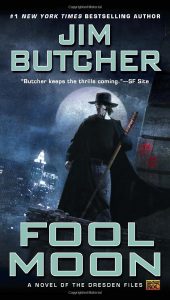
Fool Moon

I cannot decide if my love for the Harry Dresden books comes from their being objectively awesome, or from them being in such sharp contrast to the Anita Blake books. I mean, sex happens, but it’s dealt with tastefully, with soft-focus lensing and quick cut-aways, and far more importantly, it is not the constant focus of Harry’s regular magic-wielding, mystery-solving lifestyle. Which leaves him some time to think about wielding magic and solving mysteries. Is the prose with which he wields his magic, the world-building in which he solves his mysteries, the characterizations that come into play when he interacts with the other, er, characters really any better than most books I read? I’m going to guess that probably not, and yet I could grab the next three that I currently own and read them all in a row without getting the least bit tired of it. Um, unless the plot suddenly changes into a situation where he’s banging the vampire chick Bianca like a drum and his cop friend starts hating him and he wallows in angst by taking up with a werewolf pack? Don’t be sexy, Harry! It’s not worth it!
But also I guess there are some specifics about Fool Moon, which book is the one I just read? Werewolves, then. It turns out that there are about 5 different ways for a person to change into a wolf in Dresden’s world, and each of them with a different name. Which sounds like pretty extraneous information to have at my fingertips, except that someone with a lupine MO has been committing murders, and Harry has to figure out who and how so he can stop them from killing again! See, and I’m still not convinced why I should love these as much as I do. We’ll assume it’s not just by comparison, and go from there. I figure the two factors that the author really has working for him are multiple interesting characters (the cop chick, the mob guy, and the skull all leap to mind) and Dresden’s voice. I’m genuinely interested in everything that Harry Dresden has to say, so this first person narration thing is like the world’s best gravy on top of a mysterious chicken fried steak. The substantial food part may be really good, or it may be mediocre, but the gravy is so great that I have no way of knowing!

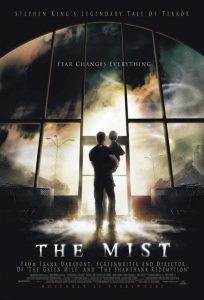
The Mist

On Monday, I spent most of the day driving around Austin digging through a few of its Half-Price Bookses, wishing I had an excuse to drop by the Alamo Drafthouse, failing to find any new Hawaiian / hipster button shirts for work, and just generally enjoying the rhythm of the town. Even over-trafficked as it is these days, if you don’t get on 35 you at least get to look at all the Austin people and landmarks while you’re stuck in your car not going anywhere. In addition to all that, though, everything was covered by a dense layer of fog all day. I mean, not the kind where the visibility is measured in feet, but probably the kind where it’s measured in hundreds of feet. When you add up all of these factors, it becomes clear that my viewing of the latest Stephen King adaptation, The Mist, was not so much a decision as it was inescapable fate.

Before the movie, though, I have to write another love letter to my favorite movie theater. I mean, sure, other places serve food. But do other places serve you food with names like Maximum Overdog? (See, ’cause it’s a hot dog with fancy chili on top, and it’s named after a different Stephen King movie! And this is only one example; there are multiple movie title puns spanning multiple genres. You can use theme as a deciding factor in your menu choices!) And if there’s another theater that not only shows a loop of hysterical trailers for old movies from the ’60s and ’70s that nobody has ever heard of, carefully selected to match whatever movie is coming on, but also finds old interview footage related to the filmmakers or writers or possibly stars of that movie, I have never heard of this theater. When it’s the Alamo, you show up early, and it’s only fractionally for the chance at good seats. Time after time, they provide the best theater experience going, and my soul dies a tiny bit when I remember that people who live north of Austin can’t just decide to go there at whim. Especially when I remember that those people include me.

Anyway, though, then I watched the movie. While out shopping after a big storm, people are surprised to see a heavy mist rolling in, reducing visibility to just a few feet. And just ahead of it, other people are running toward their cars in terror, while one man makes for the supermarket, shouting, “There’s something in the mist, and it killed [some local guy]!” As you can see, this is the kind of premise that can pretty much go anywhere. The places that it does go include an invasion of scary poisonous and/or flesh-rending monsters, government conspiracies, and religious fanaticism for starters. Mostly, though, it demonstrates over and over again the horror that comes to pass when a group of normal people collectively has more fear than they have hope. This is not much of an ‘up’ message, I admit, but it’s portrayed with incredible effectiveness, and that’s a pretty cool thing to see a movie do.

Ex Machina: The First Hundred Days

I guess I mentioned new graphic novels, right? The opening salvo is The First Hundred Days, which combines one part superhero comic with two parts recent events and two more parts politics. I’m still trying to decide how I feel about it. The writing was definitely solid, and given that it’s the same author as the Y series, I certainly expected it to be so. The content, on the other hand was… possibly outside my area of interest, I guess. There were only bits and pieces that related to Mitchell Hundred’s powers and stint as a hero, and while I did enjoy both of the major political storylines, the ins and outs of city hall doesn’t really seem like my long-term thing. I’m glad that there were hints of stories with a larger scope in the future and signs that we’ll learn more about his life before he became the mayor of New York City; if the rest of the series were to be very much like this one was, I’d run out of interest pretty fast, despite the quality of the writing. (As far as the art, it’s not really as good as most of what I’ve been reading lately, but without being in any way bad.)

Fury

51l3ROGsfaLI am now officially caught up with all thing Star Wars. By which I mean not the comic books, not most of the prequel era or Sith era novels, not the young adult section books, and not the video games. But at least all of the future of the galaxy stuff, right? Well, probably all of that, anyway. Definitely all of the current big time Legacy of the Force series. So fancy! Nothing new until late February, which is probably more time away than I’ve spent reading the first seven books in the series, so that’s probably going to be a relief for some people, I bet.

Fury chronicles another chapter in the descent of Darth Caedus from grey-shaded humanity toward Sithy goodness evilness, in the galactic civil war at large, and in perennial heroic families Skywalker and Solo’s attempts to work against those forces and try to bring about something good from it all, the kind of galaxy where people can solve things diplomatically instead of by starting wars, building or utilizing planet-destroying megaweapons, or disassembling other people via the aggressive use of lightsabers. There is some dramatic irony in the fact that Caedus’ only moments of humanity these days revolve around his interactions with and thoughts about his daughter, despite that without his monofocus on her well-being at the expense of the other sons and daughters out there in the galaxy, he wouldn’t have fallen to the Dark Side in the first place. But if you leave that out of consideration, there’s nothing particularly special about this book to distinguish it from any other good Star Wars story. The ground is well-trodden by now, is what I’m saying, and as the series ramps up towards its finale, there’s not really any room for the unexpected twists and thematic explorations that marked the early volumes.

I do have an active complaint, which is about the series as a whole rather than this particular book; but now is as good a time as any. Even though the series has been tightly plotted, the breaks between books are far too jarring. One author (this one) is invested in the space battles, and another feels the stirrings of the Force on a regular basis if you know what I mean, and the third has an enormous hard-on for Boba Fett. And there’s nothing particularly wrong with any of these things, except that the books are written alternatingly by each author, with only enough attention paid to the other authors’ foci to maintain that it’s a single series and probably these earlier references will come back before everything is over. I’m fine with Fett still being alive and in the series, but if he pops up tangentially to the story, disappears for two books other than a few throwaway lines, pops back up on an even greater tangent to the story and then disappears for two more books minus a few more throwaway lines, then by the time he pops up for the third time, I’m going to feel a little jerked around by the pacing, even if he’s suddenly integral. And of course that’s only the one author; the other two are doing the same thing but with the characters they’re in love with instead. So, that’s the fly in an otherwise extremely entertaining serial ointment.

Hitman (2007)

hitman_ver3_xlgOnce upon a time there was a video game named Hitman 2 that I played in a desultory fashion before setting it aside and moving on to other things. It had a pretty good stealthy assassin vibe rather than the guns-blazing Rambo style, and as big a fan as I’ve been of the Thief series, I expected to like it a lot. However, I kind of failed to really get into how the game ticked; despite my best efforts, I ended up doing the guns blazing thing consistently instead of sneaking in and out, leaving behind just an inexplicable dead body. So, y’know, that’s probably on me, and the story would end there in a completely dissatisfactory way, except that someone decided to make a movie based on this game and the others in its series.

Between the fact that it was a movie based on a video game and the fact that I’d had so little luck getting into one of the games it was based on, my expectations for Hitman were kept manageably low. It’s possible this was an extremely good thing, but I mostly found it to be unnecessary. Several characters and the look of things were drawn straight out of the games, but plotwise this could have been any boilerplate “extremely skilled assassin is abandoned or turned on by his former bosses, and must race against time and an army of theoretically equally skilled opponents to discover the truth or make amends or take down the organization that betrayed him” story. Nothing is left out, not the graceful action scenes turning violent, bloody murder into a dance, not the frequently naked $ETHNICITY prostitute who had no way out until he came along, and certainly not the overly convoluted, red-herring-littered revelation of the conspiracy that has brought everything to this point of crisis. Don’t think of it as a video game movie, think of it as an action movie that has a spin-off video game. It’s not entirely inaccurate, and gives a much fairer snapshot of both media.

Beowulf (2007)

MV5BMTUzMjM0MTc3MF5BMl5BanBnXkFtZTcwNzU0ODMyMw@@._V1__SX1537_SY747_Things which I did not like about Beowulf: the way that either the 3D glasses directly or my regular glasses compressed beneath them were pushing against my sinuses so hard that occasional tears would stream down my face, and also the way that this gave me a nearly blinding headache by the end of the movie. I also wasn’t a giant fan of the times when coins or rocks or other small objects would fly out of the screen at me; the closer they got, the more out of focus and obviously fake they looked.

Things which I did like about Beowulf: practically everything else. I expected it to be gorgeous and awesome, and it pretty well was, what with the strides in depth of field they’ve made over the past few years. The screen really does look like it’s there in front of you spread out with the same depth as though you were in the front row at Beowulf: The Play, with the added bonus that the larger objects sometimes stick out over the audience instead of staying on the stage. The people looked… well, pretty fake at first, but mostly not too fake towards the end, as though my brain just took an hour or so to accept them. (Oddly, Grendel never looked the least bit fake.) The acting was often over the top, but look at the source material! And it had a good bit of subtlety and skill in it when needed.

So, a long time ago, like in the 4 digits range of years ago, someone wrote down a poem. In it, a warrior called Beowulf came to Denmark to kill a monster that was bothering everyone there. Later, he killed its mother, because of how she was unhappy about her son having been killed. Much later still as a king, he killed a dragon, but died doing so. That’s basically the entire story, as far as it goes. The only things particularly notable about it are that the stories are padded out to extreme length, partly with battle details but mostly with braggadocio on the behalf of the protagonist, and that it is the first piece of literature written in English. (Where first equals oldest in existence, at least that we’ve found yet. But since English doesn’t greatly predate the poem, it’s a fairly easy claim to make.) All of which adds up to a story with eye candy that has clearly been leveraged to great effect, but not much else going for it, right? Right.

Except, wrong! 10th century pre-British people understood spectacle[1], make no mistake. But they did not particularly understand story structure, probably because mostly what people wanted out of their story-telling was to be amused or excited, and you don’t really need themes or foreshadowing or alliteration (well, it was a performed piece; probably alliteration was fine, but they for sure frowned on fucking foreshadowing) to accomplish these goals. With our rather more sophisticated modern tastes[1], we of course hope for a little bit more to tie everything together. And with Neil Gaiman in the script credits, I can’t really act surprised that we got it. My point is, there was a lot more movie there than I expected from the trailers. Comedy[2], pathos, consequence and regret, all in addition to completely acceptable spectacle. I can dig it.

I did say I liked practically everything else. In the interests of full disclosure, one more thing bugged me. Late in the film, there’s a damsel-in-distress scene. I’m not automatically opposed to these on principle, but it simultaneously served no plot function and required no masculine intervention to solve, and yet I immediately knew that they were going to need the big strong man to come save them and had to roll my eyes. To those who will complain that modern feminism postdates the story of Beowulf, and thus making a point of the girls saving themselves would have been a little bit grating and out of place: I agree completely! The scene served no purpose at all and should have been removed entirely, is all I’m saying.

[1] By which I mean, check out the rack on Grendel’s mom!
[2] Clever scripting, sure, but also pretty decent physical comedy. Beowulf runs around naked, but the goods are always artfully concealed by random candlesticks or severed arms or things. Which is only a little funny by itself and has been done before, except that the 3D thing makes it seem as though if you crane your neck just right, stupid Wiglaf will no longer be blocking your view. (Trust me, the girl in the seat next to me was trying.)