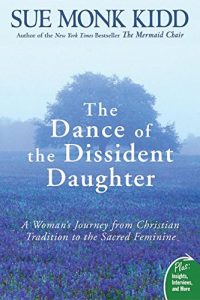
The Dance of the Dissident Daughter: A Woman’s Journey from Christian Tradition to the Sacred Feminine

First off: holy wow, but The Dance of the Dissident Daughter has a long title.

Second off: I know, I know, there are all kinds of reasons why it’s bizarre that I read this book. I’m not so much a woman, nor am I steeped in Christian tradition, nor do I spend very much time with non-fiction, outside of the historical. But I was asked to, and I said I’d give it a try, and here we are. So.

It turns out that once upon a time, the author of The Secret Life of Bees (which is a book about which I know essentially nothing, but I bet you’ve heard of it, too) mostly wrote in the thriving world of inspirational Christian books, a world that was alive and doing very well long before Left Behind burst onto the scene.[1] And then one day, which would far more accurately be portrayed by me as over a series of several months and years, she realized that her religion as it is practiced in her church and by most people she knew, and not incidentally in a way that also matches my experience on the topic, is really not very good for women. They are made to feel inferior by words both spoken and left out, by numerous deeds, and by unavailability of responsibility and influence. And after she realized it, she started taking steps to repair her life. And after she had repaired her life to her satisfaction, she wrote a book in the hopes that other women out there could also get a little bit of the same kind of repair.

Me, then, not so much the target audience. My responses are many and varied and far too extensive for the scope of this review, even were I inclined to try to present them all. But they are certainly colored by the fact of feeling so far outside. That is, so many of the complaints that she had about the church as a monolithic entity (which it is of course not, but in many ways it acts enough as one to move the discussion forward with and handwave that of course there are exceptions) were highly similar to experiences I’ve had, in which the self is devalued at the expense of the group and of tradition. Some of these complaints were specifically related to being a woman, of course, but many were not. And yet the book is very explicitly and throughout addressed just to women instead of to everyone. But at the same time, it’s really difficult for me to validly complain about being the excluded gender in this book when I’m the included gender in the majority of books out there, especially here noting the Bible in this category. I guess if I were the kind of person who hasn’t internalized the inherent correctness of gender equality, this could have been some kind of important wake-up call?

Anyway, that’s a sample reaction to the book. Feel free to discuss it with me in person, and I’d expect to be able to come up with others. It was, in any event, a very interesting book wherein I got to have a conversation about a lot of things that are typically well outside my experience. The author has some written tics that bothered me from time to time, as I’ve said about previous things I’ve read. In this case[3] as in those, it was rarely an important issue, just something that buzzed around my head from time to time. On the whole, feel free to read it. There could be something there for you. Certainly the moreso if you’re a Christian woman who is open to the idea that chicks are as good as dudes.[5]

[1] You know, I never did finish that series, and I regularly forget I ever read most of them. They were way worse than Narcissus in Chains, but failed to trigger the sin of unmet expectations in my head. So, oops on that?[2]
[2] My hand to, um, God, that statement was not intended as a sop. It’s just on my mind now.
[3] She would be talking about an event, and state that as the event was happening, it occurred to her that it tied in to this other previous event or to this metaphor that she’d recently been considering regarding her spiritual changes.[4] And the thing is, I’m sure that happened sometimes, but she says it so often that I eventually became unwilling to believe it really happened right then, and not far later as she was gathering her thoughts and her notes in order to tell her story. I try to be a fairly thoughtful person about my actions and motivations, but I’m not always on like she would have to have been. (And she certainly might have been anyway, it’s just so far outside my experience that it grew to bug me.)
[4] I feel so petty even complaining about this! But is it genuine pettiness, or is it gender-guilt? You decide! (I think it’s genuine pettiness, for my part.)
[5] I’ve gotten in trouble for saying this before, so I feel obligated to clarify. “as good as” can be taken as loaded language, but I don’t believe it to be so. Our societal problem is that men are perceived as being more valuable (your quantifiable or qualifiable scale of choice here) than women. Changing that perception necessarily, I would claim, requires that the value placed on women rises. The value placed on men could instead fall, but there are all kinds of psychological and sociological reasons why I feel that would be the lesser of the two choices.
Doomsday

Spring is a weird time for movies. I mean, usually not for me, because it’s often full of horror options, but it feels like there are fewer this year than usual, and thusly I join the ranks of people for whom spring is a weird time for movies. Or I could get off my ass and start catching up on the horror movies that are available to me, but I’m getting way the hell off topic here. What I’m actually trying to say is, there are all kinds of movies that I sort of want to see, enough to keep me going twice a week for probably the next month solid. But there are practically no movies that I want to see so badly that I can immediately point at the listing and say, “That’s the one, no question, how are we not already eating popcorn?!” I suppose this also happens a little bit in the fall, but by then I’m so glutted on summer fare that I barely notice.

This is the exact situation that occurred on Monday, after having dismissed the pointlessly bad movies about high school kids using underground mixed martial arts competitions as a metaphor for growing up and the flooded with Spring-Breakers kid flicks. The remaining options were Vantage Point, wherein a lot of people witness and try to unravel a Presidential assassination, and Doomsday, wherein a semi-recognizable actress faces off against post-apocalyptic Scotland. I wanted to see both in a vague sort of way without expecting awesome out of either of them, but we ended up going with Doomsday because it was showing earlier, and also because there’s clearly something about post-apocalyptica that revs my engine.

Apparently, sometime later this year a flesh-ravaging deadly virus breaks out in Edinburgh, say, and England walls off Scotland to contain it. Then thirty years pass. Now the virus has resurfaced in London, and tough-as-nails hot chick Rhona Mitra is sent behind the wall with a small military team on a suicide mission to recover a cure that has only been speculated to exist. What follows is an adrenaline-filled hodge-podge of politics, cannibalism, pole-dancing, gladiatorial combat, piercings, and car chases populated by every single person that’s seen Mad Max Beyond Thunderdome and really wished they’d been old enough to be an extra when it came out. And if the Road Warrior motif doesn’t float your boat, things change directions in an equally awesome way about two-thirds of the way in. All this, plus gory sensibilities and a slick, dark sense of humor surprised me out of my former blasé attitude into having genuine fun at every turn. If the summer were not exclusively reserved for sequels these days, Doomsday would have been a perfect July action flick, and you should consider it an early treat for 2008’s season.

The Signal

I’ve been sitting on this review for a goodly while now, and it’s just not getting any easier to proceed with. Some of the delays were valid, some were due to being busy, but still mostly I’ve just been stuck. Somehow or other I caught wind of this indie horror film, The Signal. Very limited release (two theaters in the area), interesting concept reminiscent of Cell by Stephen King, and some of the descriptions implied that it was also very funny. Which sounds like basically everything I’d want out of a movie. I even talked Jessica into going, though she claims to find such movies far too scary. (And yet she watched 28 Days Later. This is a dichotomy that warrants further consideration.)

So, one night in the thematically named city of Terminus, a staticky image appears on all of the televisions (which are turning themselves on), and staticky sounds emerge from all of the cellphones, landlines, and airwaves. And after a very short period of time, some people are affected. The short description is that they’re all going crazy, but from the characters that we got to spend time with, I’d say instead that they are all being amplified. Whatever primary emotion they are feeling, be it resentment, jealousy, fear, concern, most everything is being blown out of all proportions, such that people are wandering the halls and the streets, committing wanton murder. In the midst of this, we are presented with a love triangle between a woman, her husband, and her lover, which is an excellent use of the background space, particularly after the husband seems slightly unhinged even before any serious effects of the signal are being felt. The story is told in three parts, one from the perspective of each member of the triangle, which is potentially interesting. And it is written by three different writers, which is more or less disastrous. The first portion focuses on the fear and claustrophobia of both the external and internal situations, and was extremely well done. The second portion is a black comedy, and also extremely well done, except for how little it fits with the first act. And the finale is a surrealist nightmare which was possibly well done, except that it failed to match the previous two acts in a new and different way, as well as suffering from the modern short story’s flaw of going all confusing right at the end and allowing you to draw your own conclusions about What Really Happened. That choice is so far outside the horror genre that I have no choice but to be offended and rule the movie lame. Which is a pity, as prior to the last ten minutes, flawed or not, it had at least been constantly interesting.

The Walking Dead: The Calm Before

After two volumes in a row with serious action and plot movement, it was almost inevitable that the newest Walking Dead graphic novel would be a rebuilding affair, and naming it The Calm Before both tightens up that promise and simultaneously swears that the next issue (delayed to April, but still probably within range of my not having to wait for it to be released to read it) will have the most plot action yet. Normally this would not do me much good, but for a change I was a bit relieved that Rick Grimes and companions have been given a respite. Not only that, but Kirkman’s writing in the series is improving both in terms of sustained character growth and of maintaining a good action balance even in the quieter stretches.

For a book that I’m painting as mostly quiet, a lot of things happened! Will our heroes grow so focussed on the external threat posed by the next town over that they start taking things for granted and lose track of the more prosaic, daily threat posed by the ravening zombie hordes that always wait just beyond the fences of their self-imposed prison? Will Lori Grimes’ pregnancy end in happiness or heartbreak for herself and Rick? Will the latest supply expedition return with the defensive measures that the survivors need now more than ever before? And one woman’s tenuous grip on sanity is poised at the breaking point…

Also, lots of sex.

Duma Key

I know what you’re thinking. Goddamn, man, do you even remember how to read?! As it happens, I do. I mean, it’s only been three weeks, right? And, being a Stephen King novel, it was pretty darn long, too. But these are basically candy-ass excuses; the truth is, I’ve just been busy with a lot of other things, and therefore reading slowly. I think it is somewhat unlikely that I’ll read 50 books this year, if things keep going the way they are; right now, for example, I’m on track for a mere 36. But, we’ll see!

Plus, I think I have a subconscious inclination to savor Stephen King books, as though each one is probably the last he’ll ever publish. This is almost certainly not the case, and yet it’s the mindset I’ve been stuck in for at least three years now. Well, as much as I don’t want it to be, I think that I could be satisfied if Duma Key actually were the last one. It was just really good in a way that I can already tell will be difficult to express. I think what really got me was how personal the scope of the story was. I mean, maybe it was personal to King, but that’s not what I’m saying, as I’d have no way to guess it. Rather, despite that it spanned a century and irrevocably altered the fates of three families, everything that happened was vital and immediate and kept me engrossed on the behalf of protagonist Edgar Freemantle.

Following a horrific construction-site accident, Edgar leaves his first life behind for an extended stay on Duma Key in Florida, where he hopes to take up drawing, recollect himself, and discover what’s left of him. He could never have dreamed of the talent he will find, and far less of the power with which that talent is imbued or the slumbering evil that inhabits the southern half of the island. Luckily, he also finds real friends to help him through the many trials that lie ahead, some far more dreadful than the accident that brought him to Duma Key in the first place.

Hey, look, it’s a jacket cover! (At least, that’s the kind of thing I imagine that they say.) One of the many cool things about Stephen King is how he effortlessly glides between genres. If you take away the spooky demon-ghost lady and the supernatural paintings, you’d still have the core of one of those feel-good dramas about people putting their lives together again after vast adversity, like what I imagine Stella getting her groove back must have entailed. I have insufficient interest in that kind of story to seek it out, but here it is, right in the middle of my horror novel. By and large, I approve of this; mostly because it provides depth and breadth to what would almost certainly otherwise be a dry well by this time. King understands what terrifies us, sure, but he also understands our essential humanity; as far as I can tell, he always has, and that’s what keeps bringing people back to him, not any temporary frights in the small hours of the night.

Half-Life 2: Episode Two

Most of my video game time[1] lately has been spent perusing the Orange Box for A) a Half-Life 2 experience that doesn’t involve sparkles flying across my screen[2] and B) an improved gamer score. It has been quite good to me on both counts, and hooray for that. The task has been spread out over so many months, though, that when I finally finished the other new content on the disc, I forgot that completed games get reviews! That is a little bit embarrassing, and the moreso because this is coming a few days out of order. But so be it, I have no other choice at this late date!
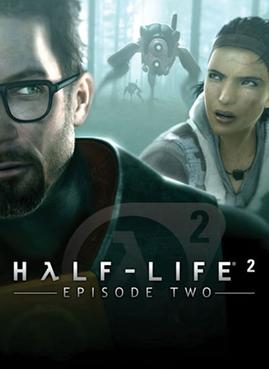
So, right, in the summer of 2006 I downloaded the first incremental sequel to Half-Life 2 from Steam and played it, and other than whatever bizarre video driver conflict I was having, it was extremely fun! Episode Two took rather longer to come out than I had originally heard, and by the time it finally appeared, I needed a refresher. (And a higher gamer score.) So that explains the delay since I got access to this newest sequel. (Well, and Portal, which is its own kind of awesome excuse.) Anyway, I got refreshed and voila, time to play! Which I did.

Directly following the climactic destruction of City 17 at the end of the previous game, Gordon and Alyx are forced to continue their journey to deliver the stolen Combine data on foot. The trouble with this plan is that the bad guys have some pretty brutal new assets for making our heroes dead, and since they’re on the ropes right now, they seem willing to throw almost all of their effort into preventing the success of the resistance. Along the way, there’s a friendly garden gnome, ever more antlions, gut-wrenching drama, and a promise that Aperture Science[3] will feature heavily in Episode Three. These really are the best first-person shooters on the market for storyline; they blow Halo clean out of the water.

[1] Not all; there’s Halo on Thursdays, for example.
[2] Thanks, PC gaming!
[3] Also, whenever Episode 3 is released, I bet Portal will have a sequel at the same time. Which would be fantastic.

Juno

mv5bmtiwmdgwodc5nl5bml5banbnxkftztywmjqzmdm4-_v1_In keeping with a longstanding Shards of Delirium tradition of only watching movies in alphabetical order[1], when I finally made it back to a theater yesterday, I saw Juno. It was exactly the sort of slice-of-life plot outline that traditionally keeps me well away from the theater, right down to the overly twee tagline[2]. And yet there was something about the previews and later the overwhelmingly positive reviews that said to me, “this one, this one you should go and see anyway.” Then, after finally getting around to seeing Jumper (alphabetical order, remember?), I did!
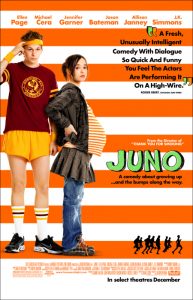
Juno MacGuff, possessed of the life-slice in question, is a junior in high school with rock & roll aspirations, delightful taste in Dario Argento films, smart-ass sensibilities… and a fetus. This last part and more specifically her choices about it, falling rather more outside society’s accepted norm than her other qualities, is the driving force behind the film’s plot. Despite being a sweet and funny (and at one point jarringly melodramatic) story, I don’t think there would have been quite enough there to really draw me in. (Slice-of-life = ew, on average; always has, probably always will.) But the acting! The acting was fantastic. Every supporting character[3] added real depth to Juno’s story, Michael Cera was his usually sweet, bumbling perfection, and Ellen Page… Every so often, you get to catch a movie right at the beginning of someone’s career and realize there’s a good chance that this actor is going to be something special. Kate Winslet in Heavenly Creatures, or Natalie Portman in The Professional. Ellen Page’s turn as Hayley in Hard Candy was another such watershed moment for me, and the only surprise behind her outstanding job as Juno yesterday is that the mainstream recognition is coming so soon. Mark my words, she’ll be even better in five or ten more years.

[1] Discussion topic: when did you first notice that habit? Don’t be shy! You might be surprised by everyone else’s answer!
[2] In case you were unaware, the tagline has been provided practically forever in the mouseover text of the movie’s title link. And eventually, even all of the archives will have this feature, after which some portion of this footnote’s truth value will be purely of historical interest.
[3] Well, okay, not so much Juno’s friend or Juno’s babydaddy’s friend. But two out of a dozen or so is an acceptable loss ratio, I say!

Jumper (2008)

First I was lazy, then I was busy, then I was distracted, then I was sick. Like, a lot sick. Stupid flu. I bet if they’d had the right shot available this year, I wouldn’t have gotten it, is all I’m saying, and then I’d only have three excuses instead of four. (Plus more money, but that’s a separate issue.) Anyway, these problems have conspired to prevent me from finishing a book in practically ages, so I’m alright on that front, but I have seen a couple of movies, one of them weeks ago. So that part is embarrassing, but I shall rectify the issue via a quick review now!
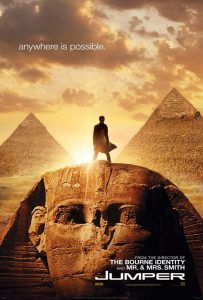
Jumper tells the story of a guy who used to be Anakin Skywalker, but instead of having a lightsaber and a pregnant girlfriend, he can teleport around and also his girlfriend isn’t pregnant. So really, life would be fantastic, since he can steal whatever he needs with no hope of being caught[1] and there’s no child support to worry about. Except his girlfriend notices little inconsistencies in his story like how she last saw him trapped under a frozen river like ten years ago and how he has an awful lot of money for not spending much time at a job and how people want to kill her because she knows him. Which is a pity, life being so great otherwise.

Well, and there’s one other fly in the ointment, I suppose, in that Samuel L. Jackson runs (or at least runs the operational end of) an organization of Paladins who have been hunting down Jumpers for centuries. They claim that this is because only God should have the power to be everywhere, but even a first-year Jesuit could easily point out that the Jumpers are only one place at a time, and anyway God made them that way, right, so what’s the big deal? Clearly the truth of the matter is that Sam is still angry about the time when the kid cut his arm off and pushed him off a building, and he invented this centuries-old underground war out of whole cloth to cover the revenge angle so it would play better to the audience. Which I can understand all of except the part where he actually thought anyone would buy the conspiracy in the first place, because, come on! What did those Jumper dudes ever do to y’all, seriously? If you were Bankers instead of Paladins, yeah, that would be one thing.

I approved of all the nifty teleportastic special effects, and of the awesome location shots, and that they dunked Rachel Bilson in a lake[2], and even in a Little Engine That Could kind of way I approved of them setting themselves up for a sequel. I cannot bring myself to approve of the plot, or really even of using the word ‘plot’ in conjunction with the shooting script that ended up on film. That would be going a little too far. But it had eye candy and humor; even the intentional kind, from time to time. I hope it turns into a cult classic, now that I’m thinking about it, because that would be a pretty fair outcome.

[1] and he doesn’t really need to spend any money on gas or airplane tickets in the first place, such that he could probably go legit as a one-man shipping company, but at least that never actually happens, because holy wow, it would have been boring.
[2] Seriously, prune skin aside, if I had my way that girl would never be dry.

My Own Kind of Freedom

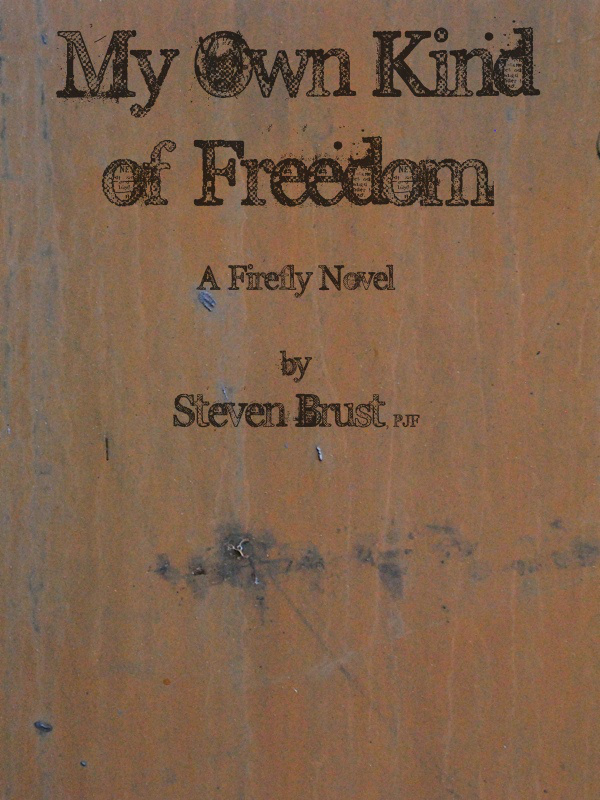
My-Own-Kind-of-Freedom-coverDespite a relative lack of reviews of his books due to the timing of my having read most of them before I started here, I like to think it’s no secret that Steven Brust is one of my favorite authors. And I’m positive that it’s no secret that Firefly is one of my favorite TV shows. So, you know what would be cool? If Brust were to write a Firefly tie-in novel and get it sold and start off a chain reaction of new book farm awesomeness. I mean, probably most of the authors would not work out that well, so there’s that, but I love the characters enough to put up with almost anything out of said hypothetical book farm other than bad character depictions. And believe it or not, that dream may have been closer than you think! However, not all dreams can come true, and nobody ultimately published the novel that he wrote a couple of years ago. Which would be where the story ends, in tears and bloody recriminations, except that he’s self-published it under the Creative Commons license, and you can read it whenever you want, for free. That’s cool except for the lack of future novels and his not getting paid, which he really should be.

My Own Kind of Freedom is tidily short novel set in the nebulous months between the end of the series and the movie, Serenity, and informed by both. Except for being slightly too long for that, it feels very much like an episode of the show, and in all the good ways. A standard shipping run turns quickly dangerous when Jayne and Mal have a parting of ways and Jayne is left free to make another attempt at collecting the reward on the head of the Tams. And, one problem never really being enough to stymie the crew of Serenity for long, unfriendly faces from Mal and Zoë’s past are popping up in the single unfriendliest place the Unification War had to offer the both of them. (And if this summary isn’t enough to get you going, it’s because you haven’t watched Firefly yet. And you really should! So go ahead. I’ll wait.)

Brust’s plotting and typically spare prose are a known quantity by now. His characterizations shine as brightly as if the entire story had been written in Firefly’s script room and then performed by the cast, voices and often images being piped directly into my brain. The story is dense, also a known quantity of Brust’s; the man loves to write just enough to let you figure out everything that’s going on, instead of providing it all to you, piece by piece. All of these are positive things, from my perspective. The only flaw, if you can call it that, is that I’ve been once again reminded of just how little access I have to a universe that could have been mined for years of entertainment. There’s time yet, though. Look how Star Trek turned out.

Untraceable

In yet another thriller for the internet age, Untraceable finds the FBI cybercrimes division in Portland working to track down a murderer that carries out his crimes in full public view over a streaming video website. Naturally they must find him and stop him before he can kill again, but they are stymied at every turn by moderately plausible technobabble about hacked Russian DNS servers and rapidly changing IP algorithms, so they must ultimately rely on old-fashioned police work involving witness interviews, basement construction-age estimates, and so on. It is at heart a boilerplate genre film, indistinguishable in most ways from dozens or hundreds of other thrillers, all of sufficient workmanlike quality to provide an entertaining distraction without really standing out years or even months later.

There were two important distinctions from the mold, however. The first was a Saw-like twist on the murders themselves. After setting up his death traps, the killer tied their activations to the number of connections open to the streaming video site. If people were not watching, nothing bad would happen to the victims. So he was able to split responsibility with a monolithic and voraciously thrill-seeking public that has long since been anesthetized to images of violence. And the second was the depiction of Diane Lane’s lead investigator. It wasn’t that she was a capable woman who was really good at the technical side of her job and simultaneously good at taking care of herself. Hollywood does that all the time, these days. What impressed me was that the script didn’t make a special note of these qualities in her. In a way, I feel like by pointing it out myself, I’m reducing the awesomeness of them not having done so; but it’s such a rare thing that it struck me, and I want to hand out the kudos in the hopes that this becomes as common as the tough, capable chick that everyone feels a need to mention just how tough and capable she is in today’s cinema.

I was a little disappointed by it not being the kind of plot you could really unravel and solve in advance, and also by only minimal discussion of the sociology of Americans inherent in these traps garnering enough viewership to kill their victims. But I really like to figure things out in advance, and I’m really interested in the kinds of things that we’ll collectively, anonymously accept that we would be horrified over in more individual situations, and I can’t really fault the writer for having a different focus. Certainly my overall impression wasn’t reduced by these omissions.

Also, despite being a Tuesday afternoon, there was a pretty girl in the theater. So, that’s alright.