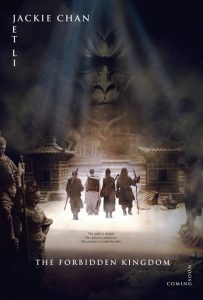
The Forbidden Kingdom

True confessions time: I never really got deeply into kung fu movies. I mean, I watched Bruce Lee movies when I was a kid, because they were just there for the taking on weekend afternoons on the UHF channels, and how could you not watch them? And it was awesome to see all the ass-kickery as Bruce (or whoever) made his way through an army of lesser men and then took out some bad guy or other in an ultimate confrontation. But I never really got into the storyline, just the chopsocky. And then later Jackie Chan appeared with his death-defying stunts of pure awesome but the same kind of storyline. And then Jet Li and his hidden snapper brought wuxia to my attention, with its emphasis on magical realism and Chinese folklore, and finally there were plots that I could get into, but I knew there was a ton of background to it that I somehow managed to miss on those long ago weekend afternoons, and I’ve felt kind of out of the loop ever since. It’s very tragic.

The thing about The Forbidden Kingdom is that it felt just like an introductory guide to the genre that didn’t assume you would know everything that was going on. A kung-fu-obsessed teen gets caught up in an armed robbery gone wrong, ends up with a magical staff, and is transported to historical China, where the staff must be returned to the Monkey King, lest the land be held forever under the tyranny of the Jade Warlord. Luckily, he has help in the form of traveling drunken scholar Jackie Chan, laconic monk Jet Li, and really hot chick-in-search-of-revenge Sparrow. He’ll need all their help, considering that the Jade Warlord has an army nearly as unstoppable as he is all by himself, plus a newly hired witch. (Upside of Chinese witches: they are also extremely hot, not bent and crone-y like lame Western witches. Downside: in addition to the magical powers, they also know kung fu. But, well, it’s historical China: everyone knows kung fu, is what I’m trying to say here.) And so our hero has to live out years of daydream fantasies, but with the complications that real life is a lot harder than imagination, and also a lot more deadly.

I got sidetracked by plot just now, but my point is, the hero-kid’s eyes gave me the window I needed. This was slightly ironic considering that he should have understood everything that was going on, what with his obsession with the movies.[1] But the huge blindspot between the movies and the reality (if you will) left a lot of room for explaining things to the audience. So if you’re like me and you accidentally missed this boat, or if you’ve got a kid that is in serious need of some Eastern cinema, The Forbidden Kingdom is a really great place to start. And if you’re not like me and you have been involved in these genres all along, well, my highly unscientific survey of one person says that it was pretty great through an old hand’s eyes as well.

[1] Or I guess it could be that in the movie’s reality, not unlike my apparent own, wuxia didn’t exist as a genre for him to have watched? If so, this was unclear at best and I think disproven by modern movie titles.

Fables: Animal Farm

I really am reading slowly lately. How else to explain a four month turnaround to cycle through my graphic novel serieses? At long last, I’ve made it to the second Fables volume, Animal Farm. As alluded to in the initial book of the series, not all of the exiled fables can mix with the mundanes in New York City. Talking pigs, just to toss out a random example, would be remarked upon in ways that a high-powered businesswoman, no matter how coal-dark her hair or snow-pale her skin, would not. And so, the giants and the dragons and the Three Bears and Louie from the Jungle Book and Chicken Little and pretty much anyone else you can think of along these lines are kept in a spacious preserve upstate.

As the arc opens, Snow White is off north to perform her biannual inspection of the farm, addressing the residents’ concerns and the government’s alike. She also hopes to reconnect with an estranged family member. What she does not expect is what she finds: a populace tired of being caged away, on the verge of full revolt, and planning an armed insurrection against the Adversary who has driven them from their original homes. An insurrection that, notably, hopes to keep its secrets until the plans have ripened. And thanks to his lack of popularity among the quadruped populace, there will be no Bigby Wolf to protect her this time.

Although the storyline flowed directly from the events of the first book, the tone was quite different. Rather than breezy noir, Animal Farm was packed with political rhetoric and literary references and a fair bit more darkness; thinking about it now, in fact, it was dark on a scale that you’d expect to see in the original fairy tales, before Disney and Charles Perrault took to clean them up. As much as I enjoyed the noir tone of Legends in Exile, Animal Farm pulled all kinds of strings with my more firmly entrenched literary scholar side. Good stuff, and I’m once again looking forward to volume three.

88 Minutes

So I saw 88 Minutes, starring Al Pacino and Leelee Sobieski and a fair number of recognizable TV actors. (Oh, and the serial killer guy is also mostly in movies, but I can’t remember his name. You’d know him if you saw him.) Anyway, Al Pacino is a forensic psychologist for the FBI who testified to get the serial killer locked up, but it’s questionable whether his testimony was completely accurate or fair, and maybe that guy actually isn’t a serial killer at all, y’know?

Therefore, come the scheduled day of execution, things go wonky. There’s a copycat killer in town for the first time in 8 years, unless it’s the real killer? And evidence points to Al, who meanwhile has been warned that he has 88 minutes to live by someone using trademark phrases the convicted guy used during the trial. And anyway, maybe Al really is the serial killer, in which case it’s the convicted guy and not the real serial killer threatening him? Plus, there has to be an accomplice, which might be his TA, or one of his students, or the creepy motorcycle guy who’s stalking around everywhere.

That right there is where the movie excelled. It ratcheted up levels of paranoia, both in Pacino and in the audience who couldn’t be sure about his real role in events, on a non-stop basis. And there were layer after oniony layer of new questions continuously being exposed. The problems I had weren’t really enough to bring me down from that high, but they were real problems.

For one thing, the script was often wooden. I would normally blame this on the actors, but I’ve seen these actors excel elsewhere, and I know that when you’ve got a Pacino on set with you, your game is naturally raised up anyway. So I listened to the lines themselves divorced from intonation, and hotty Alicia Witt bemoaning her choice to fall for her professor while he sits beside her in stony silence, almost as if she’s supposed to be having an internal monologue, that was a terrible scene. But I can’t believe it’s because she or Pacino are terrible, which leaves few options. I suppose the directing may have been bad instead; or perhaps they colluded, partner-style, one from prison? Oh, oops. Forget I said that. Anyway, that was an occasional issue, plus the ending kind of stalled out for me. But since I can’t point to any specific complaint, it may just tie back into the original issue, that the villainous monologue had the same kinds of problems as at other script-points.

But I’m seriously about the paranoid tension. They hit that one out of the ballpark.

Confessor

41zwvtAmaML 51VSfzZ9TcLThat’s that, then. The Sword of Truth series is officially over, marking, what, the second open-ended series in my adult life to be completed by its author? (The only other one I can think of is King’s Dark Tower series, though it technically predates my adult life.) The final book, Confessor, very nearly drew me in. Despite the inevitable lecturing on the nature of good and evil as they relate to objectivism, there were some really solid moments. I’m thinking especially of the climactic rugby[1] game in the middle of the book and the events that followed after. I know that sounds like a ridiculous (if not outright parodic) thing to say, but I’m sincere on this point. There were 5 or 10 chapters of non-stop action that was probably as affecting as anything I’ve seen Goodkind write; my pulse was up, I was excited to see the outcome of the events (not just the game), I basically couldn’t put the book down. So, hooray for that.
My complaints, alas, outweigh that moment. I mean, I’ve accepted that objectivist screeds are an inevitable side-effect of the series, but there’s more to it than that in this book. It’s that the first screed was performed between two of the good guys, and since the good guys are all on the side of objectivism, it was required that one of them act angrily out-of-character so that the other could calm him down with the clear truth of things. It’s that a later one was performed by a (let’s say) 10 year-old girl, explaining to a (let’s say) 14 year-old girl that it was the teen’s own evil choices that had led her to this fate and she had nobody to blame but herself, moments before her flesh was devoured from her bones. It’s that the climactic screed was performed to an audience of, literally, every person in the entire world. (That’s right. Literally.) Plus, on a non-screed topic, it’s pretty clear that in the last 200 pages Goodkind still had about another book’s worth of story to tell, but was either out of screeds or tired of the series or wanted to stand by his promise that it was the final book, and so he had to rush things to a degree that was certainly all out of pace with the entire rest of the series, but that also[2] genuinely felt like important explanatory events were being left out. Plus plus, I’m nearly positive that elements of the series’ conclusion were lifted from Atlas Shrugged. But this last is not something I’m willing to elevate to the level of complaint, partly because I have thusfar failed to finish that book and partly because I’m pretty sure it would properly be called an homage, anyway.

If you’ve made it this far[3], you may as well finish the series out, right? Plus, that middle part of the book was, I reiterate, genuinely good.

[1] I mean, it’s not exactly rugby. But close enough for the purposes of this review.
[2] Because, and let’s be honest, it’s hard to see that as a negative at first blush. Objectivist screeds kind of break up narrative momentum, is what I’m trying to say here.
[3] And let’s face it: you haven’t.

Run Fatboy Run

Way back at the dawn of Delirium here, I watched a fantastic movie called Shaun of the Dead. It was a satirical zombie-laden romantic comedy which was also hilarious, and I cannot recommend it highly enough. Later, I watched Hot Fuzz due to it sharing some of the same actors, including the lead actor and co-writer, Simon Pegg. Hot Fuzz was a satirically over-the-top action movie, and it was also hilarious as well as highly recommendable.

At this point, it is fair to say that I am essentially sold on Simon Pegg. Therefore, it is no surprise that I’ve been to see his most recent starred and co-written movie, Run Fatboy Run. It’s maybe a little surprising I waited this long to see it, but sometimes life jumps in the way, all scary and monster-like and you have to run through the woods while it plods implacably behind you. You know, the kind of metaphor that would be pitch perfect if I were using it to segue into Shaun of the Dead? It maybe seems a little more out of place describing a straightforward romantic comedy about marathons; I suppose life doesn’t always do what we’d like, though, and there’s no help for that, and you just have to keep on putting one foot in front of the other nevertheless. (Oh, neat, the metaphor fixed itself!)

There’s no denying that this is exactly what Run Fatboy Run is. No satire of sports films here; the montage scene is even played straight. But there’s nothing wrong with these guys doing a normal romantic comedy, as long as they promise to remain hilarious. And, hooray, they have. If my heart was warmed at the same time, so be it! Plotwise, Simon Pegg leaves his extremely pregnant girlfriend at the altar, and 5 years later he’s finally starting to realize what a tremendous mistake that was, by virtue of spending time around her as they do the friendly visitation thing around their son. Only, now he’s an out-of-shape slob who hasn’t accomplished anything worthwhile in that same 5 years, and his ex- has a new boyfriend (will he turn out to be a prat?). So he decides to prove his love by running a marathon. Hijinx, as they say, ensue.

In review: yay, Simon Pegg, for being an awesome writer and actor both. Everyone should be watching all three of these movies!

Ex Machina: Tag

When I read the first volume of Ex Machina, I wasn’t very impressed. The story just failed to grab me, which was a pity since I like the author so much. But it got reasonably good reviews in the comments, plus my graphic novel buddy liked it, so I proceeded apace, which pace is more akin to a crawl these days, but I digress. The important part is that I’ve read the second volume, Tag, and now I’m sold.

It still has all of the high-level (and very occasionally, the nitty-gritty) politics of running New York City that Mayor Mitchell Hundred has to deal with, that I found simultaneously so well-written and so non-involving last time. But instead of a somewhat lifeless origin story holding the politics together, they threw in a solid plot with far-reaching ramifications that I’m excited about seeing further investigated, and the moreso since this is the same author as the superb Y: The Last Man series. He’s pretty well proven his ability to have a destination in mind for his world-spanning mysteries, which would be my only remaining concern at this point, the art having been solid. (Well, I could take or leave the faces, but everything else is dandy.) The mystery in question, interspersed among Hundred’s dating life and dealings with school vouchers and gay marriage, goes to the heart of his power over machines. Because whatever it was that gave him those powers appears to be cropping up in other places in New York now, and affecting other people in dire and possibly diabolical ways. Mysterious!

Leatherheads

I hate writing this kind of review, because it will look like I’m complaining when in fact I really rather liked Leatherheads. George Clooney is always a delight with his charisma and spot-on comedic timing, Jim from the Office is, if not quite as awesome as on the Office, certainly a fine addition to the cast, and Renée Zellweger, okay, her face kind of looks like a lemon to me, but as this has no real bearing on her talent, I should probably not have brought it up. Plus, it was in general a highly amusing film that also managed to be sweet and occasionally dramatic.

Of course, that last bit is what my complaint-sounding statements are all about. The movie almost seemed to have multiple personality disorder. At times it was a straight (albeit made-up and played comedically) representation of the coming of age of professional football. At times it was a romantic comedy, triangle-style. At other times it was one of those sports underdog movies, complete with the Big Game in which Everything is On The Line. At still yet times it was slapsticky in the style of the 1920s era in which it was set, complete with a Keystone Kops chase scene. And there were odds and ends of other things besides these. To be clear, it made a pretty good show of every genre it tried to hit upon, but the gestalt was nevertheless a little off-putting, not unlike this abrupt ending.

Revelation

In the book of Revelation, we finally discover what’s been going on with God’s plan for Creation, plus there’s a lot of drama involving trumpets and earthquakes and some prostitute from Babylon 5. I don’t want to give away the ultimate climax, but, spoiler alert, Jesus is finally back, after we’ve all been waiting for what seems like millennia at this point. What I can’t figure out is how, if this is the penultimate novel of the Legacy of the Force series, they’ll have anything remaining for the last one.

Oh. Um. This is embarrassing. It turns out that the book I read is also called Revelation, but just that title by itself. Oops! So, right, completely different plot, but it fits much better as a next-to-last book, so on the whole I have to approve. (Sadly, no Jesus.) We’ve come back around to another entry focussed on Boba Fett, except this time it finally ties into the overall plot of the series, leading me to care a lot more. Plus, Mandalorian society and Fett’s personality are both a fair bit more interesting than they were in the previous such volumes, making this easily the best of Traviss’ three entries to the series. In addition to the superior character- and society-building being done, the plot that has to do with the new Sith Lord’s ascendancy that we’ve been examining over the past eight books now is also returning to the quality form of the first couple of books in the series.

Unfortunately, I’ve reached the point where anything I could say that holds meaning will be a serious spoiler for the first half of said series. I doubt this will really bother anyone, but on the off chance, look below the cut.

Continue reading

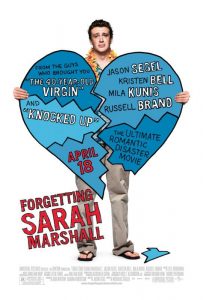
Forgetting Sarah Marshall

mv5bmtyzodgzmjaym15bml5banbnxkftztcwmti3nzi2mq-_v1_After finishing the first Lucifer volume, I started reading Dzur, which is nice because I haven’t read a Vlad Taltos book in years. Both of these events (the finishing and the starting) occurred while in line to see a sneak preview of a movie coming out next month, Forgetting Sarah Marshall. After getting a couple of chapters into the book, the movie started. And then I left it behind in the theater, not to be discovered in the Lost and Found this morning as I had hoped. None of which would be particularly relevant, except that the last time I lost a book in a theater, it was Brokedown Palace by the same author and set in the same universe. I’m assuming there’s a lesson in that, somewhere. But mostly it means that when I review the new Star Wars book I’m currently reading instead, it will suffer by already not being nearly as good as Dzur was. Dammit.

But anyway, there was also this movie, right? Marshall from How I Met Your Mother is a composer who’s dating actress Veronica Mars (and writing the incidental music for her cop drama TV show), but then after several shots of his cock taking up the majority of the early-movie screen time, they break up because she’s cheating on him with some British rock star. After weeks of misery, he goes to Hawaii for a vacation, only to discover that Veronica and her new rocker boyfriend are staying at the resort. Also, Jackie from the 70’s Show is one of the hotel staff, and she has her eye on Marshall, who I should probably be referring to in some other way to avoid confusion with the film’s title. (Veronica Mars is Sarah Marshall, incidentally.) In any event, hilarity ensues, and there is a pretty great supporting cast to help the hilarity along its way. Also written by Marshall, aka Jason Segel, Forgetting Sarah Marshall is consistently funny across several genres of humor. The writing is a little looser than it could be, with a couple of characters seeming to serve no plot purpose at all, but the laughs make up for a lot.

And what they don’t cover is handled deftly by the film’s soft, gooey center. Three out of the four major characters are achingly human in between the laughs, trying to make their best of a horrible situation that we’ve probably all experienced at some point, a situation in which there is plenty of blame to share around to all parties. But, I mean, don’t go see it because of the romance and drama. Go see it because it’s pretty hilarious, and then just be pleased by the perks.[1]

[1] To sum up, these were a surprisingly realistic and adult portrayal of a rocky break-up, Kristen Bell on constant bikini display, and Marshall-cock.

Lucifer: Devil in the Gateway

So, you know Sandman? Awesome series about life, death, love, dreams, family, and the nature of reality, in comic form and written by Neil Gaiman? Let’s assume you do and move on, because the alternative would take far too much time. (I have reviews of many of the titles, but you should not read them, due to spoilers and really deserving an uninfluenced first look.) Anyhow, there’s a spin-off series of comics about the character of Lucifer, last seen in the Sandman series having abdicated his rule over Hell in favor of running a Los Angeles nightclub-slash-piano bar. And I’ve known about it for a good long time, but I never got around to actually reading any, until now.

The first volume, Devil in the Gateway, picks up with exactly that premise, and then of course proceeds to throw him headlong right back into the politics of the celestial realm. I’m trying to come up with a way to explain it with more detail than that, and I’m failing spectacularly. Every step springs naturally from the one before, and in that sense there’s apparent tight plotting. But every step is highly episodic in nature and difficult to describe without going into verbose minutiae, which I would prefer to avoid. So take my word for it that the stories are individually as well as collectively interesting. If there’s a central theme running through them, I’m missing it; but as with Sandman, it could be the case that the first reading is for enjoyment and the second is for depth.

What I can talk about is our main character, Lucifer Morningstar himself. Although I expect a more detailed and different account to emerge over the course of the series, for now it’s fair to say that it’s the same Lucifer you’re thinking of. Led a failed revolution against the omniscient Lord of Hosts, was cast out of Heaven, and created or was given the realm of Hell to use as the scourging ground for all mankind. That guy. Carey plays him up as antihero in a way that is very appealing to me. His rebellion was about freedom from predestination, he claims, but reading between the lines, it is apparent that he’s only interested in freedom for himself. His deceit is the very best kind, that tells people true things that they want to hear, leaving out only certain inevitable unpleasantries that they could easily have heard if they’d taken the time to listen. Horrifying as he would be to know in person (and of course there are real people like him out in the world to be known; give the devil his due!), as a character he is very entertaining indeed. And it’s quite clear to me that his goal has never changed: he still wants to be free. I look very much forward over the course of the series to finding out whether he can succeed, as he seems to believe.