Ultimate Spider-Man: Learning Curve

Once again, expectations have served me greatly. With a name like Learning Curve, I expected this second Ultimate Spider-Man story to mostly revolve around Peter learning to deal with his new powers, such as climbing on walls and being strong, and that this would be basically fine, but nothing to write home about while waiting for the next good story to start up.

Instead, I got a sensible revamp of several eye-rollingly silly criminals from the early Spider-Man run (and also Kingpin, who I haven’t even gotten to yet in the originals), as well as the beginnings of Peter’s work as a freelance photographer and the beginnings of a relationship with Mary Jane. On top of this, there are some seeds scattered about for future plot development, and Aunt May seems like a real and interesting character, which I would not have guessed was possible; in my experience she has only ever been a device to serve as a limiting factor on Peter’s choices in life. All this, plus the learning curve in question is Spider-Man learning to behave intelligently instead of bulling forward into fight after unwinnable fight. Which is to say, something that’s actually interesting to read about, and not filler in the slightest.

All of that plus the beginnings of the smart-mouthed banter that was, at least to my eye, Spidey’s first real trademark maneuver have gelled this series in my mind as my clear favorite in the super-hero genre, and in the top 5 of graphic novel series generally. Looking forward to more quite eagerly, let me say.

Buffy the Vampire Slayer Omnibus, Volume 2

Apparently, the first omnibus of collected old Buffy comics didn’t leave that much of an impression on me, because I’ve felt no particular drive to read the next one since. The only reason I did now is because I’ve been trying to put off starting something new before the next Walking Dead collection comes out. But it’s been delayed by another month at least, and what the hell is up with all that? So, I caved. But the thing is, I mostly liked the first Buffy collection, both in my memory and in my review, so on the whole, inexplicable!

Volume 2 picks up still a little before the start of the series, but then rushes ahead into early season 3; I’m left with the impression that the comic didn’t start until season 3 or later, and that’s why things have moved so fast. As much as I still appreciate that the order of the comics is in show-chronology rather than publication, it is a bit jarring to see Dawn in the earliest comics, and then have her vanish from later ones when the writers were not aware that she would exist later.[1] In any event, most of these stories don’t do much to indicate when they are set, so chronology lets me only spend a few minutes trying to work it out, instead of the hair-tearing that would be happening if they were just scattered randomly.

As for the book itself: definitely a bit of a letdown from the previous. Part of it is that the art is either worse, or still as iffy but stands out again from what I’m used to, after the delay. But also, the stories mostly just didn’t do it for me. The first long one was a little too heavy on existential angst, the ones focused on writer favorites Spike and Drusilla were basically fine, the one set during Angelus in season 2 was quite good, and the remaining couple were pretty meh; one included an incomprehensible denouement, and the other had Giles’ niece as a really annoying character who contributed nothing. She wasn’t even whoa awesome enough to write her off as a Mary Sue.

I never really disliked any of it, besides the niece. But I occasionally wished it would be over so I could be reading something more interesting. This makes me skeptical about my likelihood to buy future volumes, barring if I see them used somewhere.

[1] But she’s still added a bit of flavor to those pre-series issues, and I can get behind that.

Harold & Kumar Escape from Guantanamo Bay

MV5BMTQ0NjgzMzQ1NV5BMl5BanBnXkFtZTYwMzI1Nzc4._V1__SX1217_SY911_It is unfortunate that I watched Harold & Kumar Go to White Castle before I was reviewing things, because its sequel practically demands to be compared to the original. Which I can do, but not very well without an original review to refer to; so I’m going to have to think of some things to say about the movie on its own merits as well, which is just annoying.

After returning from dinner, stoners Harold (Wall Street accountant) and Kumar (medical prodigy with a slacker attitude toward med school) hop a plane to Amsterdam in pursuit of Harold’s new romance with neighbor Maria. But before the plane gets far out over the Atlantic, their ethnicities and certain illegal drug-related activities find them hauled off to Guantanamo Bay under suspicion of terrorism, and then across the South toward Texas to find someone who can get them out of trouble with the law and incidentally maybe stop the wedding of Kumar’s college ex-. Plus, Amsterdam is still beckons from beyond the horizon.

The blend of scatalogical, sexual, political, racial, hallucinogenic, and romantic humor leaves something for just about everyone, and it was funny far more often than not. My complaint, I guess (here comes the comparison motif), is that in trying to recapture the frenetic pacing and good-natured insanity of the original film, they lost the deep current of lackadaisical fun that made it so brilliant in the first place. As a comedy, it was largely successful. As a sequel, it made a valiant but ultimately doomed effort. On the bright side, Neil Patrick Harris once again spent five minutes of film single-handedly being worth the price of admission, brilliantly portraying a beyond parodic version of Neil Patrick Harris.

Micah

I was getting ready to work up a movie review from last night, when I realized I’d finished a book a few days ago and not ever reviewed it. I mean, it was the weekend, when I rarely review anything, so the delay is understandable. The forgetting, though, quite a bit less so. I’m not sure if I’ve ever done that before, or even come close. All of this would seem to indicate bad things about the book in question, and maybe reading between the lines they do, but my expectations for Micah were set so low that I walked away pretty happy about the outcome.

Yup, as intimated recently, I read another Anita Blake book. My outline created from the several most recent books states that a book in the series will start out with a mystery, quickly shift to sexual politics among Anita’s many were- and vampiric lovers, possibly also include were- and/or vampiric politics as well, occasionally hint at the mystery, and then draw it all together in the final 50 pages, sometimes very neatly and impressively but other times wildly implausibly. But the sexual politics is definitely the unfortunate-image-inducing glue that binds the whole plot together. I’ve pretty much typed this exact paragraph in a previous review; I revisit it here because Micah is not the usual Anita Blake novel. It weighs in at a light 250 pages, and with the font and spacing choices factored in as well could not be more than a third of the length of her last several books. The big question, then: what was removed from the formula to allow for this unexpected shrinkage?

My dread was that it would be all sexual politics (or possibly just sex completely divorced from any kind of characterization or plot), with no mystery or anything else. To my surprise, it was something rather more than that. There is a plot, and of course there are sexual politics, but mostly it was a chance to provide a little bit of character growth between Anita and her most recent and eponymous boyfriend. Actual growth, relative to the reader’s previous knowledge and between each other, as opposed to the typical jockeying for sexual political position that has often masqueraded as character growth lately. And the plot, bare bones though it is, wasn’t half bad. I once more believe that Hamilton can still write good mystery fodder, if she is willing to sit down and actually do it. Rumor tells me she probably isn’t willing, though. Neverthless, I retain hope!

The Ultimates: Homeland Security

To be clear, this was not the next book in question, although I’ve now started that book, and it really will be the next book reviewed. It’s just, I still hadn’t found a replacement for my vanished Dresden Files #3, and took the excuse to make a little bit more delay by reading a little bit more Marvel modernity. (And, as I expect to like the next Dresden Files, you can see that I’ve still failed to find it or its replacement copy. Alas, for more reasons than one.)

Anyway, the continuation of the Ultimates, Homeland Security, was every bit as good as the original; what it lacked in characterization (which was not much at all), it more than made up in plot. In brief, the Ultimates (substantially expanded in scope from volume 1) must defend the world from shape-shifting Nazi aliens bent on the destruction of free will. Which I know sounds awesome enough all by itself, but it includes battles between massive military armadas, superb plot twists, semi-cannibalism, and discreet incestuous undertones. Plus, like I said, fantastic characterizations. Quicksilver, only present in a couple of scenes, is worth the price of admission all by himself on that front, and everyone else is well worthwhile. (Except Henry Pym; deeply flawed, I can handle, but he was pretty boring in this one. Still, that is a minor complaint, and about my only one. This is, as the first volume was, a flat-out excellent story.)

Ultimate X-Men: The Tomorrow People

Yet more graphic novels! I’ve been going kind of crazy with them lately, I guess? On the bright side, they are filled with an excessively high fun quotient, and when compared to the next book I’ll be reading… well, you’ll see what I mean, I’m sure. In the meantime, the first volume of Ultimate X-Men marks the last new series I plan to pick up from Marvel for a while, probably, so there’s that, anyway.

The Tomorrow People is the least successful as an origin story of the four I’ve read lately. I mean, sure, it introduces a lot of people and concepts, but it does it in media res; which is not a bad thing, except that I felt like if I weren’t already familiar with most of the media, I’d have been immediately lost. We’re supposed to already know about the Mutants and their war against humanity, and we’re supposed to accept that these characters have both person names and superhero names without ever really being introduced to them. It’s not that it affected my enjoyment of the book, but I really think the new people they were trying to draw in would have some early struggles that none of the other series presented.

The good news is, the actual storyline following the origin was pretty darn excellent, if perhaps rushed. Pre-9/11 America is nevertheless obsessed with terrorism, in the form of mutants who have been beaten down too long and now wish to use their powers for dominance over humanity. Before you’ve had barely time to take a blink, three forces are on a collision course: the Brotherhood of Mutants, led by the evil Magneto, seeks to place homo superior at the top of Earth’s food chain, Professor Charles Xavier’s X-Men wish to prevent Magneto’s plans and make peace with their human brethren, and the robotic Sentinels have been programmed to murder any person with the mutant gene. Mix all that in with assassins, unexpected betrayals, secret unrevealed pasts, familial angst and a reasonable portion of sex, and, y’know, good times. I measure this one as just below the Ultimates on the adult content scale, but at the bottom of the entertainment scale of the four series with Ultimate Fantastic Four, at least so far. (But still entertaining!)

Point of historical interest: I’ve never really read modern superhero comics, and only recently the semi-old stuff from the 60s and 70s. Ultimate X-Men marks the first comic I’ve read which contains the otherwise ubiquitous appearance of the female hero with outsized breasts and bared midriff. The only real surprise here is that it took this long, I guess, but there it is. On the bright side, none of them was placed in a refrigerator.

Ex Machina: Fact v. Fiction

The third volume of Ex Machina is essentially more of the same. Which is to say, it contains odds and ends of political discussion[1], bits and pieces of Mayor Mitchell Hundred’s past, both before and after he gained his power over machinery of all kinds[2], and, most interestingly to me, continued gradual reveals about the source of his powers and other related incidents around the world[3]. Also, there’s a rival vigilante superhero in New York City! Plus more drama within Hundred’s past and present support systems!

I’m just saying: still a solid story, about which I have little of substance to say at this point. But I have a feeling that it’s all going to come together someday, and I’ll be, like, wow. It’s a theory, anyway.

Oh, and also, the occasional skyline shots with the remaining World Trade Center tower portrayed prominently? Still just as chilling as they were in the first volume.

[1] Well, really a lot less than usual, but replaced by civic responsibility in the guise of jury duty. Which falls in the same bucket, I guess.
[2] Including a bit of a family bombshell, something I’m starting to realize that Vaughan is pretty good at; I should pay attention to his episodes of Lost and issues of Buffy Season 8 and see if the trend holds there, as it has in this and Y: The Last Man.
[3] See, without going into spoilers, there’s an event that seems related to Hundred’s powers, but which is later revealed to have been a mislead. Except, I’m pretty sure that reveal was the real mislead, and that this information will be very important later.

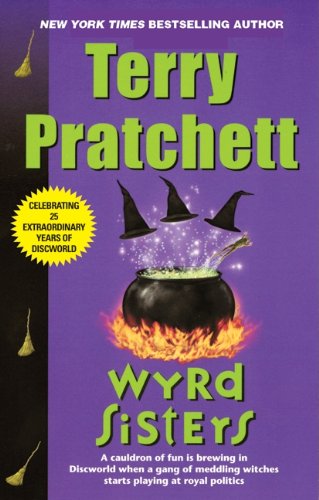
Wyrd Sisters

510tZcYWM+LI’ve just spent some time[1] looking over my past several Discworld reviews. And my memory matched the apparent reality, which is that Wyrd Sisters is definitely the first one that I’ve liked almost without reservation. It is notably the first one since Mort (my previous favorite) that lends itself to thoughtful examination and analysis. Also, it marks the first book to be populated with characters that seemed real and interesting to me right from the start.

The titular witches, who have recently formed a coven at the dreadfully modern urgings of their youngest member, are accidentally embroiled in politics when the infant heir to the throne of Lancre is deposited at their feet by loyalists fleeing from the scene of the king’s recent murder. They immediately deliver the child to a troupe of actors passing by, by way of removing the political odor as quickly as possible, only to discover that the duke who has taken the throne is bent on ruining their lives anyway. At which point, it’s time to get the heir-turned-actor back onto his rightful seat by any means imaginable.

Plus there’s a lot more and a fair bit funnier that I can’t easily shoehorn into a paragraph of plot description. I was definitely moved to laughter aloud now and then. But as I said, the depth was the best draw for me. On the surface, there are glaring parallels with Macbeth, Hamlet, and the actual life of William Shakespeare, all used to the comedic effect for which Pratchett is justifiably famous. But, and speaking as quite a fan of the Bard, the most interesting piece by far was the witches themselves.

I’ve only ever heard ‘wyrd’ in the context of witches and fortune tellers and the like, and I thought I knew that it meant something generally pertaining to that kind of job. To my surprise yesterday, wiktionary defined it as ‘fate’. Which fit very well in that the witches, despite their best efforts, are being forced to take a hand in the destiny of the entire kingdom, if only to maintain their own reasonably comfortable lives. But it fit far better as and pulled sharply together for me what a profound (if unconventional) fit they are for the Fates. Magrat the newly confirmed Wiccan, painfully naive in the ways of the world, eager to be accepted by her sisters, and entangled in a hilarious romantic subplot, is clearly the Maiden. Nanny Ogg can hardly go two sentences without reference to one of her seemingly infinite brood, and she’s as bawdy as they come. And Granny Weatherwax, despite not seeming to be old enough for the role, definitely contains the no-nonsense attitude, certainty of her own superiority in all things, and barely held-back ire that… okay, these qualities are not automatically what I would have expected from the Crone before today, but they work so very well that the urge to say I did is almost overwhelming.

All of which to say this: in addition to being as funny as he’s been yet and providing his best characters yet, this is the book where Pratchett became not just funny, but also very clever in subtly high-brow ways. I don’t think he’s quite where I expect him to be on coherent plotting, but the odds and ends that seemed off to me are partially explicable by the oddness of his world, certainly less glaring than in some previous volumes, and for the most part have already faded from my mind, replaced by everything I was happy about. So they can’t have been as bad as all that.

[1] Okay, not just; more like several hours ago. It’s not like you’d ever find out, or even know the difference. But I could never lie to you, baby, you know that.

Indiana Jones and the Kingdom of the Crystal Skull

I mean, it’s Indiana Jones, right? Star Wars was basically imprinted upon my brain from my earliest memories, and the consecutive releases of The Empire Strikes Back and Raiders of the Lost Ark cemented Harrison Ford as the coolest guy on the planet. What I’m saying is, objectivity is basically impossible. Despite this, Indiana Jones and the Kingdom of the Crystal Skull came out last week, and now I’m forced to try for objectivity anyway. Thanks a lot, Harrison Ford! (And George Lucas and Steven Spielberg!) Which may explain my review delay of almost a full week past having seen it in a midnight premiere showing, although my inclination is to blame my recent vacation instead.

So, it’s been twenty years since Indy was last thwarting supernatural Nazi plots and freeing slave kids and otherwise trotting the globe in pursuit of archaeological treasures. Well, no, since we’ve last seen him doing such things. It’s clear almost immediately that he hasn’t stopped doing them. The only real difference is that 1957 leaves him with slightly tireder muscles at the end of a long day’s adventure and that the jackbooted enemies have a different ideology. The graverobbery and the cool whip use and Indy’s instinctive understanding of and respect for history (both the commonplace and the paranormal), in stark contrast to everyone around him? All of that is the same. And when push comes to shove, that’s what I’m looking for in an Indy (not indie) flick. It can have goofy dialogue and it can have some of the worst effects I’ve ever seen come out of ILM and it can have slightly more pointless moments designed to make the children in the audience giggle than in previous Indiana Jones films. And I’m not saying I’ll like those things; but since it still feels like swashbuckling archaeology, since the core appeal of the film is still there, I’ll accept them.

The real problem I have is knowing that I went into the theater with extremely low expectations, and came out pleasantly surprised. It was about on par with Indiana Jones and the Temple of Doom, which is a low bar for Indy, but still pretty great overall. And now I have to think to myself, what if someone reads this and goes into the movie with higher, dashable expectations? That’s a tough responsibility to shoulder. So, if you want to avoid it because it’ll be crap, you shouldn’t, because it isn’t. But you should also bear in mind some terrible effects[1], cheesy dialogue[2], and a hilariously bad refrigerator sequence are there to temper you back down to thinking it will be bad anyway, so you can still like it. It’s a tightrope, I know.

Final thought, to the lady who was sitting next to me in the airport on Tuesday morning: look, I understand that some people have a hard time with science fiction being inserted into anything in the universe world. I can accept that you walked into the theater not expecting [spoilers]. But I also know this is not your first experience in the life of Doctor Jones. The first time you watched one of his movies, the climactic scene showed a lot of Nazis having their faces melted off of their skulls because they had the temerity to open God’s toybox. The second time, some dude pulled some other dude’s heart out of his chest, without breaking the skin. It might be worth your time to admit to yourself that your complaint isn’t really so much about the [spoilers] as it is about your decision to get rid of your imagination sometime in the last 25 years, and now you resent anyone around you who still has one, because they look like they’re having more fun. Just think about it, is all I’m saying.

[1] It’s not just the prairie dogs.[3] There was a punching battle on a couple of side-by-side jeeps that was as obviously green-screened as anything I’ve seen in the past several years in a Sci-Fi Channel original motion picture.
[2] For my part, I really didn’t mind, and was even amused. But it seems a little incestuous to have Indiana Jones “have a bad feeling about this”. I’m pretty sure I should have minded, y’know?
[3] Although it’s possible I’m wrong, I just kind of assume everyone already knows about the prairie dogs, even if they know nothing else. It’s like they were inserted just to remind everyone that George Lucas still had some creative control?

Ultimate Fantastic Four: Doom

I haven’t found any Ultimate X-Men yet, the upshot of which is that I’ve already looped around on these quick reads to volume 2 of something. I don’t mind so much: there’s a goodly pile of things available, and so far they’ve been uniformly entertaining. That is not, as they say, nothing. The second Ultimate Fantastic Four picks up essentially right where the first one left off. Fresh from their first victory, Reed Richards and company[1] are still working to find a way to become normal people again. And the key to that is discovering what happened to the fifth person affected, Victor Van Damme. He, after all, was the one who changed the experiment’s parameters that caused the accident in the first place. The downside to the plan is that he already knows where they are. Being under effective house-arrest courtesy of the United States in the same Baxter Building where all of their schooling and late night studies took place makes this kind of easy, you see.

I’m definitely still liking the series. The comedic timing is improved over an already funny previous run, and the elements of government control over what is not yet a famed superhero group, but just a quartet of college kids? That’s a story with a lot of depth behind it, if they choose that direction to go in. Plus, y’know, Doctor Doom is there now, and we all know he’s a great adversary.

[1] My historical knowledge of the group, predating any actual reading, leaves me with only his name at the tip of my tongue. So my instinct is to assume that the other names wouldn’t mean a lot to most people. However, I feel compelled to come out in praise of how Sue Storm has been handled thusfar. She’s a modern love interest, in that he seems as much like her prize as she seems like his. And on top of that, she’s a gifted biologist in her own right, every bit as skilled in her field as Reed is in his. It’s a very pleasant contrast with the 1960s version; and make no mistake, even then she was a pretty strong female character for her genre and time!