Tag Archives: science fiction

TRON: Legacy

I saw the Tron sequel (which I know I should be making all caps, yet cannot bring myself to) as a midnight premiere showing, which was… difficult. I can definitely tell I’ve turned some kind of corner, and it makes me sad. Anyway, I definitely liked it, which seems to be a minority opinion on the internet, though I’m not sure why. It is stupidly pretty (although young Jeff Bridges skirts the edge of the uncanny valley when seen in IMAX), it has a lot of coolness, and it has sfnal ideas that, while not very new, are certainly interesting. What’s not to like?

Well… if I had to pick something, it would be that there’s Too Much. I spotted aesthetic elements from The Wizard of Oz and The Empire Strikes Back, story influences from at least three different sources that I’ve since forgotten, and a reach[1] that, just like in the original movie, consistently exceeds its grasp. But I have a hard time grading that harshly, even as I understand why other people might not.

Nutshell: go see it. If you loved the original, this stays true to it while expanding into uncharted vistas, and if you never saw the original[2], this at least gets all of the tech stuff right, which is rare enough in Hollywood to deserve monetary reward.[3] Also, since I spotted a few frames worth of sequel-potential, I’d like to predict that their choice to act on one any time in the next 24 months will result in a terrible outcome. Heed my advice, $Disney_executive!

[1] This again referring to the storyline.
[2] It occurs to me that I’m forced into another one of my footnote plot summaries, since I forgot people might not know much about it, until just now in the editing pass. Both movies contemplate a human-permeable barrier into a computer network called the Grid, in which both full programs and stray lines of code have viable personifications and struggle against stronger programs who have forced them into either servitude or else brutally short lives in a games arena. Whenever a User enters the Grid, plot occurs!
[3] If you think I left out a third possibility, then I am currently glaring at you. For being a bad person.

Crater Lake

Y’know, it’s hard to add much about the Deathlands books, at least anytime soon. I’ve already specified that they’re post-apocalyptic gun porn with implausibly equitable gender politics, right? Then yeah, at that point, there’s not yet a lot to add per book. In this specific book, our heroes are teleported[1] to Crater Lake, where they discover the first gender-inequitable civilization in the series, which is notable both for being populated by obvious bad guys and for not having occurred during any of the previous three books. They also discover, as I got distracted by all the (admittedly non-Bechdelian, but the book is from 1987 and aimed toward teenage boys and gun enthusiasts) non-sexism from pointing out already, the evils of government-funded weapons research and a great deal more about the mysterious Doctor Theophilus. (Which, to be clear, is pretty cool.)

[1] Which you would know if you also remembered that this particular post-apocalyptia has a sci-fi theme, which I know I’ve also mentioned.

Serenity: The Shepherd’s Tale

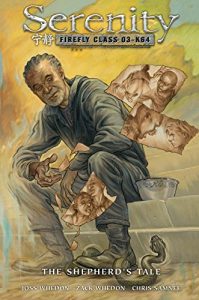
51OPFX5nmALA third[1] graphic novel in the Serenity universe has just recently been released, and I love me my Firefly more than enough to snap it up and into the rotation right quickly. If you are familiar with the universe, the title alone will be all the spoiling you could hope for, and if you are not, this would be a hard (but not insurmountable) place to start. Still, just in case, The Shepherd’s Tale chronicles the history of Shepherd Derrial Book, focusing especially on his life before taking up a berth as a passenger (and eventually as crew) of the Firefly-class transport ship Serenity, a history that up until now has been as shrouded in mystery as anything that happened in that story. There were, to me, a couple of pieces that don’t quite add up, but not enough to object to what was a very well-presented, long term character arc in the fewest number of pages possible. Then again, the nitpicking (and the small sense of letdown from which it stems) could be more about another in an almost certainly finite number of doors closing on one of my favorite stories.

[1] As has been my perhaps unfortunate wont, I read the first two as they were released in comic form. So, uh, oops, no review for you.

The Passage

The Passage is exactly the kind of widely popular fiction that I avoid, the kind that is probably cited as the most recent book read on 3 out of 5 new eHarmony accounts right now. (Well, the ones that acknowledge reading as something people actually do.) I honestly have no idea how it got on my radar in the first place, given that. I guess from a person I know, or NPR? It’s a total blank, I just remember that it got added to my shopping list notepad on the iPhone, and that at the time, I was not shocked, so apparently remembered having added it. My brain works like this far more often than I am comfortable with. Anyway, whatever I had heard was sufficiently convincing, I guess, so I did end up reading it, and really quite early after purchase considering my enormous queue.

But, okay, whatever convinced me was basically right, as the book is at its most basic level a post-apocalyptic overrun-world story, with only a few beacons of huddled humanity in pools of infinite darkness. And I like that setting a lot. As you can perhaps imagine from the title, the people with whom we are concerned don’t just stay huddled under the beacon, but why they go, from whom they are huddled, and what they hope to accomplish are all questions with interesting enough answers that I don’t want to spoil them, except to tease by saying that Amy, introduced in the first sentence of the book as The Girl Who Lived a Thousand Years, is definitely involved. (Every good post-apocalyptic story that isn’t about the actual apocalypse needs a character from Before, to tie the reader to the shattered landscape. Otherwise, it might as well not be set on Earth in the first place!)

So, it has a setting I like and a story I’ve approved of. Why am I not gushing, as I almost certainly too often do? It’s a number of little things that add up to overall dissatisfaction. Like, the perfect record of using “wretch” as a verb. Or the innocent murderer on death row in act one of the story who eventually provided nothing to the plot’s genesis or resolution. Or, and I suppose this is not so little, the overly coincidental coming together of the hero and the plot token just as doom was assured through means unrelated to that doom, without there being some kind of fantastic element or prophecy to justify it.[1] Or the spiritual underpinning throughout the story that never quite gelled for me. Or the sadism of the last sentence of the epilogue. And now it sounds like a story I didn’t like, which isn’t right either. I guess it was a story that I liked a lot, but that had some real need for editing, enough so that I was too often pulled out of the story by it. There is some irony in the fact that I’ve never had this complaint about what are objectively worse books in the Deathlands series.

[1] I am apparently willing to swallow all manner of implausible coincidence, as long as the author tells me that some person wrote it down cryptically generations before.

Neutron Solstice

I am still a little bit astounded by just how well the Deathlands series is paying off for me. Okay, sure, I’ve only read three of them so far and the series is still being published some 25 years later, but the truth of the matter is that the setting, formula, and characters are enough to keep me satisfied for a very, very long time. It turns out that post-apocalyptic gun porn with a hearty dash of science fiction and hints of a large backstory around the edges, being revealed piece by laborious piece, is pretty much my idea of comfort reading. And the irony of it is that my review of Neutron Solstice is essentially identical to my review of Red Holocaust, at least in every important way. The only differences are in the window dressing; instead of the bitter cold of Alaska, our heroes have teleported to the steamy swamps of Lousiana, and instead of Soviet invaders as the enemy, they must face the iron fist of a giant baron who is improbably not named Samedi.

But if you are looking for giant mutant alligators, voodoo zombies, maddening hints of the past from resident anachronism Doc Theophilus, or a decent chunk of backstory on one-eyed hunk Ryan Cawdor, you’ve come to the right place. Of course, you have no reason to be looking for most of those things, but that’s what I’m here for. If you’re like me and societal decay is your literary bread and butter, prepare to be astonished by just how much you’ll care about these characters, and especially by how affecting each scenario can become. Whoever this James Axler is[1], he’s actually a pretty damn good writer. Who knew?

[1] Pete knows, and I cannot help but dread the day when a new author shows up under the farm name, because what if the books drop back down to the quality of generic men’s adventure stories?

Boneshaker

Oftentimes, I do not read Hugo-nominated novels. Basically, any times. This is not by design, and I’m sure you could prove to me that I’ve read several by pointing things out on a list, but I’m at least never aware of it. I wonder if next year I will start? It would at least be an interesting change of pace. This matters to you because my good friend Skwid lent me Boneshaker, on the premise that it was a steampunk/zombie crossover novel and I would therefore like it. Which is plausibly a fair assumption to make.

So, anyway, I did.

Longer review: yes, it’s Seattle steampunk set in the late 19th Century, yes, it has differently-named zombies, yes, it has wholly gratuitous zeppelin chase scenes. Yes, it has a lightning fast pace that would be well suited to future filming. But at its heart, it’s a family drama about parents and children, husbands and wives, learning how to let go and when to hold on. It sounds insulting to say that if you removed the steampunk zombies and gratuitous zeppelins, I could find this story on the Lifetime Movie Network a dozen times a week, but it isn’t. It isn’t insulting at all, because Cherie Priest made me fail to hate the idea of reading [or watching] that story, and it turns out that (as you’d expect) it’s a pretty good story indeed when told interestingly rather than hand-wringingly. I have of course no idea whether it’s better than the other Hugo-nominated books, nor am I likely to. But yeah, maybe next year?

Splice

Here is the main thing you need to know about Splice: it is being mismarketed in the previews as a horror movie. It is occasionally scary, it’s intensely psychological, and it has a moral component big enough for any three normal movies. But except for an unfortunate five minute interlude near the climax of the film, it is decidedly not horror. The real problem is that I’m not exactly sure what else to say; my options seem to veer between massive spoilers and convincing people that they shouldn’t watch it, neither of which would be my intention and both of which seem likely if I really tried to explain it. I’m pretty sure I can manage to dodge the spoilers, but the other part will be trickier.

So, what happens is, there’s this genetic engineering lab being funded by a pharmaceutical company, and the two lead scientists are rock stars in their field, even on the cover of Wired, for their work in splicing various genes together to create new organisms with solid pharmaceutical applications. Also, they are a couple because of how a man and a woman cannot simply be professional colleagues in a movie. (Or, it occurs to me, in comic books. But as this would be a messy digression, I’ll stop now.) Then, like you would probably expect to happen in a sci-fi morality play, they decide that it’s time to up the stakes by including human DNA into their splicing experiments. This is successful via the power of montage, and from there forward what you have is a movie. The thing is, it’s a very disturbing movie, and although I’m glad I saw it and would even say I liked it, I don’t think I want to see it again anytime soon.

Which is exactly the concern I had, because I feel like this was a very successful film in several ways: emotionally affecting, structurally sound, and technically excellent all three. Although I’m not convinced the masses will really understand[1] the distinction, I feel like they did an especially good job by portraying the moral component strictly via the  characters and their actions, never really focusing that hard on the idea that the creation of Dren (the putative star of our drama) had a positive or negative moral component at all. Which, to bring it full circle, is another way I think the previews / marketing have failed the actual movie, though again, I doubt the viewing public will realize that particular “moral” dimension was disregarded so thoroughly.

[1] Then again, the masses won’t go see this movie anyway, so I may not have a point here after all.

Collision Course

As you may already be well aware, William Shatner wrote several entertaining-despite-their-self-indulgence novels about the future of James Kirk, who thanks to various authorial tricks is functionally immortal. You couldn’t take them as high drama, but except for the last one you could mostly like them. Anyway, another two and a half years have passed, which made me due for reading his Kirk prequel novel, Collision Course. The series it was evidently meant to be spawning is not in evidence anywhere, so I suppose that means the book didn’t do too well. I theorize that this is a result of the previous book’s badness rather than any particular flaw of the current one, because honestly it was exactly what you would expect it to be. Which is not to say it was without flaws: far from it. But there are enough of them out to have a pretty good idea of whether you like Shatner’s vision enough to make up for his excess, so nobody could really buy it not knowing exactly what they’d be getting, is my point.

As for said prequel, here’s what it does. It takes teenaged Jimmy Kirk and slightly less teenaged Spock and chronicles their first meeting and the start of their friendship. See, there’s a plot involving stolen dilithium, stolen Vulcan cultural artifacts, and an army of killer children, and they end up in the middle of it due to possible complicity from Spock’s father and Jimmy’s Academy girlfriend, non-respectively. Also, there is a link to Kodos the Executioner, so that’s nice for longtime fans. And as usual, he gets a lot of things right through his many years of time spent in Kirk’s head. The only thing he particularly gets wrong, in fact, is that it’s a little too perfect. All of the important protagonist and antagonist players are involved in the plot from start to finish. There’s no tightening web of intrigue, no choice to get involved. As a result, everything is too pat. Which didn’t make the storytelling less good, but it did constantly take me out of the story. Pity, as it was a quick, engaging read except for that.

On Basilisk Station

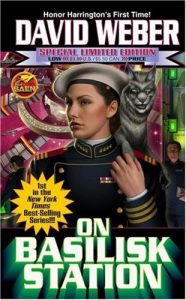
I’m having a hard time writing a cold review of On Basilisk Station, because I myself did not come to it cold; instead, a string of reviews by Mike Kozlowski has colored my perceptions of the entire series for the whole time I’ve been aware of its existence. It is like being in your twenties and finally watching this Star Wars movie you’ve heard so much about from the thirty-somethings you hang out with. And so I’ve got the simultaneous experience of the book itself intertwined with various snickerings as I note the exact kinds of things about the books that he had previously said that are just so ridiculous, and I have to wonder if they’d have struck me as forcibly, at least in this first book, if I hadn’t already known what was coming.

In any event, a rundown for you: a couple of thousand years from now, give or take a century, mankind has spread throughout the stars, only with none of that Earth-That-Was nostalgia for a vanished planet. In fact, the Solarian League (or something like that) is one of the biggest players in galactic politics, though they play no particular role in this first book of the series. And the aliens, such as they are, all appear to be way behind mankind. But that’s because this is a very 18th-19th Century setting, only with spaceships instead of boats, and of course all the European countries were the most advanced, with the native tribes there only to be enlightened or used as catspaws, depending on whether you (like our plucky heroine, Honor Harrington) are a member of the Royal Manticoran system of planets or are one of the socialist and expansionistic bad guys, such as the Republic of Haven are mostly peopled by. Because this isn’t actually 19th C. European politics and warfare, you understand. It’s the future, and we’re in space!

All you really need to know about Honor Harrington is that she’s very very smart, both as a manager of people and as a military tactician. Possibly as a strategist too, but for now she is only the captain of one fast-response warship, the HMS Fearless, so we don’t get to see her conducting a full-scale war like Luke Skywalker does sometimes. At least, not yet, and it’s good we’re in the future, because the Force would not do Luke much good against Honor. Anyway, I may be drifting a bit afield here. The point is, Honor has lots to overcome. For example, she did a bad job in a military exercise because her old reliable weapons were traded in for new technology that only works at close range if the enemy doesn’t expect you to have it, and for some reason everyone expected her to have it in the second through twentieth runs of the exercise. Thanks to this embarrassment of the weaponry and strategic thinking behind it, she and her ship get sent out to the middle of nowhere (on Basilisk Station, you are no doubt shocked to learn) for a pointless picket duty, inspecting merchant cargo for contraband. Also, her crew is angry at her, her executive officer doesn’t respect her (even though he constantly berates himself for it, since he knows she deserves his full support, for being as awesome as she is), and her doctor is a slacker. And this career failure in the making doesn’t even take into account the Republic of Haven and their expansionism that I mentioned earlier.

I think I have never read more escapist fiction, is my point here. I will not speed through them, but I am looking forward to the next one despite myself. Because no matter how bad things get, she’ll be an impressive genius. If you dropped her naked into the middle of the Australian Outback, she would not walk out alive three weeks later. She and her Aboriginal Air Force would have already conquered Sydney by then and be making plans for how to take on China. (I mean, she wouldn’t do those things for the hell of it; we can take it as read that Sydney and China are bad guys, because otherwise they would already be plying her with fresh accolades instead of resisting.)

Also, for some reason, she has an empathic six-legged cat. The book is… well, “good” is not the correct word here. The book is entertaining despite said cat. My understanding is that it is exactly the same as reading Horatio Hornblower stories, but I have never done this thing. So if you like those, or like over-the-top awesomeness that cannot be prevented by any government-built levee, or probably if you like empathic six-legged cats for some reason, then this right here is the book (and probably the series) for you. I know I’ll read more, because even if she is too awesome for me on paper[1], it is impossible to deny the holy-shit face-splitting grins that occurred several times over the course of the last few chapters of the book.

[1] Yes, yes, but I mean it metaphorically.
Warbreaker

It is hard to start a review when you are afraid of saying too much. It is harder still when you are both afraid of saying too much and also have very little idea about what to say. I can say that I’m glad I came to Warbreaker almost completely cold[1], and that this is exactly why I’m afraid of saying too much. I can say that Sanderson has created a third completely new magic system, and that it is really hard to explain even though it was not all that hard to understand. It has to do with an amalgam of color and life-force transference, anyway.

But what I can mainly say is that the story is fantastic. So many different viewpoint characters, each with wholly realized and differing viewpoints[2], failing to communicate the way that Jordan’s characters do but for completely understandable reasons and with real and immediate consequences that aren’t four books of mounting irritation from now. (To be clear, Warbreaker is standalone.) And they exist in a world rife with religious and political conflict that has no easy answers. Best of all, every important character out of at least six is in the midst of a crisis of identity whose solutions are poised to cut to the heart of generations of barely constrained turmoil. Also, there is a talking sword that I am prepared to say is the best talking sword character I’ve ever witnessed in the genre. In short: if you think Brandon Sanderson has been doing a good job with his career to date, this book is guaranteed not to suddenly make you change your mind.

[1] There is an unfortunate spoiler in one of the reviews on the back cover, all the more insidious because it’s not obviously a spoiler until you’re mostly through the book and realize that it hasn’t been revealed anywhere else.
[2] Which sounds redundant, but I dispute that it is.