Ultimate X-Men: New Mutants

I’m not sure what, if indeed anything, it indicates, but I find that the Ultimate X-Men volumes are the ones that make me remember that I really need to find a way to continue my thoroughly stalled read of of the original Marvel runs. Are the Ultimate X-Men the least divergent from their 1960s counterparts? If so, I don’t consider that a bad thing; the X-Men are still what I want most to read, supplanted only by Spider-Man after something like thirty years’ of combined comics reading from that era.

And in relatedly good news, New Mutants continues the UXM trend of ever-increasing quality. Despite the addition of several familiar faces from the original X-Men, the story returns to basics: mutant-human relations, the people trying to improve them, and the people trying to destroy them, complete with politicking and knock-down, drag-out fights. It really is a great gimmick. Mutation contains themes of racism, teenaged outsider feelings, and the religion/science dichotomy in one neat package. Plus, one shocking event may change everything I take for granted in the Ultimate universe!

But the best part of the book was a short one-off issue between a newly discovered mutant and Wolverine, in which we discover the length, breadth, and depth of Professor Charles Xavier’s commitment to permanent peace between homo superior and homo sapiens. I am pretty pleased by this revelation and what it says about the series.

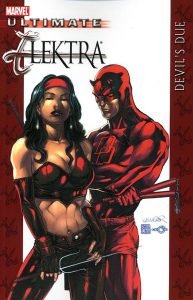
Ultimate Elektra: Devil’s Due

It has not been difficult for me to find graphic novels from the Ultimate Marvel series in my various used bookstores. I don’t have all of them by any means, but I’ve been able to pick up a lot just by keeping my eyes open. And then there’s the ambitiously numbered volume one of the Ultimate Elektra series, which seemed to have five or more copies available at every store I entered over the course of 2008. Which, despite the underlying snarkiness of that fact, is not to say that it was a bad book.
I imagine that if you knew nothing about the characters, even had not seen the Daredevil movie[1], then Devil’s Due might have told a pretty good story. See, there’s this ninja chick named Elektra, and she wants to protect her father from various lowlife thugs who are trying to destroy his business and / or manipulate him as part of a money-laundering scheme, presumedly because he owns a dry-cleanery. There’s also a blind lawyer who will probably be the Ultimate Daredevil someday, only he’s shown up in other Ultimate entries as himself instead of a shoddily-costumed law student; am I to assume this occurs before the rest of the Ultimate universe timeline? But I digress.

Anyhow, Daredevil, being the law and order type, wants Elektra to stop being such a deadly vigilante, she wants him to get off her back and stop being such a drag, and Manhattan crime boss Wilson Fisk, AKA the Kingpin, wants the lot of them to stop doing things that might result in his prosecution. The story has potential for nuanced shades of grey and moral quandaries; I think the biggest failure of the book lay in the knowledge that no character was ever going to budge from their initial position, which removed any hope of moral drama.

On a more nitpicky note, if Matt Murdock is going to dress all in dark clothes with a bandanna mask over his eyes, can they stop showing him in the red Daredevil uniform on the covers?

[1] You are incredibly lucky, by the way, for this one.

Just after Sunset

For the first time in a while, a Stephen King release slipped by me. (Although typing that feels familiar, and it could be that a delve into the archives would prove me wrong. We’ll pretend this is not my problem and proceed, nevertheless.) But I noticed it just a couple of weeks later and easily found a copy at Half Price Books next time I was in, because he’s one of those authors that is big enough to fill the inexplicable niche of people who pay hardback prices, only to resell the book at a pittance the moment they’ve finished reading. Contrariwise, while I may love books[3] at only a slightly above-average amount for my circle of friends, I’m pretty sure that in the general population, I’d be the inexplicable one, so there you go.

Just after Sunset is a short story collection, which makes me feel a bit better about having run late on it; after all, I’ve read a couple of these already in Playboy, months or years beforehand. Which maybe balances out the month or so I ran behind on the rest of the stories? And they’re, you know, Stephen King. None were bad, and a few were hovering right in that range that I’d call brilliant. He can scare you, sure, but his best talent has always been the way he can shine a spotlight on the human soul. The fear, the anger, the grime, the longing, the love, just all of it. And I think some of that is effortless, but I have to think that some of it is carefully honed craft. I can say this because some of my favorite of his stories over the past decade (including, in this book, N.) are natural[1] successors to H.P. Lovecraft’s terror over the worlds that lie just to the left of ours and yet are unbearably alien and unthinkingly malevolent. And he rarely wrote in that style before, which makes me imagine that one day there was a conscious effort to start. And now, lots of success at it!

Plus, he wrote a story that perfectly captured the spirit of my sporadically recurrent nuclear explosion nightmares. I’m glad[2] I’m not the only one that still gets hit by that, every so often.

[1] And more importantly, modernized! I mean, the language more than the topic-space. ‘Cause… yeah.
[2] “Glad” is probably not the right word. Relieved is closer, but a little too far the other direction.
[3] Not specifically reading, although that too!

Milk (2008)

I remember how absurdly pleased I was at the sneak preview of Tropic Thunder when the crowd mostly applauded for the gay couple.[1] Restored my faith in humanity, a bit. But, y’know, there’s always the other side of the coin. I’m not shocked by that; it’s all around the political landscape, right? And nevermind all the more personal examples. This stuff is pretty much exactly what Milk is about, which is why I could not have predicted an example right in the theater.

See, the first thing that happens in the movie is eventual gay activist Harvey Milk meets and hooks up with the guy who will be his long-time partner. Pretty much inevitably, this means dudely make-outs. Therein lies my surprise: you would have a hard time going to a movie about a famous gay politician during the first days of the gay rights movement, and not expect to see some gay men doing gay things, right? But as soon as Sean Penn and Harry Osborne started kissing in the subway (I want to reiterate that the movie had not been on for five minutes yet), a [straight] couple got up and left the theater. It was almost a perfect moment for underlining everything the movie was trying to say; thinking about it now, I could almost believe they’d been planted to bolster the rest of the audience into feeling good about themselves.

Anyhow, the flick itself starts off a little choppy. They needed to dump a lot of set-up information, but it never really came together until Harvey decided to get into politics, maybe 20 minutes in. After that, the acting shines through, and it really is an inspiring story. Maybe it could win a few people over. The only thing that bothers me about it is that I’m sad people still need to be won over to what seems like an obvious message: let people have their happiness where they can find it, instead of stealing it from them.

I know there’s more to do, but it really was a little horrifying to see how bad things were around the time I was born. I’m really glad it’s better, and I’m going to be more thoughtful about what I can do in small ways to keep it improving. ‘Cause, yeah, I’m a bit inspired. Not so much with the going activist or having my gay friends hook me up with the parade calendar or anything, but for sure I won’t be as quick to let things go that I’m used to ignoring for the sake of peace. This is important shit, right here. It’s peoples’ lives.

[1] Which, okay, that doesn’t exactly make sense, but I don’t want to ruin it, either; the point is, it was an overwhelmingly positive response to something that I would have expected my Dallas peeps to react to neutrally at best.
[2] Unreferenced footnote: I just want to apologize for my inability to write today. Sorry you had to read this, instead of just having the gestalt beamed into your brain.

Saw V

So I caught Saw V[1] last week, and, y’know, that happened. Which is to say, it had the Rube Goreberg stuff going for it, and the usual test set up where the Jigsaw killer gives you a choice in which you have to do something that is against your nature to avoid certain death. And it had the FBI guy and the local PD guy who looked exactly alike again, but at least this time I knew in advance. And it had a mini-hook for yet another sequel. But the truth is, the first and second movies were very good, each in their own way, yet no entry in the series has matched them since. There’s a lot of information floating around, and each new movie adds pieces to the jigsaw puzzle[2], but it’s just not enough to convince anyone to pick up these sequels, unless you were gonna do that anyway.

At least there’s a lot to ponder about while it’s happening. I’ve watched other horror movies and franchises with far less benefit than the mental exercise these ones give me.

[1] See what I… aw, damn, this footnote ruins it. Nevermind.
[2] And, okay, that’s pretty cool; I can see what they did there!

Transporter 3

It is the rare movie that arrives exactly as advertised. Assuming you’re aware of the Transporter series, I have nothing else to say. But since you might not be, a little more explanation is in order. There’s this guy, Frank Martin. He is an American expatriate who drives things from European places to other European places for people. Specialized things that said people think might have trouble arriving, such as a bunch of mysterious bags in the trunk or a red-headed Ukrainian party girl in the passenger seat. But Frank never cares what the package is, only that he does the job and gets paid. (Will he eventually break this rule in every single movie in the series, and discover that there are layers that might make him change his definition of the job? You betcha, but plot is so far to the side of the point of the movie that it has caught up to the leading edge of the Big Bang.)

No, what is important about Transporter 3 is that it includes the same signature car chases, explosions, sexual tension, and kung fu action that each of the other entries in the series has contained. And a shirtless Jason Statham is probably an important ingredient to some members of the audience; I will not begrudge them it. So, if you want to see a lot of over-the-top action sequences of the types described above, you’ll love it. It is exactly what it pretends to be, neither more nor less. And that’s kind of refreshing, even in a year where I have seen a lot of exceptional films.

Ex Machina: Smoke, Smoke

The Ex Machina series has settled into a predictable pattern wherein three things happen in every volume: 1) Mayor Hundred tackles some kind of political firestorm, usually of his own creation that 2) is reminiscent of an adventure that his superhero alter-ego The Great Machine partook in before Mitchell Hundred ran for mayor, while 3) events transpire around him over which he has little control, such as a crime spree that may or may not relate to the (alien?) oddities surrounding his powers and those of his one-time nemesis or perhaps a behind-the-scenes conspiracy arrayed against him and getting closer step by incremental step.

And if it was not for the fact that the writing is pretty decent and I really enjoy the little drops of information about what’s behind it all, I think the predictability would get me to start losing my interest, by and large. Especially in books like Smoke, Smoke where our hero isn’t even particularly all that likable. But then again, I trust the author by now, too, so that helps me maintain momentum.

In case you were wondering, thing 1 relates to marijuana, thing 2 relates to a vigilante drug bust, and thing 3 mostly involves a firefighter on a crime spree that is, unfortunately, played far more for shocks than for story arc relevance. But there’s some pretty cool stuff going on too, most especially in the stand-alone final issue contained in the book. So don’t believe it’s as dire as I seem to be letting on. But I will want to like the protagonist again by the next book; that’s pretty important.

Ultimate Fantastic Four: God War

51OxcYYylpL._SY344_BO1,204,203,200_With Skrull and zombie troubles safely behind them, the Fantastic Four can finally turn their attention back to their research and romance and whatnot. Or they could if Manhattan wasn’t being threatened by still more interdimensional travelers, that is. Too many, as it happens; I think this must be what newspaper and NPR movie reviewers feel like when watching science fiction. There were a bunch of humanoids that had no apparent way of sharing a common species, although they might have been engineered instead, which would explain that part. And they had a lot of standard nouns for names[1], but I was only ever able to associate a couple of their forms to names, and only one or two more to character types.

The plot was clear enough, I guess. There’s some kind of war (perhaps a God War?) in progress in this other dimension, and all the unsortable Seed 19 people are on the run from a bad guy named Thanatos, who dies and resurrects regularly, for no clear reason beyond that it maybe fits his name. And they have a friend who they’re trying to save that’s apparently pivotal to the war, again for no clear reason. And Thanatos (plus the good guy, who lives in a giant, world-spanning tree[2]) has a long-standing prophecy about how Reed Richards will help him win, which doesn’t really seem like Mr. Fantastic’s style, but I cannot deny that by the end of the book, Reed was ominously constructing something that looks like it might have been the Cosmic Cube, an original series staple that gave people cosmic powers. That Cube was less inexplicable than anything here only because Stan Lee pretty clearly meant for cosmic powers and transistor powers and radiation powers to be cyphers that allowed his protagonists to do whatever they needed to do, via the scientific power of handwavium. I’m not convinced that Mike Carey has such an excuse here, which is probably what made the book so hard to swallow. Give me my underlying rationales, dammit!

[1] I honestly can’t remember any of them except Tesseract, now, or I’d give examples. But the book is in another room, so meh.
[2] I mean actually down inside the guts of it, or whatever trees have. Not up in the branches.

Ultimate Spider-Man: Irresponsible

The thing is, Peter Parker has a pretty hard life. Not for a teenager; in general. Sure, some of the things that are hard about his life are a result of his age and relative lack of agency, but these are full-blown causes, not excuses. I wouldn’t want his life, if I were to pause and consider it. Which, okay, I would probably not do, because you can’t tell me it looks in any way non-awesome, what he does. But I should have paused, clearly. I mean, he’s got school and a flexible job, which, no big, but then he’s got this whole tight-rope double life that endangers his loved ones even as it drives subtle wedges between him and them. Plus, you know, fighting crime, already a full-time occupation by itself.

In a way, therefore, it’s like the first half of Irresponsible is a kind of love letter directly to Peter Parker, trying to get him to buck up, take a good look at himself and realize what a great job he’s doing. After all, the alternative is being a foreign exchange student who blows up cars with his mind to be popular! And in another way, the whole book felt a little like an apology to Peter, giving him lots of cool things to do and a pretty trivial bad guy to deal with, and maybe a girlfriend again. And it’s nice to see good stuff happen to Pete, because he’s the kind of guy who deserves it, rare though it be. But then, all this uninterrupted goodness leaves me waiting for the other shoe to drop, and drop hard. Because the individual days might be pretty good, but I would not want Peter Parker’s life. Not if I thought about it.

Dead Witch Walking

I can’t even remember exactly why I picked the book up in the first place. Most likely, there was an internet discussion about which urban fantasies were worthwhile and why, and after the Harry Dresden and Anita Blake books[1], the Rachel Morgan series was the only one that struck my interest. Anyhow, between the amount of time I spend at various Half Price Books around the metroplex and the amount of depth on my to-read shelf[2], I can’t exactly be surprised that I’d bought five books into the series without ever having read the second sentence of Dead Witch Walking quite yet.

Mind you, I have now. It was not bad. There’s this girl Rachel, and she’s a witch. And she has a job capturing the bad elements of the magical world that humanity is stuck with, however unhappy it makes them. But when she decides to get out from under her boss’s oppressive thumb and go into business for herself, things quickly go from bloody to deadly. Soon, she’s caught between her old boss’s hired assassins, a potential and unwanted relationship with her vampire business partner, and a Cincinnati councilman / criminal overlord of unknown lineage and power. And that’s just for starters.

Okay, truth be told, I’m not sure I would have finished the book if I hadn’t already bought the next four. Our heroine took a while to get past whiny to likable. (Honestly, she may not have managed it yet, and it’s more that I got used to her voice finally, complainy-pants and all. She for damn sure isn’t as good to her friends as I would prefer.) The plot took a little while to quite get revved up from a simple problem to be solved into actually interesting events. Most troublesome was the setting, though; the average urban fantasy, in my still-limited experience, works as closely as possible to our normal world, with only limited variation to explain all the fairies and werewolves and ubiquitous vampires roaming the landscape. This one took a different tack, diverging in, I think, the 1960s; and what a divergence! Half the population or better dead in America, far worse elsewhere, and with all the magical people suddenly taking center stage by virtue of not having been susceptible to the deadliness. All of which is fine and good, except that the author kept dropping modern pop-culture references into the mix. It’s not that J.R. being shot or Luke learning about the Force are all that impossible even in a changed history. But when she tossed in another three of four such references that I’ve forgotten, it began to strain the bounds of reason. I don’t want to be yanked out of my suspension of disbelief over such trivial matters, is all; if you want to call the pop-culture, just don’t change your world around that much; that pretty much handles the problem right there.

But in the end, it turned out to be a decent book, and I have enough questions I care about that I will want to see what happens next. My hope is that someone mentioned the wonkiness to her, and I won’t run into these problems by the time book two comes around.

[1] about which I already know plenty
[2] Now officially overflowed, if not quite extending onto a second full shelf yet.